
Evanger’s proposes donating recalled pet food. FDA says ‘no’

The United States Food and Drug Administration (FDA) has vetoed a proposal by Evanger’s Dog and Cat Food Co. to donate recalled pet food to animal shelters after conducting random spot-checks for pentobarbital.

The proposal was revealed in a June 29, 2017 Warning Letter issued by FDA, and released on its website Tuesday morning (July 4, 2017) under the agency’s standing policy to post recent Warning Letters on a weekly basis.

The letter addressed to Holly N. Sher and Joel A. Sher, President and Vice President, respectively, notifies them that FDA found “…serious violations of the Federal Food, Drug, and Cosmetic Act (FD&C Act) and its implementing regulations” during an investigation that included supplier traceback, facility inspection, and analysis of samples collected by FDA.

In its response to the Evanger’s proposal to donate recalled pet food, FDA said that finding the contents of individual cans of food from recalled lots to be negative for pentobarbital would not provide “…sufficient assurance that the remaining units are not adulterated.”

After stating that FDA’s own testing confirmed the pentobarbital contamination not to be homogeneous throughout an entire lot, the agency declined Evanger’s proposal and recommended destruction of all remaining recalled product.

The Warning Letter is the most recent development in an investigation of Evanger’s that began in early January with the reported illness of five dogs in a single household and the death of one of the dogs. Lab tests conducted on the gastric contents of the dead dog and on the remains of Evanger’s Hunk of Beef au Jus canned dog food that had been fed to all five of the animals, revealed the presence of a ‘large quantity’ of pentobarbital in both samples.

FDA opened its investigation immediately upon becoming aware of the incident. A team of inspectors began an on-site inspection of Evanger’s manufacturing facility in Wheeling, Illinois on January 10, 2017.

On February 14, 2017, the inspection team furnished Evanger’s management with a Form 483, listing a series of Inspectional Observations, including:

• Pentobarbital found in a sample of Evanger’s Hand Packed Hunk of Beef au Jus, 12 oz. can (Lot #1816E06HB13)
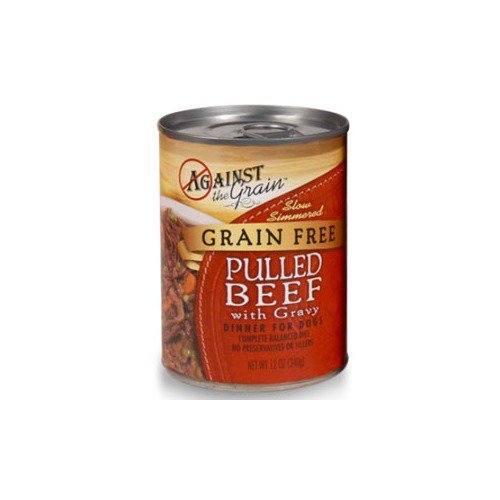
• Pentobarbital found in a sample of Against the Grain brand Grain Free Pulled Beef with Gravy Dinner for Dogs, 12 oz. can (Lot #2415E01ATB12; BEST DEC 2019)
• Condensate dripping throughout the facility, including into open cans in-process and onto totes of raw meat
• Pitted, cracked and damaged floors
• Peeling paint, mold throughout the facility and a live ‘fly-like insect’ in the hand-packing area during processing
• Inadequate temperature controls

In addition to the two pentobarbital-positive samples cited in the February 14th Form 483, FDA has found pentobarbital in the following five production lots of Evanger’s dog food:

• Braised Beef Chunks, lot code 2016E08BBW11 Best Aug 2020.
• Hunk of Beef Au Jus, lot code 1816E14HBC18 Best June 2020.
• Hunk of Beef Au Jus, lot code 1816E02HB12 Best June 2020.
• Hunk of Beef Au Jus, lot code 1316E23HB09 Best Jan 2020.
• Hunk of Beef Au Jus, lot code 1816E03HB17 Best June 2020.

On March 3, 2017, Evanger’s voluntarily recalled all cans of Evanger’s Braised Beef Chuncks, Evanger’s Hunk of Beef Au Jus and Against the Grain Pulled Beef with Gravy manufactured between December 2015 and January 2017.

In correspondence dated 2/4/2017, 2/21/2017, 4/4/2017, 5/18/2017 and 5/23/2017, Evanger’s addressed FDA’s Inspectional Observations, and proposed a series of corrective actions. In addition to the proposed donation of recalled product, the following actions, listed in the Warning Letter, are those FDA found to be inadequate or unacceptable.

Evanger’s discontinued doing business with the meat supplier alleged by the company to be the source of the adulterated meat.

Evanger’s was unable to supply any documentation or evidence that the indicated supplier was the only one who supplied the contaminated raw materials. Therefore, FDA was unable to evaluate whether or not this was an adequate response.

Evanger’s suggested that if pentobarbital were to be present in any of its ground loaf products, it would be “…well within the range that FDA had previously deemed not to be a health or safety concern in pet foods.”

FDA disagrees that grinding would dilute any pentobarbital to safe levels, and points out that there is zero tolerance for pentobarbital in pet food.

Evanger’s proposed random pentobarbital tests of finished products prior to shipment as a way to ensure that raw materials are not adulterated.

FDA considers this to be an inadequate and unreliable way to ensure the safety of the finished product. FDA’s own testing has demonstrated pentobarbital contamination is not uniformly distributed throughout all cans in a production lot. Also, the agency disagrees that finished product testing can mitigate the risk of pentobarbital in the raw material.

Evanger’s now requires new and current suppliers to provide letters of guarantee for their products.

FDA points out that a letter of guarantee may not provide adequate assurance of product safety, and recommends conducting site audits and/or reviews of supplier procedures in addition to the letter of guarantee.

As is customary, the Warning Letter concludes with a requirement that Evanger’s must furnish a written reply within fifteen working days, spelling out the steps it has taken or will take to correct the violations and prevent them from occurring again.

The complete text of the Warning Letter can be found on the FDA website.

This article first appeared in Food Safety News and is reposted here with permission.

Death by a Thousand Cuts

Donald Trump has declared war. Not on North Korea; not on ISIS or Iran. Certainly not on Russia.

Donald Trump has declared war on the Food Safety Modernization Act.

Trump has not asked Congress to repeal the act or to void its regulations. He knows that would not happen. Instead, he has launched a stealth attack via the budgetary process. An attack on the underpinnings of the country’s food safety enforcement system.

Last week, the Trump White House submitted its budget proposal to Congress. Buried within a single line of the more than one thousand-page budget was the following information:

Foods Program
2016 Actual spending: $1,002,000,000
2017 Estimated spending: $985,000,000
2018 Proposed spending: $910,000,000

That’s correct. Spending on food safety activities under Trump is already on the decline and, if he has his way, will continue to decrease year by year until the Food Safety Modernization Act is nothing but an empty shell. Emasculated due to lack of funding.

How does this compare with the previous administration’s funding? Since the 2011 enactment of the Food Safety Modernization Act, funding for the Foods Program has increased year over year at least in line with inflation, except for 2013 (the year of the infamous budget sequester – the 10% across-the-board cut to all discretionary spending programs).

Actual Spending on Foods Program
(Inflation-adjusted value of 2011 spending in brackets for comparison)
2011: $836,244,000
2012: $866,920,000 ($853,550,000)
2013: $796,638,000 ($866,052,000)
2014: $882,814,000 ($880,101,000)
2015: $903,340,000 ($881,146,000)
2016: $1,002,000,000 ($892,262,000)
2017 (est’d): $985,000,000 ($909,054,000)

We were already nearly four months into the fiscal year by the time Trump’s occupation of the Oval Office began, mitigating his impact on the Foods Program spending for 2017. However, his budget proposal for 2018 will reduce spending on the FDA’s Foods Program to less than the actual dollars spent in 2011, when adjusted for inflation.

The Animal Drugs and Feed Program, which encompasses approval of veterinary drugs and enforcement of pet food safety, fares even worse.

Animal Drugs and Feed Program
2016 Actual spending: $159,000,000
2017 Estimated spending: $158,000,000
2018 Proposed spending: $108,000,000

The Animal Drugs and Feed Program has been the runt of the FDA litter for many years, its year-over-year funding having failed to keep up with inflation more often than not. Yet, in an age when pet food safety is more important to more people than ever before, Trump has proposed to cut the budget for this program by 32% in real dollars and by 38% in inflation-adjusted dollars (based on 2011 dollars).

Spending on the Animal Drugs and Feed Program has not been this feeble since 2008.

Actual Spending on Animal Drugs and Feed Program
(Inflation-adjusted value of 2011 spending in brackets for comparison)
2011: $158,771,000
2012: $156,909,000 ($162,057,000)
2013: $147,774,000 ($164,430,000)
2014: $164,313,000 ($167,098,000)
2015: $175,024,000 ($167,296,000)
2016: $159,000,000 ($169,407,000)
2017 (est’d): $158,000,000 ($172,595,000)

Other federal departments and agencies are not immune to the disease of deregulation by financial starvation. The Centers for Disease Control and Prevention, the Environmental Protection Agency, and others too numerous to list here also are affected. Trump’s war on government regulation is unrestricted. And he is using the budget process as his primary weapon.

It is not a coincidence that I revived eFoodAlert when Trump took office. In the absence of robust and well-funded FDA enforcement programs, it is up to each one of us to provide the necessary vigilance. To recognize and report food safety issues. And to raise our voices in support of the regulatory and enforcement activities that are the essential underpinning of the Food Safety Modernization Act.

Remember Peanut Corporation of America. Remember De Coster Egg Farms. Remember the illnesses and deaths that resulted from the cavalier attitudes of the principals in both companies. Lack of enforcement breeds lack of compliance.

Trump has declared war on clean water, clean air, and food safety. It is time to fight back.

Evanger’s Blames Supplier, FDA, for Pentobarbital in Dog Food

FDA says beef suppliers are not registered; Evanger’s hints at expanded recall

lh-600dpi-with-ice-no-color-restBreaking news: Evanger’s reveals presence of horse DNA in its Hunk of Beef dog food in a Wednesday letter to its customers. The company will recall all of its Hunk of Beef, Braised Beef Chunks with Gravy and Against the Grain Pulled Beef. The formal recall announcement will be issued this week.

Consumer complaints continue as the FDA digs deeper into operations at Evanger’s pet food after discovering evidence that none of the company’s meat suppliers are registered with USDA. Evanger’s owners blamed their suppliers and the FDA in the wake of findings that their dog food contains a barbiturate used to euthanize animals.

At least one dog has died and at least four others required medical attention after eating Hunk of Beef canned dog food from Evanger’s Dog & Cat Food Company Inc., which is owned by the Sher family. Evanger’s and Nutripack LLC, another pet food company owned by members of the same family, have recalled certain lots of certain flavors of their canned dog food.

“The guilty party has turned out to be one of our most trusted meat suppliers. A USDA-APHIS inspected supplier who we had done business with for over 40 years, and whose plant we had visited numerous times over the years,” said Evanger’s owners Holly and Joel Sher in an online statement posted Sunday. “We have taken it upon ourselves to lead the campaign to force the FDA to put an end to allowing drugs like pentobarbital to enter the raw material stream and contaminate our pets’ food and endanger their lives.”

Officials with the Food and Drug Administration do not agree with the company’s contention that the agency is responsible for the pet food being contaminated.

“The detection of pentobarbital in pet food renders the product adulterated in violation of the Federal Food, Drug, and Cosmetic Act. Therefore, it is not acceptable to use animals euthanized with a chemical substance in pet or animal foods,” an FDA spokesperson said Tuesday.

“It is the responsibility of the animal protein ingredient suppliers to implement practices at their facilities to ensure that euthanized animals are either not accepted at the facility, or to determine how they died and ensure euthanized animals are segregated from animal protein going for animal food use.

“Further, it is the responsibility of the pet food manufacturer to ensure that the food they produce is safe for consumption and properly labeled. One way that a manufacturer can do this is by taking steps to verify the identity and safety of the ingredients they receive from their suppliers.”

During the course of their investigation, FDA inspectors discovered a bill of lading from Evanger’s supplier, which listed “Inedible Hand Deboned Beef – For Pet Food Use Only. Not Fit For Human Consumption.”

While FDA cannot reveal the identity of the supplier, an agency spokesperson described it as one that, “…provides materials from animals that are not fit for the human food supply, for a variety of reasons.”

Evanger’s sources the meat for its pet food from more than one supplier. According to the FDA spokesperson, the agency’s “… preliminary assessment indicates that none of these suppliers are USDA-FSIS registered facilities.”

Those findings are in direct contrast to statements from Evanger’s and Nutripack LLC about their pet foods, which they say are made with human-grade food. FDA inspectors also found incomplete information on Evanger’s brand and Nutripack’s Against the Grain brand production records.

According to FDA, inspectors were unable to determine from company records whether any of the beef that was used in the recalled Evanger’s and Against the Grain production lots was also used in any other products. In a letter to its customers released Feb. 21, Evanger’s indicated the recall could be expanded to include all products containing chunk beef, “out of an abundance of caution.”

The investigation so far

In a Friday consumer advisory, the FDA cautioned the public not to feed the recalled Evanger’s and Against the Grain canned dog food products to their pets. The products in question were recalled on Feb. 3 and Feb. 9 by Evanger’s Dog & Cat Food Company Inc. and Against the Grain, respectively, after pentobarbital was confirmed in samples of both products.

In conjunction with the advisory, FDA released two Inspectional Observation reports — Form 483 reports — which detailed the conditions found by the agency’s inspectors during visits to Evanger’s production facility in Wheeling, IL, and to the facility belonging to Nutripack LLC in Markham, IL.

The Wheeling operation had last been inspected by FDA in November 2012. According to a spokesperson with FDA, the Illinois Department of Agriculture performed an inspection in 2016 and classified the Wheeling facility as ‘No Action Indicated.’ However, the plant was not operating at the time, and the inspector was unable to observe the normal day-to-day activities. Nutripack had not been inspected either by the state or by the FDA prior to February 2017.

The USDA’s Food Safety and Inspection Service (FSIS) is the federal agency tasked with oversight and inspection of slaughterhouses and meat processing operations. To be deemed “Fit for Human Consumption,” any meat that enters interstate commerce must have been produced under USDA-FSIS supervision. Slaughterhouses and meat processing operations that do not engage in interstate commerce come under the supervision of the department of agriculture in their home state.

Evanger’s is a private company, incorporated in Illinois. Its President and Agent of Record is Holly Sher, who owns the business together with her husband, Joel Sher.

Against the Grain
Against the Grain

Nutripack is a Limited Liability Company registered in Illinois. Its Agent of Record is Brett Sher, son of Joel and Holly Sher. Nutripack is managed by Sher Services Company Inc. Joel A. Sher is both the agent of record and the president of Sher Services, while Holly Sher is the secretary. The Against the Grain trademark is registered to Chelsea Sher, daughter of Joel and Holly Sher. Chelsea Sher also is listed as Secretary of Evanger’s.

In their online letter Sunday, the Sher family’s reference to their supplier having been “USDA-APHIS inspected” suggests they may not understand what agencies have jurisdiction over their pet food operations.

According to the USDA website the primary role of APHIS (Animal and Plant Health Inspection Service) in the U.S. food safety network of agencies “is to protect against plant and animal pests and diseases. APHIS also administers the Animal Welfare Act and carries out wildlife damage management activities.”

On the other hand, according to USDA, the FSIS is “responsible for ensuring the safety and wholesomeness of meat, poultry, and processed egg products and ensures that it is accurately labeled.”

As its investigation continues, FDA reports it has received additional complaints from consumers who fed Evanger’s Hunk of Beef to their dogs, in some cases exclusively.

As consumers tend to throw out or recycle empty cans, obtaining specific lot number information has been difficult. The agency continues to encourage consumers to report problems with Evanger’s products through the Safety Reporting Portal or by contacting a Consumer Complaint Coordinator. Additional information is available on the FDA web page, How to Report a Pet Food Complaint.

This story first appeared on Food Safety News and is reposted here with permission.