
“Groundhog Day” for Darwin’s Natural Pet Food

FDA issues new safety advisory after two cats fall sick

October 26, 2026
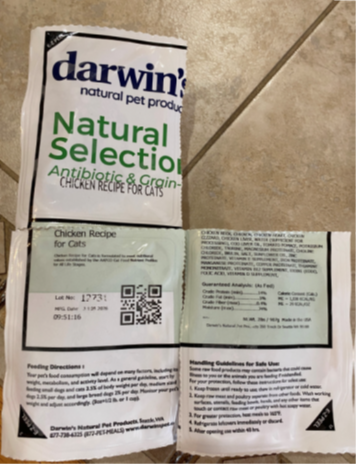
The FDA is cautioning cat owners not to feed their pets two lots of Darwin’s Natural Selections Chicken Recipe for Cats after both lots tested positive for Salmonella.

The affected lots are identified as Lot 12731, MFG Date: Jul 08, 2026 and Lot 12493, MFG Date: Apr 02, 2026, and are sold frozen in 2-pound white and clear plastic packages with green and black labeling.

The FDA tested samples from these two lots after receiving a consumer complaint about two cats that developed symptoms of gastroenteritis after having consumed the product. One of the cats was hospitalized.

Both cats recovered after being switched to a different food.

The FDA recommended that Arrow Reliance, Inc., the manufacturer of Darwin’s Natural Pet Products, initiate a recall. As of today, the company has not complied.

In the movie Groundhog Day, the main character relives the same 24-hour period over and over again, until he gets it right.

What better metaphor than that for the years-long dispute between the FDA and Arrow Reliance?

The company and the FDA have been at loggerheads for close to a decade over repeated instances of Salmonella, Listeria monocytogenes, and shiga toxin-producing E. coli in Darwin’s dog and cat foods. Multiple inspections of the company’s production facility in Tukwila, Washington, have documented environmental contamination and sanitation deficiencies.

On August 11, 2026, the US Department of Justice, acting on behalf of the FDA, filed a complaint in federal court asking for a permanent injunction to prevent Arrow Reliance and its owner from “…manufacturing and selling adulterated pet food.”

The DoJ’s complaint specified five counts:

  • Adulteration due to containing a poisonous or deleterious substance
  • Adulteration due to production under insanitary conditions
  • Failure to follow preventive controls regulation
  • Failure to register as a food facility
  • Introduction of unapproved new animal drug into interstate commerce.

In response, the company filed a motion requesting that the court dismiss the third and fourth counts. Arrow Reliance claims that it is a “retail food establishment” because it sells directly to consumers through its website, and therefore, is not required to register as a food facility. The company further claims that as a “retail food establishment,” it is not required to follow the federal preventive controls regulation.

The case is still pending.

If you have any of the lots of Darwin’s Natural Selections cat food products listed above, stop feeding the product to your pets and throw it away in a secure container where other animals, including wildlife, cannot access it. Do not donate the food.

The product lot codes are printed on the front of the lower left unit of the package of food. If you no longer have the part of the package with the lot code or can’t read the lot code, throw the food away.

Consumers who have had the products listed above in their homes should clean and disinfect all pet supplies, including all storage containers, bowls, utensils, food prep surfaces, pet bedding, toys, floors, and any other surfaces that the food or pet may have had contact with, including your refrigerator or freezer. Clean up the pet’s feces in yards, parks, or other places where people or other animals may become exposed. Consumers should thoroughly wash their hands after handling the product or cleaning up potentially contaminated items and surfaces.

Pets do not always display symptoms when infected with Salmonella, but signs can include vomiting, diarrhea (which may be bloody), fever, loss of appetite and/or decreased activity level. If your pet has these symptoms, consult a veterinarian promptly.

Pets do not need to display symptoms of illness to pass bacteria on to their human companions. Infected pets can shed these bacteria in their feces and saliva, further contaminating the household environment, other animals, and sometimes, people. To help prevent the spread of bacteria from infected pets to other animals or people, it is important to clean up feces immediately, to wash hands after touching the pet or its environment and avoid contact with the saliva of pets.

People who think their pets have become ill after consuming contaminated pet food should first contact a veterinarian.

The FDA encourages consumers and veterinarians to report complaints about pet food products electronically through the Safety Reporting Portal.


“A complete and compelling account of the hidden and not-so-hidden ways the food we give our beloved pets can be contaminated.” – JoNel Aleccia, Health Reporter, Food & Nutrition, The Associated Press.

“An invaluable resource for busy pet owners” – Food Safety News

Viva Raw’s contract manufacturer failed two FDA inspections

USDA-inspected company received FDA Warning Letter

Lewis Sausage Company Inc. (Burgaw, NC) is a small meat and poultry processing company that falls under USDA jurisdiction. It has been producing smoked sausages since the 1950s, and has never issued a product recall for any USDA-inspected food.

The company also performs contract manufacturing for Viva Raw LLC, a Hillsborough, NC, pet food company that falls under FDA jurisdiction.

And therein hangs the story.

On January 23, 2024, Viva Raw recalled four of its pet foods after being notified by the FDA that the products had tested positive for Listeria monocytogenes and Salmonella. No public recall notice was ever published, but the products were listed in the FDA’s Enforcement Report as:

On May 15, 2024, the FDA, together with the North Carolina Department of Agriculture and Consumer Services (NCDACS), completed an inspection of Lewis Sausage Company’s processing facilities, including collecting finished product samples. Five Viva Raw products, all manufactured under Lot 21244, were found to be contaminated with Listeria monocytogenes.

On June 12, 2024, Viva Raw initiated a recall of the five products, including Viva Turkey for Dogs Ground, Viva Turkey for Dogs Chunked, Viva Turkey for Cats, Viva Pure Turkey, and Viva Beef & Turkey for Puppies, according to FDA Enforcement Report files. The company issued a public recall notice on July 1, 2024.

The FDA classified the results of its May 2024 inspection as Official Action Indicated, citing deficiencies in Lewis Sausage’s Hazard Analysis and Preventive Controls actions. The agency issued an Untitled Letter on March 14, 2025, and performed a follow-up inspection on August 25 through August 29, 2025. Once again, the inspection was carried out jointly with the NCDACS.

On August 25, 2025, the day the inspection began, Viva Raw announced yet another recall. This time, the company recalled six varieties of raw dog and cat foods, comprising two lot codes. The company’s recall notice explained that routine testing by the NCDACS had found Salmonella and Listeria monocytogenes in samples of the products.

In January 2026, Viva Raw announced on its website that the company had adopted high pressure processing to enhance the safety of its raw pet food products.

Finally, on August 5, 2026, the FDA issued a Warning Letter to Viva Raw and a separate Warning Letter to Lewis Sausage. In those letters the agency reviewed the issues raised as a result of the inspection conducted the previous year and listed the items that required additional documentation to confirm correction of issues that were outstanding.

Lewis Sausage is a USDA-inspected facility. But this means very little when the subject is microbiological safety of raw pet foods.

It is true that using USDA-inspected meat and poultry exclusively provides assurance that the finished pet food does not contain any 4D meat (denatured meat from dying, disabled, diseased or dead animals). However, the USDA have very different criteria for the presence of pathogenic bacteria in meat and poultry.

USDA, which has authority over meat and poultry for human consumption, considers raw beef that contains shiga toxin-producing E. coli to be adulterated and subject to recall. On the other hand, raw meat and poultry that is contaminated with Listeria monocytogenes or Salmonella is not treated as adulterated on the principle that the meat will be subject to further processing (including cooking in the home kitchen) before being consumed.

The FDA has authority over all food for animals, whether companion animals or livestock. It considers any product—even raw pet foods—that is sold as ready-to-eat to be adulterated if it contains ANY foodborne pathogen, regardless of the level of contamination.

My curiosity was piqued when I read the FDA Warning Letter to Lewis Sausage and realized that I had never seen a recall notice for the products listed as contaminated, so I started checking pet food recalls around the timeframe when the company had been inspected. When I found the August 2025 Viva Raw recall notice, I did some additional cross-checking and confirmed the relationship.

Viva Raw is very open on its website about employing a contract manufacturer to produce its raw pet foods, but does not reveal the company’s name.

The FDA considers information such as the identity of a company’s clients or the name of a company’s contract manufacturer to be confidential commercial information. That information was redacted from the Warning Letters issued to Viva Raw and Lewis Sausage.

It should come as no surprise to anyone who has followed eFoodAlert over the years, or who has read my book on pet food safety, that I am not a fan of commercial raw pet food. There are some companies out there who try hard to produce and supply high-quality, safe products.

There are others that hide behind a philosophy that dogs and cats have a different digestive system and are not susceptible to foodborne pathogens like Salmonella. Some of these bad actors give short shrift to sanitation and cross-contamination in their production facilities, choosing to spend their time complaining about being targeted “unfairly” by the FDA instead of working to meet federal guidelines for producing safe pet food.

I have fed raw meat to our dog at times during her eleven-year lifespan. But I have always done so with full control over the preparation and storage, buying whole cuts of beef or lamb at the supermarket, searing the outside to kill most of the bacteria (which tend to be on the surface and not in the depths of the muscle), and grinding it myself before freezing individual portions.

In my opinion, the convenience of commercial raw pet food is not worth the risks associated with it.


“A complete and compelling account of the hidden and not-so-hidden ways the food we give our beloved pets can be contaminated.” – JoNel Aleccia, Health Reporter, Food & Nutrition, The Associated Press.

“An invaluable resource for busy pet owners” – Food Safety News
Pet food company ignores FDA inspection report

The story begins, as these stories often do, with a consumer complaint about a sick dog.

In December 2025, the Connecticut Department of Agriculture (CDoAg) was contacted by a pet owner who complained that her dog suffered a gastrointestinal illness after being fed a Raaw Energy Chicken Medley dog food.

On December 18, 2025, the CDoAg collected a sealed sample of Raaw Energy Chicken Medley (lot 7.17.25) from the complainant, who stated this was the same lot that she had fed her dog. The state lab found three different pathogens in that sample. Specifically, the lab was able to confirm the presence of Salmonella Infantis, Listeria monocytogenes, and Campylobacter jejuni in the sample of raw dog food.

On January 14, 2026, the CDoAg issued a “withdraw from distribution” to the company for the contaminated lot of product.

Raaw Energy, LLC is based in Adelphi, New Jersey. The New Jersey Department of Agriculture (NJDA) was informed of the Connecticut consumer’s complaint, and visited the production plant on December 22, 2025, to collect samples at their source. The New Jersey state lab found Listeria monocytogenes in two different products: Chicken Medley (lot code not released) and Salmon (lot 12.5.25).

The NJDA issued a “stop sale” notice to the company for those two lots on January 8, 2026, and returned to the production facility to collect samples of additional finished products. Five of those samples contained Listeria monocytogenes and one of the five also was contaminated with Salmonella Kentucky.

On January 13, 2026, an investigator from the FDA arrived at the Raaw Energy production facility.

On April 7, 2026, the NJDA performed additional follow-up sampling and found additional products that were contaminated with Listeria monocytogenes. The NJDA issued a “stop sale” notice on April 21st, and the FDA notified Raaw Energy of the state’s findings on May 13th.

The FDA investigator carried out an inspection of the manufacturing plant, including a review of records. The findings were disturbing. In addition to the eight different production batches of Raaw Energy’s dog food that New Jersey and Connecticut found to be contaminated, there were several serious flaws in the company’s physical plant and in its procedures. These included:

  • Conditions that could cause contamination of the dog food from the production environment
    • an employee using a high pressure water hose that caused aerosols and overspray to contact open containers of chicken and unfinished product in the area
    • plastic totes that were cracked, allowing product contained in the totes to contact the floor
    • plastic totes were reused through the production day without cleaning or sanitizing between uses
    • floor was pitted and cracked, and was not sloped to allow water to drain off
    • condensation from overhead air conditioning units dripped directly onto raw chicken and other ingredients
  • Poorly maintained equipment and utensils may have allowed pathogens to contaminate raw ingredients and in-process materials
    • meat-grinding equipment had rust on food-contact surfaces and uneven edges with missing and bent metal at the chute where food is dispensed
    • apparent rust on the extrusion point of a grinder and on a pitchfork used for chicken ingredients
  • Frozen products were shipped to customers in unfrigerated trucks over long distances, and the company had no procedures in place to ensure that finished products remain under appropriate time and temperature conditions while in transit.
  • Whole genome sequencing of the various Listeria monocytogenes cultures found by NDJA in the Chicken Medley and in three sample of the Salmon product were nearly identical, indicating a resident strain of Listeria monocytogenes that was not being addressed by the company’s sanitation procedures
    • the Chicken Medley and Salmon products used two different recipes and had no common ingredients
    • the various pathogen-positive samples were produced over a five-month period (between July 17, 2025, and December 20, 2025).
    • an additional Listeria monocytogenes-positive sample, manufactured on May 13, 2026, also matched the same genetic profile.

At the close of the inspection, the FDA investigator issued a Form FDA 483, listing all of the issues that needed correction, and reviewed each one with company management.

In view of the pathogen-positive lab results, the FDA recommended that Raaw Energy voluntarily recall eight lots of raw dog food. On January 23, 2026, concerned about the adequacy of the company’s action, the FDA issued an advisory to consumers, urging that the eight lots not be fed to their pets.

On January 26, 2026, Raaw Energy recalled three lots of Chicken Medley, two lots of Salmon, and one lot each of Beef and Chicken Medley, Beef and Turkey Medley, and Beef and Chicken Tripe Medley.

In response to the results of follow-up sampling reported by the NJDA, on May 22, 2026, the company expanded its recall to include all products manufactured between July 17 and December 23, 2025, and one lot manufactured on March 31, 2026. That same day, the FDA updated its public advisory, providing a list of the additional recalled products.

The company’s response to the issues raised in the FDA Form 483 was less satisfactory. According to the FDA’s Warning Letter, issued on August 21, 2026, the company never responded in writing to the Form 483.

Raaw Energy addressed the recall situation on its website at least two months before the May 22nd expanded recall. The identical notice is still in place today and states,

The recall was the result of bacteria identified during required safety testing. From the start, we worked closely with the FDA and followed all safety and reporting guidelines to ensure the situation was handled responsibly.

Since then, we’ve taken important steps to move forward and strengthen our processes:

  • Streamlining our product selection so that we can focus even more closely on quality
  • Enhancing sanitation and food safety practices
  • Renewing our commitment to continuous improvement at every stage

Food safety isn’t just a priority — it’s an ongoing responsibility we take seriously every single day.

Raaw Energy was given fifteen working days from receipt of the warning letter to respond in writing with specific steps the company has taken to address the list of violations. In that absence of an adequate response, the FDA, with the cooperation of the Department of Justice, could take legal action, including the possibility of seizure and injunction.

Whether and in what way the FDA chooses to act remains to be seen.


TAINTED formats 3
“Reads like a true crime novel” – Food Safety News

Interested in learning more about food safety and the history of foodborne disease outbreaks and investigations?

Click on the link to listen to a short excerpt, then follow the buy links to add a digital, print or audio copy to your personal library.

Chapter 6. Birth of a Pathogen