

Recalls and Alerts: January 24 – 26, 2019

Here is today’s list of food safety recalls, product withdrawals, allergy alerts and miscellaneous compliance issues. The live links will take you directly to the official recall notices and company news releases that contain detailed information for each recall and alert.

If you would like to receive automatic email alerts for all new articles posted on eFoodAlert, please submit your request using the sidebar link.

United States

Allergy Alert: Mrs. Grissom’s Salads recalls Mrs. Grissom’s SELECT Old Fashioned Pimento Cheese (Best before MAR 13 2019) due to undeclared milk.

Allergy Alert: Harvest Food Group, Inc. recalls yumnum global cuisine YAKITORI SEASONED CHICKEN FRIED RICE (9-oz pkgs; Lot codes C041A8K12 BEST BY 11/12/2019, C091A8L04 BEST BY 12/04/2019, and C091A8L05 BEST BY 12/05/2019) due to undeclared milk. The recalled items were shipped to retail locations in Illinois and Michigan.

Allergy Alert: Publix recalls Publix Deli Turkey, Cheddar & Bacon Pinwheels (Use by January 28) due to undeclared egg.

Food Safety Recall: Whole Foods Market recalls various prepared foods items prepared with baby spinach from Satur Farms, due to potential Salmonella contamination. Please refer to the recall notice for a complete list of affected products, which were sold in Whole Foods Market stores in Connecticut, Florida, Maine, Massachusetts, New Hampshire, New Jersey, New York, and Rhode Island.

Food Safety Recall: Jac. Vandenberg, Inc. recalls Fresh Peaches, Fresh Nectarines and Fresh Plums due to potential Listeria monocytogenes contamination. Please refer to the recall notice for a complete list of affected products, which were distributed in Alabama, California, Georgia, Illinois, Kentucky, Maine, Massachusetts, Michigan, Mississippi, New Jersey, New York, North Carolina, Ohio, Pennsylvania, South Carolina, Tennessee, West Virginia and Virginia through ALDI, Costco, Fairway Market, Hannaford, Market Basket, Walmart and various small retail establishments.

Food Safety Recall: Thrive Market, Inc recalls various Thrive Market-branded nut butters due to potential Listeria monocytogenes contamination. Please refer to the recall notice for a complete list of affected products.

Canada

OUTBREAK ALERT / Food Safety Recall: Sofina Foods Inc. recalls Crisp & Delicious brand Chicken Breast Nuggets – Uncooked Seasoned Breaded Chicken Cutlettes (1.6 kg; Product code 2019 JL 19; UPC 0 69299 11703 5) due to Salmonella contamination. This recall was triggered by findings by the Canadian Food Inspection Agency (CFIA) during its investigation into a foodborne illness outbreak.

Allergy Alert: Industry recalls certain Ottogi brand noodle products due to undeclared egg. Please refer to the recall notice for a complete list of affected products.

Food Safety Recall: Le Maître Boucher recalls Hummus Maison (Variable weights; Product sold January 13 – 24, inclusive) due to potential Listeria monocytogenes contamination.

Food Safety Recall: Boucherie 4 Saisons recalls Spaghetti sauce (500 mL and 1 L glass jars; product sold up to 25 January 2019) because the product may not be safe to consume.

Food Safety Recall: Karino gâteaux recalls Spaghetti sauce, vegetarian sauce and chili (500 mL and 1 L glass jars; product sold up to 23 January 2019) because the product may not be safe to consume.

Europe

OUTBREAK ALERT / FOOD SAFETY RECALL (France): Lactalis recalls Picot AR brand infant formula (sold in pharmacies from November 29, 2018 onward) due to possible contamination with Salmonella Poona. The product was manufactured in the same Spanish facility that manufactured product associated with 4 cases of Salmonella Poona in infants under two years of age.

OUTBREAK ALERT / FOOD SAFETY RECALL (France): SODILAC recalls various Modilac brand rice-protein based infant formula products due to Salmonella Poona contamination. Please refer to the recall notice for a complete list of affected products. The product has been linked to 4 cases of Salmonella Poona in infants and toddlers under two years of age.

Allergy Alert (Belgium): Turk Food Impex SPRL recalls various Dr Oetker brand products due to undeclared milk, wheat (gluten), and soy. Please refer to the recall notice for a complete list of affected products.

Allergy Alert (Finland): Gunz Warenhandels GmbH recalls Piacelli brand citrus juice concentrates due to undeclared sulfite. Please refer to the recall notice for a complete list of affected products.

Allergy Alert (Iceland): Blomsterbergs recalls Blomsterbergs lemon fromage (116g; All batches and dates) due to undeclared almonds and other nuts.

Allergy Alert (Netherlands): Bonvita B.V. recalls Bonvita Bon-Ice Dark Chocolate (100g; Production code L8/78; Best before 31-3-2020) due to undeclared milk.

Allergy Alert (Netherlands): Jan Linders recalls various Onze Trots and Jan Linders products due to undeclared sulfites. Please refer to the recall notice for a complete list of affected products.

Food Safety Recall (France): McCain recalls McCain brand La Noisette (1 kg; Lot LZ 25102018 manufactured between 16h00 and 19h00; Best before end 10/2020) due to foreign matter (small metal pieces) contamination.

Food Safety Recall (France): Naturalia recalls L’Atelier V brand Red beet bean hummus (150g; Lot 90110022; Best before 12/03/2019) due to absence of high pressure processing, resulting in a shortened shelf life.

Food Safety Recall (Germany): OVO-Vertriebs-GmbH recalls various Bockwurst and Wiener sausages due to foreign matter (small black plastic pieces) contamination. Please refer to the recall notice for a complete list of affected products.

Food Safety Recall (Germany): Bell Germany GmbH & Co. KG recalls Zimbo Spicy onion sausage (3x40g; Best before 03.02.2019; Lot #L926012-14) due to Salmonella contamination.

Australia and New Zealand

Allergy Alert: So Real Natural Food Products Ltd recalls Soreal Natural Food brand Pork Buns Mini (all batches and all dates) due to undeclared soy.

Pet hedgehogs fingered by CDC as source of Salmonella outbreak

Eleven people in 8 states have been infected with Salmonella Typhimurium after coming in contact with pet hedgehogs, according to the US Centers for Disease Control and Prevention (CDC).

One person has been hospitalized.

The outbreak strain was recovered in samples obtained from three pet hedgehogs in two ill patients’ homes in Minnesota.

Illnesses have been confirmed in patients from Colorado (1), Maine (1), Minnesota (2),  Mississippi (1), Missouri (3), Nebraska (1), Texas (1) and Wyoming (1).

Ten of the eleven outbreak victims reported contact with pet hedgehogs obtained from various sources, including pet stores, breeders or online. A common supplier of the hedgehogs has not been identified.

Outbreak victims are between 2 and 28 years old, with 50% of them being 12 years old or younger.

In 2013, pet hedgehogs infected with Salmonella Typhimurium were responsible for an outbreak of salmonellosis in 12 states. One person died, and 8 were hospitalized. In all, 26 people were confirmed to have been infected with the outbreak strain.

Hedgehogs are known to carry Salmonella, according to a 2005 report in Emerging Infectious Diseases. Approximately 28% of infected hedgehogs display no symptoms of the disease.

CDC offers the following advisory to pet owners and retailers of hedgehogs

  • People who own or come in contact with hedgehogs should take steps to stay healthy around their pet.
    • Hedgehogs can carry Salmonella germs in their droppings while appearing healthy and clean.
    • These germs can easily spread to their bodies, habitats, toys, bedding, and anything in the area where they live. People become sick after they touch hedgehogs or anything in their habitats.
  • Wash your hands
    • Always wash hands thoroughly with soap and water right after touching, feeding, or caring for a hedgehog or cleaning its habitat. Adults should supervise handwashing for young children.
  • Play safely
    • Don’t kiss or snuggle hedgehogs, because this can spread Salmonella germs to your face and mouth and make you sick.
    • Don’t let hedgehogs roam freely in areas where food is prepared or stored, such as kitchens.
  • Clean habitats, toys, and supplies outside the house when possible. Avoid cleaning these items in the kitchen or any other location where food is prepared, served, or stored.
  • Pick the right pet for your family. Children under 5 years old, adults over 65, or people with weakened immune systems are at a greater risk for serious illness. Households with these individuals might consider a different pet.
  • Hedgehog breeders, pet stores, or others that sell or display hedgehogs should provide educational materials to employees and customers.

BULLETIN: FDA names California romaine farm as CDC reports additional E. coli patients

This story by Coral Beach first appeared in Food Safety News and is reposted here with permission

They say the investigation is ongoing and more sources are possible, but as of this afternoon, the FDA is reporting traceback efforts in the ongoing E. coli outbreak linked to romaine lettuce has led to Adam Bros. Farm in Santa Maria, CA.

The outbreak strain of E. coli O157:H7 has been confirmed in the sediment of an irrigation reservoir on the family-owned farm, according to officials from the Food and Drug Administration and the Centers for Disease Control and Prevention. During a hastily called news conference today the officials said they can’t yet say the outbreak is over, but it is definitely winding down.

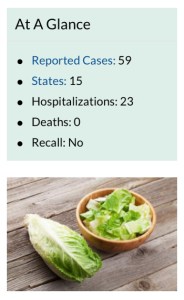
The statistics above are for the United States as of Dec. 13. In Canada, as of Dec. 6, there had been 27 confirmed cases of E. coli illness investigated in Ontario (4), Quebec (19), New Brunswick (1), and British Columbia (3). The illnesses in British Columbia were related to travel to Quebec, Ontario, and the United States. Nine individuals have been hospitalized, and two individuals suffered from hemolytic-uremic syndrome (HUS), which is a severe complication that can result from an E. coli infection. No deaths have been reported. Individuals who became ill are between 2 and 93 years of age.

Seven more people have been confirmed infected since the CDC’s Dec. 6 update. Ian Williams, chief of the CDC’s Outbreak Response and Prevention Branch, Division of Foodborne, Waterborne, and Environmental Diseases, said during the news conference that the most recent illness onset date was Nov. 16.

FDA officials said they are continuing to investigate how the E. coli came to be in the sediment of the irrigation pond. They stressed they are also continuing to test samples from other locations.

“As of Dec. 13, our investigation yielded records from five restaurants in four different states that have identified 11 different distributors, nine different growers, and eight different farms as potential sources of contaminated romaine lettuce,” FDA Commissioner Scott Gottlieb said in a statement issued immediately after the news conference. 

“Currently, no single establishment is in common across the investigated supply chains. This indicates that although we have identified a positive sample from one farm to date, the outbreak may not be explained by a single farm, grower, harvester, or distributor.”

Investigators collected samples from the Adam Bros. Farm on Nov. 27, said Stephen Ostroff, senior advisor to the FDA commissioner. The confirmed results from those tests sparked the news conference today.

Ostroff, the CDC’s Williams and two of FDA’s top officials — Deputy Commissioner Frank Yiannas and Kari Irvin, deputy director of the agency’s Coordinated Outbreak Response and Evaluation Network — all stressed the investigation is ongoing, with public health epidemiologists continuing to interview patients.

They said the current outbreak is different from the one earlier this year in more than one way. A different strain of E. coli O157:H7 is involved, according to whole genome sequencing. 

Also, the current outbreak strain has not been found in water or sediment that is used by multiple growers. The first outbreak this year, which was associated with romaine from the Yuma, AZ, growing area, has been linked to open water in an open canal that runs between produce fields and a cattle feedlot.

Even though the current outbreak strain has only been confirmed on the Adam Bros. farm, investigators say is it likely additional entities will be implicated. One reason cited for that expectation is the rule of thumb that people generally don’t eat romaine just one time, or from just one source before becoming ill.

The CDC and FDA continue to urge consumers, restaurants, institutional kitchens and retailers to avoid romaine if its origin is not clearly visible on labels. The FDA did, however, remove three California counties from the list of implicated growing areas.

“Given the identification of the outbreak pathogen on the farm in Santa Barbara County, the farms identified in the traceback, and the fact that the lettuce on the market at the peak of the outbreak should be beyond shelf-life we feel there is no longer a reason for consumers to avoid romaine lettuce from San Luis Obispo, Santa Cruz, and Ventura Counties, in California, provided it was harvested after Nov. 23,” according to the FDA. 

“If consumers, retailers, and food service facilities are unable to confirm that romaine lettuce products are from unaffected sources, we urge that these products not be purchased, or if the products have already purchased, they should be discarded or returned to the place of purchase.”

Both FDA and CDC credit the produce industry’s voluntary market withdrawal of romaine two days before Thanksgiving Day as having prevented additional illnesses. Officials say Adams Bros. Farms is cooperating with the FDA, allowing investigators to confirm that the farm hasn’t shipped any romaine lettuce since Nov. 20.