
On July 2, 2018, the European Food Safety Authority (EFSA) advised consumers in the EU that an outbreak of Listeria monocytogenes linked to contaminated frozen corn was under active investigation.
Based on a genetic analysis of strains recovered from patients in five EU contries, the outbreak began in 2015. As of June 15, the contaminated corn was responsible for 47 cases of listeriosis in five EU member countries, including: Austria, Denmark, Finland, Sweden and the United Kingdom.
Whole genome sequencing anaysis of 29 non-human L. monocytogenes isolates found them to be closely related to the multi-country human cluster of L. monocytogenes serogroup IVb, multi-locus sequence type 6 (ST6). The majority of the non- human isolates were obtained from 2017 season products: mainly frozen corn (13 samples), followed by frozen vegetable mixes including corn (8 samples), frozen spinach (1) and frozen green beans (1). Only one isolate was reported from a frozen vegetable mix produced in 2016, while three isolates were obtained from spinach products produced in 2018.
The probable source of the contaminated corn was traced to a production facility owned by Greenyard and located in Baja, Hungary. The corn was processed in Hungary and packed in Poland.
On 29 June 2018, the Hungarian Food Chain Safety Office banned the marketing of all frozen vegetable and frozen mixed vegetable products produced by the plant between August 2016 and June 2018, and ordered their immediate withdrawal and recall.
According to information obtained from the European Commissions’s Rapid Alert System for Food and Feed (RASFF), the recalled corn was distributed to the following countries: Argentina, Australia, Austria, Belgium, Bosnia and Herzegovina, Brazil, Bulgaria, Canada, Croatia, Czech Republic, Denmark, Estonia, Finland, France, Germany, Greece, Hungary, Iran, Ireland, Israel, Italy, Jordan, Mexico, Netherlands, Poland, Romania, Slovakia, Slovenia, Sweden, Switzerland, United Kingdom and the United States of America.
The following partial list of recall notices will be updated as more information becomes available
Australia (sold at Woolworths, ALDI and IGA, Campbells and Independent grocery stores)
Woolworths – Essentials snap frozen mixed veg 1kg: Carrots, peas, corn, green beans & potatoes – National distribution Best Before 19 MAR 2020 through to 24 APR 2020
Woolworths – Bell Farms Steam Veggie Carrot Corn and Broccoli 3pk 450g – National distribution, all stock
IGA – Black & Gold Corn Kernels 500g – National distribution Best Before all dates
IGA – Black & Gold Mixed Vegetables 1kg: Carrots, peas, beans & corn – National distribution Best Before all dates
ALDI – Market Fare Peas, Carrots and Super Sweet Corn 1kg – National distribution
ALDI – Market Fare Corn Kernels 1kg QLD, VIC, WA and select NSW stores Product of Hungary (only)
ALDI – Market Fare Mixed Vegetables 1kg QLD, NSW, ACT, WA Packed in Belgium from Imported and Belgian Ingredients (only)
ALDI – Market Fare Quick Steam Carrot Broccoli and Cauliflower 450g – National distribution
ALDI – Market Fare Quick Steam Carrot Corn and Broccoli 450g – National distribution
ALDI: Only products with country of origin of Belgium, United Kingdom or Hungary, all other countries not affected.
Pinguin – Maïs (1kg & 2.5 kg; all lot codes and best before dates)
Pinguin – Maïs Super doux (1kg & 2.5 kg; all lot codes and best before dates)
Pinguin – Mexico Mix (1kg & 2.5 kg; all lot codes and best before dates)
Pinguin – Maya Mix (1kg & 2.5 kg; all lot codes and best before dates)
Denmark
Coop – Frozen Extrasweet Corn (650g; all batch codes)
Lidl – Freshona Frozen Cream Spinach (450g; all batch codes)
Lidl – Freshona Frozen Extrasweet Corn (450g; all batch codes)
Finland
SOK – Rainbow Makea maissi (pakaste) / Rainbow frozen sweet corn (450g; Best before dates 06.01.2019 – 09.06.2019). Sold at S Group’s Prisma, S-market, Sale and Alepa stores throughout Finland.
Lidl – Freshona Légumes Vapeurs Jeunes carottes, petits pois, haricots verts, maïs (All lots and Best before dates)
Lidl – Freshona Légumes Vapeurs Carottes, brocolis, maïs (All lots and Best before dates)
Sweden
COOP – COOP Frozen Corn Kernels (450g; Best by 2019-06-09). Sold at COOP stores.
Lidl – Freshona TK Vegetable Mix (1000g; all best by dates).
Aldi – Four Seasons Frozen Carrots, Peas & Supersweet Sweetcorn Steamers (all sizes and batch codes; all best before dates to Jan 2020, inclusive)
Aldi – Four Seasons Frozen Carrots, Broccoli & Supersweet Sweetcorn Steamers (all sizes and batch codes; all best before dates to Jan 2020, inclusive)
Aldi – Frozen Four Seasons Mixed Vegetables (all sizes and batch codes; all best before dates to Jan 2020, inclusive)
Aldi – Four Seasons Supersweet Sweetcorn (all sizes and batch codes; all best before dates to Jan 2020, inclusive)
basics – Mixed Vegetables (1kg; all batch codes; all best before dates to Jan 2020, inclusive)
Growers Pride – Supersweet Sweetcorn (750g; all batch codes; all best before dates to July 2020, inclusive)
Growers Pride – Supersweet Sweetcorn (450g; all batch codes; all best before dates to July 2021 inclusive)
Growers Pride – Mixed Vegetables (750g; all batch codes; all best before dates to July 2020, inclusive)
Growers Pride – Mixed Vegetables (450g; all batch codes; all best before dates to July 2021 inclusive)
Iceland – Frozen Mixed Vegetables (700g; all batch codes; all best before dates between January 2020 and June 2020 inclusive)
Independent – Mix Vegetables (all sizes and batch codes; all best before dates to July 2019, inclusive)
Lidl – Frozen Green Grocer’s Supersweet Corn (1kg; all batch codes; all best before dates to Jan 2020, inclusive)
Lidl – Frozen Freshona Vegetable Mix (1kg; all batch codes; all best before dates to July 2020, inclusive)
Lidl – Green Grocer’s Mixed Vegetables (1kg; all batch codes; all best before dates to July 2020, inclusive)
Lidl – Green Grocer’s Baby Carrots, Peas, Green Beans & Sweetcorn Steamers (640g; all batch codes and best before dates)
Lidl – Green Grocer’s Fragrant Golden Rice Steamers (400g; all batch codes; all best before dates to July 2020, inclusive)
One Stop – Frozen Sweetcorn (all sizes and batch codes; all best before dates to Jan 2020, inclusive)
Oriental Express – Chinese Chicken (350g; all batch codes; all best before dates to Jan 2020, inclusive)
Oriental Express – Chinese Prawns (350g; all batch codes; all best before dates to Jan 2020, inclusive)
Oriental Express – Egg Fried Rice (350g; all batch codes; all best before dates to Jan 2020, inclusive)
Pinguin – Frozen Sweetcorn (all sizes and batch codes; all best before dates to July 2020, inclusive)
Pinguin – Supersweet Sweetcorn (all sizes and batch codes; all best before dates to July 2020, inclusive)
Pinguin – frozen Golden Rice and Vegetables (all sizes and batch codes; all best before dates to July 2020, inclusive)
Pinguin – Mixed Vegetable (all sizes and batch codes; all best before dates to July 2020, inclusive)
Pinguin – Country Vegetable (1kg; all batch codes; all best before dates to July 2020, inclusive)
Pinguin – Frozen Cut Beans (all sizes and batch codes; all best before dates to July 2020, inclusive)
Ross – Mixed Country Vegetables (1kg; all batch codes; all best before dates to July 2020, inclusive)
Ross – Mixed Vegetables (450g; all batch codes; all best before dates to July 2021, inclusive)
Ross – Mixed Vegetables (1kg; all batch codes; all best before dates to July 2020, inclusive)
Ross – Sweetcorn (450g; all batch codes; all best before dates to July 2021, inclusive)
Ross – Sweetcorn (1kg; all batch codes; all best before dates to July 2020, inclusive)
Sainsbury’s – by Sainsbury’s Mixed Special Vegetables (1kg; all batch codes; all best before dates to Jan 2020, inclusive)
Sainsbury’s – by Sainsbury’s Mixed Vegetables (1kg; all batch codes; all best before dates to Jan 2020, inclusive)
Sainsbury’s – by Sainsbury’s White Rice, Broccoli, Supersweet Sweetcorn & Peas Microwaveable steam bags (540g (4x135g); all batch codes; all best before dates to Jan 2020, inclusive)
Sainsbury’s – by Sainsbury’s Carrots, Broccoli & Sweetcorn Microwaveable steam bags (540g (4x135g); all batch codes; all best before dates to Jan 2020, inclusive)
Tesco – frozen Mixed Vegetables and Peppers (all sizes and batch codes; all best before dates to Jan 2020, inclusive)
Tesco – Broccoli Frozen Sweetcorn Peas and Spinach Steamer (all sizes and batch codes; all best before dates to Jan 2020, inclusive)
Tesco – Growers Harvest Sweetcorn (all sizes and batch codes; all best before dates to Jan 2020, inclusive)
Tesco – Frozen Growers Harvest Carrot Peas and Sweetcorn Steamer (all sizes and batch codes; all best before dates to Jan 2020, inclusive)
Tesco – Frozen Growers Harvest Mixed Vegetables (all sizes and batch codes; all best before dates to Jan 2020, inclusive)
Tesco – Frozen Broccoli, Carrot and Sweetcorn Steamer (all sizes and batch codes; all best before dates to Jan 2020, inclusive)
Tesco – Frozen Every Day Value Sweetcorn (all sizes and batch codes; all best before dates to Jan 2020, inclusive)
Tesco – Frozen Mixed Vegetables (all sizes and batch codes; all best before dates to Jan 2020, inclusive)
Tesco – Growers Harvest Frozen Mixed Vegetables (all sizes and batch codes; all best before dates to Jan 2020, inclusive)
Tesco – Frozen Sweetcorn (all sizes and batch codes; all best before dates to Jan 2020, inclusive)
Waitrose – Essential Supersweet Sweetcorn (E1kg; all batch codes; Best before Oct 2019, Nov 2019, and Aug 2019)
Waitrose – Essential Vegetable Mix (E1kg; all batch codes; all best before dates to Dec 2019, inclusive)
Waitrose – Fine Cut Vegetable Steamer (E640g (4 x 160ge); all batch codes; all best before dates to Jan 2020, inclusive)
Waitrose – Love Life Vegetable Medley Steamers (E640g (4 x 160ge); batch codes P6163, P7021, P7080; best before May 2018, Jul 2018, Sep 2018)

 Kellogg’s® Honey Smacks® sweetened puffed wheat cereal has been linked to 73 cases of
  Kellogg’s® Honey Smacks® cereal (23-oz pkg; UPC 3800014810; Best if used by JUN 14, 2018 through JUN 14, 2019)
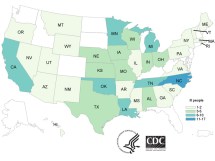
 Confirmed cases have been reported from the following states: Alabama (2), Arizona (1), California (5), Connecticut (3), Georgia (2), Illinois (1), Indiana (3), Kentucky (1), Louisiana (2), Massachusetts (5), Maryland (1), Michigan (4), Mississippi (1), Montana (1), North Carolina (3), New Hampshire (1), New Jersey (3), New York (7), Ohio (1), Oklahoma (2), Oregon (1), Pennsylvania (5), Rhode Island (2), South Carolina (1), Tennessee (1), Texas (2), Utah (1), Virginia (4), Washington (3), Wisconsin (1), West Virginia (3).