eFoodAlert posts links to recalls for English-language countries only. If you are interested in recall information for other countries (including EU-member countries), please click on the Recall Link menu, above.
The live links in this post will take you directly to the official recall notices and company news releases that contain detailed information for each recall and alert.
If you would like to receive automatic email alerts for all new articles posted on eFoodAlert, please submit your request using the sidebar link.
Advertisements
“Reads like a true crime novel” – Food Safety News
Interested in learning more about food safety and the history of foodborne disease outbreaks and investigations?
Click on the link to listen to a short excerpt, then follow the buy links to add a digital, print or audio copy to your personal library.
USA (Update): CDC has reopened its investigation into an outbreak of Salmonella Typhimurium and Salmonella Newport infections linked to consumption of moringa leaf powder capsules. The agency is reporting 119 cases and 32 hospitalizations in 36 states.
Advertisements
United States
Allergy Alert: DE DIOS’S ICE POPS II LLC recalls multiple flavors ofD’DIOSES FRUIT POPS (3.7 oz; Produced prior to 4/27/2026) due to undeclared milk, pecans, pistachios, yellow #5 and red #40.
Allergy Alert: Bazzini, LLC recalls SkinnyDipped® Dark Chocolate Coconut Almond Bites (Multiple lot codes and Best By dates) due to risk of undeclared peanut.
FDA Warning Letter: FDA warns Best Buy Bones, Inc. that a September 8 through September 12, 2025 inspection of the company’s pet food manufacturing facility found evidence of significant violations of FDA’s Current Good Manufacturing Practice, Hazard Analysis, and Risk-Based Preventive Controls for Food for Animals requirements, including the presence of Salmonella Uganda in a finished product sample collected during the inspection.
FDA Warning Letter: FDA warns Shineluck Foods, Inc. that an October 7, 2025, through October 14, 2025 inspection of the company’s facility found serious violations of the Standards for the Growing, Harvesting, Packing, and Holding of Produce for Human Consumption regulation (Produce Safety regulation).
Canada
No Alerts
Advertisements
Ireland and United Kingdom
No Alerts
Hong Kong and Singapore
No Alerts
Australia and New Zealand
No Alerts
Advertisements
“A complete and compelling account of the hidden and not-so-hidden ways the food we give our beloved pets can be contaminated.” – JoNel Aleccia, Health Reporter, Food & Nutrition, The Associated Press.
“An invaluable resource for busy pet owners” – Food Safety News
The California Department of Public Health (CDPH) has tested a can of ByHeart powdered infant formula that was fed to an infant who later developed infant botulism. Preliminary results indicate the presence of botulinum toxin-producing bacteria in the sample consisten with the type of toxin reported from confirmed outbreak cases.
As of November 8, 2025, 13 infants with suspected or confirmed infant botulism have been reported from 10 states, according to the CDC: Arizona, California (2), Illinois (2), Minnesota, New Jersey, Oregon, Pennsylvania, Rhode Island, Texas (2), and Washington.
Eight of the 13 cases have been confirmed as Type A botulism; the remaining five cases are still under investigation. Illnesses started on dates ranging from mid-August to November 2025. All 13 infants were hospitalized and treated with BabyBIG® (an antitoxin for infant botulism developed and supplied by the CDPH). No deaths have been reported. Infants ranged in age from 16 to 157 days.
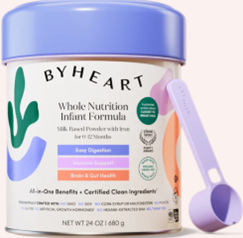
Interviews conducted with caregivers for the 13 outbreak victims revealed that all 13 (100%) infants were fed ByHeart Whole Nutrition infant formula.
In response to the findings, ByHeart Inc. has recalled the following two batches of ByHeart Whole Nutrition Infant Formula (UPC: 5004496800):
Batch Code: 251261P2, Use by: 01 Dec 2026
Batch Code: 251131P2, Use by: 01 Dec 2026
ByHeart’s inspection history
ByHeart Inc. is the parent company for three manufacturing / packaging facilities:
Blendhouse LLC (Reading, PA), a manufacturing site
Blendhouse Allerton, LLC (Allerton, IA), a manufacturing site
Blendhouse Portland LLC (Portland, OR), a packaging site
The Reading location achieved its FDA registration on April 28, 2022 and was subjected to an initial, and successful, FDA inspection in June of 2022.
Then, the Cronobacter sakazakii tsunami hit, and the FDA chose to take an in-depth look at all of the powdered infant formula manufacturing sites, including ByHeart’s Reading facility. What they found was disturbing, resulting in both inspections being classified as “Official Action Indicated.”
Inspection end date February 17, 2023
The FDA investigation team uncovered numerous problems, which were summarized in a Warning Letter, dated August 30, 2023. These included
Lack of process control system, as evidenced by a finding of Cronobacter sakazakiiin a batch of ByHeart Whole Nutrition Infant Formula finished product. The infant formula base which was incorporated into that batch had been manufactured in continuous process from July 13, 2022, through August 23, 2022.
Discrepancy between company’s root cause analysis of the Cronobacter contamination problem and the conclusion of the third-party lab, in which the company blamed lab error and the lab denied that they had erred.
Multiple notifications from third party lab of positive Cronobacter sakazakii findings from July 25, 2022, through August 27, 2022 within the processing environment.
Two water events, during which water leaked into the manufacturing areas from outside.
Inspection end date January 19, 2024
The FDA conducted its next inspection eleven months later. According to information posted on the FDA’s inspection data dashboard, investigators uncovered several serious problems.
did not implement a system of production and in-process controls for an infant formula
did not maintain a building used in the manufacture, processing, packing or holding of infant formula in a clean and sanitary condition
did not minimize the potential for contamination of raw materials through the use of appropriate measures
did not ensure that all surfaces that contacted ingredients, in-process materials and infant formula were cleaned and sanitized and maintained to protect infant formula from being contaminated by any source
did not monitor the temperature in a thermal processing equipment at a point where temperature control is necessary to prevent adulteration.
did not exclude pests from your food plant to protect against contamination of food.
Tempest in a teapot?
The ByHeart recall notice appears to make light of the probability that the company’s products are the source of the 13 cases of infant botulism, stating, “The FDA has not identified a direct link between any infant formula and these cases and there is no historical precedent of infant formula causing infant botulism.”
However, Clostridium botulinum is a common inhabitant of soil. This spore-forming bacterium also is relatively resistant to heat, and has the ability to endure long exposure to dry conditions. Poor sanitation, inadequate temperature control, and inadequate pest control are all routes by which this microbe can find its way into a powdered product.
Infant botulism, unlike the form of the ailment that attacks the general population, does not require pre-formed toxin to be present in the product. An infant’s digestive system can become infected by spores that are ingested or inhaled and set up an infection in the intestine.
In 2005, researchers in the United Kingdom described a case of infant botulism that appeared to be linked to consumption of contaminated powdered infant formula, even recovering a strain of Clostridium botulinum from a sample of the formula. However, in that case, genetic profiling suggested that the strain recovered from the formula was not the same as the one responsible for the illness.
Most prior cases of infant botulism have been traced to ingestion of soil or honey products. Nevertheless, caregivers and medical professionals must be on the alert. Untreated, infant botulism can be deadly. It should never be taken lightly.
What caregivers should do
Do not use recalled infant formula. Throw it away or return it to where you bought it.
If possible, record the lot number.
Wash items and surfaces that may have touched the recalled formula using hot soapy water or a dishwasher.
Seek immediate medical care if your infant has consumed ByHeart Whole Nutrition Infant Formula and has any of these symptoms:
Poor feeding
Loss of head control
Difficulty swallowing
Decreased facial expression
Symptoms of infant botulism can take as long as several weeks to develop, so parents should remain vigilant if they used the recalled lots of infant formula.
Consultation with the Infant Botulism Treatment and Prevention Program is available for suspected cases. If you suspect your infant patient has botulism, immediately call 510-231-7600 for case consultation. Consultation is available 24/7.
If clinical consultation supports infant botulism, begin treatment as soon as possible. Do not wait for laboratory confirmation.
Infant botulism is a notifiable disease. All suspected cases must be reported to the state public health department.
Symptoms of infant botulism
Most infants with infant botulism will initially develop constipation, poor feeding, loss of head control, and difficulty swallowing.
If untreated, infants with infant botulism experience a progressive, flaccid paralysis that can lead to breathing difficulties and require weeks of hospitalization.
Treatment with BabyBIG® is recommended for all suspected cases of infant botulism.
“Reads like a true crime novel” – Food Safety News
Interested in learning more about food safety and the history of foodborne disease outbreaks and investigations?
Click on the link to listen to a short excerpt, then follow the buy links to add a digital, print or audio copy to your personal library.
eFoodAlert posts links to recalls for English-language countries only. If you are interested in recall information for other countries (including EU-member countries), please click on the Recall Link menu, above.
The live links in this post will take you directly to the official recall notices and company news releases that contain detailed information for each recall and alert.
If you would like to receive automatic email alerts for all new articles posted on eFoodAlert, please submit your request using the sidebar link.
“Reads like a true crime novel” – Food Safety News
Interested in learning more about food safety and the history of foodborne disease outbreaks and investigations?
Click on the link to listen to a short excerpt, then follow the buy links to add a digital, print or audio copy to your personal library.
AUSTRIA Update: AGES reports 72 cases of Salmonella Enteritidis infections between December 2024 and July 2025 in eight federal states. Thirty-two people have been hospitalized. The illnesses appear to be linked to consumption of eggs and egg products.
UKRAINE:Kyiv reported a case of foodborne botulism linked to dried fish, bringing the total number of cases in Ukraine in 2025 to 57.
USA: FDA is investigating a new outbreak of five cases of Salmonella Oranienburg linked to an as yet unidentified food.
United States
Public Health Alert: FDAadvises restaurants and retailers not to serve or sell and consumers not to eat certain frozen, raw, half-shell oysters from Republic of Korea potentially contaminated with Norovirus
Food Safety Recall: Délifruits Inc. recalls Délifruits brand and Chocofolie brand Pistachio products due to Salmonella contamination.
Food Safety Recall: KubulVan Food Ltd. recalls Pistachio kernels (Bulk; Sold from March 31, 2025 to August 13, 2025 inclusively) due to Salmonella contamination.
Advertisements
Ireland and United Kingdom
No Alerts
Hong Kong and Singapore
No Alerts
Australia and New Zealand
No Alerts
Advertisements
“A complete and compelling account of the hidden and not-so-hidden ways the food we give our beloved pets can be contaminated.” – JoNel Aleccia, Health Reporter, Food & Nutrition, The Associated Press.
“An invaluable resource for busy pet owners” – Food Safety News