eFoodAlert posts links to recalls for English-language countries only. If you are interested in recall information for other countries (including EU-member countries), please click on the Recall Link menu, above.
The live links in this post will take you directly to the official recall notices and company news releases that contain detailed information for each recall and alert.
If you would like to receive automatic email alerts for all new articles posted on eFoodAlert, please submit your request using the sidebar link.
Advertisements
“Reads like a true crime novel” – Food Safety News
Interested in learning more about food safety and the history of foodborne disease outbreaks and investigations?
Click on the link to listen to a short excerpt, then follow the buy links to add a digital, print or audio copy to your personal library.
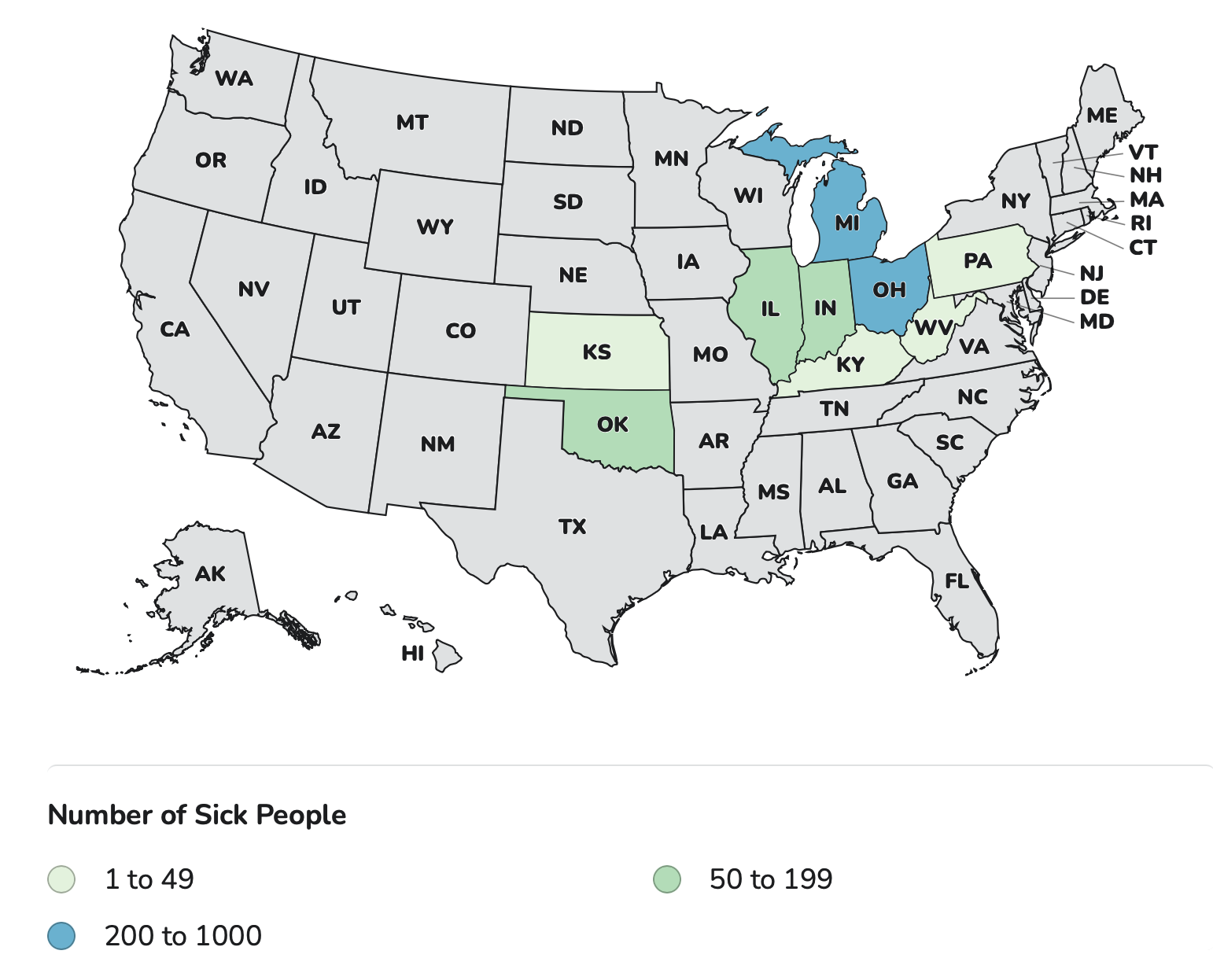
USA Update: Michigan reports first two deaths in Taylor Farms Cyclospora outbreak.
Advertisements
United States
Food Safety Recall: Boticelli Foods recalls bettergoods Pistachio Nut Butter (6.7 oz; Lot code LB028ACP04; Expiration date January 28, 2027; UPC 194346207968; Product of Italy) due to possible Salmonella contamination.
“A complete and compelling account of the hidden and not-so-hidden ways the food we give our beloved pets can be contaminated.” – JoNel Aleccia, Health Reporter, Food & Nutrition, The Associated Press.
“An invaluable resource for busy pet owners” – Food Safety News
The CDC has been silent for more than a week now on the status of the Cyclospora outbreak linked to lettuce supplied by Taylor Farms de Mexico.
As of July 24, 2026, the agency has confirmed what it describes as “at least 1,947” cases, including 98 hospitalizations, in nine states.
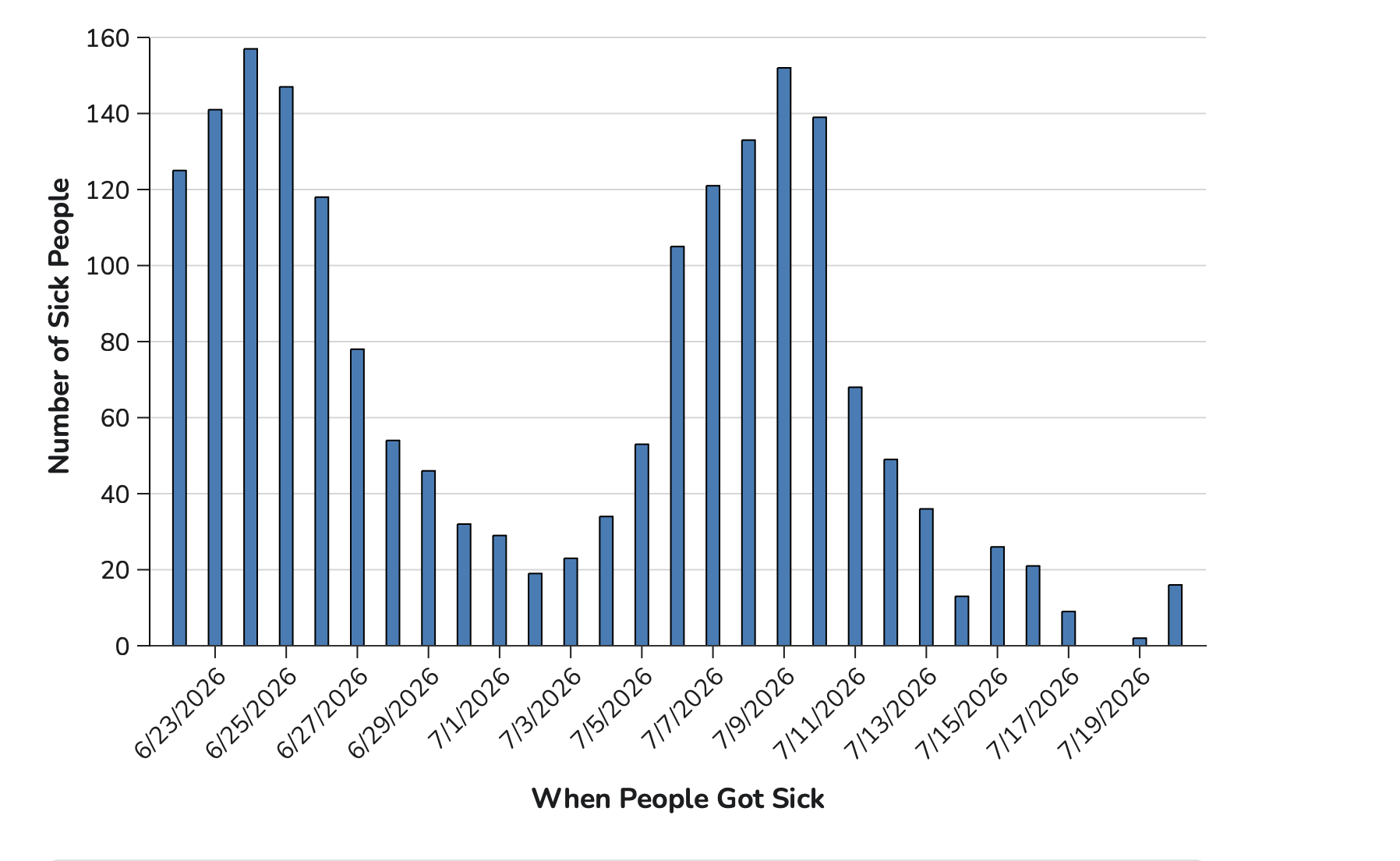
It’s still unclear when this outbreak actually began. In its initial announcement on July 14th, the CDC cited an onset date of June 22, 2026. That onset date was changed three days later. It was pushed back almost six weeks to May 13, 2026.
On July 24th, the CDC quietly changed the onset date back to June 22, 2026, removing more than 200 Michigan cases from its total in the process.
As a result of the CDC having cut six weeks from the front end of the outbreak, the agency’s timeline curve (the Epi Curve) took on a very unusual appearance. Instead of a typical build-up of cases, the outbreak appears to begin two days before the daily case count reaches its peak, tapers off, and then builds a second wave.
Outbreak timeline versus lettuce distribution
On July 17, 2026, Taylor Farms de Mexico recalled all iceberg lettuce sourced from central Mexico. The shredded lettuce was distributed from June 29th thru July 16th to 27 states.
On average, it usually takes about a week (range of 1-14 days) for someone who has been infected with Cyclospora to show symptoms. Any illness arising on or before July 1st (to use a very conservative timeframe) would not be due to consumption of the recalled shipment.
Bill Marler did some excellent reporting on just this point earlier today in his post on Food Poison Journal.
The CDC versus the states
In the absence of frequent and substantive updates (and explanations) from the CDC, it is helpful to turn to the various states for more information.
In his weekend wrap-up, Marler reports just under 21,000 total Cyclospora cases, based on data supplied by individual states. This number includes both domestic cases and those acquired as a result of international travel. Because various states report at different intervals and some do not differentiate between confirmed and probable cases, it is difficult to correlate the state numbers directly with CDC Cyclospora surveillance totals.
What is more instructive in understanding the timeline of the outbreak are the Epi Curves posted by a few states. Again, these curves do not differentiate between cases linked to Taylor Farms lettuce and other cases, nor do they always differentiate between domestic and international cases or between confirmed and probable cases.
Nevertheless, one thing stands out clearly. Every single one of these state charts show a slow build-up to a peak. Not one of them starts at the peak of the outbreak.
Iowa
The Iowa chart presents lab-confirmed cases only, by week of onset. Notice the number of cases start to climb around mid-May. As of July 24th, the CDC has not included Iowa in its Taylor Farms lettuce outbreak data.
New York City
New York is not one of the states that received the recalled lettuce. However, Taylor Farms supplied that lettuce to consignees in New Jersey, just across the river. New York City has experienced 511 cases of Cyclospora infections since May 1, 2026 (as of July 27th). This chart is based on date of diagnosis (rather than onset of symptoms) and displays the data by week.
North Carolina
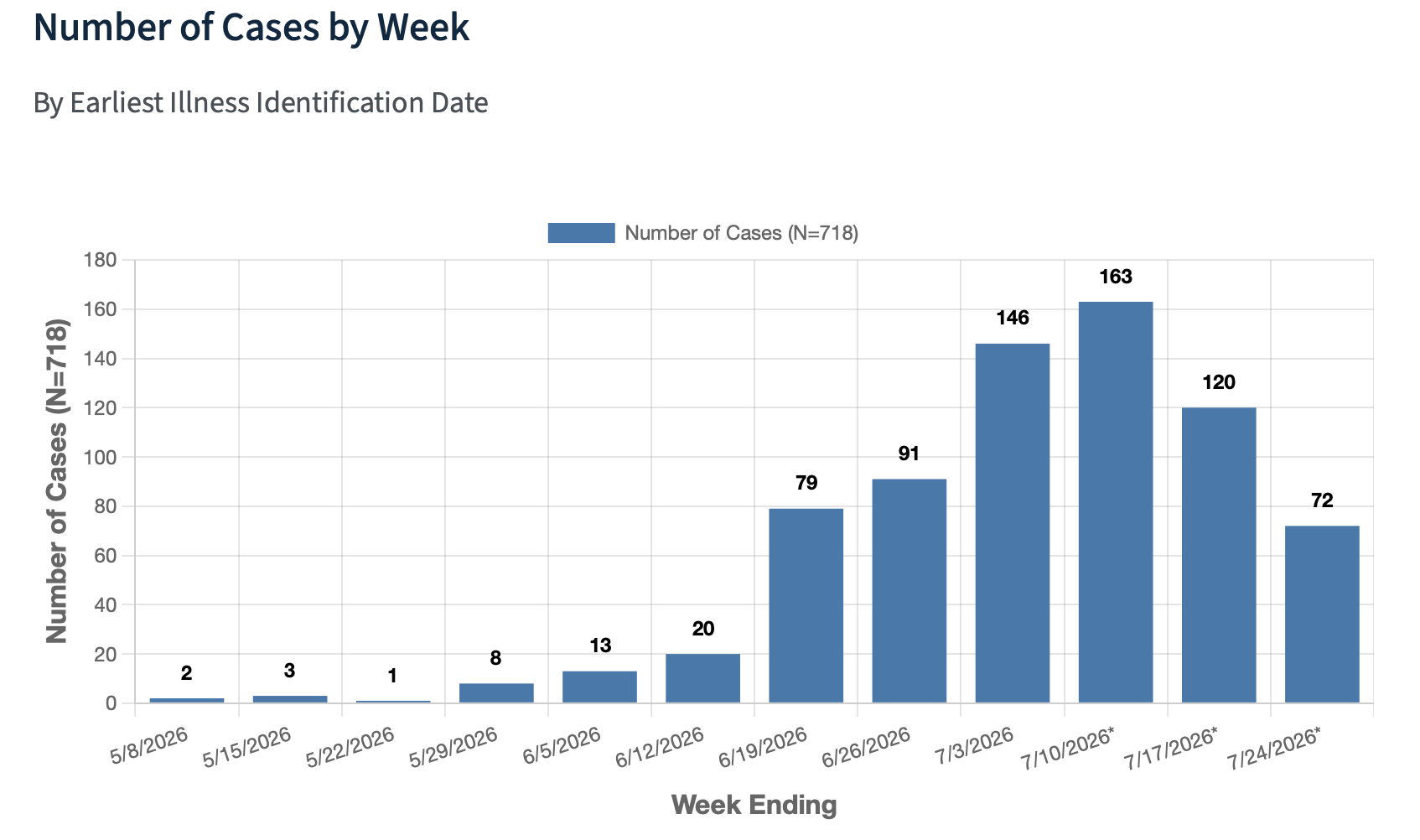
The source of North Carolina’s 718 Cyclospora illnesses is still very much a mystery. Parsley and cilantro consumption have been mentioned as possible factors.
Oklahoma
Oklahoma is one of the nine states identified by the CDC as being part of the Taylor Farms outbreak. The state’s Epi Curve is color-coded to differentiate between domestic and international cases and is accompanied by a table that provides some demographic depth to the state’s reporting.
West Virginia
Also one of the nine Taylor Farms outbreak states, West Virginia’s outbreak onset was later than the other states, starting in the latter part of June 2026 instead of in May.
The unanswered questions
When will the CDC next update its outbreak reporting? Will it change the starting date for the Taylor Farms outbreak yet again?
Where did the prior shipments of Taylor Farms lettuce go? The recalled product was not the first shipment of lettuce to reach the United States. This is the sort of question the FDA’s Traceability Rule was meant to answer. That rule was due to come into force on January 20, 2026. It would have required companies to maintain and share the sort of records that are critical to tracing contaminated product both to its source and to its destination. Enforcement of that rule was put on hold by Congress until July of 2028.
Where did the Cyclospora contamination originate at Taylor Farms de Mexico? Was it in the irrigation water? The processing water? How did it enter the water supply?
Cyclospora can remain viable in the environment for weeks or even months under the right conditions. Can the wastewater treatment facilities in the various cities and rural areas affected by the Cyclospora surge handle the pathogen load? Are municipal water treatment facilities able to ensure safe drinking water in the affected parts of the country?
“Reads like a true crime novel” – Food Safety News
Interested in learning more about food safety and the history of foodborne disease outbreaks and investigations?
Click on the link to listen to a short excerpt, then follow the buy links to add a digital, print or audio copy to your personal library.
The FDA’s Import Alert system is an important tool in the agency’s food safety toolbox.
While there are many Import Alerts in effect, covering a range of pharmaceuticals, devices, cosmetics and foods (both human and animal), today’s focus is on Import Alert 99-35: Detention Without Physical Examination Of Fresh Produce That Appears To Have Been Prepared, Packed Or Held Under Insanitary Conditions.
Some context
The FDA gives the following conditions under which a company’s produce may be added to this Import Alert:
Produce is vulnerable to contamination with pathogenic microorganisms if exposed to insanitary conditions during growing, harvesting, packing, holding, manufacturing, processing, or transportation. Multiple foodborne illness outbreaks have been linked to produce that was likely contaminated as a result of insanitary conditions during growing, harvesting, packing, holding, manufacturing, processing, or transportation. Produce is of special concern because in many instances it is consumed without further treatment to adequately destroy or remove pathogenic microorganisms.
FDA may document insanitary conditions that may have resulted in the contamination of produce with human pathogens during an inspection of an establishment that grows, harvests, packs, holds, manufactures, processes, or transports produce. FDA may also use analytical evidence or epidemiological and traceback evidence to establish that produce was grown, harvested, packed, held, manufactured, processed, or transported under insanitary conditions that may have resulted in contamination of the produce with human pathogens.
In order for a company’s produce to be removed from the detention list (known as the Red List), it “…should submit documentation to FDA demonstrating that the firm has resolved the conditions that gave rise to the appearance of adulteration so that the Agency will have confidence that future entries will be in compliance with the Act.”
A recent example
On July 6, 2026, the CDC posted a notice linking a multistate outbreak of 12 cases of E. coli O145 illnesses to GreenWise Organic Frozen Blueberries imported from Chile. The blueberries had been sold in Publix stores in multiple states.
Three days before the CDC went public with the outbreak notice, Frutas y Hortalizas del Sur S.A. (San Carlos, Chile) recalled the implicated batch of blueberries. On July 29, 2026, Publix expanded the company’s initial recall to include all lots of the GreenWise frozen blueberries.
The connection between the product and the outbreak cases was made based on epidemiological and traceback information only. Neither the CDC nor the FDA reported having found the outbreak strain in a sample of the blueberries.
On July 27th and 28th, the FDA added multiple frozen berry products from four Chilean suppliers to Import Alert 99-35. The entities named in the alert were: COMFRUT SA (Santiago, Chile), Comercial Fruticola S.A.(COMFRUT) (Santiago, Chile), Comfrut Curico (Maule, Chile) and Frutas y Hortalizas del Sur S.A. (Nuble, Chile).
Where is the Taylor Farms Import Alert?
Import Alert 99-35 specifies the following criteria, either of which can merit adding a company’s produce to the Red List. It is not necessary for both criteria to be met in order for a company to qualify for inclusion on the list.
Inspectional evidence demonstrating that produce has been grown, harvested, packed, held, manufactured, processed, or transported under insanitary conditions whereby it may have become contaminated with pathogens.
Epidemiological evidence, traceback evidence, and expert opinion.
There are thirteen countries (fourteen, if one includes US-based importers) represented on the Red List. One of the thirteen is Mexico.
There are 26 individual Mexican companies on the Red List, cited for pathogens ranging (alphabetically) from Cyclospora to Shigella.
The produce items listed for detention include papayas, peppers, herbs and spices, berries, and green onions.
Taylor Farms de Mexico is NOT one of those 26 companies. Iceberg lettuce (or any other variety of lettuce) is NOT one of the produce items.
Why is Taylor Farms de Mexico not on the Red List?
It can’t be because the outbreak is too small to be worthy of notice. Even using the CDC’s most recent outbreak notice (released on July 24, 2026), there are at least 1,947 confirmed Cyclospora outbreak cases in nine states, with 98 people hospitalized. In comparison, the outbreak linked to frozen blueberries comprises only 12 cases in two states.
It can’t be because the linkage is “only” based on epidemiological and traceback data. The E. coli O145 outbreak was linked to frozen blueberries based on the same level of data.
It can’t be because there hasn’t been enough time to add Taylor Farms de Mexico to the Red List. The two outbreaks have overlapping timelines.
In 2013, this company’s lettuce was linked to an outbreak of Cyclospora. It is evident that the investigation into the root cause of that 2013 outbreak was unsuccessful or incomplete. Otherwise, the same problem would not have reoccurred.
Taylor Farms de Mexico qualifies to be added to the Red List through epidemioloigical and traceback evidence linking its produce to a foodborne disease outbreak. It is also a repeat offender. A two-time loser.
The bottom line
The Import Alert system is designed to place the onus on foreign suppliers with a history of food-safety problems to prove their produce is safe BEFORE it is allowed into distribution in the United States.
Taylor Farms de Mexico has a troubled food-safety history and deserves to be added to the Red List for Import Alert 99-35 pronto.
“Reads like a true crime novel” – Food Safety News
Interested in learning more about food safety and the history of foodborne disease outbreaks and investigations?
Click on the link to listen to a short excerpt, then follow the buy links to add a digital, print or audio copy to your personal library.