People, Pooches, and Pig Ears: An Update

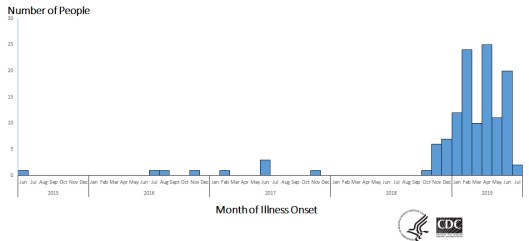
treats-smallNinety-three people have been infected with Salmonella in a 27-state outbreak linked to contact with pig ear dog treats, according to the latest update from the US Centers for Disease Control and Prevention (CDC).
Twenty of the outbreak victims have been admitted to hospital.

Pig ear dog treats sold from bulk bins at Pet Supplies Plus stores are thought to be behind the outbreak, which involves four different Salmonella serotypes, including: I 4,[5],12:i:-, Infantis, Newport, and London.

Lab testing (Whole Genome Sequencing) is in progress to determine whether the strains recovered from from the treats are a genetic match to those recovered from outbreak patients, according to FDA.

Testing carried out by the Michigan Department of Agriculture and Rural Development (MDARD) found three of the four serotypes in samples taken from bulk product in a Pet Supplies Plus store in that state.

On July 3rd, Pet Supplies Plus pulled bulk pig ear dog treats from their stores and stopped shipping the bulk product from their Distribution Center. The bulk treats had been distributed to stores in AL, AR, CA, CO, CT, DE, FL, GA, IA, IL, IN, KS, KY, MA, MD, MI, MN, MO, NC, NE, NH, NJ, NY, OH, OK, PA, RI, SC, TN, TX, VA, WI and WV.

Prepackaged pig ear dog treats are not implicated in this outbreak and remain on store shelves.

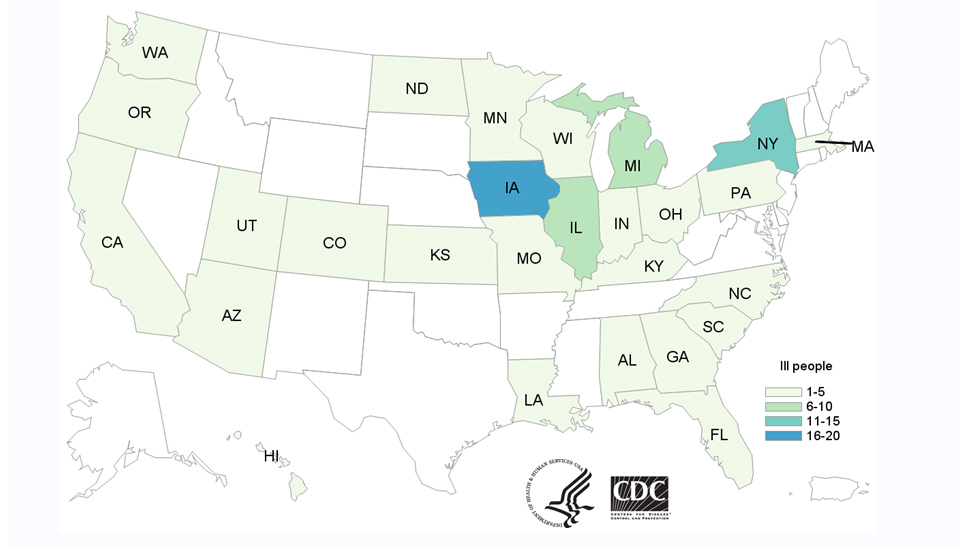
map-7-17-19Confirmed outbreak cases have been reported from Alabama (1), Arizona (1), California (1), Colorado (2), Florida (2), Georgia (1), Hawaii (1), Illinois (6), Indiana (4), Iowa (18), Kansas (3), Kentucky (4), Louisiana (1), Massachusetts (4), Michigan (9), Minnesota (1), Missouri (5), New York (11), North Carolina (1), North Dakota (1), Ohio (5), Oregon (2), Pennsylvania (3), South Carolina (1), Utah (1), Washington (1), and Wisconsin (3).

Pet Supplies Plus stores were located in most, but not all, of the states reporting outbreak cases.

A single, common source of the bulk pig ear dog treats has not yet been identified. It is possible that the same contaminated batch of treats also was supplied to other retailers.

Pets with Salmonella infections may be lethargic and have diarrhea or bloody diarrhea, fever, and vomiting. Some pets will have only decreased appetite, fever and abdominal pain. Infected but otherwise healthy pets can be carriers and infect other animals or humans.

The US Food and Drug Administration (FDA) has received “a few” complaints of sick dogs, and is in the process of evaluating these, according to a spokesperson for the agency.

FDA encourages consumers to report complaints electronically through the Safety Reporting Portal. FDA will evaluate any additional complaints it receives.

Veterinarians who wish to have pets tested for Salmonella may do so through the Veterinary Laboratory Investigation and Response Network (Vet-LIRN Network) if the pet is from a household with a person infected with Salmonella.


Recalls and Alerts: July 22 – 24, 2019

Here is today’s list of food safety recalls, product withdrawals, allergy alerts and miscellaneous compliance issues. The live links will take you directly to the official recall notices and company news releases that contain detailed information for each recall and alert.

If you would like to receive automatic email alerts for all new articles posted on eFoodAlert, please submit your request using the sidebar link.

United States

OUTBREAK ALERT: Pennsylvania Department of Health warns residents not to consume milk from Creamworks Creamery in Waymart, Wayne County, after 17 cases of Yersinia enterocolitica infection and numerous additional digestive illnesses were linked to milk sold at this dairy.

OUTBREAK ALERT UPDATE: CDC reports 93 cases of lab-confirmed Salmonella illnesses in people exposed to pig ear dog treats in 27 states. The outbreak now encompasses four different serotypes of Salmonella, including: 4,[5],12:i:-, Infantis, Newport, and London.

Allergy Alert: CM&R Inc. recalls approximately 25 pounds of ready-to-eat beef stick products due to undeclared milk. Please refer to the recall notice for detailed information on the affected products.

Food Safety Recall: Mountain Rose Herbs recalls Fennel Seed Whole (all sizes; Lot #25031) due to potential Salmonella contamination.

Canada

Food Safety Recall: Polish Trade Center Ltd. recalls Ryki brand Gouda Cheese Slices (4.76 oz; Product code C29N / 290351; UPC 5 902208 000859) due to Listeria monocytogenes contamination.

Food Safety Recall: Gaia Garden Herbals Inc. recalls Gaia Garden Herbal Dispensary brand Gaia Balancing Tea (variable weight; Sold from June 12, 2019 to July 22, 2019, inclusive) due to Salmonella contamination.

Food Safety Recall: Boucherie Distinction recalls SAUMON FUMÉ SUR PLACE  / Salmon smoked on site (variable weights; Best before 10 August 2019) because the product may be unsafe for consumption.

Europe

OUTBREAK ALERT (DENMARK): The Danish Veterinary and Food Administration reports 50 cases of Campylobacter infections traced to chicken meat from a specific Danish chicken slaughterhouse. The outbreak investigation is ongoing.

Allergy Alert (Denmark): Hanegal recalls IRMA Bygotto with mushrooms (400g; Best before 25.07.2019) due to undeclared celery.

Allergy Alert (Italy): ADRIATIC FISH recalls FILETTI DI ALICI PANATI CONGELATI (5-kg carton; Lot #183747130619; Best before 02-08-2020) due to undeclared soy.

Allergy Alert (Italy): Conad recalls CONFETTURA EXTRA AMARENA Cherry Jam (320g; Lot N19002133; Best before 21-03-2021) due to undeclared sulphite.

Food Safety Recall (France): Casino recalls Saveurs d’Ailleurs (Casino) brand 8 Beignets de Crevettes / 8 Shrimp Fritters (8 x 15g; Lot #192723; Best before 28/07/2019) due to potential Listeria contamination.

Food Safety Recall (Germany): Tillman’s Qualitätsmetzgerei GmbH recalls Meine Metzgerei – Gemischtes Hackfleisch / My butchery – mixed minced meat (500g; expiration date Aldi Süd 27.07.19 and Aldi Nord 28.07.19) due to foreign matter (small, red plastic pieces) contamination.

Food Safety Recall (Germany): GAEC Froidevaux Cornuet (France) recalls various cheeses made from sheep’s milk due to Salmonella contamination. Please refer to the recall notice for a complete list of affected products.

Food Safety Recall (Ireland): Quorn Foods recalls Quorn Chilled Cocktail Sausages (180g; 27 July 2019, 28 July 2019 and 30 July 2019) due to foreign matter (small pieces of metal) contamination.

Food Safety Recall (Italy): Salumificio Bianco Angelo recalls Salumificio Bianco Angelo brand Salami (approx. 700g; Lot #28/05/2019) due to Listeria monocytogenes contamination.

Food Safety Recall (UK): Quorn Foods recalls Quorn Chilled Cocktail Sausages (180g; 27 July 2019, 28 July 2019 and 30 July 2019) due to foreign matter (small pieces of metal) contamination.

Australia and New Zealand

Allergy Alert (Australia): Greens General Foods recalls Lowan Rice Flakes (500g; Best before 17/01/2020, 4/02/2020, 5/02/2020, 4/03/2020, 5/03/2020, 11/04/2020, 12/04/2020, 29/4/2020, 13/05/2020, 3/06/2020) and Lowan Rice Porridge (500g; Best before 17/01/2020, 18/01/2020, 5/03/2020, 6/03/2020, 12/04/2020, 6/05/2020, 14/05/2020, 3/06/2020, 4/06/2020) due to undeclared gluten.

Allergy Alert (Australia): Balfours Pty Ltd recalls Balfours Banger Chilli Cheese Kransky (150g; Batch codes TR9171 and TR9178) due to undeclared sesame.

Allergy Alert (Australia): Bulla Dairy Foods recalls Bulla Ready to Decorate Ice Cream Cake Base (1.5L; Best before 24/03/2021) due to undeclared soy.

Pig ear pet treats blamed for human Salmonella outbreak

Pig ear pet treats have been linked to an outbreak of multidrug-resistant Salmonella infections in 13 states, according to an investigation report released today by CDC.

Forty-five individuals in California (1), Illinois (3), Indiana (3), Iowa (12), Kansas (3), Massachusetts (2), Michigan (7), Missouri (3), New York (6), North Dakota (1), Pennsylvania (2), South Carolina (1) and Wisconsin (1) have been infected with the outbreak strain, identified as Salmonella I 4,[5],12:i:-.

Twelve outbreak victims were hospitalized.

According to CDC, epidemiological evidence points to pig ear pet treats as a likely source of the illnesses.

Of the outbreak victims interviewed, 89% reported contact with a dog before getting sick and 71% reported contact with pig ear dog treats or with dogs who were fed pig ear dog treats.

In comparison, only 61% of healthy individuals reported contact with a dog, and only 16% reported having handled dog treats such as pig ears in the week before the interview.

Pig ear pet treats obtained from bulk bins at two Michigan retailers have tested positive for a number of different Salmonella strains, according to a report from the Michigan Department of Agriculture and Rural Development (MDARD).

According to FDA, MDARD found four different strains – Salmonella London, Salmonella Typhimurium, Salmonella Newport, and Salmonella Infantis – in the pig ear samples.

FDA is working with CDC and state health partners to determine whether any human or animal cases of Salmonella illness may be linked to the strains found in the treats tested by MDARD.

Other brands of individually wrapped or bagged pig ears sold at multiple retail locations in the state tested negative for Salmonella.

Pet Supplies Plus (Livonia, MI) issued a voluntary recall after learning that MDARD found Salmonella in “…aging bulk pig ear product…” in one of the company’s stores.

The contaminated bulk pig ears were stocked in open bins in Pet Supplies Plus stores in AL, AR, CA, CO, CT, DE, FL, GA, IA, IL, IN, KS, KY, MA, MD, MI, MN, MO, NC, NE, NH, NJ, NY, OH, OK, PA, RI, SC, TN, TX, VA, WI and WV. Prepackaged pig ears are unaffected by the recall.

The company has removed bulk pig ear treats from all of its stores and has stopped shipping these treats from its distribution center.

FDA is working to identify the source of the pig ear treats, how they became contaminated, and where they were distributed.

What consumers need to know

Salmonella can cause illness in both humans and animals. People infected with Salmonella can develop diarrhea, fever and abdominal cramps. Most individuals recover without treatment. However, in some cases, the diarrhea may be so severe that hospitalization is needed.

In severe cases, without antibiotic treatment the infection may spread from the intestines into the blood stream and from there to other parts of the body.

Pets do not always display symptoms when infected with Salmonella, but signs can include vomiting, diarrhea (which may be bloody), fever, loss of appetite and/or decreased activity level. Infected pets can shed the bacteria in their feces and saliva without showing signs of being sick.

If you or a household member is suffering from symptoms of Salmonella, consult a healthcare provider.

If you believe your pet may be infected with Salmonella, consult your veterinarian.

How to alert FDA to a problem

Veterinarians who wish to have pets tested for Salmonella may do so through the Veterinary Laboratory Investigation and Response Network (Vet-LIRN Network) if the pet is from a household with a person infected with Salmonella.

FDA encourages consumers to report complaints about pet food products electronically through the Safety Reporting Portal. This information helps FDA further protect human and animal health.