
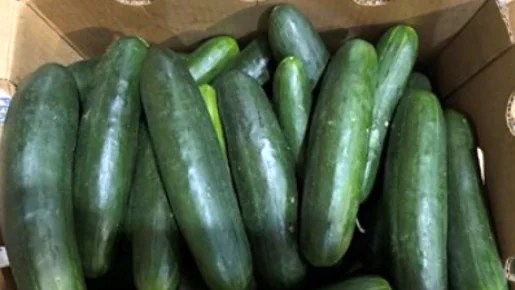
Contaminated cucumbers send 125 to hospital

Cucumbers grown and packed by Bedner Growers, Inc. (Boynton Beach, Florida) are responsible for 449 confirmed cases of Salmonella infections in 31 states and the District of Columbia, according to updated information released by the US Centers for Disease Control and Prevention (CDC) and the US Food and Drug Administration (FDA).

Two outbreak strains have been identified: Salmonella Africana (234 cases) and Salmonella Braenderup (215 cases). There have been no deaths reported.

On June 1, 2024, Fresh Start Produce Sales, Inc. recalled 6167 cases of Whole Cucumbers grown in Florida after the Pennsylvania Department of Agriculture (PDA) found Salmonella in a sample of the company’s cucumbers.

The recalled cucumbers are beyond shelf life and should no longer be available for sale to consumers in stores.

The FDA conducted an onsite inspection at Bedner Growers, and samples collected during the inspection, and Salmonella Braenderup was detected in samples of untreated canal water. Whole genome sequencing determined that the strain found in the water was identical to the strain recovered from some of the outbreak patients.

Other strains of Salmonella also were found in soil and water samples at Bedner Growers. CDC and FDA are working together to determine whether those strains have been associated with any reported illnesses.

Bedner Growers’ growing and harvesting seasons are over. There is no product from this farm on the market and likely no ongoing risk to the public, according to the FDA.

Bedner is just one among many cucumber growers in the state of Florida, and the CDC reports that Bedner’s cucumbers do not account for all of the outbreak cases.

The FDA is continuing to conduct traceback investigations to identify other possible sources.

Follow these four food safety steps to prevent getting sick from Salmonella.

  • Clean: Wash your hands, utensils, and surfaces often. Rinse fruits and vegetables under running water before eating, cutting, or peeling.
  • Separate: Keep food that won’t be cooked separate from raw meat, poultry, and seafood.
  • Cook: Use a food thermometer to make sure you have cooked your food to a temperature high enough to kill germs.
  • Chill: Refrigerate perishable food (food that goes bad) within 2 hours. If the outside temperature is hotter than 90°F, refrigerate within 1 hour. Thaw food in the refrigerator, not on the counter.

Call your healthcare provider if you have any of these severe Salmonella symptoms:

  • Diarrhea and a fever higher than 102°F
  • Diarrhea for more than 3 days that is not improving
  • Bloody diarrhea
  • So much vomiting that you cannot keep liquids down
  • Signs of dehydration, such as:
    • Not peeing much
    • Dry mouth and throat
    • Feeling dizzy when standing up

TAINTED formats 3
“Reads like a true crime novel” – Food Safety News

Interested in learning more about food safety and the history of foodborne disease outbreaks and investigations?

Click on the link to listen to a short excerpt, then follow the buy links to add a digital, print or audio copy to your personal library.

Chapter 6. Birth of a Pathogen

TAINTED is available in digital format from all major on-line retailers. Press the button to go directly to your preferred digital bookstore.

Salmonella Africana outbreak and the cucumber conundrum

The US Centers for Disease Control and Prevention (CDC) and the US Food and Drug Administration (FDA) are investigating two outbreaks of Salmonella infections that apparently are linked to consumption of cucumbers.

On June 1, 2024, Fresh Start Produce Sales, Inc. recalled 6167 cases of Whole Cucumbers grown in Florida after the Pennsylvania Department of Agriculture (PDA) found Salmonella in a sample of the company’s cucumbers.

Nevertheless, it is still an open question whether the cucumbers supplied by Fresh Start are the source of either or both outbreaks.

The Salmonella Africana outbreak

  • As of June 12, a total of 196 people infected with the outbreak strain of Salmonella Africana have been reported from 28 states and the District of Columbia.
  • Illnesses started on dates ranging from March 11, 2024, to May 23, 2024.
  • 68 people have been hospitalized.
  • Age of outbreak victims range from <1 to 94 years.
  • 63 out of 85 people interviewed (74%) reported eating cucumbers, as compared with 50% of individuals responding to a population survey.

The Salmonella Braenderup outbreak

  • As of June 12, a total of 185 people in multiple states were reported to be infected with the outbreak strain of Salmonella Braenderup.
  • The outbreak shares similarities with the Salmonella Africana outbreak, including where and when illnesses occurred and the demographics of ill people.
  • Investigators are working to determine whether the two outbreaks could be linked to the same food vehicle. 

The Salmonella-positive cucumber sample

  • The cucumber sample supplied by Fresh Start Produce and tested by the PDA was contaminated with Salmonella Bareilly. The strain does not match any ongoing Salmonella outbreaks.
  • The recalled cucumbers were distributed to 14 states: Alabama, Florida, Georgia, Illinois, Maryland, North Carolina, New Jersey, New York, Ohio, Pennsylvania, South Carolina, Tennessee, Virginia, and West Virginia.
  • The cucumbers recalled by Fresh Start were packed by Bedner Growers, Inc., a family-owned business. Bedner grows 1,500 acres of bell peppers and 500 acres of cucumbers in Palm Beach and Martin counties, Florida.
  • The FDA inspection database shows no record of any prior inspections of Bedner Growers by the federal agency.

Bedner is just one among many cucumber growers in the state of Florida.

The FDA and its state partners are continuing to sample cucumbers from other sources as part of the traceback investigation for both the Salmonella Africana and the Salmonella Braenderup outbreaks. However, cucumbers have a limited shelf life, and the produce responsible for the outbreaks may no longer be available for sale.

The best chance of making a definitive link to a specific grower/packer will be if the FDA is able to find one or both outbreak strains in samples obtained during an on-site inspection.

The FDA has already initiated inspection and sampling activities in conjunction with the Salmonella Africana outbreak, although the agency has not specified where the inspection is taking place. More information will be forthcoming from the FDA as it becomes available.

  • Do not eat any recalled cucumbers. If you recently purchased cucumbers and have them at home, you can check with the store where you purchased them to see if they were part of the recall. If you can’t tell, do not eat them.
  • Wash items and surfaces that may have touched the recalled cucumbers using hot soapy water or a dishwasher.
  • Call your healthcare provider if you have any of these severe Salmonella symptoms:
    • Diarrhea and a fever higher than 102°F
    • Diarrhea for more than 3 days that is not improving
    • Bloody diarrhea
    • So much vomiting that you cannot keep liquids down
    • Signs of dehydration, such as:
      • Not peeing much
      • Dry mouth and throat
      • Feeling dizzy when standing up
  • Do not sell or serve recalled cucumbers.
  • Wash and sanitize items and surfaces that may have come in contact with recalled cucumbers.
  • Stores can also notify customers who may have purchased recalled cucumbers using signs in stores or emails to customers.

TAINTED formats 3
“Reads like a true crime novel” – Food Safety News

Interested in learning more about food safety and the history of foodborne disease outbreaks and investigations?

Click on the link to listen to a short excerpt, then follow the buy links to add a digital, print or audio copy to your personal library.

Chapter 6. Birth of a Pathogen

TAINTED is available in digital format from all major on-line retailers. Press the button to go directly to your preferred digital bookstore.

Recalls and Alerts: June 4–5, 2024

Here is today’s list of food safety recalls, product withdrawals, allergy alerts and miscellaneous compliance issues. The live links will take you directly to the official recall notices and company news releases that contain detailed information for each recall and alert.

If you would like to receive automatic email alerts for all new articles posted on eFoodAlert, please submit your request using the sidebar link.


United States

OUTBREAK INVESTIGATION: FDA, CDC and state and local partners are investigating an outbreak of 162 Salmonella Africana illnesses in 25 states and the District of Columbia. Fifty-four of the outbreak patients have been hospitalized. The outbreak is believed to be linked to consumption of cucumbers grown in Florida.

OUTBREAK INVESTIGATION: FDA and CDC are investigating an outbreak of 158 Salmonella Braenderup illnesses. This outbreak shares several similarities with the Salmonella Africana outbreak, including where and when illnesses occurred and the demographics of ill people. Investigators are working to determine whether the two outbreaks could be linked to the same food. 

Food Safety Advisory: FDA advises restaurants and food retailers not to serve or sell and to dispose of, and consumers not to eat, oysters and bay clams harvested from growing areas in Netarts Bay and Tillamook Bay, OR (harvested on or after 5/28/24), and all shellfish species from growing areas in Willapa Bay, WA (Stony Point, harvested between 5/26/24 and 5/30/24; Bay Center, harvested between 5/29/24 and 5/30/24; and Bruceport, harvested between 5/29/24 and 5/30/24), and distributed to AZ, CA, CO, HI, NV, NY, OR, and WA because they may be contaminated with the toxins that cause paralytic shellfish poisoning (PSP).

Allergy Alert: New Seasons Market recalls Strawberry Rhubarb Bakewell Tart (Sold from 03/22/24 to 06/03/24; All best if used by dates) due to undeclared almonds. The product was sold at the Bakery and Pastry departments in New Seasons Market stores located in Oregon and Washington.

Food Safety Recall: JBR (KR-15-SP) Tongyeong, Republic of Korea recalls all frozen half-shell oysters (harvested between 11/26/2023 and 2/14/2024; processed between 11/27/2023 and 2/15/2024; Lot codes B231126, B231128, B231129, B231130, B231201, B231202, B231204, B231205, B231206, B231209, B231225, B231226, B231227, B240102, B240103, B240104, B240109, B240111, B240114, B240201, B240203, B240204, and B240214) due to potential Norovirus contamination.

Food Safety Recall: South American Meat Inc. (aka 5Gogi LLC) recalls approximately 20,111 pounds of various eligible frozen raw beef products that were not presented to FSIS for import reinspection upon entry into the United States. Please refer to the recall notice for a complete list of affected products, which were imported from Uruguay.

Food Safety Recall: Schreiber Foods Inc recalls eight varieties of cream cheese spreads due to potential for Salmonella contamination. Please refer to the Enforcement Report notice for a complete list of affected products.

Infant Formula Safety Recall: Dairy Manufacturers Inc. expands its earlier recall to include Crecelac Infant 0-12 (12.4 oz; Lot code 24 039 1 CHE 352-1; Expiry date 08/2025; UPC 8 50042 40847 6; Manufactured at D.M. Mexicana Sa De Cv in Monterey, Mexico) due to Cronobacter spp. contamination.

Canada

No Alerts

United Kingdom and Ireland

Food Safety Recall (Ireland): Trade recalls Hosyaushka Sonnenblumenkerne, geschält / shelled sunflower seeds (250g; Batch code 229/23A; Best before 30.04.2025; Product of Bulgaria) due to Salmonella contamination.

Hong Kong and Singapore

No Alerts

Australia and New Zealand

No Alerts

Advertisements

Links to national recall sites

Australia

Austria

Belgium

Canada

Czechia (Czech Republic)

Denmark

Finland

France

Germany

Greece

Hong Kong

Hungary

Iceland

Ireland (Republic of)

Israel

Italy

Lithuania

Luxembourg

Netherlands

Norway

Romania

Singapore

Slovakia (Slovak Republic)

Spain (food safety alerts)

Spain (allergy alerts)

Sweden

Switzerland

United Kingdom

United States of America (FDA)

United States of America (USDA/FSIS)


TAINTED formats 3
“Reads like a true crime novel” – Food Safety News

Interested in learning more about food safety and the history of foodborne disease outbreaks and investigations?

Click on the link to listen to a short excerpt, then follow the buy links to add a digital, print or audio copy to your personal library.

Chapter 6. Birth of a Pathogen

TAINTED is available in digital format from all major on-line retailers. Press the button to go directly to your preferred digital bookstore.


“A complete and compelling account of the hidden and not-so-hidden ways the food we give our beloved pets can be contaminated.” JoNel Aleccia, Health Reporter, Food & Nutrition, The Associated Press.

“An invaluable resource for busy pet owners” – Food Safety News

Available from all major on-line retailers, including:


Advertisements