
Recalls and Alerts: July 28 – 31, 2019

Here is today’s list of food safety recalls, product withdrawals, allergy alerts and miscellaneous compliance issues. The live links will take you directly to the official recall notices and company news releases that contain detailed information for each recall and alert.

If you would like to receive automatic email alerts for all new articles posted on eFoodAlert, please submit your request using the sidebar link.

United States

Food Safety Recall: Conagra Brands, Inc. recalls Kaskey’s BEEFY MAC PASTA IN TOMATO & MEAT SAUCE (15-oz can; Best by JUL 07 2021) due to possible processing defect.

Pet Food Safety Recall: Lennox Intl Inc recalls Premium Natural Pig Ears shipped to nationwide distributors and/or retail stores from November 1st 2018, to July 3rd, 2019 (8-pack branded pouch, UPC 742174 995163 and 742174994166; individual shrink-wrapped piece, UPC 0385384810 and 742174P35107) due to potential Salmonella contamination. The recalled products may be linked to a multi-state outbreak of Salmonella illnesses in 33 states.

Canada

Allergy Alert: FV Foods recalls FV Foods brand Hawaiian Sweet Roll (750g; All product codes; UPC 8 29604 05010 1) due to undeclared egg.

Food Safety Recall: Polish Trade Center Ltd. recalls Ryki brand Rycki Edam Cheese Slices (4.76 oz; Product code D30N / 300454; UPC 5 902208 000811) and Ryki brand Rycki Edam Smoked Cheese Slices (4.76 oz; Product code D30N / 300469; UPC 5 902208 000828) due to Listeria monocytogenes contamination.

Europe

Allergy Alert (Belgium): Nicolas KLINGLER – SCRL Vins et Elixirs de Franchimont recalls Fleur de Franchimont (5-litre jug; All lots) due to undeclared sulphites.

Allergy Alert (Netherlands): Amazing Oriental recalls Mr Kon’s Braised Beef Bowl Noodle (105g; All expiration dates) due to inadequate allergen labeling.

Allergy Alert (Netherlands): Jumbo recalls Jumbo Eating Out at Home brand Craft Quiche Lorraine (All date codes) and Jumbo Eating Out at Home brand Craft Salmon & Spinach Quiche (400g; All date codes) due to undeclared soy.

Food Safety Recall (Belgium): Söbbeke recalls Söbbeke Bio Schokopudding / Organic Chocolate Pudding (150g; Best before 9/8/2019) due to foreign matter (pieces of glass) contamination.

Food Safety Recall (France): Carrefour recalls Reflets de France brand Véritable Andouille de Guéméné / Genuine Guéméné Andouille sausage (~270g; Lot #91580057; Best before 26/07/2019) due to Listeria contamination.

Food Safety Recall (France): LEADER PRICE recalls LEADER PRICE brand Beignets de crevettes + sauce / Shrimp fritters with sauce (140g/8-pack; Lot #192723; Best before 28/07/2019) due to Listeria contamination.

Food Safety Recall (Germany): Banketbakkerij Merba B.V. recalls Biscotto American Cookies (225 g; Best before 24.05.2020) due to foreign matter (plastic pieces) contamination.

Food Safety Recall (Germany): Mediterraneo Feinkost GmbH & Co. KG recalls San Vicario Tomatensugo della Mamma / Tomato sauce (330 ml; Lot #B43.19; Expiry 29.04.2022) due to foreign matter (glass fragments) contamination.

Food Safety Recall (Germany): Alnatura Produktions- und Handels GmbH recalls Alnatura brand Schokopudding / Chocolate pudding (150g; Best before 9/8/2019) due to foreign matter (pieces of glass) contamination.

Food Safety Recall (Germany): t`Dischhof recalls Petit Fleur mit Kräutern / Petit Fleur cheese with herbs (Lot #25.3; Best before 19.08.2019) due to shigatoxin-producting E. coli contamination.

Food Safety Recall (Germany): Söbbeke recalls certain Organic chocolate pudding and Organic red fruit jelly due to foreign matter (glass particles) contamination. Please refer to the recall notice for a complete list of affected products.

Food Safety Recall (Luxembourg): Söbbeke recalls Söbbeke Bio Schokopudding / Organic Chocolate Pudding (150g; Best before 9/8/2019) due to foreign matter (pieces of glass) contamination.

Pet Food Safety Recall (Luxembourg): Fressnapf recalls MultiFit native brand Lammlungen / Lamb lungs (150g; Lots #024, 199 & 101; Best before 13/11/2020, 21/12/2019 & 12/12/2020 respectively; Product of Poland) due to Salmonella contamination.

Pet Food Safety Recall (UK – England and Wales specific): Raw Treat Pet Food Ltd recalls four batches of frozen raw pet food due to Listeria monocytogenes contamination. Please refer to the recall notice for a complete list of affected products.

Asia, Africa and the Pacific Islands

Food Safety Recall (Singapore): Yu Fish Pte Ltd recalls Fresh Atlantic Salmon (Produced 25 July 2019; Product of Norway) due to Listeria monocytogenes contamination.

Australia and New Zealand

Allergy Alert (Australia): Mingfa Trading Co P/L recalls Chinese Crisp Cake (Production date 10/04/2019) due to undeclared walnut and cashew.

Allergy Alert (Australia): Korean Foods Pty Ltd recalls various Korean Foods Kimchi due to undeclared shellfish. Please refer to the recall notice for a complete list of affected products.

Allergy Alert (New Zealand): Green Meadows Beef Ltd recalls Woodburn Venison brand venison burger (400g; Batch #6689; Best before 04 AUG 19) due to undeclared gluten and soy.
Feds urge consumers to nix pig ear dog treats

FDA AND CDC ARE ADVISING THAT CONSUMERS AVOID ALL PIG EAR PET TREATS, AND THAT RETAILERS STOP SELLING ALL PIG EAR TREATS AT THIS TIME.

THE OUTBREAK

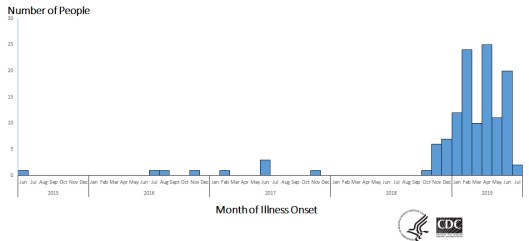
Pig ear dog treats are behind a multi-strain outbreak of Salmonella infections that has sickened 127 people in 33 states, according to the latest update from the US Centers for Disease Control and Prevention (CDC).

Twenty-four (21%) of the illnesses are in children under the age of five.

Fifty-five (45%) of the victims are female.

Twenty-six (26) of the victims have been admitted to hospital. No deaths have been reported.

Illnesses started on dates ranging from June 16, 2015 to July 6, 2019. Outbreak victims range in age from less than 1 year to 90 years, with a median age of 40 years.

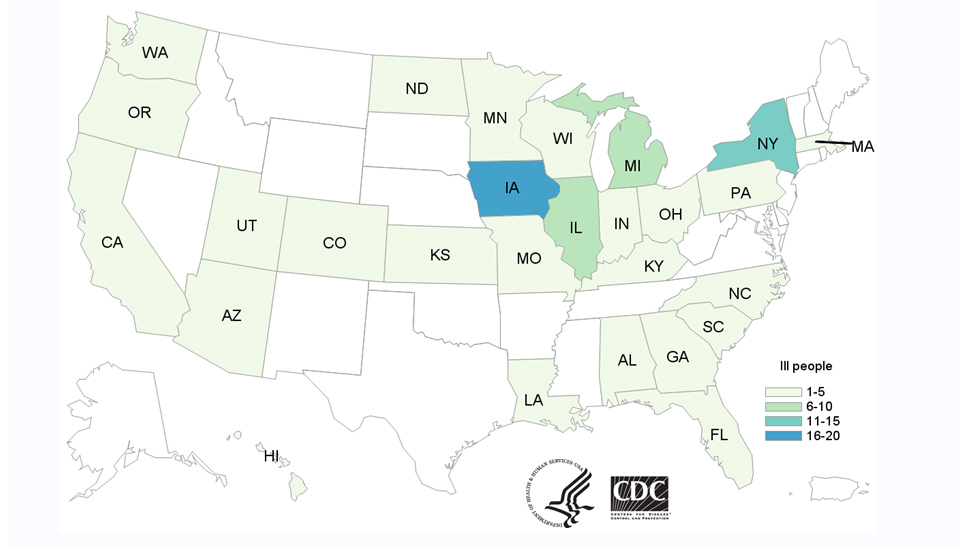
Illnesses have been reported to CDC from Alabama (1), Arizona (1), California (1), Colorado (3), Connecticut (1), Florida (3), Georgia (2), Hawaii (1), Illinois (7), Indiana (5), Iowa (23), Kansas (3), Kentucky (6), Louisiana (1), Maine (1), Massachusetts (4), Michigan (12), Minnesota (1), Missouri (6), New Hampshire (1), New Jersey (2), New Mexico (1), New York (15), North Carolina (2), North Dakota (1), Ohio (5), Oregon (2), Pennsylvania (6), South Carolina (2), Texas (2), Utah (1), Washington (1), Wisconsin (4).

To date, CDC has identified four different Salmonella serotypes as contributing to the outbreak: Salmonella enterica serotypes I 4,[5],12:i:-, Infantis, London, and Newport.

Based on epidemiology, lab results, and traceback investigations, pig ear dog treats appear to be the source of the outbreak.

In addition to the Salmonella serotypes already identified in the outbreak, testing carried out by Kansas, Michigan, Pennsylvania, and the FDA found Salmonella PanamaSalmonella BrandenburgSalmonella Anatum, and Salmonella Livingstone in treat samples purchased from retailers.

CDC is reviewing its databases to determine whether any of the additional strains have been associated with reports of human illness.

Illnesses were linked to contaminated pig ear dog treats were imported from Argentina and Brazil, according to traceback investigations carried out by FDA. However, these two sources do not account for all of the 127 reported infections.

In addition to the existing Import Alert 72-03 on pig ear pet treats, FDA is increasing its scrutiny of pig ears imported into the United States through sampling and examination.

THE RECALLS

On July 3rd, Pet Supplies Plus recalled bulk pig ears stocked in open bins from its stores in 33 states.

On July 26th, Lennox Intl. Inc. recalled Natural Pig ears that were shipped to to nationwide distributors and/or retail stores from May 1st, to July 3rd, 2019.

On July 30th, Lennox expanded its recall to include packages of Premium Natural Pig Ears shipped to nationwide distributors and/or retail stores from November 1st 2018, to July 3rd, 2019.

More products may be recalled and more suppliers identified as testing continues.

FDA STATEMENT

The FDA takes seriously our responsibility to protect both human and animal health,” said Steven M. Solomon, D.V.M., M.P.H., director of the FDA’s Center for Veterinary Medicine. “Multiple products have tested positive for numerous types of Salmonella resulting in two company recalls to date. Given this and the links to human illness, we believe the most effective way to protect public health at this time is to warn consumers to avoid purchasing or feeding their pets all pig ear treats and for retailers not to sell these products. We also continue to advise those who may have come into contact with potentially contaminated products to practice safe hygiene, including thoroughly washing hands and disinfecting any surfaces that have touched pig ear pet treats. The FDA will provide additional updates as our investigation further progresses.

ADVICE FOR PET OWNERS

  • Do not feed any pig ear treats to your dog. Throw them away in a secure container so that your pets and other animals can’t eat them.
  • Even if some of the pig ears were fed to your dog and no one got sick, do not continue to feed them to your dog.
  • Wash containers, shelves, and areas that held any pig ear dog treats with hot, soapy water. Be sure to wash your hands after handling any of these items.
  • People who think their pets have become ill after consuming contaminated pet food should first contact their veterinarians. Veterinarians who wish to have pets tested for Salmonellamay do so through the Veterinary Laboratory Investigation and Response Network (Vet-LIRN Network) if the pet is from a household with a person infected with Salmonella.
  • FDA encourages consumers to report complaints about pet food products electronically through the Safety Reporting Portal. This information helps FDA further protect human and animal health.

People, Pooches, and Pig Ears: An Update

treats-smallNinety-three people have been infected with Salmonella in a 27-state outbreak linked to contact with pig ear dog treats, according to the latest update from the US Centers for Disease Control and Prevention (CDC).
Twenty of the outbreak victims have been admitted to hospital.

Pig ear dog treats sold from bulk bins at Pet Supplies Plus stores are thought to be behind the outbreak, which involves four different Salmonella serotypes, including: I 4,[5],12:i:-, Infantis, Newport, and London.

Lab testing (Whole Genome Sequencing) is in progress to determine whether the strains recovered from from the treats are a genetic match to those recovered from outbreak patients, according to FDA.

Testing carried out by the Michigan Department of Agriculture and Rural Development (MDARD) found three of the four serotypes in samples taken from bulk product in a Pet Supplies Plus store in that state.

On July 3rd, Pet Supplies Plus pulled bulk pig ear dog treats from their stores and stopped shipping the bulk product from their Distribution Center. The bulk treats had been distributed to stores in AL, AR, CA, CO, CT, DE, FL, GA, IA, IL, IN, KS, KY, MA, MD, MI, MN, MO, NC, NE, NH, NJ, NY, OH, OK, PA, RI, SC, TN, TX, VA, WI and WV.

Prepackaged pig ear dog treats are not implicated in this outbreak and remain on store shelves.

map-7-17-19Confirmed outbreak cases have been reported from Alabama (1), Arizona (1), California (1), Colorado (2), Florida (2), Georgia (1), Hawaii (1), Illinois (6), Indiana (4), Iowa (18), Kansas (3), Kentucky (4), Louisiana (1), Massachusetts (4), Michigan (9), Minnesota (1), Missouri (5), New York (11), North Carolina (1), North Dakota (1), Ohio (5), Oregon (2), Pennsylvania (3), South Carolina (1), Utah (1), Washington (1), and Wisconsin (3).

Pet Supplies Plus stores were located in most, but not all, of the states reporting outbreak cases.

A single, common source of the bulk pig ear dog treats has not yet been identified. It is possible that the same contaminated batch of treats also was supplied to other retailers.

Pets with Salmonella infections may be lethargic and have diarrhea or bloody diarrhea, fever, and vomiting. Some pets will have only decreased appetite, fever and abdominal pain. Infected but otherwise healthy pets can be carriers and infect other animals or humans.

The US Food and Drug Administration (FDA) has received “a few” complaints of sick dogs, and is in the process of evaluating these, according to a spokesperson for the agency.

FDA encourages consumers to report complaints electronically through the Safety Reporting Portal. FDA will evaluate any additional complaints it receives.

Veterinarians who wish to have pets tested for Salmonella may do so through the Veterinary Laboratory Investigation and Response Network (Vet-LIRN Network) if the pet is from a household with a person infected with Salmonella.