
Last month, the US Food and Drug Administration (FDA) fired the latest salvo in an ongoing battle between the government and Arrow Reliance Inc. (dba Darwin’s Natural Pet Products), a manufacturer and distributor of raw pet food.
On February 16, 2023, the FDA sent a formal Warning Letter addressed to the company’s owner, Gary T. Tashjian.
In that letter, the agency summarized the violations its investigators observed during an August/September 2022 inspection of the company’s manufacturing facility, located in Tukwila, Washington.
The inspection was triggered by a consumer complaint. The consumer informed the FDA that her three kittens had developed diarrhea after consuming about one tablespoon each of a Darwin’s Natural raw cat food.
A stool sample from one of the kittens tested positive for Salmonella.
The FDA obtained three unopened packages of Darwin’s cat food from the complainant’s home. Two of those packages tested positive for Salmonella Typhimurium, and one of those two packages also was contaminated with Salmonella Kentucky. Both of these serotypes are capable of causing human illness, and have been responsible for foodborne disease outbreaks in the United States and other countries.
The agency also collected a sample of cat food at the production plant during the course of its inspection. That sample, too, was positive for Salmonella Typhimurium.
The FDA holds raw, ready-to-eat pet foods to the same zero-tolerance standard for pathogens as it does all other forms of pet food.
Upon confirming the presence of Salmonella in the company’s products, the FDA urged Darwin’s to initiate a voluntary recall.
The company refused.
The FDA advised Darwin’s that, in the absence of a recall, the agency would post a consumer advisory on its website to warn the public about the contaminated batches of pet food.
In response, Darwin’s sought a court injunction to prevent the FDA from posting its advisory.
The court denied the injunction, and the FDA posted its advisory on August 5, 2022.
The opening salvoes
The war between Darwin’s and the FDA began in earnest in September 2017, when Darwin’s recalled a batch of cat food due to Salmonella contamination.
The recall was initiated as a result of a consumer complaint to the FDA involving a dead kitten. Darwin’s undertook the recall after an FDA lab confirmed the presence of Salmonella in an unopened package of the same batch of food the kitten had been fed.
In December 2017, the company recalled certain batches of raw cat food and raw dog food after lab testing found Salmonella and Listeria monocytogenes in samples of the products.
Later that same month, the FDA received yet another consumer complaint, this time involving a German Shepherd named Blitz, who had been suffering from severe, protracted diarrhea for several months. The dog’s owner had been assured by Darwin’s that the production lots of food they had supplied to her were not implicated in the product recall, and were “safe” for her to feed to her dog.
Upon learning about the recalls, Blitz’s owner arranged for his stool to be tested for Salmonella. It was positive, as was an unopened package of the dog food collected from her home by an inspector with the FDA.
In response to this and other complaints, the FDA and the Washington Department of Agriculture initiated a joint investigation of Darwin’s manufacturing facility.
On April 2, 2018, the FDA issued its first Warning Letter to the company. In it, the agency addressed a series of violations, including the presence of Salmonella, Listeria monocytogenes, and E. coli O128 in samples of finished products and the use of an additive that was not “generally recognized as safe” for pet foods.
The Warning Letter also addressed the consumer complaint involving the dead kitten. The strain of Salmonella recovered from the kitten on necropsy was genetically identical to the strain of Salmonella found in an unopened package of cat food from the same batch the kitten had eaten, and also matched Salmonella found in two other products sampled during the inspection of the manufacturing facility..
The second round
In March 2019, in response to yet another consumer complaint, the FDA collected and analyzed samples of three different batches of Darwin’s raw dog food.
When the agency’s lab found Salmonella in all three batches, Darwin’s recalled the products by notifying the recipients of those specific batches by email.
The company declined to cooperate with the FDA’s efforts to ensure an effective recall.
As a result, the FDA posted a consumer advisory on its website.
Darwin’s responded to the advisory by posting a statement on its own website. In its statement, the company denied that its products posed any danger to people or to animals, and said that it had received no medical reports of illnesses attributed to the recalled products.
Darwin’s also claimed that the FDA issued the consumer advisory “in retaliation” for the company’s refusal to share customer contact information.
The Covid-19 lull
The restrictions placed upon the FDA’s ability to conduct on-site investigations during the Covid-19 pandemic greatly reduced the agency’s ability to monitor the activities of Darwin’s.
An inspection carried out in 2021 proceeded only after a one-week notice to the company, and found little.
Even so, FDA investigators determined that Darwin’s was still using an additive–albeit a different one–that was “not recognized as safe” for the purpose.
Worse, between 2021 and 2022, Darwin’s increased the concentration of the additive (known as peroxyacetic acid, or PAA) to well beyond the level determined to be safe for any food application, animal or human.
The bottom line
The issues raised in the FDA’s 2022 Warning Letter are serious.
The company’s decision to increase the level of PAA in its products to a concentration significantly beyond the recognized safe level for any application displays a flagrant disregard for the safety of its four-legged consumers.
The company’s denial that Salmonella in its products presents a health risk to either people or animals is disingenuous.
The company’s denial of FDA jurisdiction over its products has been shot down in federal court.
As the years have passed, the position taken by Darwin’s and its owner, Gary Tashjian, has become more and more adamant. The company has not even complied with its obligation to register with the FDA as a Food Facility.
In its Warning Letter, the FDA put the company on notice that its failure to address the issues raised in the letter “…may lead to legal action, including, without limitation, seizure and injunction.”
Unfortunately, initiating these legal actions requires the cooperation and involvement of the Department of Justice (DoJ).
There is precedent for such action. In 2022, the DoJ obtained a Permanent Injunction against another repeat offender, Bravo Packing, Inc. But that came only after the FDA and Animal Outlook, a non-profit animal advocacy organization, documented multiple egregious violations of animal welfare and manufacturing practices on the part of the company and its owner.
Evidence in the Bravo Packing case included cats urinating on meat destined for dog food, and the owner spitting on the production room floor as he accompanied the FDA inspector on his rounds on two separate visits.
Is that what it will take for the DoJ to get on board for Darwin’s?
How many more dogs and cats will have to die or suffer from severe illnesses before the FDA and the DoJ can be persuaded to act?
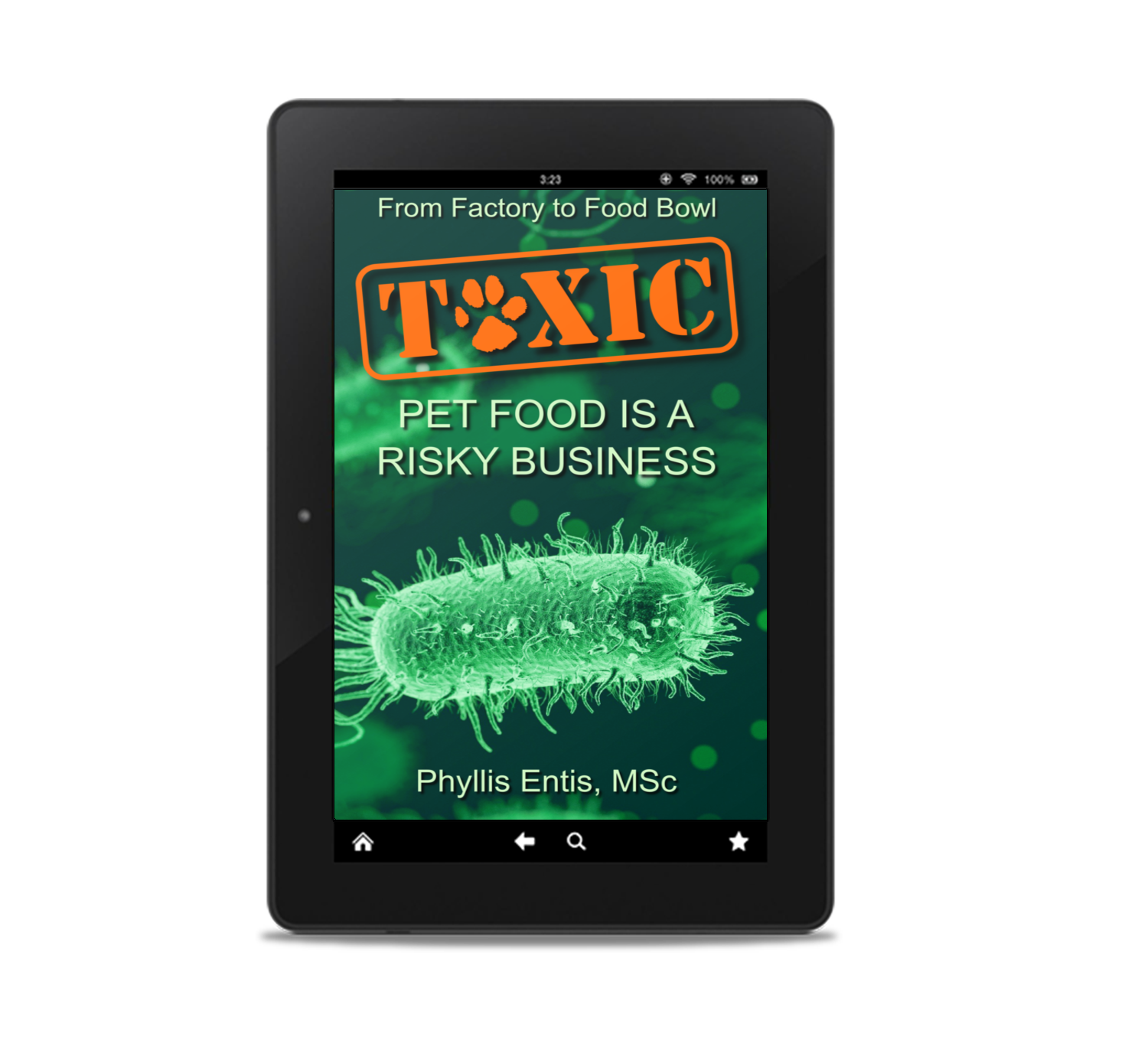 Want to learn more about safety issues involving pet foods?
Pre-order TOXIC today for automatic delivery to your ebook reader on June 22, 2023.
Available from Amazon, Apple, Barnes & Noble, Kobo and Smashwords.

 Arrow Reliance Inc., dba Darwin’s Natural Pet Products, is taking steps to correct multiple violations of the Federal Food, Drug, and Cosmetic Act discovered during an investigation of Darwin’s raw pet food manufacturing facility in December 2017 and January 2018.
 Foods under FDA jurisdiction, including pet foods, are deemed to be adulterated if they bear or contain a poisonous or deleterious substance that may render them injurious to health, according to the Federal Food, Drug, and Cosmetic Act (the Act). Introduction of an adulterated food into interstate commerce is a prosecutable violation of the Act.

