

Arrow Reliance, Inc., doing business as Darwin’s Natural Pet Products (Darwin’s), has delayed acting on a request from the US Food and Drug Administration (FDA) to initiate a recall of three Salmonella-contaminated raw pet foods.
This information is contained in an August 16, 2023 FDA Advisory cautioning pet owners not to feed their pets certain lots of Darwin’s Natural Pet Products raw cat and dog food.
The FDA issued its advisory out of concern that pet owners might feed the contaminated products to their pets, warning that the Salmonella-contaminated products, “…pose a significant risk to human and animal health.”
The following three products, all of which have tested positive for Salmonella, were listed in the FDA notice:
- Darwin’s Natural Pet Products Natural Selections Chicken Recipe with Organic Vegetables for Dogs, Lot 9774, manufactured on Jun 13, 2023.
- Darwin’s Natural Pet Products Natural Selections Chicken Recipe for Cats, Lot 9795, manufactured on Jun 28, 2023.
- Darwin’s Natural Pet Products Natural Selections Chicken Recipe for Cats, Lot 9830, manufactured on Jul 19, 2023.
Not for the first time
Darwin’s has a troubled history dating back as far as 2016 with both the FDA and the Washington State Department of Agriculture (WSDA).
in 2016, the WSDA found Salmonella in a sample of a Darwin’s raw dog food.
In 2017, the FDA found both Salmonella and Listeria monocytogenes in a sample of Darwin’s dog food after a consumer complained that the product had made her dog ill.
In 2018, the FDA alerted the public to a “pattern of contamination” in Darwin’s raw pet foods after the agency found Salmonella, Listeria monocytogenes, and E. coli O128 in samples of the company’s products.
During a multi-day inspection of the company’s manufacturing facility in 2018/2019, the FDA found Salmonella and Listeria monocytogenes in the production environment, and also recovered Salmonella from finished product samples.
In 2022, in a follow-up to yet another consumer complaint, the FDA found two different Salmonella serotypes in samples of a Darwin’s cat food.
The inspections conducted in 2017/2018 and in 2022 both resulted in the issuance of a formal Warning Letter to the company.
In its response to the 2022 Warning Letter, obtained in response to a Freedom of Information Act request, the company simply refused to correct any of the violations listed in the letter.
Voluntary recalls and FDA Cautions/Advisories
In 2016/2017, Darwin’s quietly recalled several products, advising its customers of the recalls via direct email messages.
In March 2018, the company recalled four additional products after the FDA found Salmonella, Listeria monocytogenes, and/or E. coli O128 in samples of the items.
However, Darwin’s has not always been compliant with the FDA’s recall requests. As a result, the agency has released a total of four Cautions or Alerts for pet owners, including the most recent Advisory issued on August 16, 2023.
- February 13, 2018:- FDA Investigates Pattern of Contamination in Certain Raw Pet Foods Made by Arrow Reliance Inc., Including Darwin’s Natural Pet Products and ZooLogics Pet Food
- March 26, 2019:- FDA Cautions Pet Owners Not to Feed Their Pets Three Lots of Darwin’s Natural Pet Products Raw Dog Food Due to Salmonella
- August 5, 2022:- FDA Cautions Pet Owners Not to Feed Certain Lots of Darwin’s Natural Pet Products Due to Salmonella
- August 16, 2023:- FDA Advisory: Do Not Feed Certain Lots of Darwin’s Natural Pet Products for Dogs & Cats Due to Salmonella
What will happen next?
The FDA has multiple enforcement tools in its arsenal. However, the most effective ones also tend to be the most difficult to implement.
When the FDA classified the results of its 2022 inspection at Darwin’s as “Official Action Indicated,” the tool it turned to was a formal Warning Letter, in which it set out a list of the violations observed during the course of the inspection and the company’s (lack of) substantive response to the requested corrections. The agency gave Darwin’s the standard fifteen (15) business days in which to respond with either proof of corrections or a written plan for making them.
Darwin’s simply declined to comply.
As this most recent FDA Advisory demonstrates, the Warning Letter was completely ineffective.
Mandatory Recall
The FDA has the authority under the Food Safety Modernization Act to mandate a recall of a contaminated product that it believes to represent a hazard to human or animal health. It has exercised this authority sparingly over the years, preferring to obtain voluntary compliance on the part of a manufacturer.
Mandating a recall is not a trivial exercise. It requires several administrative steps, and can only be undertaken with the approval the FDA Commissioner, and after the company has been given written notice and one last chance to initiate a voluntary recall. At any stage in the administrative/notification process, there is a risk that the company will choose to seek an injunction to block the FDA’s action.
Suspension of Federal Food Facility Registration
Under the Food Safety Modernization Act, all food facilities under the FDA’s jurisdiction must register with the FDA and renew their registration every two years.
The FDA has the authority to suspend a food facility’s registration, effectively shutting down its activities, if, “…food manufactured, processed, packed, received, or held by a registered food facility has a reasonable probability of causing serious adverse health consequences or death to humans or animals…”
While this would appear to be a very effective tool, Darwin’s has never registered with the FDA as a food facility, claiming that its direct sales business model and the fact that it does not distribute through a third party exempts the company from this requirement.
As indicated in the 2022 Warning Letter, the FDA disagrees with the company’s interpretation.
Request For Injunction—The Nuclear Option
When a company demonstrates a pattern of behavior that flouts the laws and regulations under which every member of its industry is required to operate and declines repeatedly to comply with those laws, the ultimate tool in the regulatory arsenal is to petition the Court to order compliance.
The FDA was forced to follow this path in 2021 when faced with egregious acts of non-compliance on the part of Bravo Packing, Inc., a New Jersey-based producer of raw foods for companion animals and exotic (zoo) animals.
This is a costly and time-consuming process, and is viewed by the agency as a last resort.
What Darwin’s customers need to know
The FDA Advisory offers the following advice to pet owners who may have purchased one of the recalled products.
- If you have any of the Darwin’s Natural Pet Products Natural Selections cat or dog foods listed above, stop feeding it to your pets and throw it away in a secure container where other animals, including wildlife, cannot access it.
- Consumers who have had this product in their homes should clean refrigerators/freezers where the product was stored and clean and disinfect all bowls, utensils, food prep surfaces, pet bedding, litter boxes, toys, floors, and any other surfaces that the food or pet may have had contact with. Clean up the pet’s feces in places where people or other animals may become exposed. Consumers should thoroughly wash their hands after handling the product or cleaning up potentially contaminated items and surfaces.
How to report a pet illness
There is no animal equivalent to the CDC. There is no mandatory reporting of animal illnesses. The FDA relies on voluntary reporting of pet illnesses by pet owners and veterinarians in order to spot potential outbreaks of animal illnesses due to contaminated pet food.
People who think their pets have become ill after consuming contaminated pet food should first contact their veterinarians. Veterinarians who wish to have pets tested for Salmonella may do so through the Veterinary Laboratory Investigation and Response Network (Vet-LIRN Network) if the pet is from a household with a person infected with Salmonella.
The FDA encourages consumers to report complaints about pet food products electronically through the Safety Reporting Portal or by calling their state’s FDA Consumer Complaint Coordinators.
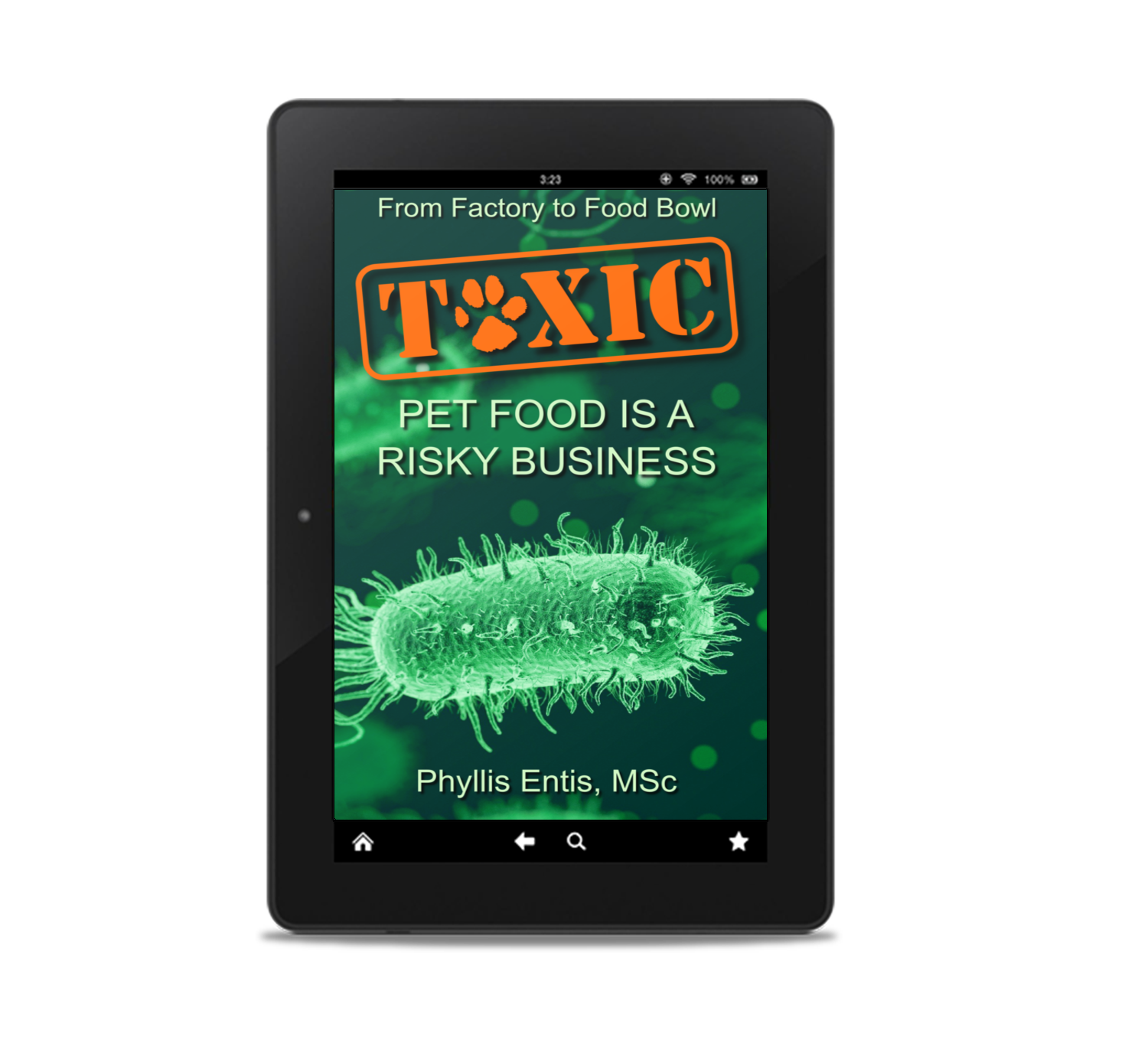
TOXIC
From Factory To Food Bowl
PET FOOD IS A RISKY BUSINESS
Learn more about the history behind the current Darwin’s issues, as well as the successes and failures of other pet food companies in the production of pathogen-free raw pet foods in TOXIC: From Factory To Food Bowl, Pet Food Is a Risky Business.
Available from all major on-line retailers, including:
“A complete and compelling account of the hidden and not-so-hidden ways the food we give our beloved pets can be contaminated.” – JoNel Aleccia, Health Reporter, Food & Nutrition, The Associated Press.




 eFoodAlert