Canal water likely source of E. coli in romaine-related outbreak

This article by Coral Beach first appeared in Food Safety News and is reposted here with permission.

Federal officials say contaminated canal water near romaine lettuce growing fields is the likely source of the unusually virulent strain of E. coli that has sickened people across 36 states, killing five.
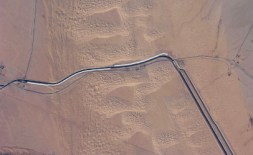
This NASA photo shows a canal snaking through the Arizona desert near Yuma, AZ. Such canals carry water to communities and farmers.

The outbreak is over, according to an update this afternoon from the Centers for Disease Control and Prevention. The agency has confirmed 210 people with infections. Twenty-seven of the victims have developed kidney failure. The most recent victim became sick on June 6.

“Samples have been collected from environmental sources in the region, including water, soil, and cow manure. Evaluation of these samples is ongoing,” according to an update this afternoon from the Food and Drug Administration investigators.

“To date, CDC analysis of samples taken from canal water in the region has identified the presence of E. coli O157: H7 with the same genetic fingerprint as the outbreak strain. We have identified additional strains of Shiga-toxin producing E. coli in water and soil samples, but at this time, the samples from the canal water are the only matches to the outbreak strain.”

Growers, researchers and produce trade associations have said in recent weeks that the Yuma area uses canal water from the Colorado River for irrigation and other agriculture uses. Some have theorized that a common water source is one of the most likely sources of the E. coli bacteria.

“CDC laboratory testing identified the outbreak strain of E. coli O157: H7 in canal water samples taken from the Yuma (AZ) growing region,” according to the CDC’s update this afternoon, which is the first since June 1.
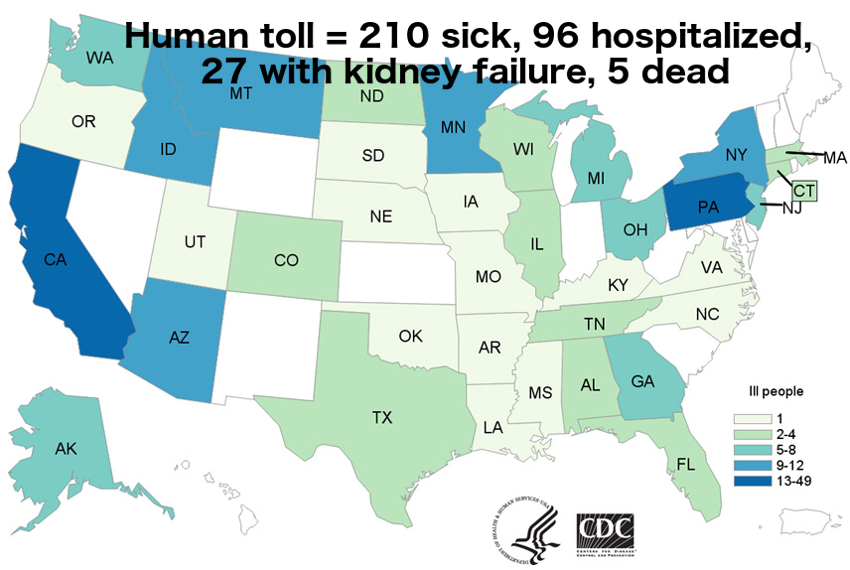
To view a larger version of this map, please click on the image

“The U.S. Food and Drug Administration is continuing to investigate the outbreak to learn more about how the E. coli bacteria could have entered the water and ways this water could have contaminated romaine lettuce.”

FDA last reported to the public on June 1 when traceback efforts were still stymied because of a tangle of hand-written, incomplete and incompatible shipping and receiving records through the supply chain from growers to retailers.

From the beginning of the outbreak, FDA and CDC have said the implicated romaine lettuce came from the Yuma growing region. Produce industry individuals and groups told the federal agencies the last romaine from that area was harvested April 16. People usually begin to show symptoms of infection in less than a week after exposure to E. coli bacteria.

The first confirmed illness in the outbreak began on March 13. The age range of victims is 1 to 86 years old.

“In interviews, ill people answered questions about the foods they ate and other exposures they had before they became ill. Of the 166 people interviewed, 145 (87 percent) reported eating romaine lettuce in the week before their illness started,” according to the CDC.


A Supplementary Note

In a related Food Safety News opinion piece, Coral Beach highlights the long delay between the determination of the geographic source of the E. coli O157:H7 outbreak and the sampling of canal water in the region.

In Chapter 8 of my book, Food Safety: Old Habits, New Perspectives, published in 2007 by ASM Press, I wrote:

Take a drive on the Interstate 5 through California’s San Joaquin Valley and you will pass fields of produce, open irrigation canals, and cattle feedlots. Irrigation is a way of life in this semi-arid agricultural area; rain is a rare visitor, except during the winter months. But when it rains, it pours. The soil becomes saturated, and excess water drains off the fields and feedlots. Some of the runoff finds its way into the irrigation canals, bringing with it pathogens such as E. coli O157:H7.

This observation is equally applicable to the agricultural region around Yuma, Arizona.

OUTBREAK ALERT: Salmonella illnesses trigger Kellogg cereal recall

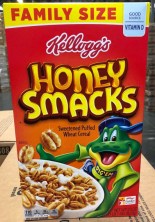
The Kellogg Company is recalling 15.3 oz. and 23 oz. packages of Kellogg’s® Honey Smacks® cereal after receiving word from FDA and CDC of reported Salmonella illnesses.

The recalled products include:
Kellogg’s® Honey Smacks®, 15.3 oz. Best if Used By dates from JUN 14, 2018 through JUN 14, 2019; UPC 3800039103.
Kellogg’s® Honey Smacks®, 23 oz. Best if Used by dates from JUN 14, 2018 through JUN 14, 2019; UPC 3800014810

Both product sizes were distributed across the USA. In addition the 15.3 oz size was distributed in Costa Rica, Guatemala, Mexico, the Caribbean, Guam, Tahiti and Saipan.

The recalled product was manufactured for Kellogg by a third party.

Neither FDA nor CDC have posted information yet on the number of Salmonella illnesses or their geographic distribution.

Although uncommon, Salmonella contamination of a breakfast cereal is not unprecedented. In 1998, an outbreak that encompassed at least 209 people in eleven US states was traced to Millville Toasted Oats breakfast cereal contaminated with Salmonella Agona. The Millville cereal was manufactured by Malt-o-Mill, Inc., a Minnesota company.

Kellogg is asking people who purchased potentially affected product to discard it and contact the company for a full refund. Consumers seeking more information, including images of these products, can visit kelloggs.com/honeysmacksrecall or call 1-800-962-1413 from Monday – Friday, from 9 a.m. to 6 p.m. ET as well as Saturday and Sunday from 10 a.m. – 4 p.m. ET.

Recalls and Alerts: June 5 – 9, 2018

Here is today’s list of food safety recalls, product withdrawals, allergy alerts and miscellaneous compliance issues. The live links will take you directly to the official recall notices and company news releases that contain detailed information for each recall and alert.

If you would like to receive automatic email alerts for all new articles posted on eFoodAlert, please submit your request using the sidebar link.

United States

Outbreak Alert: CDC advises that 124 individuals in 36 states have contracted a Salmonella infection as a result of contact with backyard poultry (primarily baby chicks and ducklings) since February. Twenty-one of the outbreak victims have been hospitalized. This represents the 71st outbreak linked to backyard poultry since 2000.

Outbreak Alert/Food Safety Recall: Caito Foods, LLC recalls fresh cut watermelon, honeydew melon, cantaloupe and fresh-cut mixed fruit containing one of these melons, produced at the Caito Foods facility in Indianapolis, because these products have the potential to be contaminated with Salmonella. CDC has received reports of 60 confirmed cases of Salmonella Adelaide infections from five midwestern states, with 31 of the victims requiring hospitalization. The recalled products were packaged in clear, plastic clamshell containers and distributed to Costco, Jay C, Kroger, Payless, Owen’s, Sprouts, Trader Joe’s, Walgreens, Walmart, and Whole Foods/Amazon.

Food Safety Recall: Tyson Foods Inc. recalls UNCOOKED, BREADED, ORIGINAL CHICKEN TENDERLOINS (12-lb. box containing 3-lb. plastic bags; Lot code 1378NLR02) due to possible foreign matter (blue and clear soft plastic) contamination. The recalled product was shipped to food services establishments, nationwide.

Food Safety Recall: Venda Ravioli, Inc. recalls approximately 672 pounds of frozen meat ravioli products that were produced without the benefit of federal inspection. Please refer to the recall notice for a complete list of affected products, which were shipped to retail locations in Massachusetts and Rhode Island.

Food Safety Recall: Supermercado Selectos recalls an undetermined amount of various raw, frozen Siluriformes fish, beef, pork and poultry products that were produced without the benefit of federal inspection. The items were shipped to DGA Food Service, LLC, who further distributed the items to Head Start Child and Adult Care Food Programs in Puerto Rico.

Canada

Food Safety Recall: Evergreen Herbs Ltd. recalls Evergreen Herbs brand Pea Shoots (100g; Purchased from May 22, 2018 up to and including June 7, 2018;  UPC 6 25280 50159 9) due to Listeria monocytogenes contamination. The recalled product was distributed to retailers in British Columbia and may have been distributed nationwide.

Food Safety Recall: Golden Pearl Mushrooms Ltd. recalls GPM brand Sweet Pea Shoots (230g; Lot code #11421; UPC 6 84469 00008 7), and GPM brand Pea Shoots (100g & 455g; Lot code #11421; UPC 6 84469 00012 4 & 6 84469 00018 6, respectively) due to Listeria monocytogenes contamination. The recalled product was distributed to retailers in Alberta and British Columbia.

Food Safety Recall: Pro-Amino International Inc. recalls various Iron Vegan Sprouted Protein Bars due to foreign matter (pieces of metal) contamination. Please refer to the recall notice for a complete list of affected products, which were distributed through retailers nationwide.

Europe

Allergy Alert (Finland): Gold&Green Foods Oy recalls Gold&Green MiniBurger Kit BBQ (184g; All batches up to and including 17.6.2018) due to undeclared mustard.

Allergy Alert (Germany): Aldi recalls D-ANTELLI Maispasta (500g; Spaghetti, Fusilli and Penne varieties) due to undeclared gluten.

Allergy Alert (Ireland): Lidl Ireland recalls Duc de Coeur Macarons (120g; All batch codes with no labeling in English) due to undeclared almond, wheat, milk, eggs, pistachio, barley, lupin, other nuts, peanuts and sesame.

Allergy Alert (UK): Lidl Ireland recalls Duc de Coeur Macarons (120g; All batch codes with no labeling in English) due to undeclared almond, wheat, milk, eggs, pistachio, barley, lupin, other nuts, peanuts and sesame.

Food Safety Recall (Belgium): Danival and BIOFRESH BELGIUM recall Danival bio Chili con carne (525g in glass jars; Lot #B334; Expiration date 30/11/2020) due to possible foreign matter (pieces of glass) contamination.

Food Safety Recall (France): Auchan recalls Anjouin and Mmm! Selles-sur-Cher raw milk cheese (150g; various lot numbers and expiration dates) due to Salmonella contamination. Please refer to the recall notice for a complete list of affected lot codes.

Food Safety Recall (Germany): Rossman recalls enerBiO almond flour (Best before 18.12.2018) due to Salmonella contamination.

Food Safety Recall (Ireland): Manufacturer recalls Fulfil White Chocolate & Cookie Dough Vitamin & Protein Bar (Lot code L8002/J; Best before 5 April 2019; Product of Netherlands) due to possible foreign matter (small pieces of clear plastic) contamination.

Asia, Africa and the Pacific Islands

Food Safety Alert (Hong Kong): The Centre for Food Safety advises consumers that a sample of Nestlé Hong Kong Limited’s Skimmed Hi-Calcium Milk Drink (236 mL; Use by June 2, 2018) was found to contain excessive Bacillus cereus. CFS is investigating.

Food Safety Recall (Singapore): Optimo Foods Pte Ltd recalls CeresOrganics Organic Breakfast Paleo Crumble – Cacao Spice (350g; Best before 05/01/2019; Product of New Zealand) due to foreign matter (small ceramic-like object) contamination.

Food Safety Recall (Singapore): Importer recalls Love Child Organics baby food pouches (128mL; various varieties; Best Before dates up to and including 25 May 2019; Product of Canada) due to a packaging defect that may permit entry of spoilage microorganisms. Please refer to the recall notice for a complete list of affected products.