Raw shell eggs from Gravel Ridge Farms (Cullman County, Alabama) are being blamed for 14 cases of Salmonella Enteritidis illnesses in Tennessee and Alabama according to reports from FDA and CDC.
Illnesses started on dates ranging from July 10, 2018 to August 7, 2018; two victims were hospitalized.
Thirteen of the 14 outbreak patients reported eating restaurant dishes made with eggs. FDA and state partners traced the source of the shell eggs supplied to these restaurants to Gravel Ridge Farms.
On September 8th, Gravel Ridge Farms recalled Gravel Ridge Farms Large Cage Free Eggs (Single Dozen and 2.5 Dozen Flats; Use by 7/25/18 through 10/3/18; UPC 7-06970-38444-6), and has ceased the production and distribution of the product while FDA and the company investigate the source of the contamination.
Recalled product was distributed between 6/25/2018 and 9/6/2018. These products were packaged in a cardboard container and sold primarily in restaurants and retail stores in AL, GA, and TN.
The following retail stores carried the recalled eggs:
Atlanta Candler Park Market
Grant Park Market
Westview Corner Market
Sevananda Natural Foods
The Merchantile
Birmingham Piggly Wiggly Clairemont Piggly Wiggly River Run Piggly Wiggly Crestline
Piggly Wiggly Bluff Park Piggly Wiggly Dunnavent Valley
Piggly Wiggly Warrior
Piggly Wiggly Homewood
Western Market Mt. Brook
Western Market Rocky Ridge
Foodland Eva
Warehouse Discount Grocery Hanceville
Warehouse Discount Grocery Cullman 2 locations
Foodland Priceville
Star Market Huntsville
Manna Grocery Tuscaloosa
Consumers who have purchased these products should return them to the store for refund or discard the product immediately. If any consumers have Gravel Ridge Farms eggs in their refrigerator, they should be discarded, regardless of the date stamped on the package. Consumers with questions may call Dustin Smith at 205-363-1105 M-F Between 8AM and 4PM Central Time.
This article by Coral Beach first appeared in Food Safety News and is reposted here with permission.
Federal officials say contaminated canal water near romaine lettuce growing fields is the likely source of the unusually virulent strain of E. coli that has sickened people across 36 states, killing five.
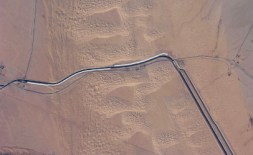
This NASA photo shows a canal snaking through the Arizona desert near Yuma, AZ. Such canals carry water to communities and farmers.
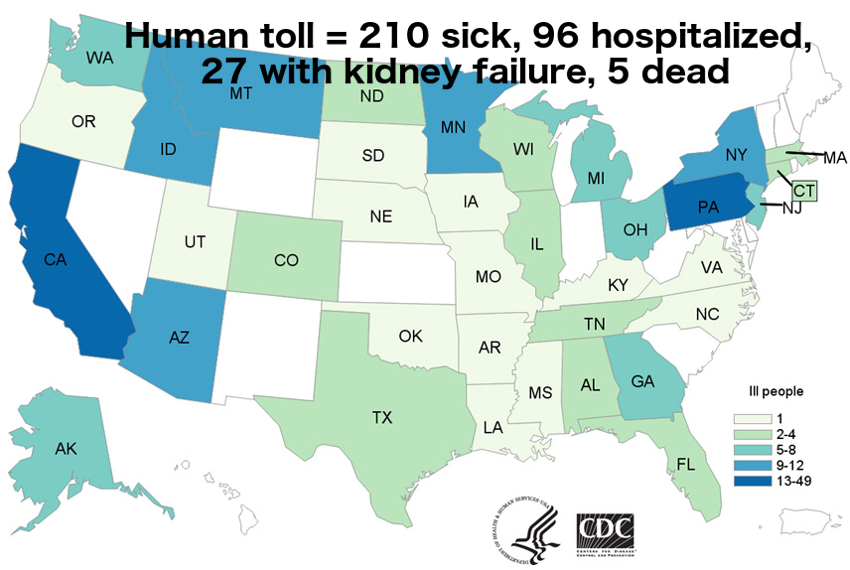
The outbreak is over, according to an update this afternoon from the Centers for Disease Control and Prevention. The agency has confirmed 210 people with infections. Twenty-seven of the victims have developed kidney failure. The most recent victim became sick on June 6.
“Samples have been collected from environmental sources in the region, including water, soil, and cow manure. Evaluation of these samples is ongoing,” according to an update this afternoon from the Food and Drug Administration investigators.
“To date, CDC analysis of samples taken from canal water in the region has identified the presence of E. coli O157: H7 with the same genetic fingerprint as the outbreak strain. We have identified additional strains of Shiga-toxin producing E. coli in water and soil samples, but at this time, the samples from the canal water are the only matches to the outbreak strain.”
Growers, researchers and produce trade associations have said in recent weeks that the Yuma area uses canal water from the Colorado River for irrigation and other agriculture uses. Some have theorized that a common water source is one of the most likely sources of the E. coli bacteria.
“CDC laboratory testing identified the outbreak strain of E. coli O157: H7 in canal water samples taken from the Yuma (AZ) growing region,” according to the CDC’s update this afternoon, which is the first since June 1.
To view a larger version of this map, please click on the image
“The U.S. Food and Drug Administration is continuing to investigate the outbreak to learn more about how the E. coli bacteria could have entered the water and ways this water could have contaminated romaine lettuce.”
FDA last reported to the public on June 1 when traceback efforts were still stymied because of a tangle of hand-written, incomplete and incompatible shipping and receiving records through the supply chain from growers to retailers.
From the beginning of the outbreak, FDA and CDC have said the implicated romaine lettuce came from the Yuma growing region. Produce industry individuals and groups told the federal agencies the last romaine from that area was harvested April 16. People usually begin to show symptoms of infection in less than a week after exposure to E. coli bacteria.
The first confirmed illness in the outbreak began on March 13. The age range of victims is 1 to 86 years old.
“In interviews, ill people answered questions about the foods they ate and other exposures they had before they became ill. Of the 166 people interviewed, 145 (87 percent) reported eating romaine lettuce in the week before their illness started,” according to the CDC.
A Supplementary Note
In a related Food Safety News opinion piece, Coral Beach highlights the long delay between the determination of the geographic source of the E. coli O157:H7 outbreak and the sampling of canal water in the region.
Take a drive on the Interstate 5 through California’s San Joaquin Valley and you will pass fields of produce, open irrigation canals, and cattle feedlots. Irrigation is a way of life in this semi-arid agricultural area; rain is a rare visitor, except during the winter months. But when it rains, it pours. The soil becomes saturated, and excess water drains off the fields and feedlots. Some of the runoff finds its way into the irrigation canals, bringing with it pathogens such as E. coli O157:H7.
This observation is equally applicable to the agricultural region around Yuma, Arizona.
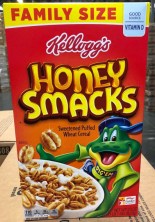
The Kellogg Company is recalling 15.3 oz. and 23 oz. packages of Kellogg’s® Honey Smacks® cereal after receiving word from FDA and CDC of reported Salmonella illnesses.
The recalled products include: Kellogg’s® Honey Smacks®, 15.3 oz. Best if Used By dates from JUN 14, 2018 through JUN 14, 2019; UPC 3800039103. Kellogg’s® Honey Smacks®, 23 oz. Best if Used by dates from JUN 14, 2018 through JUN 14, 2019; UPC 3800014810
Both product sizes were distributed across the USA. In addition the 15.3 oz size was distributed in Costa Rica, Guatemala, Mexico, the Caribbean, Guam, Tahiti and Saipan.
The recalled product was manufactured for Kellogg by a third party.
Neither FDA nor CDC have posted information yet on the number of Salmonella illnesses or their geographic distribution.
Although uncommon, Salmonella contamination of a breakfast cereal is not unprecedented. In 1998, an outbreak that encompassed at least 209 people in eleven US states was traced to Millville Toasted Oats breakfast cereal contaminated with Salmonella Agona. The Millville cereal was manufactured by Malt-o-Mill, Inc., a Minnesota company.
Kellogg is asking people who purchased potentially affected product to discard it and contact the company for a full refund. Consumers seeking more information, including images of these products, can visit kelloggs.com/honeysmacksrecall or call 1-800-962-1413 from Monday – Friday, from 9 a.m. to 6 p.m. ET as well as Saturday and Sunday from 10 a.m. – 4 p.m. ET.


 Raw shell eggs from Gravel Ridge Farms (Cullman County, Alabama) are being blamed for 14 cases of Salmonella Enteritidis illnesses in Tennessee and Alabama according to reports from FDA and CDC.
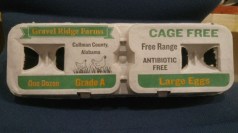 On September 8th, Gravel Ridge Farms recalled Gravel Ridge Farms Large Cage Free Eggs (Single Dozen and 2.5 Dozen Flats; Use by 7/25/18 through 10/3/18; UPC 7-06970-38444-6), and has ceased the production and distribution of the product while FDA and the company investigate the source of the contamination.

 The recalled products include:

