eFoodAlert posts links to recalls for English-language countries only. If you are interested in recall information for other countries (including EU-member countries), please click on the Recall Link menu, above.
The live links in this post will take you directly to the official recall notices and company news releases that contain detailed information for each recall and alert.
If you would like to receive automatic email alerts for all new articles posted on eFoodAlert, please submit your request using the sidebar link.
“Reads like a true crime novel” – Food Safety News
Interested in learning more about food safety and the history of foodborne disease outbreaks and investigations?
Click on the link to listen to a short excerpt, then follow the buy links to add a digital, print or audio copy to your personal library.
Food Safety Recall: Goot Essa LLC recalls Goot Essa brand Der Mutterschaf Cheese (4 oz and 8 oz; Batch #33) due to possible Listeria monocytogenes contamination.
Food Safety Recall: AquaStar (USA) Corp recalls AquaStar Raw Peeled Tail-on Shrimp Skewers (1.25 lbs; Lot codes 10662 5127 10 and 10662 5128 11; Best if used by 11 07 2027 & 11 08 2027, respectively; UPC 731149390010; Product of Indonesia) due to possible radionuclide (Cesium-137) contamination.
FDA Advisory (Pet Food): FDA cautions consumers not to feed Darwin’s Natural Pet Products BioLogics All-Natural & Grain-Free Beef Recipe for Dogs (2 lb pkgs; Lot 11895; MFG date Jul 29, 2025) and Darwin’s Natural Pet Products BioLogics All-Natural & Grain-Free Beef Recipe for Dogs (2 lb pkgs; Lot 11826; MFG date Jul 07, 2025) due to Listeria monocytogenes and Salmonella contamination. The FDA recommended that the manufacturer, Arrow Reliance, Inc., recall the two affected product lots. The firm reportedly sent a letter to customers notifying them about the two lots testing positive for L. monocytogenes, but the letter did not inform customers about the presence of Salmonella in one lot.
Canada
Allergy Alert: TT Supermarket (Brossard, QC) recalls multiple products due to undeclared allergens.
Allergy Alert: Beretta Farms recalls Beretta brand Chicken Pot Pie (908g; All packages; UPC 8 33307 00400 2) due to undeclared egg.
Food Safety Alert: MAPAQ advises the public not to consume Chocolat Dubaï / Dubai Chocolate prepared and sold by Sour Bites between 7 April 2025 and 5 September 2025 due to possible Salmonella contamination.
Food Safety Recall: Supermarché Danika (Montréal, QC) recalls Pistaches en vrac / Bulk pistachios (Sold between 7 May 2025 and 29 August 2025) due to possible Salmonella contamination.
Food Safety Recall (Ireland): Freshways recalls Café Sol Pesto Pasta & Chicken (224g; Use by 25/09/2025; Product of Ireland) due to Listeria monocytogenes contamination.
Hong Kong and Singapore
No Alerts
Australia and New Zealand
No Alerts
Advertisements
“A complete and compelling account of the hidden and not-so-hidden ways the food we give our beloved pets can be contaminated.” – JoNel Aleccia, Health Reporter, Food & Nutrition, The Associated Press.
“An invaluable resource for busy pet owners” – Food Safety News
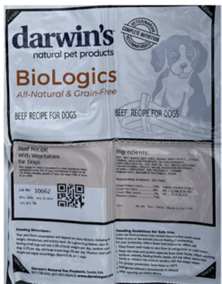
The US Food and Drug Administration (FDA) is advising the public not to feed certain lots of Darwin’s Natural Pet Products raw food to their pets after a four-year-old child became ill with E. coli O157:H7.
The contamination came to light after food-safety attorney, William Marler, initiated third-party testing of an previously unopened package of BioLogics All-Natural and Grain Free, Beef Recipe for Dogs found E. coli O157:H7 in the raw, frozen product. Whole genome sequencing (WGS) confirmed that the strain found in the pet food was a match for the strain recovered from the child.
In addition to the E. coli O157:H7-positive sample, the third-party lab recovered Salmonella Infantis and Salmonella Hadar from previously sealed packages of Darwin’s chicken dog food and duck dog food, respectively.
The FDA recommended that Arrow Reliance, Inc. (the manufacturer of Darwin’s Natural Pet Products) recall the product lots that tested positive for E. coli O157:H7 and Salmonella; however, the company has not recalled the affected products.
The products in question were manufactured in May or June 2024, were sold frozen, have no expiration date on the label, and could still be in consumers’ freezers. The FDA urges consumers who purchase Darwin’s products to check their freezers for the following three items:
Darwin’s Natural Pet Products, BioLogics All-Natural and Grain Free, Beef Recipe for Dogs:- Lot 10662, MFG Date of May 30, 2024
Darwin’s Natural Pet Products, BioLogics All-Natural and Grain Free, Chicken Recipe for Dogs:- Lot 10683, MFG date of June 05, 2024
Darwin’s Natural Pet Products, Natural Selections Duck Recipe for Dogs:- Lot 10638, MFG date of May 22, 2024
The affected lots of pet food were sold in frozen 2-pound white and clear plastic packages with four separate units. The beef and chicken BioLogics dog food have orange labeling, and the duck Natural Selections dog food has blue labeling. If you have any of these products, please throw them away in a secure container. DO NOT FEED THEM TO YOUR PETS.
Anatomy of an illness investigation
In August 2024, a four-year-old boy living in Utah became ill and was diagnosed with E. coli O157:H7.
The child was hospitalized, and developed a severe case of hemolytic uremic syndrome (HUS), requiring dialysis. He spent a total of six weeks in hospital and is at risk of permanent injury to his kidneys.
As a matter of routine, the strain of E. coli O157:H7 that was recovered from the boy was genetically typed using WGS and, in September 2024, the genetic profile was uploaded to the CDC’s National Center for Biotechnology Information (NCBI) database.
Investigations carried out by the health authorities in Utah were unable to find any other related cases or to determine a possible source for the infection. It appeared to be an isolated incident.
In October 2024, the family contacted food-safety attorney, William Marler.
According to information provided to eFoodAlert by Marler, initial reviews of the files did not reveal any clues about the source of the infection. However, when Marler reviewed the files once more, he noted that the family had a dog, and asked about the dog’s health and diet. He learned that the dog exclusively ate Darwin’s pet food, and had begun vomiting one day before the child fell ill. The dog subsequently died in a car accident, so could not be tested, but the family had not discarded the remaining frozen, raw dog food.
Marler arranged for an accredited third-party laboratory to test the sealed packages of food that were still in the family’s freezer. On June 19, 2025, the lab reported that they had found E. coli O157:H7 in a sample of the Darwin’s beef dog food and that the strain was a perfect match to the strain recovered from the Utah boy.
Marler notified the FDA, the Utah health department, the Washington Department of Agriculture (Darwin’s manufacturer is located in Tukwila, WA) and Arrow Reliance, Inc. (the manufacturer) of the lab’s findings.
The FDA sent an investigator to Utah to interview the family, and also tried to locate additional samples of the affected products for testing. Unfortunately, by the time the FDA became involved, there were no retail samples available for testing, nor did the company have any samples from the specified production lots available to test.
And, as has occurred of several prior occasions, Arrow Reliance has not complied with the FDA’s request for a voluntary recall.
What consumers need to know
If you have any of the lots of Darwin’s BioLogics or Natural Selections pet food products listed above, stop feeding the product to your pets and throw it away in a secure container where other animals, including wildlife, cannot access it. Do not donate the food.
The product lot codes are printed on the front of the lower left unit of the package of food. If you no longer have the package or can’t read the lot code, throw the food away.
Consumers who have had the products listed above in their homes should clean and disinfect all pet supplies, including all storage containers, bowls, utensils, food prep surfaces, pet bedding, toys, floors, and any other surfaces that the food or pet may have had contact with, including your refrigerator or freezer. Clean up the pet’s feces in yards, parks, or other places where people or other animals may become exposed. Consumers should thoroughly wash their hands after handling the product or cleaning up potentially contaminated items and surfaces.
Salmonella, E. coli O157:H7 and your pet
Dogs and cats can become infected with STEC, although the symptoms are generally milder than symptoms in people. Dogs and cats infected with STEC can develop watery diarrhea, bloody diarrhea, urinary tract infections, and vomiting. Symptoms may be more severe in pets with weakened immune systems. The infection is rarely lethal in pets, but deaths have been reported in infected dogs. If your pet has symptoms of a STEC infection, consult a veterinarian promptly.
Pets do not need to display symptoms to be able to pass STEC on to their human companions. Whether or not a pet is symptomatic, once STEC gets established in the pet’s gastrointestinal tract, the animal can shed the bacteria when having bowel movements, contaminating their environment.
Pets do not always display symptoms when infected with Salmonella, but signs can include vomiting, diarrhea (which may be bloody), fever, loss of appetite and/or decreased activity level. If your pet has these symptoms, consult a veterinarian promptly. You should also be aware that infected pets can shed the bacteria in their feces without showing signs of being sick.
How to report a pet illness?
People who think their pets have become ill after consuming contaminated pet food should first contact their veterinarians.
“A complete and compelling account of the hidden and not-so-hidden ways the food we give our beloved pets can be contaminated.” – JoNel Aleccia, Health Reporter, Food & Nutrition, The Associated Press.
“An invaluable resource for busy pet owners” – Food Safety News
Observations recorded by FDA investigators during an August 26—September 18, 2024, inspection of the Arrow Reliance Inc. (Darwin’s Natural Pet Products) pet food production facility in Tukwila, Washington reveal that the company has failed to correct siginificant food-safety violations, some of which date back to 2018.
This information was obtained by eFoodAlert in response to a Freedom of Information Act request.
The repeat offenses
Darwin’s has not identified and implemented adequate controls to ensure that any hazards requiring a preventive control are significantly minimized or prevented (repeat observation from inspection conducted in 2023)
Lack of documentation to support use of peroxyacetic acid to control Listeria effectively
Employees not following the company’s written procedures for conducting swabbing to verify effectiveness of cleaning and sanitizing in production room
Operations not conducted in accordance with current good manufacturing practices; adequate precautions not taken to prevent contamination of food or to conduct manufacturing under conditions to protect against contamination (repeat observation from inspection conducted in 2018)
FDA investigators cited multiple examples, including:
The peroxyacetic acid additive used by Darwin’s to control pathogens in its raw, ready-to-eat pet foods is not been used in a manner consistent with the ingredient labeling and is not generally recognized as safe for use in animal food
During a sanitation shift, aerosolized waster was being blown throughout the room and onto exposed ready-to-eat product on the uncovered packaging line and in an open hopper
Aerosolized water from a sink hose was blowing throughout the room where exposed product was being prepared for rework
An employee was handling multiple items, including soiled paper towel, filler hose, and finished product without changing gloves or cleaning them in a hand dip
Water from a hose was spraying onto boxed ingredients staged for production
The company had not maintained food contact surfaces to protect food from being contaminated (repeat observation from inspection conducted in 2018)
FDA investigators observed the following:
White plastic cutting board portion of meat prep table contained deep cut marks that appeared to remain discolored even after cleaning and sanitation
A grinder used to grind raw meat and poultry ingredients appeared damage, with numerous gouges and scratches throughout
A blade housing with visible apparent rust
Several parts stored on shelving units appeared pitted, damaged or rusty even after cleaning and sanitizing. These parts were considered by the company to be clean and ready for use
Additional observations
Maintenance issues
The floor through the production room appeared damaged and pitted. There was an accumulation of water, blood, and raw ingredients across the floor during production.
There was damage around the entire base of a pillar near the meat prep table, with accumulation of water, blood, and raw ingredients in the crevaces. Thawed, boxed raw proteins for processing are staged against this pillar.
Design deficiencies
Plant was not constructed or designed to facilitate cleaning, maintenace and pest control
Visible condensation and apparent dust build-up on the production room ceiling, including over the uncovered packaging line
Drops of condensate observed falling from the ceiling into clean/sanitized vemag carts (wheeled bins used to move bulk product and ingredients from place to place in the plant)
HACCP plan deficiencies
Company did not identify drug residues associated with incoming raw meat and poultry as a known or reasonably foreseeable hazard
Company did not identify specific vitamin/mineral toxicities and deficiences of concern for dogs and cats as a known or reasonably foreseeable hazard for those pet foods manufactured and labeld as “complete diets”
Pathogens
Finished product testing
On August 27, 2024, the FDA sampled six finished products for pathogen testing. The samples were collected from Darwin’s third-party cold storage facility. Salmonella was recovered from all six products. In addition, Listeria monocytogenes was found in one of the products. A second species of Listeria (L. innocua) was found in one product.
Natural Selections Antibiotic & Grain-free CHICKEN RECIPE FOR CATS, Lot No. 10832:-Salmonella detected
Natural Selections Antibiotic & Grain-free CHICKEN RECIPE FOR CATS, Lot No. 10856:-Salmonella detected
Natural Selections Antibiotic & Grain-free CHICKEN RECIPE FOR CATS, Lot No. 10890:-Salmonella detected
Natural Selections Antibiotic & Grain-free CHICKEN RECIPE FOR DOGS, Lot No. 10828:-Salmonella and Listeria monocytogenes detected
Natural Selections Antibiotic & Grain-free CHICKEN RECIPE FOR DOGS, Lot No. 10844:-Salmonella detected
Natural Selections Antibiotic & Grain-free CHICKEN RECIPE FOR DOGS, Lot No. 10887:-Salmonella and Listeria innocua detected
Environmental testing
FDA collected 63 environmental swab samples during the course of the inspection and submitted these for Listeria monocytogenes analysis. No Listera were found in any of the 63 environmental samples.
FDA collected 101 environmental swab samples during the course of the inspection and submitted these for Salmonella analysis. Salmonella Typhimurium was found in one of the swab samples.
What next for Arrow Reliance/Darwin’s?
The FDA has classified the results of this inspection as “Official Action Indicated.” This can mean anything from a Warning Letter up to and including legal action to halt the company’s operations until it complies with FDA regulations.
On two past occasions—in April 2018 and February 2023—the FDA has issued Warning Letters citing a long list of violations. These have been totally ineffective.
Pet families can only hope that the FDA will take a firmer hand this time around.
“A complete and compelling account of the hidden and not-so-hidden ways the food we give our beloved pets can be contaminated.” – JoNel Aleccia, Health Reporter, Food & Nutrition, The Associated Press.
“An invaluable resource for busy pet owners” – Food Safety News
Available from all major on-line retailers, including:





 eFoodAlert