

BREAKING NEWS: Salmonella outbreak triggers massive egg recall

A seven-state outbreak of Salmonella Enteritidis illnesses has been traced to eggs supplied by August Egg Company of Hilmar, California, according to information from the CDC and the FDA.

As of today, the CDC has received reports of 79 confirmed outbreak cases, including 21 hospitalizations. Cases have been reported from Arizona (3), California (63), Kentucky (1), Nebraska (2), New Jersey (2), Nevada (4), and Washington (4).

The first case was identified on February 24, 2025. Victims range in age from 1 year to 90 years, with a median age of 48 years.

Of 30 people interviewed, 27 (90%) reported eating eggs. Six of the victims from Kentucky, New Jersey, and Washington reported having traveled to California or Nevada in the week before they became ill.

The FDA has conducted an inspection of August Egg Company’s processing facility and has recovered Salmonella that is closely related to the outbreak strain from environmental samples collected during the inspection.

August Egg Company has announced a recall of 1,700,000 dozen brown cage free eggs and brown certified organic eggs, sold under the brand names, Clover, First Street, Nulaid, O Organics, Marketside, Raleys, Simple Truth, Sun Harvest, and Sunnyside.

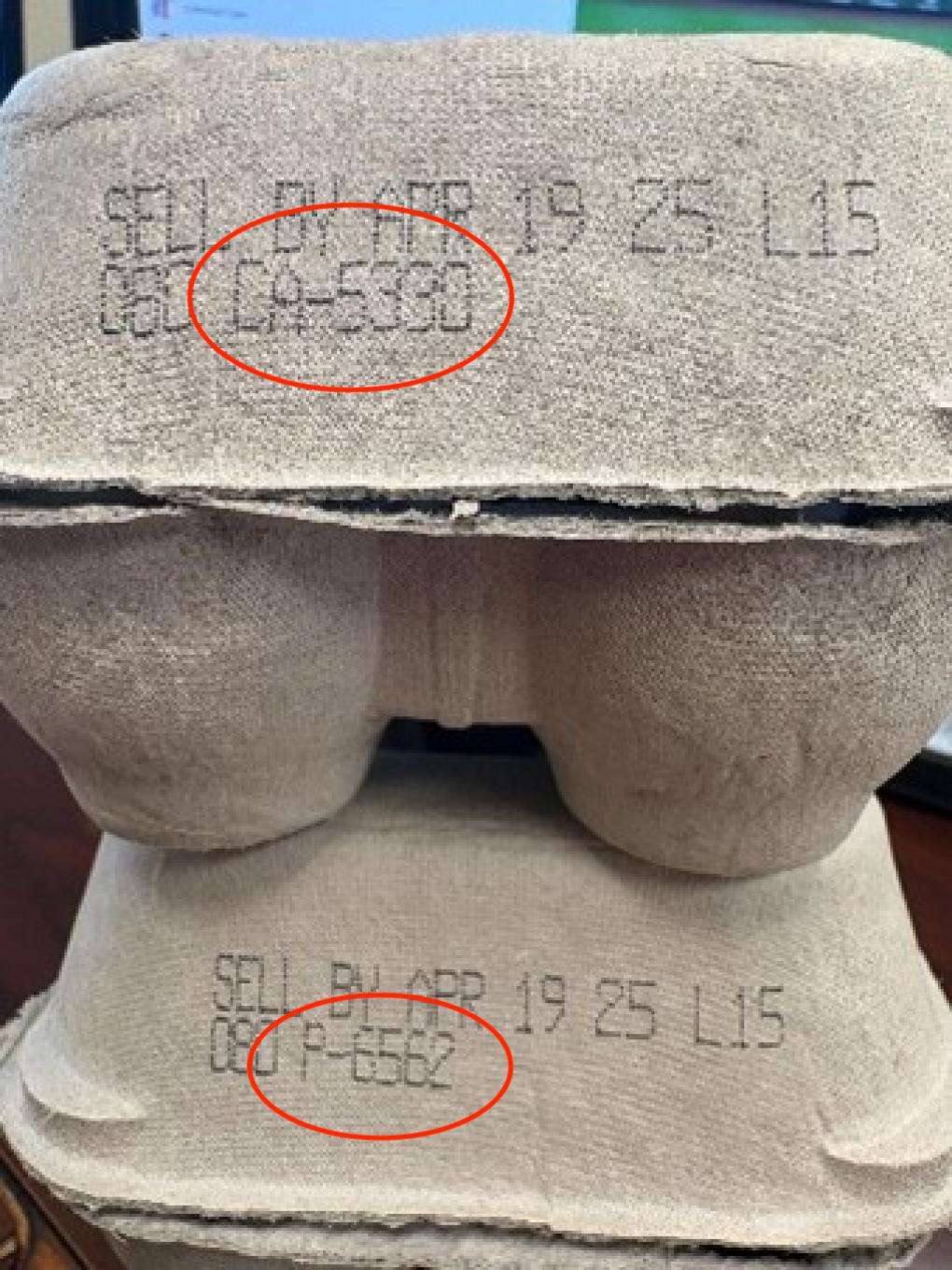
The recalled eggs will have printed on the carton or package a plant code number P-6562 or CA5330 with the Julian Dates between 32 to 126. The recalled retail eggs will be in fiber or plastic cartons, with the above codes printed on one side of the carton. The eggs were packed in cartons of 12 or 18, or supplied in flats.

The eggs were distributed from February 3, 2025, through May 15, 2025, with sell by dates from March 4, 2025, to June 4, 2025, within California and Nevada and were sold at retail locations including Save Mart, FoodMaxx, Lucky, Smart & Final, Safeway, Raleys, Food 4 Less and Ralphs.

The eggs were also distributed from February 3, 2025, through May 6, 2025, with sell by dates from March 4, 2025, to June 19, 2025, to Walmart locations in California, Washington, Nevada, Arizona, Wyoming, New Mexico, Nebraska, Indiana and Illinois.

Please refer to the recall notice for a detailed list of affected eggs.

According to information contained in the company’s recall notice, the company has been voluntarily diverting its eggs to an egg-breaking plant for pasteurization for more than a month. The company gave no explanation as to why it delayed recalling its eggs from the marketplace until today.

  • Consumers, restaurants, and retailers should not eat, sell, or serve recalled brown cage free and brown certified organic eggs from August Egg Company.
  • Consumers, restaurants, and retailers who purchased or received the recalled eggs, including wholesale eggs, should carefully clean and sanitize any surfaces or containers that they touched.
  • Check your refrigerators for the recalled brown cage free and brown certified organic eggs and throw them away or return them to the place of purchase. If you stored the eggs without the original packaging and can’t tell if it is part of this outbreak, throw them away.
  • Wash hands, utensils, and surfaces with hot, soapy water before and after handling raw eggs and raw egg-containing foods. Follow FDA’s safe handling and cleaning advice and use extra care in cleaning and sanitizing any surfaces and containers that may have come in contact with this product to reduce the risk of cross-contamination.
  • Contact your healthcare provider if you think you may have developed symptoms of a Salmonella infection, after eating eggs.

TAINTED formats 3
“Reads like a true crime novel” – Food Safety News

Interested in learning more about food safety and the history of foodborne disease outbreaks and investigations?

Click on the link to listen to a short excerpt, then follow the buy links to add a digital, print or audio copy to your personal library.

Chapter 6. Birth of a Pathogen

Botulism risk triggers canned tuna recall

Tri-Union Seafoods is recalling certain lots of Genova®, Van Camp’s®, H-E-B, and Trader Joe’s canned tuna, due to a manufacturing defect in the “easy open” pull tabs.

The defect may compromise the integrity of the can, leading to possible leakage and spoilage.

The manufacturer warns that the defect could even lead to the contents becoming contaminated with Clostridium botulinum.

Consumers who have purchased any of the following products should either discard them or return them to the store for a refund. Please refer to the recall notice for a list of affected Can codes and Best If Used By dates for each product.

The following products were sold at Harris Teeter, Publix, H-E-B, Kroger, Safeway, Walmart, and independent retailers in Alabama, Arkansas, Arizona, California, Florida, Georgia, North Carolina, New Jersey, Tennessee, and Texas.

  • Genova Solid White Tuna in Olive Oil (5.0 oz; UPC 4800000215)
  • Genova Yellowfin Tuna in Olive Oil (5.0 oz; UPC 4800013265)
  • Genova Yellowfin Tuna in Olive Oil (5.0 oz 4 Pack; UPC 4800073265)
  • Genova Yellowfin Tuna in in Extra Virgin Olive Oil with Sea Salt (5.0 oz; UPC 4800013275)

The following product was sold at Costco in Florida and Georgia.

  • Genova Yellowfin Tuna in Olive Oil (7.0 oz 6 Pack; UPC 4800063267)

The following products were sold at Walmart and independent retailers in Pennsylvania, Florida and New Jersey.

  • Van Camp’s Solid Light Tuna in Oil (5.0 oz; UPC 4800025015)
  • Van Camp’s Solid Light Tuna in Oil (5 oz 4 Pack; UPC 4800075015)

The following products were sold at Trader Joe’s in Delaware, Illinois, Indiana, Iowa, Kansas, Kentucky, Maryland, Michigan, Minnesota, Missouri, Nebraska, New Jersey, New York, North Carolina, Ohio, Pennsylvania, Virginia, Washington D.C., and Wisconsin.

  • Trader Joe’s Solid Light Yellowfin Tuna in Olive Oil (Item #51403)
  • Trader Joe’s Solid White Tuna in Olive Oil (Item #99287)
  • Trader Joe’s Solid White Tuna in Water (Item #99285)
  • Trader Joe’s Solid White Water Low Sodium (Item #95836)
  • Trader Joe’s Solid White Water No Salt Added (Item #99284)

The following product was sold at H-E-B stores in Texas.

  • H-E-B Solid White Tuna in Water (5.0 oz 4 Pack; UPC 4122043345)

Consumers are warned not to use the product even if it does not look or smell spoiled.  Consumers feeling unwell should seek immediate medical attention.  No illnesses associated with the recalled products have been reported and the recall is being conducted to ensure consumer safety.

Consumers can contact Tri-Union Seafoods at support@thaiunionhelp.zendesk.com or 833-374-0171, if they have any questions or to request replacement product. The toll-free number hours are Monday through Friday from 9:00 a.m. to 5:00 p.m. EST.


“Reads like a true crime novel” – Food Safety News

Interested in learning more about food safety and the history of foodborne disease outbreaks and investigations?

Click on the link to listen to a short excerpt, then follow the buy links to add a digital, print or audio copy to your personal library.
Chapter 6. Birth of a Pathogen

TAINTED is available in digital format from all major on-line retailers. Press the button to go directly to your preferred digital bookstore.

Blue Ridge Beef—Repeat offender

Eight recalls in eight years. Two failed inspections—one in 2019, the other in 2021. One Warning Letter, Dated June 26, 2020.

Something is very wrong at Lea-Way Farms, Inc. (dba Blue Ridge Beef).

Yesterday (January 31, 2025), Blue Ridge Beef recalled 5,700 lbs of its Natural Mix for Dogs (2-lb logs; Lot #N25/12/31; UPC 854298001054) after the North Carolina Department of Agriculture’s Food and Drug Protection Laboratory found Salmonella in a sample of the product.

The recalled raw dog food was distributed between January 3/2025 to January 24/2025 and sold primarily in retail stores in Virginia, Maryland, Pennsylvania, Connecticut, Massachusetts, New York State, Tennessee, and Rhode Island.

Although no illnesses were reported in connection with this recall, the same cannot be said for two prior recalls.

  • On December 6, 2024, the FDA received a complaint about two cats that had developed gastrointestinal symptoms after being fed Blue Ridge Beef – Kitten Mix (two different lot numbers). The cats survived. The company recalled a single production lot of the Kitten Mix after the Massachusetts Department of Agriculture Resources reported the presence of Salmonella in a sample of the food.
  • On November 24, 2024, the FDA received a complaint about a litter of puppies that had fallen ill after being fed Blue Ridge Beef Puppy Mix. Fecal samples from the puppies tested positive for Salmonella. The puppies appeared to have recovered after two weeks of treatment with antibiotics. One puppy died suddenly after recovering from the initial illness. A necropsy revealed evidence of sepsis (generalized infection) and stomach ulcer consistent with a bacterial infection. Blue Ridge Beef recalled 9,600 lbs of the Puppy Mix after testing by the Virginia Department of Agriculture and Consumer Services confirmed the presence of Salmonella in a sample of the product.

According to the FDA Inspections Dashboard, Lea-Way Farms has been inspected three times—in 2016 (Voluntary Action Indicated), 2019 (Official Action Indicated), and 2021 (Official Action Indicated).

The Official Action taken following the 2019 inspection culminated in a Warning Letter issued on June 26, 2020, and addressed to Steven J. Lee, CEO/Owner of the company. In this letter, the FDA cited multiple, serious violations of Current Good Manufacturing Practice (cGMP). The agency also noted that Lea-Way had failed to renew its food facility registration, as required by law.

Some of the cGMP violations included:

  • Raw materials were not examined to ensure their suitability for manufacturing and processing, and were not handled under conditions that would protect the food from contamination. Specifically, the company used tissues from animals that died otherwise than by slaughter without determining whether the animals had been sick, or injured, or medicated prior to death.
  • Concrete floors of the kill floor (used for skinning and evisceration of whole animals), the cooler room, and the grinder/mixer room were rough and pitted, and there were standing pools of water.
  • Thawing beef parts were allowed to come into contact with the concrete floors.
  • Carcasses were dragged on the concrete floors, dropped from the railing system onto the floors, and trimmed from the floors.
  • Stomach contents and fecal matter were observed to have spilled over onto exposed carcasses, which were then transferred into the cooler area without being rinsed clean.

One year later, not much had changed. A July/August 2021 inspection revealed multiple violations, some of which were repeat observations from 2019.

  • Although the company’s Food Safety Plan specified daily sampling of product for pathogen testing, no samples had been collected or analyzed since the April 2019 inspection.
  • The company used pathogen reduction steps that had not been validated for their ability to reduce the level or presence of pathogens in the finished product.
  • The company still used tissues from animals that had died other than by slaughter without determining whether they had been sick, diseased, injured, or medicated prior to death.
  • The company was unable to provide monitoring records associated with metal detection, sanitation, pest control, environmental monitoring, water testing, and employee training.
  • The concrete floors had not been repaired.
  • Environmental testing had not been conducted since April 2019, and the test kits on had had expired on 22 Feb 2018.
  • Salmonella London, Salmonella Montevideo, and Listeria monocytogenes were recovered from finished product samples collected during the course of the inspection.

The company responded in writing to the observations from the 2021 inspection with a list of promised corrections, including:

  • A hazard analysis had been generated and supplied to the FDA.
  • Random product samples would be tested using test swabs and, if positive, would be sent to a third party lab for analysis.
  • Documentation of pathogen reduction effectiveness would be made available during subsequent inspections.
  • The cattle in question were shot on the farm and the carcasses transported to the manufacturing facility. The farm advised the company that the cattle had not received any medication.
  • Monitoring records are now updated daily and have been made available to FDA.
  • Employee training has been updated and all employees have been retrained in proper procedures.
  • New test swabs for environmental testing were ordered and periodic testing will resume.
  • The company is seeking a contractor who can perform a resurfacing of the concrete floor that can withstand cleaning and sanitation and be affordable.

We don’t know.

There has been no Warning Letter issued as a follow-up to the 2021 inspection.

The FDA did not release their reply to the company’s corrective measures as part of the agency’s response to eFoodAlert‘s Freedom of Information Act requests.

As best we can tell from the FDA Inspection Database, there has been no further follow-up inspection since 2021.

An email to FDA’s Center for Veterinary Medicine spokespersons regarding the most recent recall notice has gone unanswered so far.

The FDA’s silence and apparent inaction could mean one of two things: either the agency does not have the resources to conduct a proper follow-up investigation at Blue Ridge Beef, or the FDA is quietly preparing legal action against the company.

Only time will tell.

Meanwhile, consumers who choose to feed their dogs and cats commercial raw pet foods should consider switching to a brand with a better track record for food safety.


“A complete and compelling account of the hidden and not-so-hidden ways the food we give our beloved pets can be contaminated.” – JoNel Aleccia, Health Reporter, Food & Nutrition, The Associated Press.

“An invaluable resource for busy pet owners” – Food Safety News

Available from all major on-line retailers, including: