
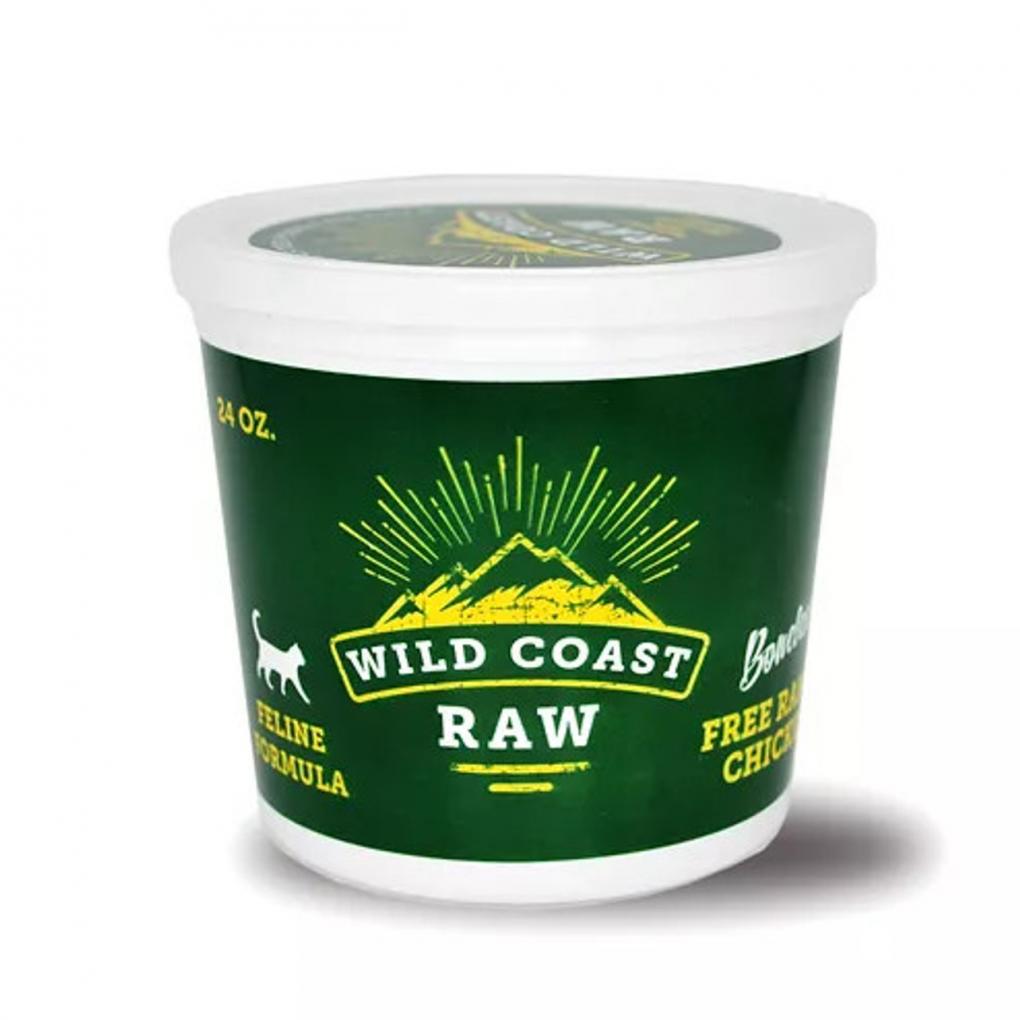
Wild Coast raw cat food recalled

March 2, 2025

Wild Coast LLC (dba Wild Coast Raw) has recalled six lot codes of raw cat food that may be linked to four cases of bird flu in domestic cats in Oregon and Washington states.

The recall encompasses 16oz and 24oz containers of the following lot codes of frozen Boneless Free Range Chicken Formula raw pet food for cats, all bearing a Best Buy date of 12/25:

  • #22660
  • #22653
  • #22641
  • #22639
  • #22672
  • #22664.

The recalled products were distributed only in Oregon and Washington states.

The recalled lots have to potential to be contaminated with Highly Pathogenic Avian Influenza (HPAI) H5N1 virus, also known as bird flu.

The public first was alerted to this problem in mid-February, when the Oregon Department of Agriculture (ODA) reported two cases of bird flu in domestic cats from two separate households.

Both cats had been fed the recalled product. The ODA found the same strain of H5N1 in the affected cats and in the Wild Coast Raw pet food they had eaten.

The Washington State Department of Agriculture (WSDA) opened an investigation of the company in response to the ODA findings and also put a “stop sale” order on lot codes #22660 and #22664. The “stop sale” order was valid only with in the borders of Washington state.

More recently, the WSDA learned of two domestic cats in Washington who also became infected with bird flu after being fed Wild Coast Raw pet food. The cats were members of two different households.

Three of the four infected cats in Washington and Oregon were euthanized due to the severity of their illnesses. The fourth cat is being treated by a veterinarian.

Yesterday’s recall notice expands the scope of the implicated products to include any raw material sharing similar production dates and lot codes to the two lot codes covered by the initial “stop sale” order.

Do not sell or donate the recalled products. Do not feed the recalled product to pets or any other animals. Consumers who have purchased this product are urged to immediately and securely discard to prevent animals and wildlife from consuming the recalled product. Contact your place of purchase for a full refund. For more information contact Wild Coast Raw at info@wildcoastraw.com or (360) 591-3543 between 8am – 4 pm PST.


“A complete and compelling account of the hidden and not-so-hidden ways the food we give our beloved pets can be contaminated.” JoNel Aleccia, Health Reporter, Food & Nutrition, The Associated Press.

“An invaluable resource for busy pet owners” – Food Safety News

Available from all major on-line retailers, including:

Two more domestic cats infected with bird flu

February 27, 2025

Two domestic cats in the state of Washington have been infected with the highly pathogenic avian influenza (HPAI) virus according to a new release from the Washington State Department of Agriculture (WSDA) dated February 26, 2025.

The infections were confirmed in testing conducted by the National Veterinary Services Laboratory.

One of the cats was euthanized and the second is being treated by a veterinarian.

The two cats belonged to separate households in King and Snohomish counties.

Both infected cats were fed potentially contaminated Wild Coast Raw pet food. Two batches of Wild Coast LLC – Boneless Free Range Chicken Formula are the subject of a “stop sale” order in the state of Washington.

These new illnesses are in addition to the two illnesses reported by the Oregon Department of Agriculture (ODA) earlier this month.

On February 14, 2025, the ODA advised pet owners that two cats residing in separate households in Multnomah County had become infected with HPAI. Both cats were fed Wild Coast raw pet food.

Both cats were euthanized due to the severity of their illnesses.

All four cats were exposed to one or both of the same two lot numbers of the raw pet food, according to a spokesperson for the WSDA.

The WSDA began investigating Wild Coast’s manufacturing facility and operations on February 7th, the day that the first Oregon cat was confirmed to have been infected with HPAI. That investigation is ongoing and is still open.

While the HPAI infections have been confirmed in all four cats, the WSDA is still awaiting confirmation of the “non-negative” (positive PCR result) for the presence of live virus particles in samples of the two implicated lots.

When eFoodAlert asked what measures Washington state has put in place to reduce the risk to consumers and pet owners, we were told the following:

WSDA has been a leader in the country by conducting surveillance sampling for HPAI on non-heat treated meat or dairy based animal food. All our routine surveillance samples have been negative, including some of Wild Coast Raw’s earlier lots. Also conducting messaging to our stakeholders and to the general public about the risks, including the HPAI in cats graphic (attached) and blog. Implementing FDA’s recent requirement for pet food manufacturers to reanalyze their food safety plans to consider HPAI a known or reasonably foreseeable hazard and to identify how they will be addressing that hazard. Working with applicable partners to continue further investigation that are outside of our jurisdiction.


“A complete and compelling account of the hidden and not-so-hidden ways the food we give our beloved pets can be contaminated.” JoNel Aleccia, Health Reporter, Food & Nutrition, The Associated Press.

“An invaluable resource for busy pet owners” – Food Safety News

Available from all major on-line retailers, including:

Bird flu virus in raw pet food. A growing concern

Add a third pet food company to the growing list of manufacturers whose raw cat food is suspected of having infected one or more cats with the highly pathogenic influenza virus, usually referred to as HPAI or H5N1.

On February 17, 2025, Savage Pet Inc., a California-based company, notified its customers that Colorado State University Laboratory has tested sealed packets of Savage Cat Food, and had found evidence of HPAI in one of the three lot codes tested. The state lab reported the result as “non-negative.”

The state’s action was triggered by a complaint from a pet owner, whose cat contracted HPAI and recovered.

Lot #11152026 (chicken packets) was reported by Colorado as “non-negative” and the sample was sent to the USDA’s National Veterinary Services Laboratory (NVSL) for further analysis, including testing for live H5N1 virus.

Just three days earlier, the Washington State Department of Agriculture (WADoA), in conjunction with the Oregon Department of Agriculture (ODA), alerted pet owners that several cats had contracted H5N1 infections in early February. Due to the severity of the illnesses, the owners of the cats opted to euthanize the animals.

The ODA collected samples from the cats before and after euthanization and recovered H5N1 virus from the animals, all of which were fed Wild Coast Raw pet food before becoming ill.

The Oregon Veterinary Diagnostic Laboratory and the NVSL confirmed the presence of H5N1 in the animals and in opened packages of the cat food.

Subsequent testing by the WADoA detected evidence of HPAI in sealed packages of one lot of Wild Coast pet food. Samples from this lot, reported by the state as “non-negative,” have been submitted to the NVSL for more detailed analysis.

A “stop sale” order has been issued in the state of Washington for two lots of Wild Coast LLC – Boneless Free Range Chicken Formula (Lots #22660 and #22664; Best by date of 12/2025).

On December 24, 2024, Northwest Naturals recalled one production lot of its Feline Turkey Recipe raw frozen pet food after the Oregon Department of Agriculture detected highly pathogenic avian influenza (HPAI) virus in a opened package of the product.

The testing was carried out after a cat that had been fed the product died of bird flu.

According to an update released by the company, Northwest Naturals’ co-manufacturer was subjected to an FDA investigation that began in late December and concluded on February 7, 2025. The FDA was unable to identify the source of the H5N1 virus that had been found in the company’s raw cat food.

eFoodAlert reached out to the WADoA for clarification of the meaning of a ‘non-negative’ result (versus a ‘positive’ result), and an explanation as to why the state acted as it did without having a fully confirmed lab result in hand.

A spokesperson for the WADoA provided the following explanation:

“Our state laboratory (WADDL) detected HPAI through PCR testing in the unopened pet food samples. Non negative results indicate the presence of H5. These samples have been forwarded to the National Veterinary Services Laboratory (NVSL) for H5N1 confirmation. As a result of Oregon’s results and our results, we’ve issued a public health alert and a stop-sale on affected product lots as a precaution.” 

This is the $64,000 question.

All three of these companies claim to use only USDA-inspected poultry meat in their raw pet foods. Indeed, Northwest Naturals’ products are manufactured in a USDA-inspected facility, according to the company.

The USDA states clearly that HPAI-infected birds do not enter the food supply. If that’s the case, the virus must be coming from somewhere else.

Two possibilities come to mind:

  • The virus might be introduced into the production facility by wild birds roosting or flying about in the plant
  • The virus might be introduced by infected rodents—rats or mice—entering the plant

Either one of these can, and should, be controlled through proper building maintenance and an appropriate pest-control program.

Of all the outstanding questions, this is the one I find the most worrisome.

All three of these companies appear to have shipped their products across state lines. This puts them under the jurisdiction of the FDA.

Under normal conditions, recalls initiated by FDA-regulated companies are listed in the weekly FDA Enforcement Reports, and recall effectiveness is—at least in theory—monitored by the agency.

Why have none of these three recalls shown up in the FDA Enforcement Reports?


“A complete and compelling account of the hidden and not-so-hidden ways the food we give our beloved pets can be contaminated.” JoNel Aleccia, Health Reporter, Food & Nutrition, The Associated Press.

“An invaluable resource for busy pet owners” – Food Safety News

Available from all major on-line retailers, including: