
Recalls and Alerts: June 24 – 26, 2019

Here is today’s list of food safety recalls, product withdrawals, allergy alerts and miscellaneous compliance issues. The live links will take you directly to the official recall notices and company news releases that contain detailed information for each recall and alert.

If you would like to receive automatic email alerts for all new articles posted on eFoodAlert, please submit your request using the sidebar link.

United States

Food Safety Recall: San Giuseppe Salami Co. by Giacomo recalls SAN GIUSEPPE SALAMI CO. BY GIACOMO ANDOUILLE SAUSAGE (SMOKE FLAVORING ADDED) (Variable weights; Sell by 11/10/2019) due to foreign matter (metal) contamination.

Food Safety Recall: Perrigo Company plc recalls Parent’s Choice Advantage Infant Formula Milk-Based Powder with Iron (35 oz/992g; Lot code C26EVFV; Use by February 26, 2021) due to potential presence of metal foreign matter. The recalled product was sold exclusively at Walmart.

Food Safety Recall: Keurig Dr Pepper recalls Peñafiel unflavored mineral spring water products (600mL and 1.5L PET bottles; All date codes; Imported from Mexico) due to the presence of violative levels of arsenic.

Canada

Allergy Alert: Allied Global Sourcing Inc. recalls Emme Foods brand ShangHai Style Deep Fried Turnip Cake (320 g (80 g x 4); All product codes; UPC 6 292640 000265) due to undeclared egg and shrimp.

Allergy Alert: UNFI Canada recalls Certain My/Mo brand bulk mochi ice cream products due to undeclared cashew. Please refer to the recall notice for a complete list of affected products.

Europe

Allergy Alert (Denmark): Dencon Foods A/S recalls certain Chicken wing products due to lack of Danish language allergen labeling. Please refer to the recall notice for a complete list of affected products.

Allergy Alert (Denmark): Mondelez Danmark ApS recalls Oreo Joy Fills Choco Caramel (90g; Best before 22.08.2019) due to lack of Danish language allergen labeling for presence of gluten, milk and soy.

Allergy Alert (Denmark): Animex Foods / Fast Food a la Francaise recalls XXL Grill Sausages (2500g; Best before 24 / 6-2019) due to undeclared cheese.

Allergy Alert (Denmark): Reitan Distribution recalls Rema 1000 Hummus (200g; Best before 27/7-2019; Product of Sweden) and Rema 1000 Aioli (200g; Best before 27/7-2019; Product of Sweden) due to undeclared sesame, mustard and egg.

Allergy Alert (Italy): Lidl Italia SRL recalls Italiamo brand Gelatino alla stracciatella di nocciole / Hazelnut stracciatella ice cream (80g; Best before 16/05/21) due to undeclared almonds.

Allergy Alert (Sweden): Paulig recalls Risenta Buckwheat flakes (250g; Best before 11-06-2020) due to undeclared hazelnut.

Food Safety Recall (France): Industry recalls Ruel brand Filets mignons fumés nature and Bacon cru fumé (All packaging formats and Best before dates) due to Salmonella contamination.

Food Safety Recall (France): Industry recalls Double Dragon brand Mung Bean Vermicelli (Lot 000027640; Best before 31.01.2022) due to elevated lead levels.

Food Safety Recall (France): Industry recalls Meray brand Pistache Premium Quality (Lot 19000438; Best before 06/02/2020) due to elevated aflatoxin levels.

Food Safety Recall (France): Rostain recalls Rostain brand Terrine de Campagne (180g;  Lot #18207011; Best before 23/07/2021) due to foreign matter (glass) contamination.

Food Safety Recall (Italy): SALUMIFICIO ALIPRANDI SPA recalls SALUMIFICIO ALIPRANDI SPA brand SALAMETTO CLASSICO/SALAME MIGNON (~220g; Lot #L190007741) due to Listeria monocytogenes contamination.

Food Safety Recall (Sweden): Siljans Chark recalls various hot dog and sausage products due to Listeria contamination. Please refer to the recall notice for a complete list of affected products.

Food Safety Recall (Sweden): HKScan recalls Bullens varmkorv / Bullens hot dogs (2.2 kg; Sold on the Ö&B) due to production failure.

Pet Food Safety Recall (Belgium): Tammenga diervoeders
recalls Tammenga diervoeders brand Meatmix fish/turkey/duck raw pet food (5kg and 500g; Lot #041919014024; Best before 08/05/2020) due to Salmonella Typhimurium contamination.

Asia, Africa and the Pacific Islands

Food Safety Recall (Israel): Yesh Maof BaGalil Company Ltd recalls various Yesh Maof brand eggs due to risk of Salmonella Enteritidis contamination. Please refer to the recall notice for a complete list of affected batch codes.

Australia and New Zealand

Food Safety Recall (Australia): Tasman Foods International Pty Ltd recalls Chan’s Yum Cha at Home Vegetarian Shiitake Dumpling, Chan’s Yum Cha at Home Prawn Hargow and Chan’s Yum Cha at Home Sesame Prawn Toast (Products of Vietnam; Use by date of 29/07/2019) due to an incorrect use by date.

FDA reveals name of Hill’s vitamin D premix supplier

DSM Nutritional Products Inc. (DSM) was the supplier of vitamin D premix to Hill’s Pet Nutrition.
DSM is an international corporation that is “…a world leading supplier of vitamins, carotenoids and other nutritional solutions…”, according to the company’s website. Its US headquarters are in Parsippany, New Jersey.

According to the FDA Weekly Enforcement Report released this morning (June 19, 2019), DSM was notified by Hill’s Pet Nutrition (Hill’s) that a dog had become ill after consuming Hills Prescription Diet W/D canned dog food, manufactured using the DSM vitamin premix.

On January 30, 2019, DSM initiated a recall of 2217 Canned Canine PMX Product Code: NP15268025, net weight: 25 Kg per package, package type: Woven polyethylene bag.

The recall encompassed two production lots – 9100058130 and 9100058131 – comprising a total of 2500 Kg (~2.75 tons) of premix.

The premix was produced on August 18, 2018.

DSM notified Hill’s of the recall by telephone. There were no other consignees, and no public recall notice was released.

Hill’s first notified FDA about potentially toxic levels of vitamin D in its canned dog foods on January 31, 2019 and initiated a recall of 25 products manufactured during the months of September 2018 through December 2018.

On March 20, 2019, Hill’s expanded the initial recall to include additional products and lot codes. A second expansion was announced on May 20, 2019.

The recalled products were distributed in the USA and around the world.

FDA initiated an inspection of Hill’s manufacturing facility in February 2019. According to the inspection report, Hill’s blamed a manufacturing error by its premix supplier (DSM) for the toxic levels of vitamin D in its canned dog foods.

Although the Hill’s written procedures called for testing of vitamin D levels in the premix, the company was unable to provide any evidence to FDA inspectors that those tests had been carried out.

Subsequent tests conducted on a retained sample of the premix revealed a level of vitamin D that was roughly 30 times the target range for this ingredient.

As of February 11, 2019, Hill’s acknowledged having received 85 consumer complaints reporting pet deaths.

More than 20 civil lawsuits have been filed against Hill’s Pet Nutrition by grieving pet owners.

FDA offers the following information regarding vitamin D toxicity to pet owners and veterinarians.

  • If your pet is having symptoms of vitamin D toxicity, contact a veterinarian immediately. Provide a full diet history to your veterinarian. You may find it helpful to take a picture of the pet food label, including the lot number.
  • Don’t feed the recalled products to your pets or any other animal. Contact the company listed on the package for further instructions or throw the products away in a way that children, pets and wildlife cannot access them.
  • Consumers can report suspected illness to the FDA electronically through the Safety Reporting Portal or by calling your state’s FDA Consumer Complaint Coordinators. It’s most helpful if you can work with your veterinarian to submit your pet’s medical records as part of your report. For an explanation of the information and level of detail that would be helpful to include in a complaint to the FDA, please see How to Report a Pet Food Complaint.
  • The FDA encourages veterinarians treating vitamin D toxicity to ask their clients for a diet history. We also welcome case reports, especially those confirmed through diagnostics. You can submit these reports electronically through the Safety Reporting Portal or by calling your state’s FDA Consumer Complaint Coordinators. For an explanation of the information and level of detail that would be helpful to include in a complaint to the FDA, please see How to Report a Pet Food Complaint.
  •  Veterinarians should also be aware that vitamin D toxicity may present as hypercalcemia, similar to dogs that have consumed rodenticide. In these cases, FDA suggests that veterinarians confirm diet history to verify whether the dog has been eating any of the recalled products.

For a comprehensive list of Hill’s Pet Nutrition canned pet foods recalled due to excessive Vitamin D, please visit Hill’s Pet Nutrition recalls: Country-by-country breakdown on eFoodAlert

Evanger’s pentobarbital recalls. A peek behind the curtain.

On February 3, 2017, Evanger’s Dog & Cat Food Co. announced a recall of specific production lots of its Hunk of Beef au Jus canned dog food after pentobarbital was confirmed in samples of the product.

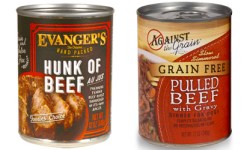
One month later, the company expanded its recall to include every batch of Hunk of Beef, Braised Beef and Against the Grain Pulled Beef canned dog foods manufactured between December 2015 and January 2017.

FDA categorized the recalls as Class I.

A Class I recall represents “a situation in which there is a reasonable probability that the use of or exposure to a violative product will cause serious adverse health consequences or death.”

More than two years later, these Class I recalls are still listed as “Ongoing” by FDA.

A series of email exchanges between Evanger’s, its attorneys, its consultants and FDA staff, released in response to a Freedom of Information Act request, offer a glimpse into the prickly relationship between Evanger’s and FDA.

The story began on December 31, 2016 when Nikki Mael gave her five dogs a New Year’s Eve ‘treat’, consisting of most of the contents of a can of Evanger’s Hunk of Beef au Jus dog food. Within 15 minutes, the dogs began to behave oddly, exhibiting acute neurological symptoms. The pet owner rushed her dogs to an emergency veterinary clinic, where one of the dogs died.

Lab tests conducted on stomach contents retrieved during necropsy of the dead dog revealed the presence of a large amount of pentobarbital, a drug used to euthanize animals. The same drug was found in the residue of food remaining in the can from which the five dogs were fed.

FDA, alerted by the veterinarian, launched its investigation into the incident, including an inspection of Evanger’s production facilities that began on January 10, 2017.

According to a February 4th email from Evanger’s to FDA, the agency first advised Evanger’s of the results of the necropsy on January 27th.

Evanger’s management protested FDA’s handling of the incident. In a series of emails, the company questioned FDA’s determination that pentobarbital was an adulterant, and cautioned the agency not to put too much credence in consumer complaints.

The company’s outside consultant had this to say in an email addressed to Joel Sher, Vice-President of Evanger’s, dated February 4, 2017.

I am dismayed by CVM’s determination. Low levels of Pentobarbital have positive uses in treating seizures and insomnia, both in humans and animals. Those who made the decision are obviously unaware of FDA’s 1998 study that found Pentobarbital in almost 50% of the dry dog foods tested and made a determination at that time that residues of Pentobarbital were acceptable.

Evanger’s consultant made reference to a 1986 fraudulent complaint targeting Gerber’s baby food before summarized the company’s thoughts regarding consumer complaints in the following words, taken from an email dated February 17, 2017.

Complaints cannot be trusted! Once a complaint hits the press unscrupulous people will line up complaining hoping for a payout. Back in 1986 FDA did not have the Office of Criminal Investigations to conduct follow-ups at complainants to interrogate them to determine if their complaints were legitimate or not. Today FDA does have that ability and, perhaps, some of the complaints against Evanger’s and Against the Grain should be investigated further by FDA. I would really caution FDA about coming out with a press statement about receiving ‘many’ complaints against these products unless a comprehensive analysis of the complaint is done first.

In a March 3rd email, Evanger’s attorney expressed concern about FDA’s press releases, and asked the agency to give Evanger’s the opportunity to ‘address the issues’ prior to issuing a new public alert, as follows:

Please recall I represent Evanger’s. On its behalf, I’d like to request that the FDA communicate to and work with Evanger’s after the completion of any investigation or the discovery of any new information or questions so that, prior to any new press release from the FDA, Evanger’s is given the opportunity to address the issues. As I am sure you are aware, an FDA press release has significant impact in the market; this is obviously the FDA’s intended effect with the goal of protecting the public. This is indeed the goal the FDA and Evanger’s share.

Later in the same email, the attorney wrote,

It is for this reason that we ask that, Evanger’s be given the opportunity to address new questions, issues or concerns before the FDA issues an independent release. If this is not possible, I believe Evanger’s would be entitled to know why so as to preclude even the appearance of arbitrary or capricious action.

On June 29, 2017, FDA issued a formal Warning Letter to Evanger’s, listing the various violations of the Federal Food, Drug & Cosmetics Act documented during the agency’s January inspection of the company’s facilities. 

On July 9, 2017, a “concerned consumer” sent the following email to FDA.

Dear Mr. Lyons,

I am responding, to the letter that your office sent to Evanger’s Dog And Cat Food Company, dated June 29, 2019. The reason is the FDA has made false Allegations against Evanger’s in the following way: [redacted by FDA].

The anti seizure medication contained 30 mg of phenobarbital not 15 mg. The medication has since been recalled by a company called Truxton because of mislabeling. [redacted by FDA]

Again the FDA jumped the gun when Evanger’s got blamed for the dogs deaths.

[redacted by FDA]

5. The FDA came charging in like a bull, and the FDA failed to ask about the medical history of the dogs. The phenobarbital that you found came from a labor dispute between the meat supplier and its employee.

Before you make any more false and misleading information about Evanger’s, you need to check your facts. As you have caused thousands of dogs to lose a perfectly safe free meal. Please correct your letter and investigate the new facts in this case. Thank you [redacted by FDA]

Ps. Let me also make it clear I am just a concerned consumer writing this letter by myself.

In October 2017, the company and FDA were still in correspondence regarding the destruction of the recalled products. An October 18, 2017 email from FDA to Evanger’s attorney provides a window into some of the ongoing issues.

As you may know, FDA initiated an inspection at the Evanger’s Markham, IL facility on Tuesday, October 10, 2017 (and is still currently in progress). According to our investigators, the firm has approximately only [redacted by FDA] pallets of recalled product in their possession at this location. The amount of recalled product originally inventoried at the firm in February 2017 by FDA was approximately [redacted by FDA] pallets of product. The firm stated they are destroying the product by discarding approximately [redacted by FDA] at a time into their regular trash bin and covering the product in trash; the trash is then collected per their regularly scheduled pickup. The firm has not provided any documentation or evidence that the product was destroyed; however, Chelsea Sher stated on the second day of the inspection that some of the product has been disposed of at a landfill with documentation. Documentation of the landfill destruction has not been provided to the investigators either. According the investigators the firm is also not rendering the product unsalvageable when the product is thrown into the trash.

Relations between FDA and the companies it regulates can be difficult. Fortunately, not every recall situation is fraught with the controversy and confrontation that characterized the interaction between Evanger’s and FDA. 

A final note: All of the excerpts quoted above are ‘as written’ except for the indicated redactions by FDA. No attempt was made to abridge the content or correct any errors of fact, spelling or grammar.