
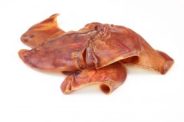
Pig ear pet treats blamed for human Salmonella outbreak

Pig ear pet treats have been linked to an outbreak of multidrug-resistant Salmonella infections in 13 states, according to an investigation report released today by CDC.

Forty-five individuals in California (1), Illinois (3), Indiana (3), Iowa (12), Kansas (3), Massachusetts (2), Michigan (7), Missouri (3), New York (6), North Dakota (1), Pennsylvania (2), South Carolina (1) and Wisconsin (1) have been infected with the outbreak strain, identified as Salmonella I 4,[5],12:i:-.

Twelve outbreak victims were hospitalized.

According to CDC, epidemiological evidence points to pig ear pet treats as a likely source of the illnesses.

Of the outbreak victims interviewed, 89% reported contact with a dog before getting sick and 71% reported contact with pig ear dog treats or with dogs who were fed pig ear dog treats.

In comparison, only 61% of healthy individuals reported contact with a dog, and only 16% reported having handled dog treats such as pig ears in the week before the interview.

Pig ear pet treats obtained from bulk bins at two Michigan retailers have tested positive for a number of different Salmonella strains, according to a report from the Michigan Department of Agriculture and Rural Development (MDARD).

According to FDA, MDARD found four different strains – Salmonella London, Salmonella Typhimurium, Salmonella Newport, and Salmonella Infantis – in the pig ear samples.

FDA is working with CDC and state health partners to determine whether any human or animal cases of Salmonella illness may be linked to the strains found in the treats tested by MDARD.

Other brands of individually wrapped or bagged pig ears sold at multiple retail locations in the state tested negative for Salmonella.

Pet Supplies Plus (Livonia, MI) issued a voluntary recall after learning that MDARD found Salmonella in “…aging bulk pig ear product…” in one of the company’s stores.

The contaminated bulk pig ears were stocked in open bins in Pet Supplies Plus stores in AL, AR, CA, CO, CT, DE, FL, GA, IA, IL, IN, KS, KY, MA, MD, MI, MN, MO, NC, NE, NH, NJ, NY, OH, OK, PA, RI, SC, TN, TX, VA, WI and WV. Prepackaged pig ears are unaffected by the recall.

The company has removed bulk pig ear treats from all of its stores and has stopped shipping these treats from its distribution center.

FDA is working to identify the source of the pig ear treats, how they became contaminated, and where they were distributed.

What consumers need to know

Salmonella can cause illness in both humans and animals. People infected with Salmonella can develop diarrhea, fever and abdominal cramps. Most individuals recover without treatment. However, in some cases, the diarrhea may be so severe that hospitalization is needed.

In severe cases, without antibiotic treatment the infection may spread from the intestines into the blood stream and from there to other parts of the body.

Pets do not always display symptoms when infected with Salmonella, but signs can include vomiting, diarrhea (which may be bloody), fever, loss of appetite and/or decreased activity level. Infected pets can shed the bacteria in their feces and saliva without showing signs of being sick.

If you or a household member is suffering from symptoms of Salmonella, consult a healthcare provider.

If you believe your pet may be infected with Salmonella, consult your veterinarian.

How to alert FDA to a problem

Veterinarians who wish to have pets tested for Salmonella may do so through the Veterinary Laboratory Investigation and Response Network (Vet-LIRN Network) if the pet is from a household with a person infected with Salmonella.

FDA encourages consumers to report complaints about pet food products electronically through the Safety Reporting Portal. This information helps FDA further protect human and animal health.


Recalls and Alerts: June 27 – 30, 2019

Here is today’s list of food safety recalls, product withdrawals, allergy alerts and miscellaneous compliance issues. The live links will take you directly to the official recall notices and company news releases that contain detailed information for each recall and alert.

If you would like to receive automatic email alerts for all new articles posted on eFoodAlert, please submit your request using the sidebar link.

United States

OUTBREAK ALERT: FDA and CDC are alerting the public to an outbreak of Salmonella Uganda illnesses linked to papayas imported from Mexico.

Food Safety Recall: Central Aquatics recalls Aqueon Betta Food (.95 oz jar; Item #100106051; Expiry dates EX04JUN22 and EX05JUN22; UPC 0 15905 06051 6) due to Salmonella contamination.

Canada

Allergy Alert: Clover Trading Co. Ltd. recalls Sanwu brand Spicy Hot Bean Curd (150g; All product codes; UPC 6 905475 352002) due to undeclared sesame and wheat.

Europe

Allergy Alert (Belgium): VINESPA recalls certain Pandomar brand calamari products due to undeclared shellfish. Please refer to the recall notice for a complete list of affected products.

Allergy Alert (Belgium): TAYBA TRADING SPRL recalls certain YAMAN et BALADNA bulgar products due to undeclared wheat (gluten). Please refer to the recall notice for a complete list of affected products.

Allergy Alert (Denmark): Lidl Danmark K/S recalls four varieties of Chef Select tortelloni due to lack of Danish language allergen labeling. Please refer to the recall notice for a complete list of affected products.

Allergy Alert (Finland): Lidl recalls My Best Veggie’s Vegetarian Spicy Bean Burger bean soup (200g; Batch code L69136; Best before July 16, 2016) due to undeclared egg.

Allergy Alert (Ireland): Leonidas recalls Various boxed Leonidas Belgium Chocolates due to undeclared sesame seeds and nuts.

Allergy Alert (Italy): THE LORENZ BAHLSEN SNACK-WORLD GMBH & CO KG recalls NIC NAC’S ORIGINAL (125g with Promo sticker; Lots 9205, 9222, 9232, 9252; Best before  02/16/2020, 02/27/2020, 03/03/2020, 03/17/2020) due to lack of Italian language allergen declaration.

Allergy Alert (UK): Tesco recalls Tesco 2 British Cheese Burgers with Buns (469g; Use by 28, 29 and 30 June 2019 and 1, 3 and 4 July 2019) due to undeclared sesame.

Food Safety Recall (Belgium): Brugse Visrokerij Alloo recalls Alloo brand saumon doux fumé artisanal / mild smoked salmon (200g; Lot #32419 1306; Best before 09/07/2019) due to Listeria monocytogenes contamination.

Food Safety Recall (Germany): P & B Foods Ltd recalls Heera Chilli Powder Extra Hot (6 x 1 kg; Batch code PB9446M/4; Best before end April 2021) due to Salmonella contamination.

Food Safety Recall (Germany): Kaufland Fleischwaren SB GmbH & Co. KG recalls certain K-Purland brand meat products due to foreign matter (red plastic pieces) contamination. Please refer to the recall notice for a complete list of affected products.

Food Safety Recall (Germany): Damse Kaasmakerij recalls Herbal Brie (Lot #190523; Best before 17/07/2019) and Pepper Brie (Lot #190523; Best before 11/07/2019, 17/07/2019, 22/07/2019, 23/07/2019) due to possible Listeria contamination.

Food Safety Recall (Germany): Fleischerei Stübner recalls Mettwurst fein / Fine Mettwurst (sold between 05.06.2019 and 28.06.2019) due to possible Listeria contamination.

Food Safety Recall (Germany): Gül Lebensmittel und Grosshandel recalls CEBEL Kirma yesil Zeytin / Kirma green olives (700g; 20.12.2020 (Series 201218) and 21.01.2021 (Series 020119)) as the product is unsafe for consumption due to a production defect and incorrect packaging.

Food Safety Recall (Germany): Zorn GmbH & Co.KG recalls certain meat products, because Salmonella was found in a raw sausage batch. Please refer to the recall notice for a complete list of affected products.

Food Safety Recall (Ireland): Iceland recalls Iceland 60 Crispy Chicken Dippers (60-pack; All date codes) due to foreign matter (pieces of hard plastic) contamination.

Food Safety Recall (Ireland): Denny recalls Denny Black Pudding (199g; Use by 17 July 2019) due to foreign matter (blue plastic) contamination.

Food Safety Recall (Ireland): P & B Foods Ltd recalls Heera Chilli Powder Extra Hot (6 x 1 kg; Batch code PB9446M/4; Best before end April 2021) due to Salmonella contamination.

Food Safety Recall (UK): Britvic PLC recalls Robinson’s Fruit Shoot Apple and Blackcurrant bottles (24 x 200ml multipack (Tesco and Costco) and 200ml single bottle (McDonald’s); Batch codes NO5 L9164, NO5 L9171 and NO6 L9171; Best before March 2020) because the spout within the sports bottle cap may become detached unexpectedly.

Food Safety Recall (UK – Northern Ireland specific): Denny recalls Denny Black Pudding (199g; Use by 17 July 2019) due to foreign matter (blue plastic) contamination.

Food Safety Recall (UK): Iceland recalls Iceland 60 Crispy Chicken Dippers (60-pack; All date codes) due to foreign matter (pieces of hard plastic) contamination.

Food Safety Recall (UK): P & B Foods Ltd recalls Heera Chilli Powder Extra Hot (6 x 1 kg; Batch code PB9446M/4; Best before end April 2021) due to Salmonella contamination.

Pet Food Safety Recall (UK): Homeland By Products Ltd recalls Frozen Raw Beef pet food (500g; Batch code 1510; Best before May 2021), Frozen Raw Turkey pet food ((500g; Batch code 1513; Best before May 2021), and Frozen Raw Tripe pet food (500g; Batch code 1518; Best before May 2021) due to Salmonella contamination.

574 Companion Animals Stricken with DCM. No answers yet

The US Food and Drug Administration (FDA) received a total of 524 reports of companion animals stricken with dilated cardiomyopathy (DCM) between January 1, 2014 and April 22, 2019, according to an update released by the agency today.

Some of the reports involve multiple animals in a single household. In all, DCM was reported in 560 dogs and 14 cats. Five cats and 119 dogs died.

Only seven reports were lodged with FDA during calendar years 2014-2017. The number of incidents spiked to 320 in 2018, and have continued at a steady pace this year, with 197 cases reported between January 1st and April 30th 2019.

FDA has posted a spreadsheet containing all of the individual reports it has received.

BY THE NUMBERS

The ten breeds appearing most often in these reports include: Golden Retriever (95), Mixed (62), Labrador Retriever (47), Great Dane (25), Pit Bull (23), German Shepherd (19), Doberman Pinscher (15), Australian Shepherd (13), Unknown (13) and Boxer (11).

DCM is recognized as a genetic condition in some large or giant breed dogs, including the Doberman Pinscher, the Great Dane, and the Irish Wolfhound, manifesting mainly in male dogs in middle to older age. DCM also is associated with taurine deficiency in Cocker Spaniels.

In contrast, cases of DCM reported to FDA have involved a wide range of dog breeds of all sizes and ages, from 0.4 – 17 years in dogs and 7 – 13 years in cats. More than one half of the cases (58.7% of dogs and 62.5% of cats) involve males.

The vast majority of affected pets (452 of the 524 reports) were fed a dry food diet exclusively. The rest of the animals were fed a diet that included one or more of dry, raw, semi-moist or wet foods. 

More than 90% of the dry dog foods were grain-free. Ninety-three percent of the formulations contained peas and/or lentils. Forty-two percent contained potatoes or sweet potatoes.

The most common animal source proteins were chicken, lamb and fish. Some foods contained exotic meats, such as kangaroo or bison. No one animal protein source predominated in the illness reports.

Dry food brands named most frequently in DCM cases were Acana (67), Zignature (64), Taste of the Wild (53), 4Health (32), Earthborn Holistic (32), Blue Buffalo (31), Nature’s Domain (29), Fromm (24), Merrick (16), California Natural (15), Natural Balance (15), Orijen (12), Nature’s Variety (11), NutriSource (10), Nutro (10) and Rachael Ray Nutrish (10).

THE FDA INVESTIGATION

FDA’s Veterinary Laboratory Investigation and Response Network (Vet-LIRN) has analyzed multiple products for minerals and metals (calcium, magnesium, phosphorus, iron, cobalt, copper, zinc, selenium, iodine) and amino acids including taurine, cysteine, and methionine. No abnormalities were found.

A comparative test of grain-free and grain-containing products for levels of protein, fat, moisture, crude fiber, total dietary fiber, soluble fiber, insoluble fiber, total starch, resistant starch, cystine, methionine and taurine revealed that both types of products contained similar levels of all of these components on a dry matter basis (ie., after removing all moisture content).

Additional tests are in progress

Vet-LIRN has interviewed 95 owners of affected pets, in order to document a complete dietary history and to explore any other possible contributing factors, including environmental factors.

FDA has received results of 19 gross necropsies from dogs with suspected heart disease, and Vet-LIRN is processing tissues from the necropsies for review by a board-certified veterinary pathologist.

Vet-LIRN is collaborating with Chesapeake Veterinary Cardiology Associates (CVCA) to collect medical records, owner interviews, and diagnostic samples from pets diagnosed with DCM. CVCA will be following the medical progress of these pets, including regular collection of diagnostic samples and follow-up echocardiogram. Vet-LIRN is collecting food associated with the pets included in this study for lab analysis.

UNANSWERED QUESTIONS

  1. Why have cases of DCM spiked in recent years? What has changed?
  2. Why are grain-free products so strongly associated with DCM, even though there is little apparent difference in the levels of minerals, amino acids, protein levels, etc. between grain-free and grain-containing products?
  3. Acana (67 DCM reports) and Orijen (12 DCM reports) are both manufactured by the same company. Why is there such a large difference in the number of associated cases between these two brands?
  4. Is there any correlation between brand popularity and number of DCM case reports? Would it be useful to compare the report frequency to the market share of each product?

WHAT CAN PET OWNERS AND VETERINARIANS DO?

  • FDA encourages pet owners and veterinarians to submit reports on any food-associated pet illness. Details for submitting this info can be found on the FDA page “How to Report a Pet Food Complaint.”
  • Pet owners should contact a veterinarian as soon as possible if their dog is showing possible signs of DCM or other heart conditions, including decreased energy, cough, difficulty breathing and episodes of collapse.
  • Veterinarians are urged to report well-documented cases of DCM in dogs suspected of having a link to diet by using the electronic Safety Reporting Portal or calling their state’s FDA Consumer Complaint Coordinators. FDA especially welcomes detailed reports, including information about feeding history, medical records, and diagnostic testing.

AN EDITORIAL NOTE

I have sometimes read complaints from pet owners and at least one blogger that FDA doesn’t care about pet food safety, or about the health of companion animals. 

The agency has spent significant resources and manpower on this investigation for more than a year, and is continuing its efforts to find the root cause for the spike in DCM in dogs. This is a complex, difficult, and wide-reaching investigation with no guarantee of success.

In my opinion, FDA’s commitment to solving the DCM riddle bears witness to its dedication to pet health.