
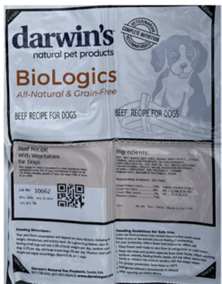


The US Food and Drug Administration (FDA) is advising the public not to feed certain lots of Darwin’s Natural Pet Products raw food to their pets after a four-year-old child became ill with E. coli O157:H7.
The contamination came to light after food-safety attorney, William Marler, initiated third-party testing of an previously unopened package of BioLogics All-Natural and Grain Free, Beef Recipe for Dogs found E. coli O157:H7 in the raw, frozen product. Whole genome sequencing (WGS) confirmed that the strain found in the pet food was a match for the strain recovered from the child.
In addition to the E. coli O157:H7-positive sample, the third-party lab recovered Salmonella Infantis and Salmonella Hadar from previously sealed packages of Darwin’s chicken dog food and duck dog food, respectively.
The FDA recommended that Arrow Reliance, Inc. (the manufacturer of Darwin’s Natural Pet Products) recall the product lots that tested positive for E. coli O157:H7 and Salmonella; however, the company has not recalled the affected products.
The products in question were manufactured in May or June 2024, were sold frozen, have no expiration date on the label, and could still be in consumers’ freezers. The FDA urges consumers who purchase Darwin’s products to check their freezers for the following three items:
- Darwin’s Natural Pet Products, BioLogics All-Natural and Grain Free, Beef Recipe for Dogs:- Lot 10662, MFG Date of May 30, 2024
- Darwin’s Natural Pet Products, BioLogics All-Natural and Grain Free, Chicken Recipe for Dogs:- Lot 10683, MFG date of June 05, 2024
- Darwin’s Natural Pet Products, Natural Selections Duck Recipe for Dogs:- Lot 10638, MFG date of May 22, 2024
The affected lots of pet food were sold in frozen 2-pound white and clear plastic packages with four separate units. The beef and chicken BioLogics dog food have orange labeling, and the duck Natural Selections dog food has blue labeling. If you have any of these products, please throw them away in a secure container. DO NOT FEED THEM TO YOUR PETS.
Anatomy of an illness investigation
In August 2024, a four-year-old boy living in Utah became ill and was diagnosed with E. coli O157:H7.
The child was hospitalized, and developed a severe case of hemolytic uremic syndrome (HUS), requiring dialysis. He spent a total of six weeks in hospital and is at risk of permanent injury to his kidneys.
As a matter of routine, the strain of E. coli O157:H7 that was recovered from the boy was genetically typed using WGS and, in September 2024, the genetic profile was uploaded to the CDC’s National Center for Biotechnology Information (NCBI) database.
Investigations carried out by the health authorities in Utah were unable to find any other related cases or to determine a possible source for the infection. It appeared to be an isolated incident.
In October 2024, the family contacted food-safety attorney, William Marler.
According to information provided to eFoodAlert by Marler, initial reviews of the files did not reveal any clues about the source of the infection. However, when Marler reviewed the files once more, he noted that the family had a dog, and asked about the dog’s health and diet. He learned that the dog exclusively ate Darwin’s pet food, and had begun vomiting one day before the child fell ill. The dog subsequently died in a car accident, so could not be tested, but the family had not discarded the remaining frozen, raw dog food.
Marler arranged for an accredited third-party laboratory to test the sealed packages of food that were still in the family’s freezer. On June 19, 2025, the lab reported that they had found E. coli O157:H7 in a sample of the Darwin’s beef dog food and that the strain was a perfect match to the strain recovered from the Utah boy.
Marler notified the FDA, the Utah health department, the Washington Department of Agriculture (Darwin’s manufacturer is located in Tukwila, WA) and Arrow Reliance, Inc. (the manufacturer) of the lab’s findings.
The FDA sent an investigator to Utah to interview the family, and also tried to locate additional samples of the affected products for testing. Unfortunately, by the time the FDA became involved, there were no retail samples available for testing, nor did the company have any samples from the specified production lots available to test.
And, as has occurred of several prior occasions, Arrow Reliance has not complied with the FDA’s request for a voluntary recall.
What consumers need to know
If you have any of the lots of Darwin’s BioLogics or Natural Selections pet food products listed above, stop feeding the product to your pets and throw it away in a secure container where other animals, including wildlife, cannot access it. Do not donate the food.
The product lot codes are printed on the front of the lower left unit of the package of food. If you no longer have the package or can’t read the lot code, throw the food away.
Consumers who have had the products listed above in their homes should clean and disinfect all pet supplies, including all storage containers, bowls, utensils, food prep surfaces, pet bedding, toys, floors, and any other surfaces that the food or pet may have had contact with, including your refrigerator or freezer. Clean up the pet’s feces in yards, parks, or other places where people or other animals may become exposed. Consumers should thoroughly wash their hands after handling the product or cleaning up potentially contaminated items and surfaces.
Salmonella, E. coli O157:H7 and your pet
Dogs and cats can become infected with STEC, although the symptoms are generally milder than symptoms in people. Dogs and cats infected with STEC can develop watery diarrhea, bloody diarrhea, urinary tract infections, and vomiting. Symptoms may be more severe in pets with weakened immune systems. The infection is rarely lethal in pets, but deaths have been reported in infected dogs. If your pet has symptoms of a STEC infection, consult a veterinarian promptly.
Pets do not need to display symptoms to be able to pass STEC on to their human companions. Whether or not a pet is symptomatic, once STEC gets established in the pet’s gastrointestinal tract, the animal can shed the bacteria when having bowel movements, contaminating their environment.
Pets do not always display symptoms when infected with Salmonella, but signs can include vomiting, diarrhea (which may be bloody), fever, loss of appetite and/or decreased activity level. If your pet has these symptoms, consult a veterinarian promptly. You should also be aware that infected pets can shed the bacteria in their feces without showing signs of being sick.
How to report a pet illness?
People who think their pets have become ill after consuming contaminated pet food should first contact their veterinarians.
The FDA encourages consumers and veterinarians to report complaints about pet food products electronically through the Safety Reporting Portal. Additionally, consumers can visit the SmartHub – Safety Intake Portal – Report a Product Problem (fda.gov) to obtain electronic assistance with submitting a report to FDA.

“A complete and compelling account of the hidden and not-so-hidden ways the food we give our beloved pets can be contaminated.” – JoNel Aleccia, Health Reporter, Food & Nutrition, The Associated Press.
“An invaluable resource for busy pet owners” – Food Safety News



 eFoodAlert