
Two people dead in Canadian Salmonella outbreak linked to Celebrate brand frozen profiteroles and eclairs from Thailand

This story by Phyllis Entis first appeared in Food Safety News and is reposted here with  permission.

Frozen profiteroles and mini eclairs sold in grocery stores are the apparent sources of two deaths among at least 73 lab-confirmed cases of Salmonella Enteritidis infections in Canada as of April 27, 2019, according to the Public Health Agency of Canada (PHAC).

The outbreak, which was first announced on April 5, 2019, has spread to six Canadian provinces: British Columbia (27), Alberta (12), Saskatchewan (9), Manitoba (10), Ontario (13) and Quebec (2).

The outbreak began in early November 2018 and remains ongoing, with the most recent case having been reported in late March 2019. Outbreak victims range in age between 1 and 88 years of age.

PHAC has not determined whether or not Salmonella was a contributing factor in either of the deaths. Nineteen outbreak victims have been hospitalized.

Many of the victims reported eating Celebrate brand classic/classical or egg nog flavored profiteroles or mini chocolate eclairs purchased at various grocery stores before becoming ill.

The Canadian Food Inspection Agency (CFIA) has issued a Food Recall Warning for certain Celebrate brand products.

The implicated products were manufactured in Thailand by Mountain Mist (The Belgian Baker) Thailand Ltd. and distributed in Canada by Retail Resource Services Inc., located in Beaumont, Alberta, Canada (Retail Resource).

All lot codes of the following Celebrate brand products have been recalled so far. CFIA warns that more products may be recalled, depending on the outcome of its food safety investigation.

  • Mini Chocolate Eclairs, 365g (UPC 8 858762 720047)
  • Classical Profiteroles / Classic Profiteroles, 325g (UPC 8 858762 720009)
  • Egg Nog Profiteroles, 375g (UPC 8 858762 720016)
  • Classic Foodservice Profiteroles, 4 kg (No UPC)
  • Pineapple Foodservice Profiteroles, 4 kg (No UPC)
  • Coconut Foodservice Profiteroles, 4 kg (No UPC)
  • Passionfruit Foodservice Profiteroles, 4 kg (No UPC)
  • Mango Foodservice Profiteroles, 4 kg (No UPC)

The recalled products were sold in Alberta, British Columbia, Manitoba, New Brunswick, Nova Scotia, Ontario, Quebec, Saskatchewan and may have been distributed elsewhere in Canada.

Symptoms of Salmonella usually begin from 6 to 72 hours after exposure and may include the following: fever, chills, diarrhea, abdominal cramps, headache, nausea, and vomiting.

In healthy individuals, symptoms usually last from 4 to 7 days and often resolve without treatment. In some cases, more severe illness can occur. The very young, the elderly, pregnant women, and individuals with weakened immune systems are more susceptible to complications from Salmonella infections.

PHAC advises consumers to take the following precautions if they have purchased or been given one of the recalled products:

  • Do not eat recalled Celebrate brand profiteroles (cream puffs) or mini chocolate eclairs.
  • Throw them out immediately and properly wash and sanitize any containers that were used to store these products before using them again.
  • If you have any profiteroles or mini eclair products without the original packaging and are unsure if these products are included in this advice, throw them out just to be safe.
  • Wash your hands with soap and warm water for at least 20 seconds immediately following contact with any of the identified Celebrate brand products.
  • Do not prepare food for other people if you think you are sick with a Salmonella infection or suffering from any other contagious illness causing diarrhea.

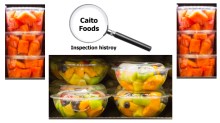
Caito Foods sanitation problems extend back to at least 2016

The following story by Phyllis Entis first appeared in Food Safety News and is reposted here with permission

The Food and Drug Administration found multiple sanitation issues during a 2016 inspection of the Caito Foods fresh produce facility that prepared pre-cut melon products currently implicated in a Salmonella outbreak.

According to the Indianapolis company’s website, Caito specializes in fresh produce distribution and fresh food processing, selling to customers nationwide.

The September 2016 FDA inspection was undertaken following detection of Listeria monocytogenes in a sample of cut butternut squash by the Ohio Department of Agriculture (ODA), according to documents obtained from FDA in response to a Freedom of Information Act request.

The company decided not to recall the squash from the sampled lot, because the product was intended to be cooked by the consumer. Also, the company did not learn about the contamination until Sept. 9, 2016, which was five days after the “BEST IF SOLD BY” date for the batch.

FDA investigators spent two days on a “directed inspection” in response to the Listeria monocytogenes finding. Their inspection focussed on the processing of raw fruits and vegetables, including butternut squash.

The “Establishment Inspection Report” noted several observations, which were provided to management at the completion of the inspection.

  • Condensate dripping onto uncovered asparagus spears on the over-wrap line during the, even though the pre-operation sanitation checklist indicated “No condensation” for that date.
  • Pre-operation sanitation check list for the date during which the butternut squash sample was produced identified three locations as “unsatisfactory” with no corrective actions indicated.
  • During the inspection, an employee on the production line was observed placing “. . . waste into a trash can under the product line, pushing the waste down into the can with their hand, until their arm from the elbow down was fully in the trash can.” The employee immediately returned to handling cut watermelon chunks without changing or sanitizing gloves.
  • Condensate water formed a puddle on the floor at one of the entrances to the receiving cooler, a potential reservoir for Listeria, which could be tracked into the rest of the facility.

Caito’s production facility was inspected again by FDA in 2018, in response to an outbreak of Salmonella Adelaide infections linked to freshcut melon products. That outbreak sickened 77 individuals in nine states.

On April 12 this year, Caito recalled various pre-cut melons and fruit medley products after the products were linked to cases of salmonellosis. As of April 24, there were 117 confirmed patients in the 10-state outbreak. At least 32 of the patients have been admitted to hospitals, according to an update this week from the Centers for Disease Control and Prevention.

The FDA is conducting an on-going investigation to determine the cause of the outbreak, including a traceback investigation to determine, if possible, a farm of origin for the melons. According to an agency spokesperson, FDA’s inspection of Caito’s production plant is still in progress.

US Salmonella outbreak linked to frozen raw tuna from Vietnam

The CDC and FDA are investigating a multistate outbreak of Salmonella Newport linked to frozen, raw ground tuna supplied by Jensen Tuna of Louisiana and imported from J K Fish Co. Ltd. of Vietnam.

Thirteen outbreak cases have been reported from seven states, including: Connecticut (1), Iowa (1), Illinois (1), Minnesota (1), New York (1), North Dakota (4), and Washington (4).

Two people have been hospitalized.

The outbreak began in January 2019, with the most recent case having been reported on March 20th.

Nine (75%) of 12 outbreak victims that were interviewed reported eating sushi from a restaurant or grocery store, according to CDC.

On April 16th, Jensen Tuna recalled frozen ground raw tuna that was imported from J K Fish Co. Ltd. of Vietnam. The recalled tuna was individually packaged in clear plastic one-pound bags, and sold in white wax 20 lb. boxes. The product is only sold as a wholesale case with twenty bags in each case. The lot numbers are z266, z271 and z272.

The recalled product was supplied to wholesale distributors in Connecticut, Iowa, Illinois, Minnesota, New York, North Dakota, and Washington for further distribution to restaurants and retail locations.

CDC recommends that consumers who order sushi made with raw tuna, including “spicy tuna,” should ask the restaurant or grocery store if the tuna is from Jensen Tuna, and should avoid eating this tuna.

Symptoms of Salmonella infection may include diarrhea, fever, and stomach cramps 12 to 72 hours after being exposed to the bacteria, and typically last from 4 to 7 days. Individuals who consumed raw tuna and develop these symptoms should consult a health care provider.

In some people, the illness may be so severe that the patient needs to be hospitalized. Salmonella infection may spread from the intestines to the bloodstream and then to other places in the body.

Children, the elderly, pregnant women, and individuals with weakened immune systems are more likely to experience severe symptoms.

Restaurants and retailers should check with their suppliers and not sell or serve the recalled ground tuna from Jensen Tuna. They should also be sure to wash and sanitize locations where the recalled ground tuna was stored or prepared.