
Reported cases: 1,642
Hospitalizations: 246
States affected: 48
Provinces affected: 7
Infectious agent: Salmonella Newport
Probable source: Red onions produced and packed by Thomson International, Inc. of Bakersfield, CA
Two months after the US Centers for Disease Control and Prevention (CDC) and the Public Health Agency of Canada (PHAC) declared this outbreak over, its root cause remains a mystery.
The US Food and Drug Administration (FDA) has plowed through more than 2,000 samples, testing finished products, swab and environmental samples from Thomson’s packing facility, and environmental samples from the vicinity of the fields where the onions were grown.
FDA labs recovered eleven different Salmonella serotypes from the various environmental samples, according to information obtained by eFoodAlert in response to a Freedom of Information Act request.
Although Salmonella Newport was found in two samples described as soil/sediment, neither sample yielded the outbreak strain recovered from patients.
Not one of the onions tested in FDA labs were Salmonella-positive.
Not one of the swab samples obtained from inside the Thomson packing facility were Salmonella-positive.
But this is not the whole story. To understand FDA’s findings, it’s important to know more about onions.
The onion
 Onions can be grown from seeds, seedlings, or sets (immature onion bulbs). The crop is ready for harvest when at least one-half of the leaves are dead.
In order to ensure an adequate storage life, the onions must be left in the field to “cure” for at least 12–24 hours. This allows the outer skin to dry. Curing is complete when the neck of the onion (the top of the bulb) is dry and tight.
After curing, the onions are “topped” above the neck to remove the leaves, after which they are ready for eating or for extended storage.
Onions are closely related to garlic and, like garlic, onions produce certain essential oils that possess anti-bacterial properties. Although Salmonella can survive on onions, these essential oils complicate the process of detecting the bacteria.
Thomson’s onion operations
Onions are onions, whether grown in a small backyard or in a large commercial field. The same principles apply. The differences are those of scale.
Thomson’s onions are grown from seeds in two different parts of California. The company uses fields both near Bakersfield, where its packing house is located, and just outside Holtville, in California’s Imperial Valley, approximately 330 miles to the south.
When the onion crop is ready for harvest, Thomson’s crews use specialized equipment to dig beneath the bulbs and cut them out of the ground. The onions are left in the field to cure.
Once the onions have cured, a crew of farm laborers works its way through the field, trimming off the tops and bottoms of the onions, culling and discarding damaged onions, and placing the trimmed onions into buckets.
Culled onions and the trimmed-off tops and bottoms are left in the field to be plowed back into the soil when it is prepared for the next crop.
The full buckets are poured into burlap bags, which are left in the field for additional curing.
Once curing is complete, the onions are either shipped in bulk directly to customers or are transported to Thomson’s Bakersfield packing facility, where they are brushed clean and packed for distribution.
What FDA did not find
- No “egregious” conditions or violations of the Produce Safety Rule
- No direct evidence of the outbreak strain in bagged onions
- No direct evidence of the outbreak strain in any environmental samples either at the packing facility or in and around the fields
What FDA found in Bakersfield
- Cats in and near the onion packing lines
- Pigeons flying or roosting inside the packing house
- Apparent bird droppings on and near the onion packing line
- A thick build-up of dirt and soil on the packing line even after the most recent cleaning/sanitizing activity
- Rough, dirty weld points on the packing line
- Inadequate documentation of cleaning/sanitizing activity
- Swallow nests overhead within a few feet of an onion-packing line
- Inconsistent cleaning/sanitation Standard Operating Procedures documentation
- Inconsistent bacteriological testing of agricultural water for coliforms and E. coli.
- Salmonella in animal scat, drain sediment, and environmental swab sample and on a water filter
What FDA found in Holtville
- Worn and uneven areas on field packing equipment that could harbor bacteria
- Indications of bird activity around the fields and equipment
- Flock of birds (ibis) in field undergoing flood irrigation adjacent to field where onions had been grown
- Salmonella, including Salmonella Newport, in several soil/sediment samples
And then there’s the water…
Information received under a Freedom of Information Act request is often heavily redacted, as anyone knows who watches The Rachel Maddow Show on MSNBC. This is what FDA’s investigation report had to say about the source of irrigation water used on the onion fields.
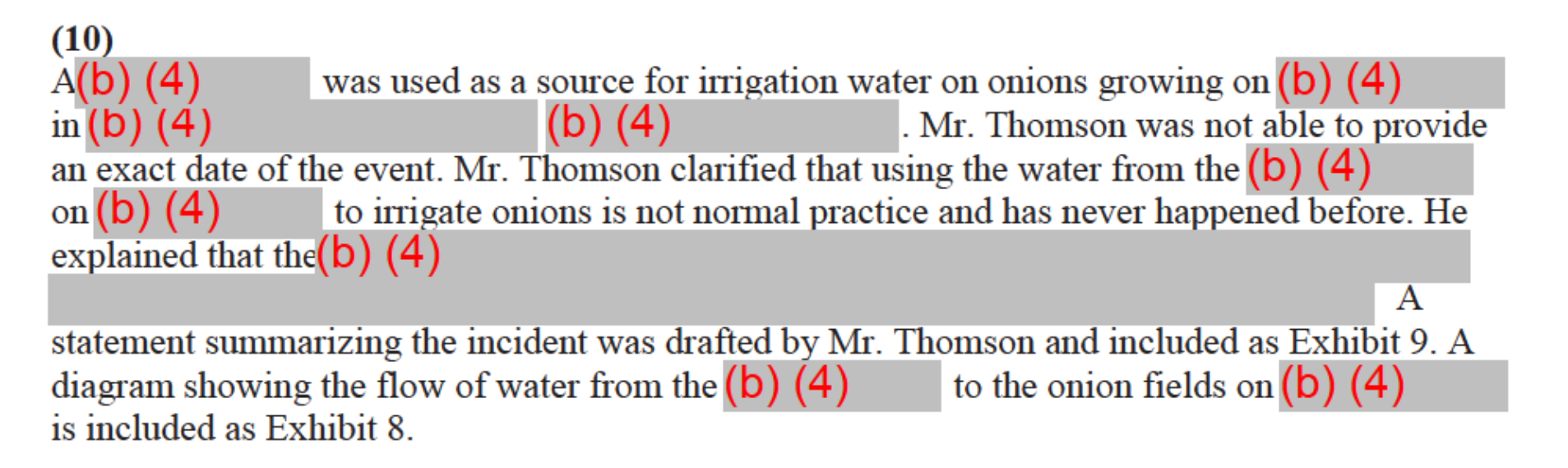
It would appear that irrigation water was drawn from a different source than was usual on at least one occasion. The details and date(s) on which this took place were redacted from the report, as was the diagram showing the flow of water from the source to the fields.
Why does this matter?
Irrigation water polluted by runoff from cattle feedlots has been linked to contaminated produce grown in the Salinas and Imperial Valleys in the past. A quick look at a Google map for the areas around Bakersfield and Holtville reveals the presence of feedlots in both vicinities.
The bottom line
As soon as Thomson onions were identified by CDC and FDA as the probable source of the Salmonella Newport outbreak, the company shut down its harvesting and packing operations.
By the time FDA investigators arrived on the scene, there were no field or packing activities for them to observe. The investigators were able to carry out extensive sampling of the equipment surfaces, the environment, and the stored onions, but were unable see either the harvest or packing operations in action.
Although neither FDA nor the Canadian Food Inspection Agency were able to find the outbreak strain in any of the onion samples, all of the epidemiological evidence from both the CDC and the PHAC points to Thomson’s red onions as the source of the outbreak,
The presence of multiple Salmonella-positive environmental samples lends weight to this conclusion, although the actual source of the contamination likely will never be known.


