
Canadian Listeria monocytogenes outbreak blamed on diced chicken imported from USA

The Public Health Agency of Canada (PHAC) is investigating seven cases of Listeria monocytogenes infections in three Canadian provinces.

Five of the seven cases were reported during the period April – June 2019; the other two cases, involving the same genetic strain, occurred in 2017.

Six of the seven outbreak victims were admitted to hospital.

Outbreak cases were reported in British Columbia (1), Manitoba (1) and Ontario (5). The outbreak victims’ ages range between 51 and 97 years. Six of the seven victims are female.

The source of the outbreak has been traced to a production batch of Rosemount brand cooked diced chicken meat, which was supplied to hotels, restaurants and institutions. The implicated product was not packaged for retail sale.

As a result of the traceback investigation, Rosemount Sales and Marketing has recalled the following product:

Rosemount brand Cooked diced chicken meat 13 mm – ½” (#16305) (4.54Kg; PACKDATE: 01/21/19; UPC 2 06 20263 12454 7)

The recalled product was supplied to hotels, restaurants and institutions in Alberta, British Columbia, Manitoba, Nova Scotia, Ontario, Quebec, and Saskatchewan, and may have been distributed nationwide.

The fully cooked, diced chicken is a product of the USA, and was exported to Canada under USDA Export Certificate No. 039833. The manufacturer cannot be identified from the package labeling.

According to PHAC, anyone can become sick from Listeria bacteria, but those at highest risk of serious illness include pregnant women, their unborn children and newborns, adults 65 and over, and people with weakened immune systems.

Individuals living in group homes, assisted living facilities, and nursing homes would be members of one or more of these at-risk groups.

What you need to know
  • Foods that are contaminated with Listeria may look, smell and taste normal. Unlike most bacteria, Listeria can survive and sometimes grow on foods being stored in the refrigerator.
  • Symptoms of mild Listeria monocytogenes infections can appear as early as three days after exposure to a contaminated food, and may include fever, nausea, cramps, diarrhea, vomiting, headache, constipation, and muscle aches.
  • Symptoms of severe infections may not appear until 2-3 weeks following exposure, and can take up to 70 days to develop. These symptoms can include stiff neck, confusion, headache, and loss of balance.
  • Pregnant women infected with Listeria monocytogenes may experience complications including stillbirth, early delivery, and infection in the newborn baby.
  • Severe cases of Listeria monocytogenes infections can be deadly.
What you need to do
  • If you have Rosemount brand cooked diced chicken meat 13mm – ½” (#16305), packdate – 01/21/2019 in your food establishment, do not eat the product or serve it to others
  • Secure the product and any foods made with the product in a plastic bag, throw it out and wash your hands with warm soapy water.
  • If you are unsure whether your Rosemount brand chicken is part of the food recall warning, discard the product.  Do not serve or consume it.
  • If you suspect you have become ill from eating Rosemount brand cooked diced chicken meat, or have symptoms consistent with listeriosis, talk with your healthcare provider.



Feds urge consumers to nix pig ear dog treats

FDA AND CDC ARE ADVISING THAT CONSUMERS AVOID ALL PIG EAR PET TREATS, AND THAT RETAILERS STOP SELLING ALL PIG EAR TREATS AT THIS TIME.

THE OUTBREAK

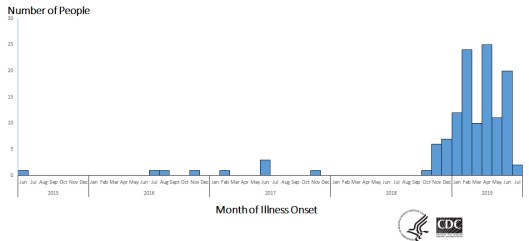
Pig ear dog treats are behind a multi-strain outbreak of Salmonella infections that has sickened 127 people in 33 states, according to the latest update from the US Centers for Disease Control and Prevention (CDC).

Twenty-four (21%) of the illnesses are in children under the age of five.

Fifty-five (45%) of the victims are female.

Twenty-six (26) of the victims have been admitted to hospital. No deaths have been reported.

Illnesses started on dates ranging from June 16, 2015 to July 6, 2019. Outbreak victims range in age from less than 1 year to 90 years, with a median age of 40 years.

Illnesses have been reported to CDC from Alabama (1), Arizona (1), California (1), Colorado (3), Connecticut (1), Florida (3), Georgia (2), Hawaii (1), Illinois (7), Indiana (5), Iowa (23), Kansas (3), Kentucky (6), Louisiana (1), Maine (1), Massachusetts (4), Michigan (12), Minnesota (1), Missouri (6), New Hampshire (1), New Jersey (2), New Mexico (1), New York (15), North Carolina (2), North Dakota (1), Ohio (5), Oregon (2), Pennsylvania (6), South Carolina (2), Texas (2), Utah (1), Washington (1), Wisconsin (4).

To date, CDC has identified four different Salmonella serotypes as contributing to the outbreak: Salmonella enterica serotypes I 4,[5],12:i:-, Infantis, London, and Newport.

Based on epidemiology, lab results, and traceback investigations, pig ear dog treats appear to be the source of the outbreak.

In addition to the Salmonella serotypes already identified in the outbreak, testing carried out by Kansas, Michigan, Pennsylvania, and the FDA found Salmonella PanamaSalmonella BrandenburgSalmonella Anatum, and Salmonella Livingstone in treat samples purchased from retailers.

CDC is reviewing its databases to determine whether any of the additional strains have been associated with reports of human illness.

Illnesses were linked to contaminated pig ear dog treats were imported from Argentina and Brazil, according to traceback investigations carried out by FDA. However, these two sources do not account for all of the 127 reported infections.

In addition to the existing Import Alert 72-03 on pig ear pet treats, FDA is increasing its scrutiny of pig ears imported into the United States through sampling and examination.

THE RECALLS

On July 3rd, Pet Supplies Plus recalled bulk pig ears stocked in open bins from its stores in 33 states.

On July 26th, Lennox Intl. Inc. recalled Natural Pig ears that were shipped to to nationwide distributors and/or retail stores from May 1st, to July 3rd, 2019.

On July 30th, Lennox expanded its recall to include packages of Premium Natural Pig Ears shipped to nationwide distributors and/or retail stores from November 1st 2018, to July 3rd, 2019.

More products may be recalled and more suppliers identified as testing continues.

FDA STATEMENT

The FDA takes seriously our responsibility to protect both human and animal health,” said Steven M. Solomon, D.V.M., M.P.H., director of the FDA’s Center for Veterinary Medicine. “Multiple products have tested positive for numerous types of Salmonella resulting in two company recalls to date. Given this and the links to human illness, we believe the most effective way to protect public health at this time is to warn consumers to avoid purchasing or feeding their pets all pig ear treats and for retailers not to sell these products. We also continue to advise those who may have come into contact with potentially contaminated products to practice safe hygiene, including thoroughly washing hands and disinfecting any surfaces that have touched pig ear pet treats. The FDA will provide additional updates as our investigation further progresses.

ADVICE FOR PET OWNERS

  • Do not feed any pig ear treats to your dog. Throw them away in a secure container so that your pets and other animals can’t eat them.
  • Even if some of the pig ears were fed to your dog and no one got sick, do not continue to feed them to your dog.
  • Wash containers, shelves, and areas that held any pig ear dog treats with hot, soapy water. Be sure to wash your hands after handling any of these items.
  • People who think their pets have become ill after consuming contaminated pet food should first contact their veterinarians. Veterinarians who wish to have pets tested for Salmonellamay do so through the Veterinary Laboratory Investigation and Response Network (Vet-LIRN Network) if the pet is from a household with a person infected with Salmonella.
  • FDA encourages consumers to report complaints about pet food products electronically through the Safety Reporting Portal. This information helps FDA further protect human and animal health.

Hill’s Vitamin D Catastrophe – A Preventable Tragedy

On August 16, 2018, DSM Nutritional Products, Inc. in Fort Worth, Texas manufactured two production lots of vitamin premix intended for use in dog food.

Due to a manufacturing error, the premix contained vitamin D at 2900% over the target concentration level.

The two batches of premix, comprising a total of 2.7 tons of material, were destined for a single customer – Hill’s Pet Nutrition Inc. in Topeka, Kansas.

The vitamin premix was used over a period of several months to manufacture 86 total lots of 33 varieties of canned, wet dog foods, under the Hill’s Prescription Diet and Hill’s Science Diet brands.

Those 86 lots, which were distributed across the United States and to 65 other countries around the world, contained toxic levels of Vitamin D.

Hill’s recalled the affected products in three separate announcements, the first in January 2019, the second in March 2019 and the third in May 2019.

In February 2019, Hill’s acknowledged to FDA inspectors that the company had received 85 consumer complaints reporting pet deaths associated with their dog food.

Those 86 lots were most probably responsible for hundreds of pet deaths and even more pet illnesses, causing pet owners unimaginable heartache and costing many thousands of dollars in veterinary bills.

DSM COULD HAVE PREVENTED THIS TRAGEDY

Had DSM carried out its responsibilities under the Food, Drugs & Cosmetics Act to evaluate foreseeable hazards and to implement preventive controls, the company would not have produced or supplied the faulty premix.

The Inspection Observations report, issued upon completion of FDA’s inspection in February 2019 and obtained by eFoodAlert in response to a Freedom of Information Act request, identified two deficiencies, quoted in full.

OBSERVATION 1

You did not evaluate each known hazard or reasonably foreseeable hazard for each type of animal food you manufacture, process, pack, or hold in your facility.

Specifically, your Hazard Analysis indicates the likelihood of using excessive Vitamin d in your premix (intended for use in dog food) to have a probability of occurring once in [REDACTED]. Your estimate is too low because your firm produced a super-potent premix on 8/16/2018 containing Vitamin D at a 30-fold excess that resulted in a Class I product recall on 1/31/2019.

OBSERVATION 2

You did not identify or implement preventive controls to ensure that any hazards requiring a preventive control are significantly minimized or prevented.

Specifically, Vitamin D is an ingredient used in your premixes intended for use in dog food. You made two batches of the premix on 8/16/2018 (total of [REDACTED lbs) that proved to contain Vitamin D at 2900% concentration over the target level. These batches were shipped from your facility in Fort Worth, TX to your customer in [REDACTED]. A preventive control such as reconciliation of Vitamin D usage at a specified frequency could have prevented the contamination of these batches. (emphasis added)

HILL’S IGNORED ITS OWN SAFETY PLAN

If Hill’s had carried out the preventive controls specified in its own food safety plan, the company would have detected the toxic level of vitamin D present in the DSM premix batches.

As previously reported by eFoodAlert, Hill’s own written procedures called for vitamin D testing of the premix. However the company was unable to provide any evidence to FDA inspectors that those tests had been carried out.

Hill’s did not verify vitamin D levels either the premix or in their finished product until after receiving a consumer complaint on December 28, 2018.

THE BOTTOM LINE

The story is not yet done.

The race is not yet run.

The lawsuits have just begun.