Former FDA officials tell congressional committee that agency needs uninterrupted chain of command

This story by Coral Beach first appeared in Food Safety News and is reposted here with permission.

Three of FDA’s former food safety chiefs have come together today to submit comments to a U.S. House of Representative’s oversight committee focused on chain of command problems at the agency.

The former Food and Drug Administration officials who submitted the comments to the U.S. House of Representatives Subcommittee on Health Care and Financial Services for the Committee on Oversight and Accountability are:

  • Stephen Ostroff, M.D., Former FDA Deputy Commissioner for Foods and Veterinary Medicine and Acting Commissioner 2016-2018;
  • Michael R. Taylor, Former FDA Deputy Commissioner for Foods and Veterinary Medicine 2010-2016;
  • David Acheson, M.D., Former FDA Associate Commissioner for Foods 2007-2009.

While the comments submitted to the committee’s official record are made in the context of the 2022 infant formula crisis, which shed light on communication problems at the FDA, they focus on the overall problem of a lack of a clear chain of command for the agency’s foods program.

“The infant formula events are one sign that FDA has not accomplished the food safety transformation FSMA (the Food Safety Modernization Act of 2011) envisioned and is not organized for success on food safety, but there are many others,” the former FDA food safety leaders say in their comments. 

“The problems begin with the program’s low priority in the FDA commissioner’s office and include its fragmented organizational structure, insular culture, bureaucratic infighting, slow decision making, and failure to follow through on FSMA implementation.”

The comments repeatedly refer to the current FDA Commissioner Robert Califf and his apparent lack of willingness to effectively overhaul the food side of the FDA. The three former officials say Califf presides over an effective drug side of the agency, but they disagree with the commissioner’s handling of recommendations from an expert panel on how to make the food side of the agency work to ensure food safety.

“. . . they (the panel of experts) called for FDA to unify the program under a single leader with full line management authority to lead its essential culture change and program modernization,” the three former FDA deputy commissioners say in their comments.

“Inexplicably, FDA leadership has rejected this recommendation. . . Even more critically, the Deputy Commissioner for Human Foods (planned by Califf) does not even have authority over all of FDA’s human food components. That is because the large field-based units within FDA that manage food inspections, field laboratories, and import oversight – and consume some two-thirds of FDA’s food-related budget – remain organizationally separate, with no direct management accountability to the new deputy commissioner.”

The former FDA deputy commissioners say that Califf is focused on operations of the drug side of the agency — even though the FDA is responsible for more than 80 percent of the American food supply. They say the commissioner keeps pushing for an unrealistic option for the operation of the food side of the agency.

“The matrix management approach Dr. Califf touts from his private sector experience has been tried and failed at FDA, as we know from our personal experience and as exemplified by the lags in FDA’s action on infant formula,” according to the comments submitted to the committee hearing record.

“It is unclear why FDA leadership has rejected the recommendations of its stakeholders and independent experts who have deep experience and expertise on food matters.  One possibility is that, while the agency’s top leaders are highly expert in medical product oversight, they lack personal experience and expertise on food safety and what it will take to transform the Food Program’s culture and performance.

“Medical products certainly deserve all the attention they get at FDA, and for years that’s been the focus of FDA’s top leadership, which helps explain why food regulation has a lower priority within FDA and is chronically underfunded.  The focus of FDA leadership on medical products may also explain why the commissioner’s proposed reorganization of the Food Program is patterned after the model that works for drugs and other medical products but won’t work for food.”

The three former FDA deputy commissioners say quick action is required to ensure the safety of the country’s food supply and that Congress should step in if Commissioner Califf fails to take appropriate action.

“Ideally, the Commissioner would change course and replace the announced reorganization with one that truly unifies the Food Program and empowers the new deputy commissioner position.  Absent that, Congress must act by directing FDA to make these critical changes.  Or Congress could elevate and reset the Food Program by removing food from FDA altogether and creating a separate agency under a Commissioner for Food Safety and Nutrition,” the former deputy commissioners say. 

“With decisive action now, Americans can get the unified, efficient and forward-leaning food program they deserve and expect. With half steps, disunity and dysfunction that was so evident during the infant formula crisis will persist and history will surely repeat itself.”


TAINTED formats 3
“Reads like a true crime novel” – Food Safety News

Interested in learning more about food safety and the history of foodborne disease outbreaks and investigations?

Click on the link to listen to a short excerpt, then follow the buy links to add a digital, print or audio copy to your personal library.

Chapter 6. Birth of a Pathogen

TAINTED is available in digital format from all major on-line retailers. Press the button to go directly to your preferred digital bookstore.

FDA Commissioner presents vague plan for reorganizing the food side of the agency

This story by Coral Beach first appeared in Food Safety News and is reposted here with permission.

The FDA Commissioner says the reorganization of the food side of the agency is still a work in progress, but promises that by fall it will be ready to submit to authorization entities. He says it will have an “empowered” deputy commissioner for foods.

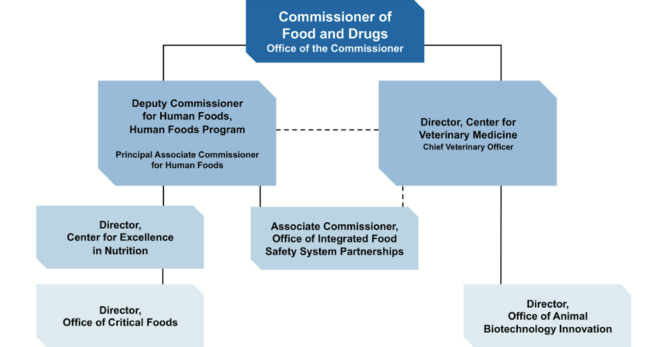
Commissioner Robert Califf has been under fire for almost a year to do something about the shotgun organizational chart for the foods program that has created silos of bureaucracy with no single person in charge. In addition to having a deputy commissioner of foods, the plan calls for the creation of yet another office that will be under that person, the Office of Integrated Food Safety Systems Partnerships.

In a follow-up report today — coming after an equally vague report on Jan. 31 — the commissioner said definitely that there will be an “empowered” deputy commissioner for food at the Food and Drug Administration. However, today’s report fails to specify what exactly “empowered” means.

“For the proposed Human Foods Program, one key to success will be an empowered Deputy Commissioner for Human Foods who will report directly to the FDA Commissioner. The agency is focused on identifying a candidate that has the expertise to provide leadership over the FDA’s nutrition and food safety programs (including programs aimed at preventing and responding to chemical, microbial, and other hazards),” Califf said. “The ideal candidate will have executive-level and real-world experience sufficient to lead the newly envisioned Human Foods Program and its vast remit. This individual will also have a clear line of authority over the proposed Human Foods Program, which would include the existing components of the Center for Food Safety and Applied Nutrition (CFSAN), the Office of Food Policy and Response (OFPR), and certain human foods-related components of ORA (Office of Regulatory Affairs). . . 

“To ensure the new Human Foods Program and all other regulatory programs at the FDA are successful, work on an agency-wide transformation effort of how the programs and field functions are organized and operate is underway. The FDA’s proposal will create a new model that better integrates ORA’s enterprise-wide expertise in field-based operations with product subject matter experts who sit in all the agency’s programs. The Deputy Commissioner for Human Foods and other program leads will be charged with setting strategic direction for food inspections and have authority over program resource allocation.”

Having a deputy commissioner for foods is not a new idea. It was in place under Obama Administration but was eliminated by FDA Commissioner Scott Gottlieb during the Trump Administration. That change and others within the agency fragmented the operations of the food side of the FDA.

In his statement today, Commissioner Califf said that the new Human Foods Program and all other regulatory programs at FDA will undergo a transformation. His plan calls for the Deputy Commissioner for Human Foods to set strategic directions for food inspections and have authority for program resource allocations.

The plan also calls for a larger executive team for the Human Foods Program to be put in place “to ensure decisive leadership over the program’s vast responsibilities.” This includes a Principal Associate Commissioner for Human Foods position, reporting to the Deputy Commissioner, to provide strong, effective operational management of the program’s day-to-day operations. In addition, a team of executives for the program’s major areas of responsibility will be created to provide the necessary management infrastructure.

In a series of bullet points the commissioner lays out some broad strokes of what the agency will do to achieve these goals. None of the bullets say how or what the “empowered” deputy commissioner will be able to do.

Among the bullet points are:

  • Assessing specific functions of ORA, CFSAN and OFPR to be unified into a new Office of Integrated Food Safety Systems Partnerships that will engage with state, local, tribal, and territorial food safety regulatory partners. The assessment will also include how best to enhance connectivity with international food safety partnership programs. 
  • Analyzing inspection and compliance functions that sit within both ORA and program offices across the agency to determine opportunities to streamline operations and clarify decision-making authority at each step of the inspection process as well as integrate new automation and information technology (IT) support. The new processes will enable ORA and program personnel to function as a multidisciplinary team, eliminating sequential steps, immediately bringing the best expertise to bear on the problem at hand, and speeding up decisions. 
  • Determining how best to empower the Deputy Commissioner for Human Foods and leaders of other programs, along with the Associate Commissioner for Regulatory Affairs, to oversee program and field resource allocation, including by publicly mapping the budget to functional activities to provide clarity on resource allocation.

“Our proposal specifically tackles issues identified in two independent evaluations of our food programs, one conducted by the Reagan-Udall Foundation and an internal evaluation of the agency’s infant formula response. We’ve heard loud and clear that the current resource distribution and operational model between the FDA’s regulatory programs and field operations are siloed and there’s too much duplication. We intend to fix this and strengthen both the regulatory programs and field force,” Commissioner Califf said. “Both subject matter experts in the programs and the expertise of our investigators in the field will see more interaction as part of multidisciplinary teams that have clarity on who is in charge of making decisions.” 

Commissioner Califf did not say specifically when the final proposal for the reorganization of the food side of FDA will be presented to the Administration and go through the Congressional notification process.

He said the agency is “seeking to finalize its proposal this fall” — which by the calendar technically comes on Sept. 23 and stretches to Dec. 23.

“This process includes the development of a reorganization package that contains the newly designed structure, an established budget, and a detailed mapping and crosswalk of staff from the current to new organization,” according to Califf. “The package then undergoes a thorough review and approval by leadership at the FDA, Department of Health and Human Services and the Office of Management and Budget, before advancing to Congress for a 30-day notification period where members may raise any concerns that the FDA may need to address. Afterward, the FDA will issue a Federal Register Notice, provide notification to and engage, as needed, in negotiations with the Unions for impacted staff, prior to initiation of the new proposal. The FDA will continue to engage with stakeholders throughout this process.”

Bill Marler, a Seattle food safety attorney and advocate for 30 years, is not impressed with the so-called plan laid out by Commissioner Califf.

“The Commissioner and present FDA leadership have essentially ignored the work of the Reagan-Udall Foundation. I am not even sure why they asked for the panel’s input if they were only going to ignore the call for a stronger head of food safety and human nutrition,” Marler said.

“The Commissioner and present FDA leadership also ignore the call for a change in culture that allows for messes like the infant formula fiasco, ongoing foodborne illness outbreaks and the complete ignoring of the surge in obesity, diabetes and heart disease caused by food.

“The last paragraph of the release says it all – the proposal needs to go back through FDA leadership, HHS, OMB, the White House and then Congress – this is designed to never get done. This is why it is time to separate Food from the FDA.

“Get The F Out of the FDA.”


TAINTED formats 3
“Reads like a true crime novel” – Food Safety News

Interested in learning more about food safety and the history of foodborne disease outbreaks and investigations?

Click on the link to listen to a short excerpt, then follow the buy links to add a digital, print or audio copy to your personal library.
Chapter 6. Birth of a Pathogen

TAINTED is available in digital format from all major on-line retailers. Press the button to go directly to your preferred digital bookstore.

Sunday Supplement: Canada’s Listeria outbreak. A study in opacity

Canada is experiencing an outbreak of Listeria monocytogenes illnesses, according to the Canadian Food Inspection Agency (CFIA).

Unfortunately, no one is prepared to reveal to the public how many people have been infected, how serious are the symptoms, or how widespread the outbreak is.

Here is what we know

  1. On January 14, 2023, Le Fromage au Village Inc. (Lorrainville, Québec) recalled five date codes of Le Cendré de Notre-Dame brand Semi-soft Surface-ripened Cheese due to Listeria monocytogenes contamination. There was no indication of any illnesses associated with this recall.
  2. On January 19, 2023, just five days later, Le Fromage au Village Inc. recalled multiple lot codes of four different cheeses, again due to Listeria monocytogenes contamination. This time, the recall notice indicated that reported illnesses “may be associated with the consumption of these products.”
  3. On January 20, 2023, the CFIA suspended the company’s Safe Food For Canadians licence (Licence #9DM4P9DP), citing the “…absence of adequate corrective measures to prevent the risk of Listeria monocytogenes contamination.” The suspension, which was announced to the public on February 3, 2023 will remain in effect until the CFIA is satisfied that the company has taken appropriate corrective measures.
  4. On February 11/12, February 14, February 15, and February 18, the CFIA announced additional recalls associated with the same investigation.

A search for answers

In response to our request for additional information on the status of its investigation, a CFIA spokesperson referred eFoodAlert to the published recall notices and suggested that we contact the Ministère de la Santé et des Services sociaux (MSSS) du Québec (the Québec Ministry of Health and Social Services).

The Public Health Agency of Canada also referred us to the Québec health authorities.

The MSSS referred us to the Public Health directorate for the Abitibi-Témiscamingue region of Québec. This region of northwestern Québec is the home of Le Fromage au Village Inc., the manufacturer of the recalled cheese. The MSSS spokesperson also suggested we contact the province’s Ministère de l’Agriculture, des Pêcheries et de l’Alimentation (MAPAQ), the Québec Ministry of Agriculture, Fisheries and Food.

The Abitibi-Témiscamingue public health spokesperson declined to answer any of our questions, even refusing to reveal how many people have been confirmed or are suspected to be part of the outbreak. The spokesperson cited reasons of confidentiality for the refusal.

As of today, eFoodAlert has not received any reply from MAPAQ.

The bottom line

Even though the recalled cheeses were distributed in Québec, Ontario, and online, it would appear that this outbreak is limited to the Abitibi-Témiscamingue region of the province of Québec.

We don’t know how many people have been infected.

We don’t know how long ago the outbreak began.

We don’t know how many people (if any) have been hospitalized, whether any pregnant women were infected, or whether there were any deaths.

The good news is that the operations of Le Fromage au Village Inc. have been shut down until the company has cleaned up its act.

The bad news is that the health authorities in the province of Québec have chosen to keep its citizens in the dark.


TAINTED formats 3
“Reads like a true crime novel” – Food Safety News

Interested in learning more about food safety and the history of foodborne disease outbreaks and investigations?

Click on the link to listen to a short excerpt, then follow the buy links to add a digital, print or audio copy to your personal library.

Chapter 6. Birth of a Pathogen

TAINTED is available in digital format from all major on-line retailers. Press the button to go directly to your preferred digital bookstore.

Advertisements