

Eggs recalled in Canada due to Salmonella contamination

Burnbrae Farms has recalled certain lot codes of six brands of shell eggs due to possible Salmonella contamination.

The recall was triggered by test results. No illnesses have been linked to the recalled products.

The following list of recalled eggs are known to have been distributed in British Columbia, Manitoba, and Ontario, and may have been distributed in other Canadian provinces and territories.

  • Compliments brand Extra Large Size White Eggs (12/pkg; UPC 0 55742 35751 6; Lot code BB 2025 FE 22; from 8 P**0021320 up to and including 8 P**0021720 (**= 03 to 32))
  • Compliments brand Large Size White Eggs (12/pkg; UPC 0 55742 35750 9; Lot code BB 2025 MR 01; from 8 P**0101145 up to and including 8 P**0101800 (** = 03 to 32))
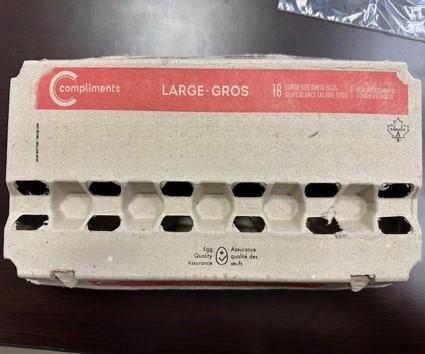
  • Compliments brand Large Size White Eggs (18/pkg; UPC 0 55742 35756 1; Lot code BB 2025 MR 01; from 8 P**0101145 up to and including 8 P**0101800 (**= 03 to 32))
  • Foremost brand Large Size Eggs (18/pkg; UPC 0 61483 05666 3; Lot codes BB 2025 FE 22; from 8 P**0021320 up to and including 8 P**0021720 (** = 03 to 32) and BB 2025 MR 01; from 8 P**0101145 up to and including 8 P**0101800 (** = 03 to 32))
  • Golden Valley Eggs brand Extra Large Size Eggs (30/pkg; UPC 0 55799 10301 2; Lot code BB 2025 MR 01 * 010 (*= C, D, E, F or H); from C6 1145 010 up to and including C6 1800 010)
  • Golden Valley Eggs brand Jumbo Size Eggs (20/pkg; UPC 0 55799 10310 4; Lot code BB 2025 FE 22 * 002 (*= A, C, D, E or F); from 1320 Est 8 up to and including 1720 Est 8)
  • Golden Valley Eggs brand Large Size Eggs (2 x 30/pkg; UPC 0 55799 10503 0; Lot code BB 2025 FE 22 * 002 (* = A, C, D, E or F); from 1320 Est 8 up to and including 1720 Est 8)
  • Golden Valley Eggs brand Large Size Eggs (30/pkg; UPC 0 55799 10303 6; Lot codes BB 2025 MR 01 * 010 (* = C, D, E, F or H); from C6 1145 010 up to and including C6 1800 010 and BB 2025 MR 01 * 010 (* = C, D, E, F or H); from C4 1145 010 up to and including C4 1800 010)
  • Golden Valley Eggs brand White Extra Large Size Eggs (18/pkg; UPC 0 55799 11101 7; Lot code BB 2025 MR 01; from 8 P**0101145 up to and including 8 P**0101800 (**= 03 to 32))
  • Golden Valley Eggs brand White Large Size Eggs (12/pkg; UPC 0 55799 10103 2; Lot code BB 2025 MR 01; from 8 P**0101145 up to and including 8 P**0101800 (** = 03 to 32))
  • IGA brand Extra Large Eggs (12/pkg; UPC 0 55742 05119 3; Lot code BB 2025 FE 22; from 8 P**0021320 up to and including 8 P**0021720 (** = 03 to 32))
  • no name brand Large Size Eggs (12/pkg; UPC 0 60383 66414 5; Lot code BB 2025 MR 01; from 8 P**0101145 up to and including 8 P**0101800 (**= 03 to 32))
  • no name brand Large Size Eggs (30/pkg; UPC 0 60383 22293 2; Lot codes BB 2025 FE 22 * 002 (*= C, D, E, F or H); from C6 1320 002 up to and including C6 1720 002, BB 2025 MR 01 * 010 (*= C, D, E, F or H); from C6 1145 010 up to and including C6 1800 010, and BB 2025 MR 01 * 010 (*= C, D, E, F or H); from C4 1145 010 up to and including C4 1800 010)
  • no name brand Large Size Eggs (30/pkg; UPC 0 60383 22293 2; Lot code BB 2025 FE 16 BW24 354 M)
  • Western Family brand Extra Large Size White Eggs (12/pkg; UPC 0 62639 41011 7; Lot codes BB 2025 FE 22; from 8 P**0021320 up to and including 8 P**0021720 (** = 03 to 32) and BB 2025 MR 01; from 8 P**0101145 up to and including 8 P**0101800 (** = 03 to 32))
  • Western Family brand Large Size White Eggs (30/pkg; UPC 0 62639 39498 1; Lot code BB 2025 MR 01 * 010 (* = C, D, E, F or H); from C4 1145 010 up to and including C4 1800 010)

The Canadian Food Inspection Agency (CFIA) is verifying that all recalled product has been removed from the market and is conducting a food safety investigation that may lead to additional recalls.

  • If you think you became sick from consuming a recalled product, contact your healthcare provider
  • Check to see if you have recalled products
  • Do not consume, serve, use, sell, or distribute recalled products
  • Recalled products should be thrown out or returned to the location where they were purchased
  • Consumers who are unsure if they have purchased the recalled products are advised to contact their retailer

Food contaminated with Salmonella may not look or smell spoiled but can still make you sick. Young children, pregnant women, the elderly and people with weakened immune systems may contract serious and sometimes deadly infections. Healthy people may experience short-term symptoms such as fever, headache, vomiting, nausea, abdominal cramps and diarrhea. Long-term complications may include severe arthritis.


“Reads like a true crime novel” – Food Safety News

Interested in learning more about food safety and the history of foodborne disease outbreaks and investigations?

Click on the link to listen to a short excerpt, then follow the buy links to add a digital, print or audio copy to your personal library.

Chapter 6. Birth of a Pathogen

TAINTED is available in digital format from all major on-line retailers. Press the button to go directly to your preferred digital bookstore.

McDonald’s onion supplier ignored sanitation protocols

Taylor Farms Colorado, Inc., a supplier of slivered onions to McDonald’s franchises in a dozen states, ignored its own sanitation and food safety protocols, according to an inspection report from the FDA. The redacted report (FDA Form 483) was made available to the public on the Marler Blog site.

The slivered yellow onions were implicated in an outbreak of E. coli O157:H7 infections that sickened 104 people; 34 of the victims were hospitalized and one person died.

Following a traceback investigation, the FDA conducted an intensive inspection of the Taylor Farms production facility and found multiple instances of inadequate or improper cleaning and sanitation procedures, some in contravention of the company’s own written directives.

The slivered onions processed in the Colorado facility were exposed to the environment from the initial peeling step all the way to the finished packaging step. These ready-to-eat items do not undergo a lethal treatment step for pathogens. They are used as a raw “topper” in McDonald’s Quarter Pounder hamburgers.

The company’s food safety plan listed Salmonella and Listeria as hazards that require a sanitation control. Yet, inspectors observed several areas in the production plant that could support pathogen growth on food contact surfaces, and the ambient temperature inside the production facility was favorable to the growth of pathogens such as Listeria.

For example, pooling water was present in the vicinity of a cutting area, and the area tested positive for Listeria, as did a number of non-food contact surface areas in the production rooms.

Although the company’s Environmental Monitoring plan specified corrective actions when an environmental pathogen was detected, monitoring records for 2023 and 2024 indicated that these requirements were not consistently followed. In addition, the verification methods used were not designed to determine the types of pathogens found on a surface.

Cleaning procedures also were unreliable. FDA investigators observed apparent biofilm and large amounts of food debris on numerous equipment surfaces AFTER the post-operation clean-ups were completed. Surfaces that were not visually clean and should have been marked as “Fail” during pre-operation inspection were marked as “Pass” instead.

Other deficiencies included:

  • Torn and damaged conveyor belts
  • Trapped water and food debris present in pitted areas of food contact surfaces
  • Food particles in crevices of the welds on production lines
  • Sanitizing disposable gloves rather than removing and replacing them
  • Missing cleanliness check documents
  • Improper storage of food contact utensils (eg., knives)
  • Incorrect concentration level for sanitizing solution
  • Sanitized surfaces not allowed to air-dry before put into use.

Taylor Farms’ Colorado facility has been inspected on four previous occasions, most recently in 2020.

The facility passed inspection each time, with no corrective actions indicated, according to information available on the FDA Inspection Database.

Either the previous inspections were superficial, or else something changed between 2020 and 2024.

After the infamous “Jack In The Box” E. coli O157:H7 outbreak in 1992-1993, Foodmaker Inc. (the restaurant chain’s parent company) overhauled its Quality Assurance programs and implemented more stringent requirements of its suppliers.

A company the size of McDonald’s has enormous clout with prospective suppliers. If it were to insist on adherence to effective cleaning, sanitation and quality assurance protocols, and were to enforce these requirements by reserving the right to conduct unannounced audits of its suppliers’ facilities, the quality and safety of McDonald’s own products would be enhanced.

The FDA’s food safety program is overworked and underfunded.

FDA is spending a large chunk of its resources (personnel, lab facilities, etc) in tracing the sources foodborne outbreaks and putting out fires.

Year by year, the number of production facilities the FDA oversees has grown, and the agency’s budget has not kept pace.

And with a new administration about to take office, chances are the situation will only get worse.


“Reads like a true crime novel” – Food Safety News

Interested in learning more about food safety and the history of foodborne disease outbreaks and investigations?

Click on the link to listen to a short excerpt, then follow the buy links to add a digital, print or audio copy to your personal library.

Chapter 6. Birth of a Pathogen

TAINTED is available in digital format from all major on-line retailers. Press the button to go directly to your preferred digital bookstore.

Bird flu: what you need to know

Highly pathogenic avian influenza (HPAI), otherwise known as bird flu, has insinuated itself into the wild bird and domestic fowl populations around the world since at least 1997.

Although there are several antigenic variants of the bird flu virus, H5N1 is the current dominant form.

The first human case of H5N1 bird flu was identified in 1997. By the end of that year, 18 human cases had been confirmed.

The virus faded into the background until 2003/2004, when a large outbreak of H5N1 infections spread through poultry flocks in several Asian countries.

Between 2003 and February 2011, the virus infected millions of birds in multiple countries. During this same period, 528 human cases of H5N1 infections were reported in 15 countries in Asia and Africa. Of these, 311 died.

Courtesy of the World Health Organization

As H5N1 has spread into flocks of wild birds and domestic fowl around the world, so too has the risk of spread to humans increased.

Since February 2022, the US Department of Agriculture (USDA) has confirmed the presence of H5N1-infected birds in 1376 poultry flocks, including 623 commercial flocks and 753 backyard flocks. More than 130 million birds from all 50 states have been affected.

The virus also is widely distributed across the wild bird population. The USDA has confirmed nearly 11,000 cases of bird flu in multiple species of wild birds since January 2022.

During this same period, the USDA confirmed H5N1 in 418 mammals across the country, including deer mice, house mice, domestic cats, mountain lions, coyotes, bottlenose dolphins, foxes, skunks, raccoons, black bears, and other species.

In March 2024, the USDA reported the first confirmed case of H5N1 infection in a dairy herd. As of December 31, 2024, there were 916 confirmed cases in cattle in 16 states: California, Colorado, Idaho, Iowa, Kansas, Michigan, Minnesota, Nevada, New Mexico, North Carolina, Ohio, Oklahoma, South Dakota, Texas, Utah, Wyoming.

In 2022, a poultry worker in Colorado was infected with H5N1—the first reported case of a human H5N1 infection in the USA. The next case was identified in March 2024.

From March 2024 to December 31, 2024, the US Centers for Disease Control and Prevention (CDC) has confirmed 66 cases of human infection with the H5N1 virus in 10 states: California (37), Colorado (10), Iowa (1), Louisiana (1), Michigan (2), Missouri (1), Oregon (1), Texas (1), Washington (11), Wisconsin (1).

Sixty-three of the 66 infected individuals worked either with dairy herds or in poultry farms and culling operations. No person-to-person spread has been reported.

Since December 2021, the Canadian Food Inspection Agency (CFIA) has detected 517 infected poultry premises (commercial and non-commercial) in nine provinces: Alberta (86), British Columbia (235), Manitoba (24), New Brunswick (2), Newfoundland and Labrador (2), Nova Scotia (8), Ontario (56), Québec (58), Saskatchewan (46).

Seventy-six of the 517 premises are currently infected. The other 441 have been cleared and released.

To date, the H5N1 virus present in US livestock (dairy cattle) has not been found in domestic poultry flocks in Canada.

To date, 3439 instances of confirmed or suspect H5N1 cases in wildlife (birds and mammals) have been reported to the Canadian Wildlife Health Cooperative. Infected wildlife have been found in every province and territory.

As of January 4, 2025, no cases of H5N1 infections in either humans or cattle have been reported in Canada.

In Canada

In May and June 2024, CFIA labs studied the effectiveness of milk pasteurization to inactivate the H5N1 virus. The study concluded that standard pasteurization procedures currently in use are effective.

Between March and September 2024, the CFIA tested 1,211 retail pasteurized milk samples from across Canada. All of the samples were negative for H5N1.

As of December 19, 2024, CFIA labs have tested 1,432 samples of raw milk arriving at processing plants in all provinces across Canada. All of the samples tested negative for H5N1.

In the USA

In May 2024, the FDA conducted a surveillance study of retail dairy products. All 297 samples were negative for the H5N1 virus.

In June 2024, the FDA released the results of its study on the inactivation of H5N1 virus in milk by standard commercial pasteurization procedures. The report concluded that the commercial pasteurized milk supply in the US is safe.

In August 2024, the FDA released the results of a second surveillance study that included aged raw milk cheese, pasteurized fluid milk and products made from pasteurized milk, such as pasteurized cheeses, cream cheese, butter, and ice cream. All 167 samples were negative for H5N1.

In October 2024, the FDA invited states to participate in a voluntary “silo study.” Grade “A” raw cow’s milk from participating states intended to be pasteurized were be sampled from raw milk storage silos at dairy processing facilities, over a six-week period.

On December 23, 2024, the FDA announced that it would begin to collect and test aged raw cow’s milk cheese for the presence of viable H5N1 virus.

Several state departments of agriculture have initiated surveillance of raw milk for the presence of the H5N1 virus. In December 2024, the California Department of Public Health announced the recall of raw milk and cream from two producers of retail raw dairy products—Raw Farm, LLC and Valley Milk Simply Bottled—after finding viable H5N1 viruses in samples of the companies’ milk.

Finally, on December 6, 2024, the USDA announced a new National Milk Testing Strategy. As part of the strategy, the USDA announced it would immediately begin testing of raw milk silos at dairy processing facilities.

The CDC recommends the following precautions:


“Reads like a true crime novel” – Food Safety News

Interested in learning more about food safety and the history of foodborne disease outbreaks and investigations?

Click on the link to listen to a short excerpt, then follow the buy links to add a digital, print or audio copy to your personal library.
Chapter 6. Birth of a Pathogen

TAINTED is available in digital format from all major on-line retailers. Press the button to go directly to your preferred digital bookstore.