Lea Way Farms, Inc., doing business as Blue Ridge Beef, today (December 21, 2023) announced a recall of three raw pet food products after the North Carolina Department of Agriculture and Consumer Services found both Salmonella and Listeria monocytogenes in one lot of each of those products.
The recall covers the following items:
Kitten Grind, 2-lb tube:- All lot codes & Use-by dates from N24 1124 to N24 1224; UPC 8 54298 00101 6
Kitten Mix, 2-lb tube:- All lot codes & Use-by dates from N24 1124 to N24 1224; UPC 8 54298 00243 6
Puppy Mix, 2-lb tube:- All lot codes & Use-by dates from N24 1124 to N24 1224; UPC 8 54298 00169 6
The recalled products were packaged in clear plastic and sold primarily in retail stores located in the states of Connecticut, Massachusetts, Maryland, North Carolina, New York, Pennsylvania and Virginia. The lot numbers and use-by dates are located on the silver tabs at the end of the tubes.
To date, FDA has not received reports of any illnesses.
This is the second recall in less than two months for the company. On October 27, 2023, Blue Ridge Beef recalled a single production lot of Breeders Choice 2# log dog food after the FDA found Salmonella in a sample of the product.
The company’s production facility was first inspected by the FDA in December 2016. Subsequent inspections were performed in October 2019 and August 2020.
The 2019 inspection revealed major infractions of food safety practices, resulting in the issuance of a Warning Letter to the company on June 26, 2020. Some of the violations raised in the Warning Letter included,
Mishandling of carcasses (dragging them across the floor)
Not examining raw materials to determine whether they were suitable for use in manufacture of animal food
Spilling of fecal material over exposed carcasses
Inadequate maintenance of equipment and facilities
Operating under a canceled Food Facility Registration
The August 2020 inspection, carried out as a follow-up to the Warning Letter, revealed that the company had not yet rectified several of the violations listed in the June 26th letter.
What consumers should know
Puppies and kittens are more susceptible to illness than adults. Pet owners who have fed the recalled products to their pets should be on the lookout for symptoms of infection.
Pets with Salmonella and Listeria infections may be lethargic and have diarrhea or bloody diarrhea, fever, and vomiting. Some pets will have only decreased appetite, fever, and abdominal pain. Infected but otherwise healthy pets can be carriers and infect other animals or humans. If your pet has consumed the recalled product and has these symptoms, please contact your veterinarian.
The FDA relies on reports from pet owners and veterinarians for information on potentially hazardous pet foods. If you believe your pet was infected or harmed by consuming a pet food, you can report the issue electronically through the Safety Reporting Portal or you can call your state’s FDA Consumer Complaint Coordinators.
“A complete and compelling account of the hidden and not-so-hidden ways the food we give our beloved pets can be contaminated.” – JoNel Aleccia, Health Reporter, Food & Nutrition, The Associated Press.
“An invaluable resource for busy pet owners” – Food Safety News
Available from all major on-line retailers, including:
Five deaths have been reported in Canada and three in the United States.
Six Canadian provinces have reported outbreak cases to the PHAC:
British Columbia: 15
Ontario: 17
Quebec: 91
Prince Edward Island: 2
New Brunswick: 2
Newfoundland and Labrador: 2
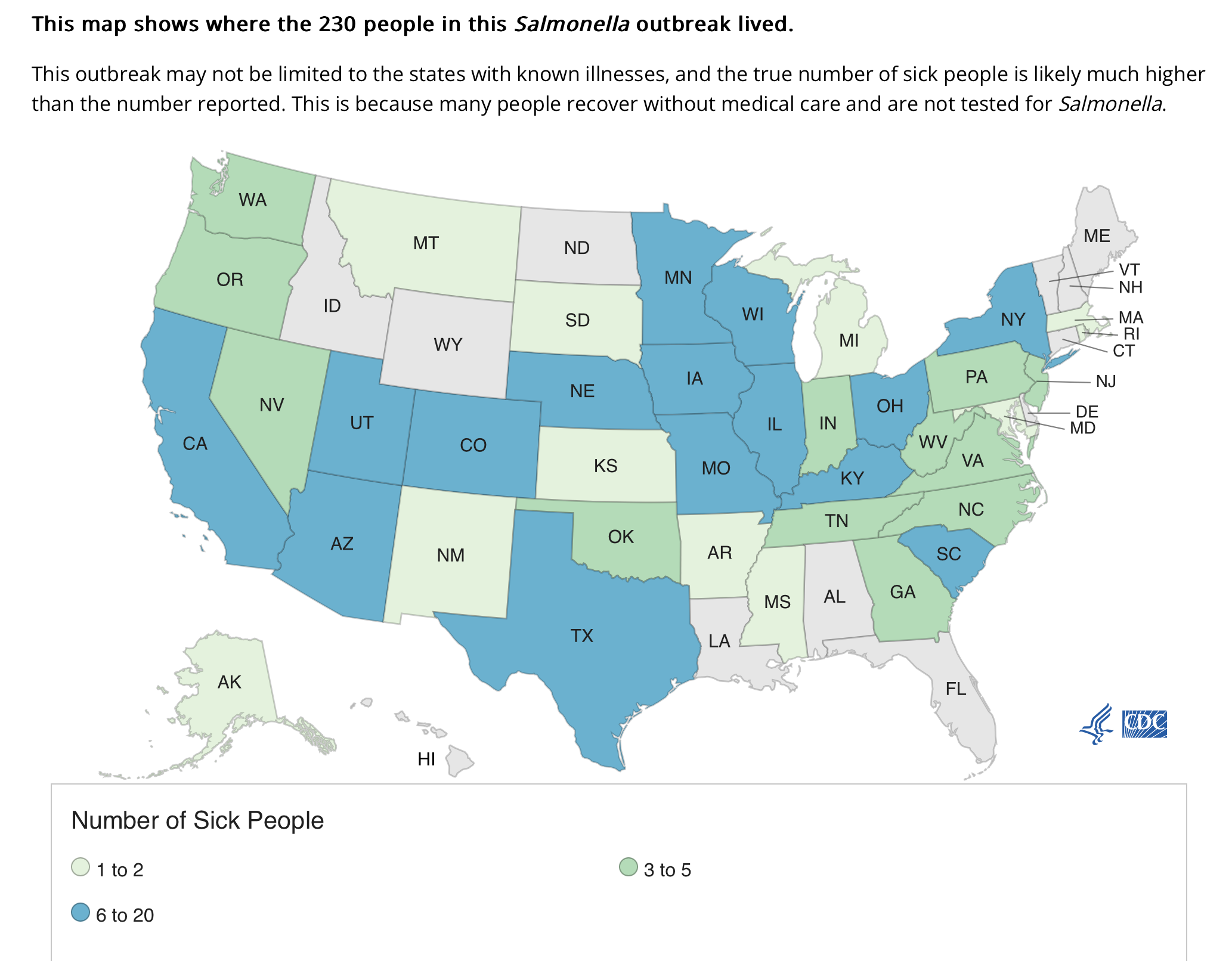
In the United States, cases have been reported by 38 states (see image below, supplied by the CDC).
Multiple recalls have been announced in both countries. The US Food and Drug Administration (FDA) has activated a webpage devoted to listing the recalls announced publically in the USA. A list of Canadian recalls has been provided on the Canadian Food Inspection Agency website.
Hardest hit populations
Both the CDC and the PHAC have pointed out that children under the age of five and adults over the age of 65 have accounted for a large majority of the lab-confirmed cases in both countries.
In the USA, children under the age of five account for 27% of the confirmed cases to date, while seniors (over the age of 65) account for 47% of cases.
In Canada, 35% of the confirmed cases occurred in children under the age of five, while seniors accounted for 45% of confirmed cases.
Why should this be so?
The very young and the elderly typically are more susceptible to most infections than the rest of the population, and also are prone to experiencing more severe symptoms.
But there are other factors in play, which are highlighted by demographic data provided by the CDC.
Specifically, 23 children attended childcare centers, and 24 of the adult victims were residents of longterm care facilities among the 230 cases in the USA.
The PHAC also reported that many of the Canadian victims resided in a long-term care home, or a retirement residence, or attended daycare.
Many of the recalled products—especially many cut fruit products and fruit salads—were supplied to medical facilities, institutions, food service facilities, hotels, and restaurants.
Not all of these recalls have been made public in the United States. Instead, the recalling company communicated directly with its customers. For example:
Market Cuts LLC:- Recalled 8 cut fruit products by letter notification to its customer(s) in Illinois, Indiana, Michigan and Wisconsin
Freshpoint Of Southern CA:- Recalled Imperial Fresh brand whole cantaloupes, which it had supplied to food services in California, Arizona and Nevada
FreshPoint Dallas:- Recalled Imperial Fresh brand whole cantaloupes, which it had supplied to institutions, medical facilities and direct food service accounts in Arkansas, Missouri, Mississippi, Kansas, Louisiana, Oklahoma, Texas
Several of the cut fruit products and whole cantaloupes distributed in Canada also were supplied to hotels, food service operations and institutions (such as hospitals, longterm care facilities and child care facilities).
What consumers in Canada and the United States should know
This outbreak is far from over, and the case counts are continuing to climb. Furthermore, the number of reported cases in any outbreak represents only a fraction of the total number of people who become infected.
Consumers are advised to discard and not consume Malichita or Rudy cantaloupes or any other recalled products. If you have whole or pre-cut cantaloupes or fruit cups, fruit platters, or fruit medleys in your home and are unsure of their origin, discard them as a precaution.
Food contaminated with Salmonella may not look or smell spoiled but can still make you sick. Young children, pregnant women, the elderly and people with weakened immune systems may contract serious and sometimes deadly infections. Healthy people may experience short-term symptoms such as fever, headache, vomiting, nausea, abdominal cramps and diarrhea. Long-term complications may include severe arthritis.
If you feel unwell, and especially if you have symptoms like diarrhea or vomiting, do not cook or prepare food for other people.
If you suspect you are suffering from a Salmonella infection, consult your healthcare provider.
“Reads like a true crime novel” – Food Safety News
Interested in learning more about food safety and the history of foodborne disease outbreaks and investigations?
Click on the link to listen to a short excerpt, then follow the buy links to add a digital, print or audio copy to your personal library.





 eFoodAlert