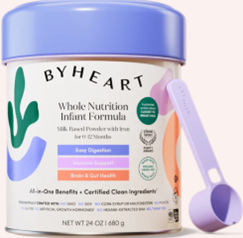
Powdered Infant Formula linked to infant botulism outbreak

The FDA, CDC, California Department of Public Health and state and local partners are investigating a ten-state outbreak of infant botulism that has sickened 13 infants so far.

Caregivers for all thirteen infants reported feeding ByHeart Whole Nutrition infant formula.

Illnesses have been reported in Arizona (1), California (2), Illinois (2), Minnesota (1), New Jersey (1), Oregon (1), Pennsylvania (1), Rhode Island (1), Texas (2), and Washington (1). These totals include both suspected and confirmed cases.

The thirteen victims range in age from 16 to 157 days. All thirteen have been hospitalized and treated with BabyBIG®, an antidote to infant botulism.

Several states have collected leftover samples of infant formula for testing; work is in progress, but the results are not yet available.

The FDA has recommended that the manufacturer, ByHeart Inc., initate a recall. The company has complied and is recalling the following two lots, which were reported to have been consumed by the infants:

  • ByHeart Whole Nutrition Infant formula:- Lot no. 206VABP/251261P2 and Lot no. 206VABP/251131P2)

Infant botulism happens when swallowed spores from a type of bacteria called Clostridium botulinum infects a baby’s large intestine and make toxin in it. 

Infant botulism often starts with constipation but is usually first noticed as difficulty feeding (sucking and swallowing), a weak and altered cry, and loss of muscle tone. Symptoms can progress to difficulty breathing and respiratory arrest.

Symptoms of infant botulism, which is diagnosed clinically, can take as long as several weeks to develop following formula ingestion.

  • Parents and Caregivers should not use certain lots of ByHeart Whole Nutrition Infant Formula and should throw this product away immediately. If your child is experiencing symptoms (see below) after consuming ByHeart Whole Nutrition Infant Formula and you still have the formula in your home, please record the information on the bottom of the package before throwing it away.
  • Botulism can be fatal, and you should take action right away. If your child has consumed ByHeart Whole Nutrition Infant Formula and is experiencing signs and symptoms of botulism such as poor feeding, loss of head control, difficulty swallowing, or decreased facial expression, seek immediate health care. 
  • If you are a Physician and suspect your infant patient has botulism, immediately call 510-231-7600 for case consultation. Consultation is available 24/7.

TAINTED formats 3
“Reads like a true crime novel” – Food Safety News

Interested in learning more about food safety and the history of foodborne disease outbreaks and investigations?

Click on the link to listen to a short excerpt, then follow the buy links to add a digital, print or audio copy to your personal library.

Chapter 6. Birth of a Pathogen

Botulism and baby food. The Oceanitan affair

Image courtesy of CDC.gov

On January 24, 2023, the Missouri Department of Health and Human Services alerted the US Food and Drug Administration (FDA) to a possible case of Clostridium botulinum in an infant.

Although primarily breastfed, the infant had also been fed some packaged refrigerated baby food on or around January 7th (pumpkin) and January 11th (broccoli). On January 18th, the infant began to show symptoms of botulism.

By January 22nd, the infant had been hospitalized, and treatment with an anti-toxin was initiated.

The treatment was successful and the infant survived.

The baby food was manufactured by Oceanitan, LLC, a contract manufacturer of baby food products located in Los Angeles, California.

On February 3rd, a Missouri health inspector collected samples of the product from the infant’s home and submitted them to the FDA for analysis.

On February 16th, with the lab analysis underway, the FDA began an in-depth inspection of Oceanitan’s manufacturing facility—an inspection that would continue into early April.

The inspection revealed multiple, serious violations of various federal standards (“rules”) for safe manufacture of food products. These violations included:

  • Lack of preventive controls for bacterial growth and/or toxin formation by Clostridium botulinum in the finished, packaged ready-to-eat products
  • Use of uncalibrated and inaccurate thermometers to measure storage temperatures
  • Exposure of cooked ingredients and products to potential environmental contamination during cooling, production, and packaging
  • Lack of an environmental monitoring program
  • Inadequate sanitation controls procedures
  • Lack of a validation study to support cooking parameters specified in the written Process Control document
  • Dripping water, exposed rust, and peeling paint in various areas of the manufacturing facility

While the inspection was still in progress, the FDA laboratory completed its analysis. The products collected by the Missouri inspector from the home of the sick infant were contaminated with both a non-toxin strain of Clostridium botulinum and a strain of Clostridium beijerinckii.

Although both of these strains were non-pathogenic, they represented clear evidence that a toxin-producing strain of Clostridium botulinum would have been fully capable of growing in the baby food. The lab also reported that the pH and water activity of these products were well within the range to promote growth of the pathogen.

In keeping with the agency’s standard operating practice, the FDA investigator met with company management on April 6th at the completion of the inspection to make a formal presentation of FDA Form 483 (Inspectional Observations) and review the documented violations.

On April 27th, Oceanitan’s Chief Executive Officer, Nelson Lee, responded in writing to the list of observations. He informed the FDA that the company had purchased calibrated temperature data monitors for its coolers, contracted a third-party lab to initiate an environmental monitoring program, updated its sanitation program, cleaned and repaired ceilings and walls, and initiated steps to have other repairs performed by an outside contractor.

After reviewing the company’s response, the FDA issued a Warning Letter on September 7, 2023. In its letter, the agency noted that Oceanitan had not taken steps to update its hazard analysis or implement written procedures for monitoring a preventive control. Nor did the company provide a validation study for its process control parameters.

The FDA gave Oceanitan fifteen working days from receipt of the letter to notify the agency in writing of the steps it was taking to correct the remaining violatiosn and prevent a recurrence, and also advised the company that the agency would be conducting a follow-up inspection to determine Oceanitan’s compliance with the requirements of the Federal Food, Drug, and Cosmetic Act and its asssociated regulations.

Botulism is not a common occurrence.

In 2019, the most recent year for which data are posted on its website, the US Centers for Disease Control and Prevention (CDC) reported 152 cases of infant botulism and just 21 cases of foodborne botulism.

That same year, the CDC logged 58,371 non-typhoidal Salmonella reports and 16,939 reports of shiga toxin-producing E. coli.

Infant botulism can be associated with consumption of honey that is contaminated with spores of Clostridium botulinum. In fact, in Canada, raw honey is the only food that has been specifically linked to infant botulism.

In foodborne botulism, individuals become ill from eating a food that contains pre-formed toxin. But in the case of infants, it’s not necessary for the toxin to be present in the food. Clostridium botulinum spores can multiply and produce their deadly toxin in the baby’s intestine.

The baby food products manufactured under contract by Oceanitan were neither commercially sterile nor shelf-stable.

The products were sold as refrigerated, “ready-to-eat” baby foods.

Information on the brand(s) of baby food products manufactured by Oceanitan was redacted from the documents obtained by eFoodAlert under the Freedom of Information Act, as this information is considered to be proprietary.

The manufacturing process consisted of cooking the individual ingredients before they were mixed and puréed. There was no second “kill” step either before or after the products were filled into their 4-ounce plastic jars. And there were serious flaws in the company’s hazard analysis, environmental monitoring, and facility maintenance.

By neglecting fundamental principles of safe food manufacture, the company and its commercial customers put a vulnerable population at risk.


TAINTED formats 3
“Reads like a true crime novel” – Food Safety News

Interested in learning more about food safety and the history of foodborne disease outbreaks and investigations?

Click on the link to listen to a short excerpt, then follow the buy links to add a digital, print or audio copy to your personal library.

Chapter 6. Birth of a Pathogen

TAINTED is available in digital format from all major on-line retailers. Press the button to go directly to your preferred digital bookstore.

Recalls and Alerts: November 15 – 18, 2018

Here is today’s list of food safety recalls, product withdrawals, allergy alerts and miscellaneous compliance issues. The live links will take you directly to the official recall notices and company news releases that contain detailed information for each recall and alert.

If you would like to receive automatic email alerts for all new articles posted on eFoodAlert, please submit your request using the sidebar link.

United States

OUTBREAK ALERT: FDA reminds parents not to feed honey to children younger than one year old. Honey Pacificers purchased in Mexico suspected in four cases of infant botulism in Texas.

OUTBREAK ALERT/Food Safety Recall: Jennie-O Turkey Store Sales, LLC recalls 91,388 pounds of raw ground turkey products due to possible contamination with Salmonella Reading. The contaminated turkey meat may be linked to a 35-state outbreak of Salmonella Reading illnesses, including one death, 164 illnesses and 63 hospitalizations.

OUTBREAK ALERT (UPDATE): CDC reports outbreak of Salmonella Newport infections linked to ground beef recalled by JBS Tolleson, Inc. has grown to 246 confirmed cases (59 hospitalized) in 25 states.

Allergy Alert: Chukar Cherries recalls Amaretto Rainier Chocolate Cherries (7.5 oz; Best By date of 09/2019; UPC 0 11261 22307 7) due to undeclared milk.

Allergy Alert: Nor Cal Food Solutions, LLC recalls Pumpkin Pesto Tapenade, manufactured by Purveyors Kitchen (7.75oz glass jars with a black metal lid; Lot codes PKPP17179A, PKPP17179B, PKPP17179C and PKPP17230B; Best before June 2019 and August 2019 (Lot code PKPP17230B)) due to undeclared walnuts.

Food Safety Recall: The Quaker Oats Company recalls 21 boxes of Cap’n Crunch’s Peanut Butter Crunch cereal (17.1 oz; Best Before JUL 30 19 or JUL 31 19; UPC 0 30000 6211 1) due to possible Salmonella contamination. The recalled product was supplied to five Target stores. Please refer to the recall notice for a list of the affected locations.

Food Safety Recall: Majestic Meat Company recalls approximately 532 pounds of bulk ground beef, ground beef patties, and meatballs due to possible contamination with E. coli O157:H7. Please refer to the recall notice for a complete list of affected products, which were shipped to restaurants in the state of Utah.

Food Safety Recall: Green Cedar Dairy recalls Green Cedar Ackawi cheese (Sell by March 26, 2019 or later) due to possible Listeria monocytogenes contamination. The recalled product was distributed at retail locations East Dearborn and Dearborn Heights Michigan.

Canada

Allergy Alert: Paradise Kosher recalls various baked goods due to undeclared wheat, gluten, eggs, sesame seeds, mustard and soy. Please refer to the recall notice for a complete list of affected products.

Allergy Alert: Industry recalls Ottogi brand Jin Ramen Spicy (600g; BEST BEFORE AUG.20.2019) and Ottogi brand Jin Ramen Mild (600g; BEST BEFORE AUG.19.2019) due to undeclared egg.

Food Safety Recall: L’Intermarché Lagoria recalls sardines due to elevated levels of histamine. Please refer to the recall notice for a complete list of affected products.

Food Safety Recall: Chez Hector Prêt à manger recalls JAMBON À LA BIÈRE ET SIROP D’ÉRABLE  (500 mL; All product sold up to and including 16 November 2018) because the product may be unsafe for consumption.

Europe

Allergy Alert (Belgium): Colruyt recalls Everyday mélange à la noix muscade (100g; Lot #P101372; Best before 08/2022) due to undeclared milk and mustard.

Allergy Alert (Ireland): Allergy Alert (UK): Nisa recalls Heritage Dark Chocolate (90g; Best before 5 December 2019) due to undeclared milk.

Allergy Alert (Ireland): Clive’s recalls Clive’s Bombay Vegetables with Daal Tarts (190g; all Best before dates; All batch codes) due to undeclared mustard and sesame.

Allergy Alert (UK): Nisa recalls Heritage Dark Chocolate (90g; Best before 5 December 2019) due to undeclared milk.

Allergy Alert (UK): Clive’s recalls Clive’s Bombay Vegetables with Daal Tarts, chilled (190g; all dates up to and including 24 November 2018) and Clive’s Bombay Vegetables with Daal Tarts, frozen (190g; all dates up to and including 24 May 2019) due to undeclared mustard and sesame.

Food Safety Recall (Denmark): Salling Group recalls Bakersfield Skagenslapper frozen rolls (10 pieces/750g; Best before 01/10/2019, 02/10/2019) due to foreign matter (blue plastic pieces) contamination.

Food Safety Recall (Denmark): Dagrofa ApS recalls Gestus Pasta with hot-smoked salmon (360g; All dates from 15.11.2018 to 28.11.2018) due to Listeria contamination.

Food Safety Recall (France): Bergams recalls Bergams brand Purée de carotte, boeuf, épices cajun, patate douce (Best before 13/10 to 06/11, inclusive) due to Listeria monocytogenes contamination.

Food Safety Recall (France): Bergams recalls Bergams brand Wrap chaud, bœuf, légumes à l’orientale (Best before 12/10 to 05/11, inclusive) due to Listeria monocytogenes contamination.

Food Safety Recall (France): Intermarché recalls Maredoc brand clams (1kg and 3kg; Sold November 6 – 12, 2018) due to Salmonella contamination.

Food Safety Recall (Germany): Ferme Chapuis recalls Perle de Compostelle raw milk cheese (Best before 16.11.2018; Product of France) due to verotoxin-producing E. coli.

Food Safety Recall (Ireland): Caffreys recalls Confectionery Halloween Bloodie Mallows (All batches; Best before 30 January 2019) due to possible Salmonella contamination.

Food Safety Recall (Ireland): Aldi recalls The Deli Green Pesto (140g; Use by 23.11.2018) due to Salmonella contamination.

Food Safety Recall (Ireland): Goldsmith Goats recalls Goldsmith Goats Raw Goats Milk (All batch codes; All use-by dates) due to contamination with Escherichia coli O157 vt1.

Food Safety Recall (UK-England): Booths recalls Booths mince pies (4-pack; Batch code P/463246; Best before 12 January 2019) due to foreign matter (pieces of white plastic) contamination.

Food Safety Recall (UK-Northern Ireland): Caffreys recalls Confectionery Halloween Bloodie Mallows (All batches; Best before 30 January 2019) due to possible Salmonella contamination.

Pet Food Safety Recall (UK-England): The Raw Factory Ltd recalls various raw pet food products containing tripe and/or pork due to Salmonella contamination. Please refer to the recall notice for a complete list of affected products.

Asia, Africa and the Pacific Islands

Food Safety Recall (Hong Kong): Angliss Hong Kong Food Service Ltd recalls Casa Modena brand Mortadella Bologna IGP con pistacchio (Use by November 28, 2018; Product of Italy) due to possible Listeria monocytogenes contamination.

Australia and New Zealand

Food Safety Recall (Australia): My Queen Pty Ltd recalls Mini Cici Jelly and Mini Cici Jelly with dairy (360g; All Best before dates; Product of China) due to a choking hazard.