

Where has all the lettuce gone?
Shredded iceberg lettuce imported by Taylor Farms de Mexico and implicated in this summer’s 5-state Cyclospora outbreak was supplied to KFC, Pizza Hut, Subway, Trader Joe’s, Walmart, Sysco, Cross Valley Farms, and Peak Fresh Produce, and may have also been distributed to other consignees, according to information released on July 20, 2026 by the Alabama Department of Public Health.
The outbreak was linked initially to lettuce supplied to Taco Bell outlets, but this does not account for all of the reported cases.
Taco Bell removed all of the implicated lettuce from its stores as soon as the epidemiological connection between that product and the Cyclospora cases was established.
The recall notice released by Taylor Farms de Mexico provided minimal information as to the brands and destinations of the shredded lettuce implicated in the outbreak. The notice contained a long list of products, most of which were identified as having been supplied to the foodservice market. Those products were identified using semi-comprehensible codes: CV, JB, MARK, PK, SUB, SY, and TF and were distributed to customers in 27 states (AL, AR, CT, FL, GA, IA, IL, IN, KS, KY, LA, MA, MD, MI, MO, MS, NC, NH, NJ, OH, OK, PA, SC, TN, TX, VA, and WI).
In addition, two products were labeled as “retail” and identified as MKTSD.

The MKTSD products were eventually revealed by the FDA to be Marketside brand products sold by Walmart in fifteen states (AL, AR, FL, GA, IN, KS, KY, LA, MO, MS, OK, TN, TX, VA, WV).
TF most likely refers to Taylor Farms’ own brand.
As of today (July 21, 2026), no additional distribution information has been released to the public by either the company or the FDA.
Where have all the cases gone?
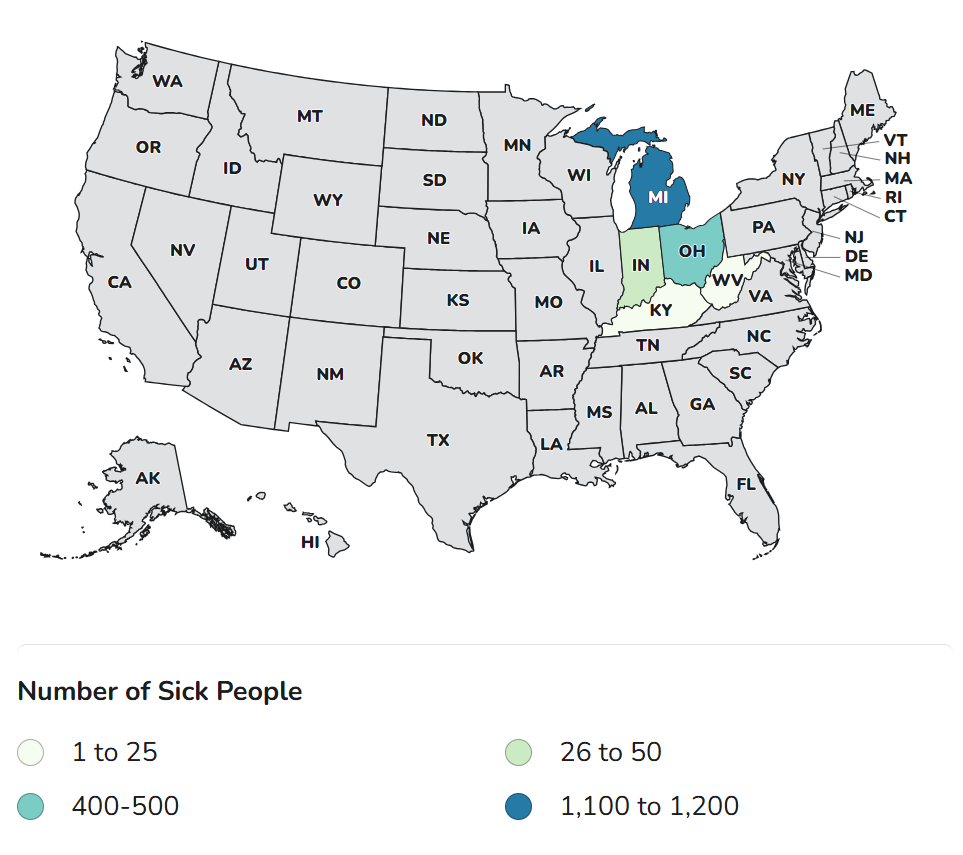
The CDC last updated the Taco Bell-linked outbreak case counts and distribution on July 18th. As of that date, the federal agency was reporting “more than 1,644” cases and 94 hospitalizations in five states.
The states with identified outbreak cases, according to the CDC, are: Indiana (47), Kentucky (25), Michigan (1,141), Ohio (420), and West Virginia (11).
As of July 21st, the CDC’s cyclosporiasis surveillance update recognized 4,173 confirmed cases of domestic origin and 308 hospitalizations in 41 states. Michigan was hardest hit, with “901 to 2100” confirmed cases, followed by Ohio with “301 to 500.” The agency is aware of an additional 7,400 cases awaiting confirmation.
Here is what the individual states have to report:
- Alabama:- As of July 20th, Alabama has recorded 28 cases. Four cases (14.3%) are related to international travel, and eight cases (28.6%) are associated with two separate foodborne outbreaks at Mexican-style restaurants (not Taco Bell).
- California:- As of July 14th, there are no known outbreaks in the state. California has logged 41 provisional cases, compared to 80 cases in 2025.
- Connecticut:- The state has confirmed 35 cases, which is nearly double the 19 cases confirmed by this time in 2025. No specific food source has been identified in Connecticut as yet.
- Georgia:- The state is unaware of “any Georgia-specific outbreaks, clusters, or potential links to the outbreak.”
- Illinois:- As of 7:00am on July 21st, Illinois has recorded 408 confirmed and probable cases, of which 215 were domestically acquired and 145 reported travel outside of the US. The travel status of 48 of the patients is unknown, and 31 people have been hospitalized.
- Maine:- Two confirmed cases, neither of which is linked to the 5-state outbreak.
- Michigan:- As of July 21st, the state has recorded 6,571 cases (102 hospitalizations as of July 16th).
- Missouri:- More than 80 positive lab reports during the week of July 7 – July 14, 2026. The state describes this as a “substantial increase” over the usual frequency.
- New Hampshire:- Six cases so far this calendar year.
- New Jersey:- 46 cyclosporiasis cases statewide between May 1 and July 11, which the state describes as a typical seasonal uptick in cases.
- New York:- The state is reporting 129 cases outside of New York City for the calendar year as of July 8th (compared to a typical level of 20-55 cases), and 381 cases in New York City for the calendar year to date, about three times the level for the same period of 2025.
- North Carolina:- 561 cases reported between May 1st and July 20th, including 16 people hospitalized.
- Ohio:- 177 cases between June 20th and July 2nd, with 28 hospitalized. The information on the state’s website was last updated on July 8th.
- Rhode Island:- Six cases so far in 2026, which is a normal baseline level for this state. There is no indication of a common food source.
- South Carolina:- 23 cases so far this year, which is a normal frequency. No outbreaks are under investigation in the state.
- Utah:- No outbreak-related cases.
- Vermont:- No outbreak-related cases.
- Virginia:- 79 cases, of which 38 were domestically acquired and 14 are of unknown travel origin or pending. As of now, there is no evidence linking these to case clusters in other states.
The FDA’s “oopsie”
Cyclospora detection in a food sample is not a trivial exercise. The parasite does not multiply outside of the human body, so it cannot be cultured in a lab.
The only way to detect Cyclospora at a sensitivity that provides any sort of meaningful result is to use PCR (DNA amplification). The procedure used by the FDA to test samples of leafy greens (or other produce) for Cyclospora involves four main steps:
- Washing the sample with a detergent solution that helps to free the Cyclospora from the surface of the produce
- Spinning the liquid in a centrifuge to concentrate the wash debris
- Extracting DNA from the wash debris
- Performing the PCR procedure on the extracted DNA
The reliability of the result depends on the correct PCR processing of the extracted DNA and on the specificity of the DNA probe used to complete the analysis. Both false positive and false negative results may occur.
Unfortunately, it would appear that someone at the FDA jumped the gun and reported a result that was not a clear-cut positive. On review (possibly on retesting, although the FDA Investigation update does not specify details), the agency expert concluded that “…the finding does not represent true amplification and should be considered a false positive.”
The retraction of the initial positive finding does NOT invalidate the epidemiological evidence linking the shredded iceberg lettuce from Taylor Farms de Mexico to the outbreak cases. Nor does it point to some conspiracy between the Trump Administration and Taylor Farms to exonerate the company from its role in the outbreak.
What next?
The 5-state outbreak linked to shredded lettuce served at Taco Bell outlets accounts for just a fraction of the massive increase in Cyclospora cases reported this season. The FDA has four additional outbreaks under investigation, but these account for only 36 cases as of last week’s update.
The clue to solving this massive outbreak probably lies in the Taylor Farms distribution list.
Meanwhile, consumers should play it safe and avoid purchasing or consuming shredded lettuce or food items (such as salads or tacos) containing shredded lettuce.

Interested in learning more about food safety and the history of foodborne disease outbreaks and investigations?
Click on the link to listen to a short excerpt, then follow the buy links to add a digital, print or audio copy to your personal library.


