


Salmonella-contaminated cantaloupe products are now blamed for eight deaths in a cross-border outbreak that has sent 140 people to hospital.
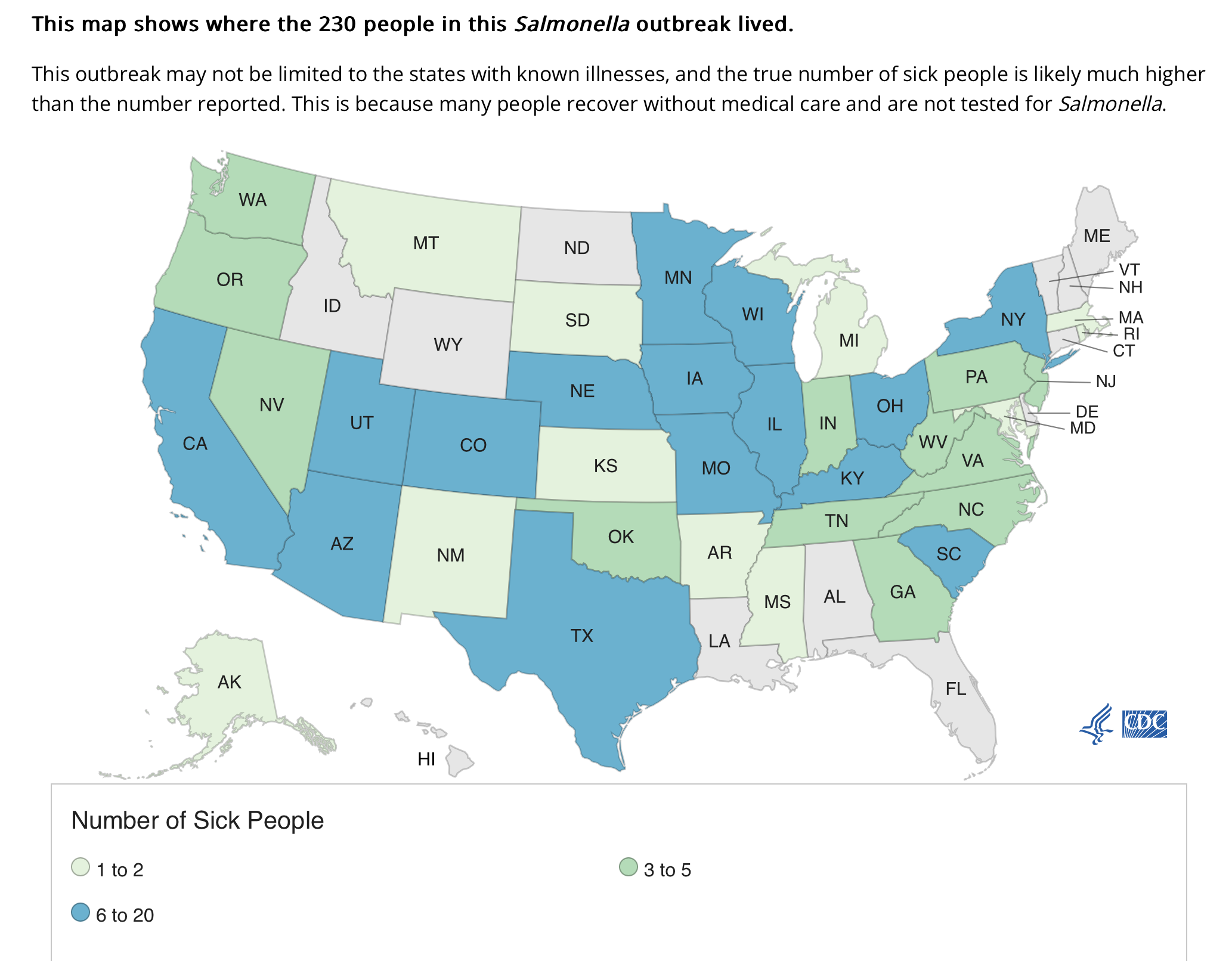
As of the latest reports from the US Centers for Disease Control and Prevention (CDC) and the Public Health Agency of Canada (PHAC), there have been 230 lab-confirmed cases reported in the USA and 129 in Canada.
Five deaths have been reported in Canada and three in the United States.
Six Canadian provinces have reported outbreak cases to the PHAC:
- British Columbia: 15
- Ontario: 17
- Quebec: 91
- Prince Edward Island: 2
- New Brunswick: 2
- Newfoundland and Labrador: 2
In the United States, cases have been reported by 38 states (see image below, supplied by the CDC).
Multiple recalls have been announced in both countries. The US Food and Drug Administration (FDA) has activated a webpage devoted to listing the recalls announced publically in the USA. A list of Canadian recalls has been provided on the Canadian Food Inspection Agency website.
Hardest hit populations
Both the CDC and the PHAC have pointed out that children under the age of five and adults over the age of 65 have accounted for a large majority of the lab-confirmed cases in both countries.
In the USA, children under the age of five account for 27% of the confirmed cases to date, while seniors (over the age of 65) account for 47% of cases.
In Canada, 35% of the confirmed cases occurred in children under the age of five, while seniors accounted for 45% of confirmed cases.
Why should this be so?
The very young and the elderly typically are more susceptible to most infections than the rest of the population, and also are prone to experiencing more severe symptoms.
But there are other factors in play, which are highlighted by demographic data provided by the CDC.
Specifically, 23 children attended childcare centers, and 24 of the adult victims were residents of longterm care facilities among the 230 cases in the USA.
The PHAC also reported that many of the Canadian victims resided in a long-term care home, or a retirement residence, or attended daycare.
Many of the recalled products—especially many cut fruit products and fruit salads—were supplied to medical facilities, institutions, food service facilities, hotels, and restaurants.
Not all of these recalls have been made public in the United States. Instead, the recalling company communicated directly with its customers. For example:
- Market Cuts LLC:- Recalled 8 cut fruit products by letter notification to its customer(s) in Illinois, Indiana, Michigan and Wisconsin
- Freshpoint Of Southern CA:- Recalled Imperial Fresh brand whole cantaloupes, which it had supplied to food services in California, Arizona and Nevada
- FreshPoint Dallas:- Recalled Imperial Fresh brand whole cantaloupes, which it had supplied to institutions, medical facilities and direct food service accounts in Arkansas, Missouri, Mississippi, Kansas, Louisiana, Oklahoma, Texas
Several of the cut fruit products and whole cantaloupes distributed in Canada also were supplied to hotels, food service operations and institutions (such as hospitals, longterm care facilities and child care facilities).
What consumers in Canada and the United States should know
This outbreak is far from over, and the case counts are continuing to climb. Furthermore, the number of reported cases in any outbreak represents only a fraction of the total number of people who become infected.
Consumers are advised to discard and not consume Malichita or Rudy cantaloupes or any other recalled products. If you have whole or pre-cut cantaloupes or fruit cups, fruit platters, or fruit medleys in your home and are unsure of their origin, discard them as a precaution.
Food contaminated with Salmonella may not look or smell spoiled but can still make you sick. Young children, pregnant women, the elderly and people with weakened immune systems may contract serious and sometimes deadly infections. Healthy people may experience short-term symptoms such as fever, headache, vomiting, nausea, abdominal cramps and diarrhea. Long-term complications may include severe arthritis.
If you feel unwell, and especially if you have symptoms like diarrhea or vomiting, do not cook or prepare food for other people.
If you suspect you are suffering from a Salmonella infection, consult your healthcare provider.

Interested in learning more about food safety and the history of foodborne disease outbreaks and investigations?
Click on the link to listen to a short excerpt, then follow the buy links to add a digital, print or audio copy to your personal library.


 eFoodAlert