Multiple Cronobacter strains in Abbott plant

The US Food and Drug Administration (FDA) has identified five different strains of Cronobacter sakazakii in environmental samples collected during an inspection of Abbott Nutrition’s Sturgis, Michigan production plant.

In a March 31, 2022, update to its outbreak investigation report, the FDA stated that four of the strains were recovered from samples taken by the agency’s team of inspectors. The fifth strain was from a sample collected by the firm.

The US Centers for Disease Control and Prevention (CDC) has completed a whole genome sequencing (WGS) of the Cronobacter sakazakii cultures obtained from two of the four infected infants.

Neither of the clinical cultures matched any of the five strains found in Abbott’s production environment.

Outbreak and recall

The FDA’s investigation of Abbott’s manufacturing facility was triggered by four reports of infants who had become infected with Cronobacter sakazakii after having been fed a powdered infant formula manufactured by Abbott Nutrition.

The first report was received by the FDA on September 6, 2021. The most recent illness began on January 4, 2022.

Two of the four infected infants have died.

According to the FDA, Cronobacter sakazakii infection “may have contributed” to their deaths.

Abbott Nutriton initiated a product recall on February 12, 2022. The recall was expanded on February 28, 2022.

Cronobacter sakazakii is a cause of necrotizing enterocolitis and meningitis in newborns, and is often fatal. In older babies, children and adults, this opportunistic pathogen can cause respiratory infections and sepsis.

Symptoms in newborns include fever, rapid heart rate, seizures and other neurological abnormalities.

The investigation

The FDA’s in-depth inspection of the Abbott’s manufacturing plant began on January 31, 2022 and was completed on March 18th.

The Inspectional Observations report (FDA Form 483) issued at the end of the inspection listed eight pages of infractions and deficiencies.

One of the most serious observations related to the maintenance of the company’s spray-drying equipment.

On reviewing the company’s own documentation, the FDA inspection team noted “a history of internal deterioration [of the dryers] dating back to September 2018.

According to the records of the most recent dryer inspections, carried out in August 2021, two different dryers showed six instances each of cracks, pits, and/or damage in the main chamber.

A further example of improper maintenance was documented by three separate work orders during the course of a year for repair of a “water event” at the same inlet to a spray-dryer. The work orders were issued on February 1, 2021, November 4, 2021, and January 21, 2022.

History repeats

A parallel can be drawn between the dryer maintenance issues at Abbott and a similar situation in Australia in the 1970s.

In 1977, powdered infant formula manufactured by three different companies was determined to be the source of a number of Salmonella Bredeney infections in the state of Victoria, Australia.

All three companies obtained their powdered milk from the same manufacturer.

When inspectors visited the powdered milk supplier’s manufacturing plant, they discovered that the interior of the cone-shaped base of the spray dryer had developed several cracks.

The company tried to repair the cracks by welding them shut. When the welds failed, the company continued to use the spray dryer, but simply discarded the powder that collected in the base of the drying chamber.

Environmental samples from the interior of the spray-dryer determined that its fiberglass insulation material had become saturated with Salmonella.

Abbott responds

In an update posted on the company’s website, Abbott responded to the FDA’s report by reassuring consumers of its cooperation with the FDA, while at the same time emphasizing that the strains of Cronobacter sakazakii found in the production environment did not match those recovered from the infected infants.

Abbott has “already begun implementing corrective actions and enhancements at the facility, leveraging new technology and strengthening our processes, to give parents and customers renewed confidence in the quality of manufacturing at our Sturgis plant when we restart operations there,” according to the company’s statement.

Who to contact for more information

If you want to check if your powdered formula is part of the recall, you can enter the product lot code on the bottom of your package on the company’s website.

If you have questions for the FDA or need information about the recall, you can Submit Questions/Get Assistance

If your infant is experiencing symptoms related to Cronobacter infection, such as poor feeding, irritability, temperature changes, jaundice, grunting breaths, or abnormal body movements, contact your health care provider to report their symptoms and receive immediate care.

To report an illness or adverse event, you can


Learn more about the history of Cronobacter sakazakii and other foodborne disease microbes in TAINTED. From Farm Gate to Dinner Plate, Fifty Years of Food Safety Failures.

TAINTED is available in digital and audiobook editions from all major on-line retailers or in print edition from Amazon.

“Reads like a true crime novel” – Food Safety News

Recalls and Alerts: March 26-30, 2022

TAINTED formats 3

Here is today’s list of food safety recalls, product withdrawals, allergy alerts and miscellaneous compliance issues. The live links will take you directly to the official recall notices and company news releases that contain detailed information for each recall and alert.

If you would like to receive automatic email alerts for all new articles posted on eFoodAlert, please submit your request using the sidebar link.

Interested in learning more about food safety and the history of foodborne disease outbreaks and investigations? Click on the TAINTED menu at the top of the page to read or listen to a short excerpt, then follow the buy links to add a digital, print or audio copy to your personal library.

Listen to an excerpt of the new audiobook edition right here

Chapter 6. Birth of a Pathogen

United States

OUTBREAK INVESTIGATION: FDA announces an investigation into “unconfirmed adverse event reports received from January 2021 to March 2022 that may be associated with an FDA-regulated food product.” No further details were offered.

Allergy Alert: Wilton Industries, Inc. recalls Ready to Build Chocolate Cookie Bunny Hutch Kit (Lots 22005, 22006 and 22007; UPC 0070896117274) due to undeclared milk.

Food Safety Recall: Liberty Fruit Company, Inc. recalls Liberty Fruit Company, Inc. and Carol’s Cuts brand Fruit Medley, Fruit Tray, Fruit Salad, Cantaloupe Chunks, Hawaiian Blend, and Melon Medley fruit trays containing cantaloupe (Expiration dates from 3/21/2022 to 3/26/2022; multiple UPCs) due to possible Salmonella contamination. Please refer to the recall notice for a complete list of affected package sizes and UPCs.

Food Safety Recall: Skippy Foods, LLC recalls four Skippy Peanut Butter varieties due to possible foreign matter contamination ( small fragment of stainless steel from a piece of manufacturing equipment). Please refer to the recall notice for a complete list of affected products.

Canada

Food Safety Recall: Pacific Rim Shellfish (2003) Corporation recalls Pacific Rim Shellfish (2003) Corp brand Oysters due to possible Norovirus contamination. Please refer to the recall notice for a complete list of affected products, which were sold in British Columbia, Alberta, Saskatchewan, Manitoba, Yukon, and Ontario and may have been distributed in other provinces and territories. There have been reported illnesses associated with the consumption of these products.

Food Safety Recall: Taylor Shellfish Canada ULC dba Fanny Bay Oysters recalls certain Taylor Shellfish Canada ULC brand Oysters due to possible Norovirus contamination. Please refer to the recall notice for a complete list of affected products, which were sold in Alberta, British Columbia, Ontario and Quebec and may have been distributed in other provinces and territories. There have been reported illnesses associated with the consumption of these products.

Food Safety Recall: Le Marchand Traiteur (Saint-Jean-sur-Richelieu, QC) recalls several products that may present a health hazard when consumed. Please refer to the recall notice for a complete list of affected products.

Europe

OUTBREAK INVESTIGATION UPDATE (France): Santé Publique France is investigating 75 reports of severe haemolytic uremic syndrome (HUS) due to infection with a shigatoxin-producing E. coli, an increase of 14 cases since the last report. The illnesses are associated with consumption of Buitoni brand Fraîch’Up frozen pizzas. Please refer to the investigation update for additional details about the outbreak and the related product recall.

Allergy Alert (France): TANG FRERES recalls HANAMI brand Craquelins saveur crevettes / Shrimp-flavoured crackers (15g & 60g; All lots and date codes) due to undeclared crustaceans, soy, wheat, milk and shellfish.

Allergy Alert (Netherlands): Naproz B.V. recalls Boerjan Lekker Zoet / Tasty Sweet (150g; Batch code PO-21-302; Expiry date 01-09-2023) due to undeclared gluten.

Food Safety Recall (Belgium): Skopos SA recalls AB brand MANOURI GRECQUE AOP cheese (200g; Best before 03/06/2022) due to shigatoxin-producing E. coli contamination.

Food Safety Recall (Belgium): Spar Colruyt Group recalls Spar brand pistaches décortiquées / shelled pistachios (150g; Best before dates between 3/7/2022 and 30/8/2022) due to aflatoxin contamination.

Food Safety Recall (Finland): Lidl recalls Bergmann naudan minuuttisuikale / Beef strips (300g; Batch #9068062103322113 32; Expiry 21.3.2022) due to possible Salmonella contamination.

Food Safety Recall (France): CORA BELFORT recalls Jambon cuit fumé / Cooked smoked ham (Sold between 09/03/2022 and 28/03/2022) due to Listeria monocytogenes contamination.

Food Safety Recall (France): SOUCHON D’AUVERGNE ALLIANCE OCEANE & CHARCUTIERE recalls Saint Agaûne Aux Cèpes édition limitée dried meat (120g; Multiple lot codes and Best before dates) due to foreign matter contamination (pebbles).

Food Safety Recall (France): GAEC du Maupas recalls various GAEC du Maupas La vache Brennouse products made with cows’ milk due to possible Listeria monocytogenes contamination. Please refer to the recall notice for a complete list of affected products.

Food Safety Recall (France): FROMACOEUR recalls FROMACOEUR brand Billes de chèvre cœur de figue / Goat cheese balls with fig centres (90g; Multiple lot codes and Use by dates) due to possible Listeria monocytogenes contamination. Please refer to the recall notice for a complete list of affected products.

Food Safety Recall (Luxembourg): Delhaize recalls three Delhaize nut products containing pistachios due to aflatoxin contamination. Please refer to the recall notice for a complete list of affected products.

Food Safety Recall (UK): Scratch Meals Ltd recalls Scratch Chicken & Veggie Tikka Masala with spiced brown rice (380g; Use by 27 March 2022, 28 March 2022, 29 March 2022, 30 March 2022, 31 March 2022, 1 April 2022 and 2 April 2022) due to undeclared niacin and zinc.

Food Safety Alert (UK): The Food Standards Agency warns the public not to buy or eat counterfeit ‘Wonka Bars’, which are being sold in shops and online across the country. The bars may be unsafe to eat, and may contain undeclared allergens. Any Wonka-branded chocolate which does not feature the official ‘Ferrero’ or ‘Ferrara Candy Company’ trademarks on the label is likely to be a counterfeit product, according to the FSA.

Asia, Africa and the Pacific Islands

Allergy Alert (Israel): Holy Cocoa Chocolate Ltd. recalls Hazelnuts coated in excellent dark chocolate 70% (100g; Best before 1/6/22, 2/6/22) due to undeclared milk.

Bravo Packing enjoined from producing raw pet food

Company and the US Food and Drug Administration enter into consent decree

A federal judge has entered a consent decree of permanent injuction against Bravo Packing, Inc., a manufacturer and distributor of raw pet food based in Carney’s Point, New Jersey.

(Bravo Packing is not related in any way to Bravo LLC / Bravo Pet Foods, located in Manchester, Connecticut)

The consent decree requires that Bravo “stop selling, manufacturing and distributing raw pet food and come into compliance with the Federal Food, Drug, and Cosmetic Act (FD&C Act).”

The backstory

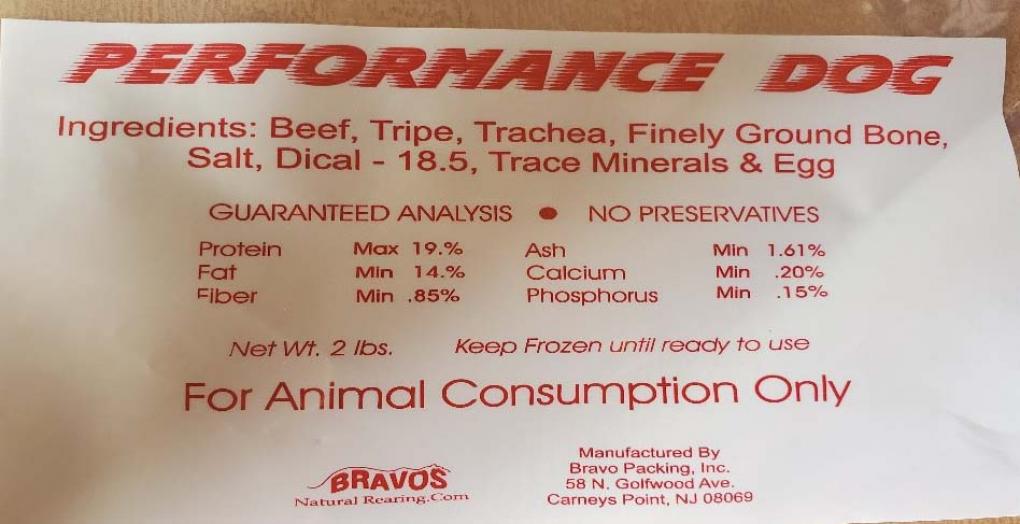
On September 12, 2018, Bravo Packing announced a voluntary recall of Performance Dog frozen, raw pet food (manufacturing date code 071418) after the FDA found Salmonella in a sample of the product during an inspection of the manufacturing facility.

In addition to the Salmonella-positive sample, FDA Investigator Michael Rosner also documented several issues of concern, including:

  • Some condensate drip and ice buildup was observed on several boxes of finished dog food product in one of the firm’s freezers. 
  • The air curtains entering the dog food processing room were observed to be soiled and in disrepair. 
  • The firm was using a santiizer product at an incorrect dilution level, which reduced the sanitizer’s effectiveness.
  • Some of the claims on the firm’s website were potentially misleading.

By the time the FDA returned to Bravo’s manufacturing facility in July 2019, the situation had deteriorated. This time, the FDA labs found Salmonella and Listeria monocytogenes in samples collected during an investigation that lasted from July 22nd to August 6th.

According to the Inspection Observations report (FDA Form 483), issued by Investigators Teigan Mule and Kyle Coville,

  • after cleaning had been completed, the elbow portion of the feeder pipe from the mixer still had a buildup of dried, dark, crusty meat-like material
  • a film residue remaining on the sides of a mixer exit chute after cleaning
  • greasy buildup of animal fat remaining at the output of a grinder after cleaning
  • black residue on the inside surface of buckets used to hold cut meat
  • condensate drip and ice buildup on boxes of finished raw dog food products in a freezer
  • cardboard boxes used to pack finished product observed to have bird droppings on the tops and sides
  • apparent mammalian (rodent?) droppings adjacent to stored, palletized boxes
  • inadequate training of employees on how to clean and degrease processing equipment after processing.

Although Bravo agreed to recall the contaminated Performance Dog Food product, the company never provided the FDA with the usual draft customer notification letter, distribution list, or draft press release.

In the absence of documentation from the company, the FDA issued its own Consumer Advisory on September 26, 2019, cautioning pet owners “not to feed their pets any Performance Dog frozen raw pet food.”

The FDA followed up its actions with a formal Warning Letter, issued on March 16, 2020. The letter reiterated and expanded upon the observations contained in the inspection report and requested a written response from the company within fifteen working days of receipt.

Downward slide accelerates

On March 3, 2021, Bravo issued yet another recall notice after Salmonella and Listeria monocytogenes were found once again in the company’s products.

The recall was expanded on March 16th to include all pet food and bones in all package sizes.

When the FDA returned to inspect Bravo’s production plant in May 2021, Investigators Kyle Covill and Sean Duke found a situation that had deteriorated further.

  • a shovel used to push meat into the grinder was covered with residual dried, black meat-like material from the handle down to the shaft and all the way to the end of the blade
  • a meat hook covered with cobwebs and other extraneous material was used to move deboned meat from raw ingredient barrels into the grinder during production
  • the grinder contained heavy rust on the inside walls, basins and screw augur
  • a piece of meat from a prior production run was left in the exit portion of the mixer, which also contained a pooled black liquid and white fat-like deposits, and the mixer was subsequently used during production without any further cleaning
  • one of the owners was seen spitting chewing tobacco on the floor of the deboning room
  • two cats were observed urinating on the outside of a raw ingredient barrel that was subsequently used (without undergoing cleaning and sanitizing) to produce Performance Dog ready-to-eat raw dog food
  • the floors in multiple rooms of the production plant, including the processing room, had large cracks, holes and depressions, which contained pooled blood and water
  • uncovered barrels of deboned meat were stored directly beneath a metal beam and brackets covered with flaking rust.

The bottom line

The consent decree prohibits the defendants (including the company’s owner and secretary, Joseph Merola, and its president, Amanda Lloyd) from receiving, preparing, processing, packing, holding, labeling, and/or distributing pet food unless and until the company undertakes and completes a comprehensive list of corrective actions.

The decree also allows the FDA to order a shutdown, recall, or other corrective action in the event of future violations and requires the defendants to pay the costs of inspections performed pursuant to the decree. Failure to abide by the agreement can also lead to civil or criminal penalties.

In commenting on the consent decree, Steven Solomon, DVM, MPH, director of FDA’s Center for Veterinary Medicine, said,

The food we give our pets should be safe for them to eat and safe for people to handle. The FDA has taken this action to protect public health because, despite multiple inspections, notifications of violations, and recalls, this firm continued to operate under insanitary conditions and produce pet food contaminated with harmful bacteria. We will not tolerate firms that put people or animals at risk and will take enforcement actions when needed.”