Recalls and Alerts: December 6 – 9, 2020

Here is today’s list of food safety recalls, product withdrawals, allergy alerts and miscellaneous compliance issues. The live links will take you directly to the official recall notices and company news releases that contain detailed information for each recall and alert.

If you would like to receive automatic email alerts for all new articles posted on eFoodAlert, please submit your request using the sidebar link.

Interested in learning more about food safety and the history of foodborne disease outbreaks and investigations? Go to TAINTED to download the first couple of chapters of my new book.

United States

Allergy Alert: Market of Choice recalls Market of Choice Sour Cherry Baked Brie (Sell by dates up to and including 12/12/20; UPC 0 217241 414996) due to undeclared almonds.

Allergy Alert: George DeLallo Co., Inc. recalls Publix Bakery Holiday Cookie Platters (20 oz; Lot #W34326; Best by 10/APR/2021; UPC 41415 88690) due to undeclared pecans.

Public Health Alert: FSIS issues a public health alert for raw, fresh goat meat products that were produced without the benefit of federal inspection and outside inspection hours. Please refer to the notice for a complete list of affected products, which are believed to no longer be available for consumer purchase.


Canada

Food Safety Recall / Illness Report: Levitts Foods (Canada) Inc. recalls certain Compliments brand, Levitts brand, and The Deli-Shop brand deli meat products due to possible Listeria monocytogenes contamination. Please refer to the recall notice for a complete list of affected products. One illness has been reported that may be associated with consumption of these products.

Food Safety Recall: Super C Saint-Jean-sur-Richelieu recalls certain products containing ground pork due to possible foreign matter (metal pieces) contamination. Please refer to the recall notice for a complete list of affected products.

Order your copy today to learn more about food safety

Europe

Allergy Alert (Austria): SPAR Österreichische Warenhandels-AG recalls SPAR Vital Naturreis Langkorn fertig in 10 Min / SPAR Vital Brown Rice Long Grain Ready in 10 Min (500g; Best before 7.1.2022) due to undeclared gluten.

Allergy Alert (Ireland): FSAI alerts the public to undeclared allergens in certain batches of several Picard products. Please refer to the allergy alert for complete details.

Allergy Alert (Netherlands): Albert Heijn recalls Picard brand mini-cheesecakes (pack of 12; Expiration date 30-04-2022) due to undeclared nuts and soy.

Allergy Alert (Netherlands): Albert Heijn recalls AH Verse woksaus teriyaki / AH Fresh wok sauce teriyaki (Expiration date 18-01-2021) due to undeclared sesame and/or soy.

Food Safety Recall (Austria): SPAR Österreichische Warenhandels-AG recalls SPAR Weizenmehl universal naturrein Typ W480 / SPAR wheat flour universal natural type W480 (Batch L789 12/12:05; Best before Oktober 2021) due to bacterial contamination.

Food Safety Recall (Austria): Lidl Österreich recalls NAUTICA ASC GERÄUCHERTE FORELLENFILETS, Sortierungen Natur und Pfeffer / NAUTICA ASC SMOKED TROUT FILLETS, natural and pepper varieties (125g; Manufactured by Herstellers Agustson a/s; All Best before dates) due to Listeria monocytogenes contamination.

Food Safety Recall (Belgium): Carrefour recalls Carrefour Cuisses de Dinde / Turkey legs (Lot #053283280540; Expiry date 09/12/2020) and Carrefour Pilons de Dinde / Turkey drumsticks (Lot #053283280540; Expiry date 09/12/2020) due to Salmonella contamination.

Food Safety Recall (France): La Salaison du Mont Pilat recalls Salaisonniers du Pilat brand Le Jésus sausage (Lot #2026002; Best before 02/02/21) due to Listeria monocytogenes contamination.

Food Safety Recall (France): La Salaison du Mont Pilat recalls Salaisonniers du Pilat brand Saucisson Campagnard sausage (Lot #2026604; Best before 02/02/21) due to Listeria monocytogenes contamination.

Food Safety Recall (France): La société Bonduelle recalls Bonduelle brand Salade Jeunes pousses et Roquette / young shoots and arugula salad (Lot #27631359; Best before 11/12/2020) due to Salmonella contamination.

Food Safety Recall (France): La société Bonduelle recalls Auchan brand Salade Roquette / Arugula salad (125g; Lots 27631324 – 27631325; Best before 0/12/2020) and Auchan brand Salade Mesclun / Mesclun salad (125g; Lot 27631328; Best before 10/12/2020) due to Salmonella contamination.

Food Safety Recall (Ireland): Industry recalls Polish Smoked Ham / Wędzonka boczkowa (Lot #0727; Best before 9/12/2020; Product of Poland) due to Listeria monocytogenes contamination.

Food Safety Recall (Luxembourg): Industry recalls Tendriade brand Haché de veau junior / Junior Minced Veal (4 x 50g; Lot #73483511; Best before 09/12/2020) due to Salmonella contamination.

Food Safety Recall (Netherlands): Dirk recalls Pure Ambacht Grillworst kaas / Pure Ambacht Grill sausage cheese (Expiry date 13-12-2020) due to foreign matter (metal particles) contamination.

Asia, Africa and the Pacific Islands

Allergy Alert (Hong Kong): Tropical Trading Company recalls Kwong Cheong Thye brand Sambal Belachan Chilli Paste (230g and 1 kg; Best before November 27, 2021 and July 9, 2022, respectively), Kwong Cheong Thye brand Laksa Paste (1 kg; Best before May 29, 2022) and Kwong Cheong Thye brand Crispy Chilli (230g; November 22, 2021) due to undeclared fish.

Australia and New Zealand

Food Safety Recall (New Zealand): Pestell’s Rai Bacon Company Ltd recalls specific batches of its Pestell’s Champagne Ham, Pestell’s Cooked Ham on the Bone, Pestell’s Boneless Ham, Pestell’s Boneless Ham pieces, and Pestell’s Sliced Ham off the Bone due to Listeria monocytogenes contamination. Please refer to the recall notice for a complete list of affected product batches.

Salmonella Outbreak Linked to Onions—a Post-mortem

Reported cases: 1,642
Hospitalizations:
246
States affected:
48
Provinces affected:
7
Infectious agent: Salmonella Newport
Probable source: Red onions produced and packed by Thomson International, Inc. of Bakersfield, CA


Two months after the US Centers for Disease Control and Prevention (CDC) and the Public Health Agency of Canada (PHAC) declared this outbreak over, its root cause remains a mystery.

The US Food and Drug Administration (FDA) has plowed through more than 2,000 samples, testing finished products, swab and environmental samples from Thomson’s packing facility, and environmental samples from the vicinity of the fields where the onions were grown.

FDA labs recovered eleven different Salmonella serotypes from the various environmental samples, according to information obtained by eFoodAlert in response to a Freedom of Information Act request.

Although Salmonella Newport was found in two samples described as soil/sediment, neither sample yielded the outbreak strain recovered from patients.

Not one of the onions tested in FDA labs were Salmonella-positive.

Not one of the swab samples obtained from inside the Thomson packing facility were Salmonella-positive.

But this is not the whole story. To understand FDA’s findings, it’s important to know more about onions.

The onion

Onions can be grown from seeds, seedlings, or sets (immature onion bulbs). The crop is ready for harvest when at least one-half of the leaves are dead.

In order to ensure an adequate storage life, the onions must be left in the field to “cure” for at least 12–24 hours. This allows the outer skin to dry. Curing is complete when the neck of the onion (the top of the bulb) is dry and tight.

After curing, the onions are “topped” above the neck to remove the leaves, after which they are ready for eating or for extended storage.

Onions are closely related to garlic and, like garlic, onions produce certain essential oils that possess anti-bacterial properties. Although Salmonella can survive on onions, these essential oils complicate the process of detecting the bacteria.

Thomson’s onion operations

Onions are onions, whether grown in a small backyard or in a large commercial field. The same principles apply. The differences are those of scale.

Thomson’s onions are grown from seeds in two different parts of California. The company uses fields both near Bakersfield, where its packing house is located, and just outside Holtville, in California’s Imperial Valley, approximately 330 miles to the south.

When the onion crop is ready for harvest, Thomson’s crews use specialized equipment to dig beneath the bulbs and cut them out of the ground. The onions are left in the field to cure.

Once the onions have cured, a crew of farm laborers works its way through the field, trimming off the tops and bottoms of the onions, culling and discarding damaged onions, and placing the trimmed onions into buckets.

Culled onions and the trimmed-off tops and bottoms are left in the field to be plowed back into the soil when it is prepared for the next crop.

The full buckets are poured into burlap bags, which are left in the field for additional curing.

Once curing is complete, the onions are either shipped in bulk directly to customers or are transported to Thomson’s Bakersfield packing facility, where they are brushed clean and packed for distribution.

What FDA did not find

  • No “egregious” conditions or violations of the Produce Safety Rule
  • No direct evidence of the outbreak strain in bagged onions
  • No direct evidence of the outbreak strain in any environmental samples either at the packing facility or in and around the fields

What FDA found in Bakersfield

  • Cats in and near the onion packing lines
  • Pigeons flying or roosting inside the packing house
  • Apparent bird droppings on and near the onion packing line
  • A thick build-up of dirt and soil on the packing line even after the most recent cleaning/sanitizing activity
  • Rough, dirty weld points on the packing line
  • Inadequate documentation of cleaning/sanitizing activity
  • Swallow nests overhead within a few feet of an onion-packing line
  • Inconsistent cleaning/sanitation Standard Operating Procedures documentation
  • Inconsistent bacteriological testing of agricultural water for coliforms and E. coli.
  • Salmonella in animal scat, drain sediment, and environmental swab sample and on a water filter

What FDA found in Holtville

  • Worn and uneven areas on field packing equipment that could harbor bacteria
  • Indications of bird activity around the fields and equipment
  • Flock of birds (ibis) in field undergoing flood irrigation adjacent to field where onions had been grown
  • Salmonella, including Salmonella Newport, in several soil/sediment samples

And then there’s the water…

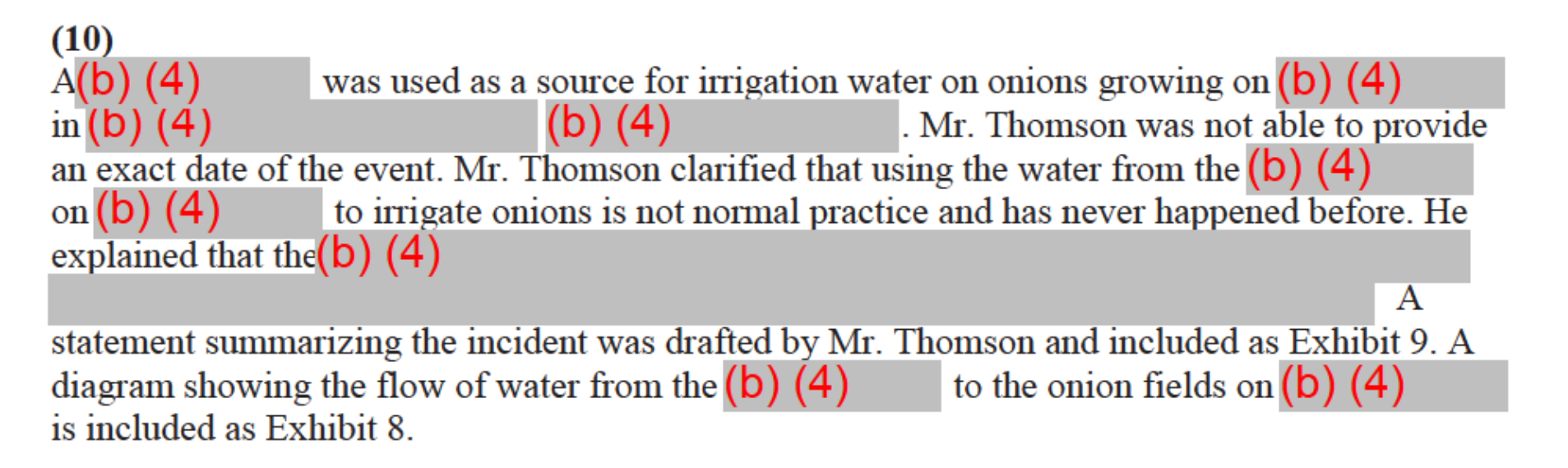
Information received under a Freedom of Information Act request is often heavily redacted, as anyone knows who watches The Rachel Maddow Show on MSNBC. This is what FDA’s investigation report had to say about the source of irrigation water used on the onion fields.

It would appear that irrigation water was drawn from a different source than was usual on at least one occasion. The details and date(s) on which this took place were redacted from the report, as was the diagram showing the flow of water from the source to the fields.

Why does this matter?

Irrigation water polluted by runoff from cattle feedlots has been linked to contaminated produce grown in the Salinas and Imperial Valleys in the past. A quick look at a Google map for the areas around Bakersfield and Holtville reveals the presence of feedlots in both vicinities.

The bottom line

As soon as Thomson onions were identified by CDC and FDA as the probable source of the Salmonella Newport outbreak, the company shut down its harvesting and packing operations.

By the time FDA investigators arrived on the scene, there were no field or packing activities for them to observe. The investigators were able to carry out extensive sampling of the equipment surfaces, the environment, and the stored onions, but were unable see either the harvest or packing operations in action.

Although neither FDA nor the Canadian Food Inspection Agency were able to find the outbreak strain in any of the onion samples, all of the epidemiological evidence from both the CDC and the PHAC points to Thomson’s red onions as the source of the outbreak,

The presence of multiple Salmonella-positive environmental samples lends weight to this conclusion, although the actual source of the contamination likely will never be known.

In case you missed it…

TAINTED is now available at all major on-line book sellers, and reached #1 New Release status in its Amazon category on Launch Day, December 2nd.

A Short Excerpt

Something Rotten in the State of Iowa

The CDC first became aware of an unusual rise in Salmonella Enteritidis infections in July 2010. Epidemiological and traceback investigations pointed the finger of suspicion at two Iowa-based suppliers of shell eggs: Quality Egg, LLC (also known as Wright County Egg) and Hillandale Farms of Iowa, Inc.

Alerted by the CDC, the FDA began a detailed inspection of Quality Egg on August 12th. They encountered an egg-laying farm overrun with rodents and birds. Henhouses and buildings used to store feed grain were in a state of disrepair, with manure seeping through the concrete foundation of one of the laying houses. Uncaged chickens ambled across an eight-foot high pile of manure to access the egg-laying area.

The situation confronting inspectors when they began their inspection of Hillandale Farms on August 19th was just as bad. Uncaged hens tracked manure into the henhouses, some of which had structural damage. There was standing water adjacent to the manure pit, and liquid manure was leaking into one of the henhouses.

It surprised no one when environmental samples collected at both Quality Egg and Hillandale Farms tested positive for Salmonella Enteritidis.

Quality Egg announced a recall on August 13th, and expanded the scope of the recall on August 18th. Hillandale followed suit with its own recall notice on August 20th.

TAINTED

From Farm Gate to Dinner Plate, Fifty Years of Food Safety Failures

Add TAINTED to your personal library today