FDA suppresses Salmonella details from Kerry cereal plant inspection

On May 17, 2018, the US Food and Drug Administration (FDA) learned about a multistate outbreak of Salmonella Mbandaka illnesses. FDA, the US Centers for Disease Control and Prevention (CDC), and agencies from the affected states joined together to investigate the source of the outbreak.

On June 14, 2018, CDC alerted the public to the multistate outbreak, which it had determined to be linked to Kellogg’s Honey Smacks cereal. The cereal was manufactured for The Kellogg Company by an unnamed third-party contract manufacturer.

On June 14, 2018, The Kellogg Company issued a voluntary recall of the implicated Honey Smacks cereal. That same day, according to FDA, the agency began to collect environmental and product samples from the unidentified contract manufacturer’s facility.

On June 14, 2018, according to information received by eFoodAlert in response to a Freedom of Information Act request, FDA initiated an inspection of a Kerry Inc. facility located in Gridley, IL. The inspection was completed on June 29, 2018.

According to the FDA Establishment Inspection Report, “Kerry Inc. is a large manufacturer of cereal based ingredients, and cereal products for food companies in the United States.”

On July 12, 2018, Kerry Inc. recalled more than 82 tons (165,600 lbs) of Soy Honey Cluster (30 lb. case, plastic bag in cardboard box; four different production lots). All of the recalled product was delivered to Minnesota. The reason given for the recall was, “[A]n ingredient in this product was manufactured during the time-frame and on the same piece of equipment that was associated with a salmonella outbreak.”

On July 16, 2018, General Mills, Inc. (Minneapolis, MN) recalled approximately 115 tons (16,308 cases) of Cheerios Protein Oats & Honey (Net Wt. 19 oz. (583g) UPC 16000-44473. 12 boxes/case, Net Wt. 14.1 oz. (399g) UPC 16000-45137. 16 boxes/case; Better if used by 05MAY2019, 06MAY2019, 07MAY2019, 08MAY2019, 09MAY2019, 10MAY2019). The recalled cereal was distributed nationwide. The reason given for the recall was, “Cheerios Protein Oats and Honey cereal may be contaminated with Salmonella.” 

One of the main ingredients in Cheerios Protein Oats & Honey is ‘Clusters’ and consists of: whole grain oats, soy protein, brown sugar, lentils, sugar, corn syrup, rice starch, honey, caramel (sugar, caramelized sugar syrup), salt, molasses, natural flavor, caramel color, baking soda. Vitamin E (mixed tocopherols) added to preserve freshness.

Neither Kerry nor General Mills issued a public recall notice.

As part of its June 14-29, 2018 “comprehensive … preventive controls inspection,” FDA used swabs to sample 200 separate locations in the process/manufacturing environment. Three samples categorized as ‘Normal Everyday Sample … Breakfast Foods Ready To Eat” were also collected for lab analysis.

Salmonella was found in all three of the product samples and in three (3) of the 200 environmental swab samples. The Salmonella-contaminated sites included:

  • Bottom of roll-up door between the cereal coating room and a processing room for rice crisps intended for pet food
  • Dryer let in a (redacted) Line 
  • Yellow plastic on roll-up door between one of the warehouse spaces and the northeast entry into a coating room.

Kerry’s own records documented a persistent and long-standing Salmonella contamination in the company’s production facility. 

According to FDA’s Inspectional Observations (Form 483), Kerry had documented 113 Salmonella-positive samples throughout the Gridley facility between September 29, 2016 and May 16, 2018.

Four of the Salmonella-positive samples were from the coating room and one from a cereal (production?) room.

Kerry did not take effective action to correct the Salmonella contamination or prevent its reoccurrence according to the Form 483 report.

Although the timeline strongly suggests that Kerry Inc. was the source of the Salmonella Mbandaka outbreak which, as of the last reported update on September 4th, had sickened 130 people in 36 states and sent 34 of them to hospital, FDA’s collective lips are sealed.

The specific type or strain of Salmonella found in the environmental and product samples was redacted from the lab reports supplied to eFoodAlert in response to the Freedom of Information request.

The agency has declined to reveal whether the Salmonella found during the Kerry inspection is the same strain responsible for the outbreak. 

When asked why this information was not forthcoming, a spokesperson for FDA responded that the information in the redacted reports was “all we can provide at this time.”

CDC continues to advise the public to avoid consuming Kellogg’s Honey Smacks cereal, regardless of production lot and expiry date. Although the number of new confirmed cases of illness appears to be on the decline, the agency has not yet declared the outbreak to be over.

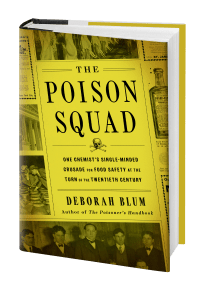
Book Review: The Poison Squad by Deborah Blum

“Regulation is bad for business.”

It’s an all-too-common refrain, but not exclusively a modern one.

Most people, when asked what they know about the origin of the US Food, Drug and Cosmetics Act, are likely to respond with either a shrug or a blank stare. A few may credit Upton Sinclair’s exposé of the horrendous practices in Chicago slaughterhouses, as described in his novel, The Jungle. Others may give credit to President Theodore Roosevelt, whose disgust at the food supplied to his troops in Cuba during the Spanish American War impelled him to support the campaign for safer food.

It would be a rare person, indeed, who would recognize the name of Dr. Harvey Washington Wiley. Yet, without Dr. Wiley’s persistence, the first Pure Food and Drug Act might never have been signed into law.

Before the turn of the 20th century, food adulteration was rife, and food labeling non-existent. Formaldehyde and other harsh chemicals were used to extend the shelf life of perishable commodities, while dyes derived from coal tar were incorporated into everything from candy to peas. Unregulated, free enterprise prevailed. Embalmed beef, swill milk, and fake food were the order of the day.

In 1882, Dr. Harvey Wiley joined the US Department of Agriculture as Chief Chemist, a position he would hold for 30 years. The first 24 years of his stewardship were devoted to promoting the passage of a safe food law. The remaining six years were consumed with protecting the act from emasculation.

The Poison Squad is the story of Dr. Wiley’s lifelong crusade for safe food in the face of opposition from large swaths of the chemicals, dyes, and food processing industries. Author Deborah Blum guides the reader through a complex and compelling saga with skill, and with a clear mastery of the subject matter. Consumers and legislators alike can learn from Blum’s portrayal of Dr. Wiley’s legacy.

About the Author
Deborah Blum is director of the Knight School Journalism Program at MIT and publisher of Undark magazine (undark.org). In 1992, she won the Pulitzer Prize for a series on primate research, which she turned into a book, The Monkey Wars. Her other books include The Poisoner’s Handbook, Ghost Hunters, Love at Goon Park, and Sex on the Brain. She has written for publications including the New York Times, Wired, Time, Discover, Mother Jones, the Guardian, and the Boston Globe. Blum is a past president of the National Association of Science Writers, a fellow of the American Association for the Advancement of Science, and a lifetime associate of the National Academy of Sciences.
Recalls and Alerts: September 19 – 22, 2018

Here is today’s list of food safety recalls, product withdrawals, allergy alerts and miscellaneous compliance issues. The live links will take you directly to the official recall notices and company news releases that contain detailed information for each recall and alert.

If you would like to receive automatic email alerts for all new articles posted on eFoodAlert, please submit your request using the sidebar link.

United States

OUTBREAK ALERT / Food Safety Recall: Cargill Meat Solutions recalls approximately 132,606 pounds of ground beef products made from the chuck portion of the carcass (produced and packaged on June 21, 2018) due to possible E. coli O26 contamination. The recalled product is linked to 18 illnesses in Colorado, Florida, Massachusetts, and Tennessee. Six individuals have been hospitalized, including one who developed hemolytic uremic syndrome. One person from Florida died. According to CDC, the outbreak is over.

Allergy Alert: Purus Labs, Inc recalls MyoWhey Chocolate Cookie Crunch (5 lb / 2.2 kg; Lot #0100518; Exp 04/2020) due to undeclared soy and milk. The recalled product was distributed through online mail orders to AR, TX, FL, MI, VA, and OK. MyoWhey was available through retail stores in TX, CA, OK, CO, and MO. MyoWhey was also available internationally in Chile and UAE.

Food Safety Recall: Junior’s Smokehouse Processing Plant recalls BUC-EE’S HILL COUNTRY BRAND TERIYAKI BEEF JERKY, MADE IN TEXAS FROM SOLID STRIPS OF BEEF, READY TO EAT (4 oz; Lot # 220-272; Best by 08-09-2019) due to foreign matter (pieces of hard metal) contamination.

Food Safety Recall: Zweigle’s Inc. recalls Olive Loaf Oven Baked (appr. 9-lb boxes containing two half-loaves; Case code 070534075225; Use by 8/22/18, 9/12/18, 9/19/18, 10/4/18 and 10/17/18) due to sodium nitrite levels in excess of regulatory limit. The recalled product was shipped to retail locations in western New York as intact loaves for slicing.

Canada

Food Safety Recall: Pâtisserie Ladouche inc. recalls various products that were not manfactured in a manner to ensure safety for human consumption. Please refer to the recall notice for a complete list of affected products.

Food Safety Recall: Lave-Auto Depan’Express recalls Home-style spaghetti sauce (500 ml glass jar; All product sold up to and including September 18) because the product was not manfactured in a manner to ensure safety for human consumption.

Food Safety Recall: Boulangerie Pâtisserie la Parisienne inc. recalls various baked products (All products sold up to and including September 18) because the product was not manfactured in a manner to ensure safety for human consumption.

Food Safety Recall (Update): Belleisle Foods Ltd. recalls Belleisle Farms brand Cole Slaw (227g; Product code 18SE28; UPC 0 33383 65260 3) due to Listeria monocytogenes contamination. The recalled product was distributed to retailers in New Brunswick, Newfoundland and Labrador, Nova Scotia, and Prince Edward Island.

Europe

Allergy Alert (Denmark): Bolchekogeriet Almuegaarden recalls three varieties of chocolate-covered lollipops due to undeclared soy in the chocolate coating. Please refer to the recall notice for a complete list of affected products.

Allergy Alert (Denmark): Tulip Food Company recalls Faaborg leverpostej (2 x 125g; Best before 23.05.2023 & 24.05.2023) due to undeclared milk.

Allergy Alert (Ireland): The Banner recalls The Banner Bangers Pork Sausages due to undeclared sulfur dioxide.

Allergy Alert (Netherlands): PLUS Supermarkets recalls PLUS Sourdough Raisin Bread (500g; Best before 26-09-2018) due to undeclared nuts.

Allergy Alert (Netherlands): Marqt recalls Marqt brand beetroot-orange and pea-mint vegetable spread (150g; Best before 02-10-2018) due to undeclared lactose and milk protein.

Food Safety Recall (Belgium): AFSCA mandates recall of BANKU-MIX fermented Banku flour (1kg; Best before 01/09/2019; Product of Ghana) due to excessive levels of aflatoxin and Bacillus cereus.

Food Safety Recall (Belgium): Delhaize recalls Delhaize brand émincé de jambon cuit / sliced cooked ham (125g; Best before 21/09/2018) due to Listeria monocytogenes contamination.

Food Safety Recall (Ireland): Cabots of Westport recalls Cabots of Westport Basil Pesto (180g; Use by 24/09/2018) due to Listeria monocytogenes contamination.

Food Safety Recall (Luxembourg): Delhaize recalls Delhaize brand émincé de jambon cuit / sliced cooked ham (125g; Best before 21/09/2018) due to Listeria monocytogenes contamination.

Food Safety Recall (Sweden): Albina Snacks AB recalls various mixed nut products due to elevated aflatoxin levels in the peanuts. Please refer to the recall notice for a complete list of affected products.

Food Safety Recall (UK): Dr Zak’s recalls Barn Farmed Liquid Egg White (970 ml; various lot codes and Use by dates) due to Salmonella contamination. Please refer to the recall notice for a complete list of affected production lots.

Asia, Africa and the Pacific Islands

Allergy Alert (UAE): Purus Labs, Inc recalls MyoWhey Chocolate Cookie Crunch (5 lb / 2.2 kg; Lot #0100518; Exp 04/2020) due to undeclared soy and milk. The recalled product was distributed through online mail orders to AR, TX, FL, MI, VA, and OK. MyoWhey was available through retail stores in TX, CA, OK, CO, and MO. MyoWhey was also available internationally in Chile and UAE.

Australia and New Zealand

Allergy Alert (Australia): YouFoodz PTY LTD recalls YouFoodz Clean Paprika Chicken (260g; Use By 29.09.2018) due to undeclared fish, gluten, egg and milk.

Allergy Alert (Australia): Quality Gourmet recalls Chilli Coconut Mayo (240g; Best Before all dates that end in 2018, 01/02/19, 14/02/19) due to undeclared milk.

Allergy Alert (New Zealand): Southern Sun Ltd trading as Wendy’s Barbeque recalls Wendy’s Barbeque brand pork and vegetable, and pork and celery dumplings (all batches and dates) due to undeclared gluten.

Food Safety Recall (New Zealand): Pokeno Bacon Manufacturing Ltd recalls Pokeno Bacon Co brand Pork Brawn (all batches and dates) due to a lack of process controls.

Food Recall (New Zealand): Lion – Beer, Spirits & Wine (NZ) Limited recalls Mac’s brand Ginger Beer (330 ml; Best before 20/3/19 and 21/3/19) due to the possibility it may contain alcohol.

Latin America and the Caribbean

Allergy Alert (Chile): Purus Labs, Inc recalls MyoWhey Chocolate Cookie Crunch (5 lb / 2.2 kg; Lot #0100518; Exp 04/2020) due to undeclared soy and milk. The recalled product was distributed through online mail orders to AR, TX, FL, MI, VA, and OK. MyoWhey was available through retail stores in TX, CA, OK, CO, and MO. MyoWhey was also available internationally in Chile and UAE.