Recalls and Alerts: June 2, 2011

Here is today’s list of food safety recalls, product withdrawals, allergy alerts and miscellaneous compliance issues. The live links will take you directly to the official recall notices and company news releases that contain detailed information for each recall and alert.

If you would like to receive automatic email alerts for all new articles posted on eFoodAlert, please submit your request using the sidebar link.

United States

  • Allergy Alert: Azar Nut Company recalls Azar Mountain Trail Mix (Item #9613896, 2/5#; Date codes 10256, 10284, 10313, 10320, 10342, 10357, 11017, 11031, 11066, 11089, 11109, 11123, 11138, and 11144), because the product may contain undeclared milk. The recalled trail mix was distributed through various food service distributors in Florida, Montana, Colorado, California, Oregon, Idaho, Arkansas, and Texas.
  • Food Safety Recall: Michel and Charles LeBlanc Fisheries (Cap-Pele, New Brunswick, Canada) recalls Michel and Charles LeBlanc Brand Smoked Split Herring (Production dates January 4, 2011 and April 14, 2011) because the product was found to be uneviscerated. The sale of uneviscerated or incompletely eviscerated fish is prohibited under New York State Agriculture and Markets regulations because Clostridium botulinum spores are more likely to be concentrated in the viscera than any other portion of the fish. The recalled products were distributed in Brooklyn and Bronx, New York.
  • Food Safety Withdrawal: California-based 99 Ranch Market has removed two kinds of Taiwanese beverages from its 35 stores, because the products may be contaminated with DEHP.
  • Food Safety Enforcement Action: FDA seeks permanent injunction against BCS African Wholesale Food Supply LLC (Brooklyn Park, MN) and its principal officers. The requested injunction would force defendants to stop importing, processing, and selling seafood products that can put consumers at risk for botulism or other food safety hazards.
  • Shellfish Growing Area Pollution Alert: Nine of Washington State’s commercial shellfish growing areas are threatened with closure this year due to pollution. The affected growing areas, by county, are: Grays Harbor (Pacific coast), Jefferson (Port Townsend), Kitsap (Dyes Inlet), Mason (Pickering Passage), Pacific (Naselle River), Pierce (Burley Lagoon, Filucy Bay), Skagit (Padilla Bay), and Snohomish (South Skagit Bay).
  • Outbreak Alert: Mississippi State Department of Health (MSDH) is investigating an increase in cases of shigellosis originating in Lauderdale County.
  • Outbreak Alert: Public health authorities in Amarillo, TX are warning residents that a “cluster” of seven cases of E. coli infections – all in children, mostly under five years of age – have been reported in Amarillo in the last few days. Four of the infected children have been hospitalized.

Canada

Asia, Africa and the Pacific Islands

  • Food Safety Recall (Hong Kong): The Centre for Food Safety (CFS) has ordered a recall of Sheng Shiang Jen Konjac Coconut Jelly, Taro Flavour (Manufactured in Taiwan by Triko Foods Co., Ltd.; all batches; all sizes), after DEHP was detected in a sample of the product. CFS also has announced a prohibition on the importation and supply of the product.
  • Food Safety Recall (Singapore): Agri-Food & Veterinary Authority of Singapore (AVA) orders the recall of Jin Guo Wan Peach Concentrate Juice (manufactured in Taiwan) after a sample fails a test for DEPH. AVA also has suspended the importation of Jin Guo Wan brand of fruit juice concentrates. These products are packaged in bulk and used as an ingredient for bubble tea.
  • Food Safety Alert (Taiwan): The Taiwan FDA has published a list of ingredients (available for download) that were found to be contaminated with DEHP. Please navigate to the Taiwan FDA site for a link to the file.
  • Food Safety Recall (Vietnam): On orders from the Vietnam Food Administration, New Choice Foods Company recalls products containing DEHP (imported from Triko Foods Co. Ltd., Taiwan).
  • Pharmaceutical Product Safety Recall (Hong Kong): Kai Yuen Pharmaceutical Company recalls Well Tab (Manufactured in Taiwan by China Chem and Pharm Company, Limited), and Marching Pharmaceutical Limited recalls five Vitamin C and dietary supplement products (manufactured in Hong Kong using an ingredient from Taiwan that may contain DEHP) because the recalled products may contain DEHP.

Some supermarket chains post recall notices on their web sites for the convenience of customers. To see whether a recalled food was carried by your favorite supermarket, follow the live link to the supermarket’s recall web site.

Recalls and Alerts: June 1, 2011

Here is today’s list of food safety recalls, product withdrawals, allergy alerts and miscellaneous compliance issues. The live links will take you directly to the official recall notices and company news releases that contain detailed information for each recall and alert.

If you would like to receive automatic email alerts for all new articles posted on eFoodAlert, please submit your request using the sidebar link.

United States

  • Food Safety Recall: C.W. Hendrix Farms, Inc. (Boca Raton, FL) recalls fresh cucumbers distributed from its facility between May 6 and May 13, 2011, because the cucumbers may be contaminated with Salmonella. The recalled produce was distributed to retailers (including Giant Eagle) and for food service distribution.
  • Food Safety Advisory (Washington): The Department of Health has issued a fish consumption advisory for carp from the lower part of the Okanogan River. Health officials recommend that people who fish the lower Okanogan limit their carp intake to one meal per month, due to the presence of harmful chemical contaminants in that part of the river.
  • Outbreak Alert (Canada/Alaska): CDC reports that 113 passengers (5.5%) and 12 crew members (1.4%) aboard the Sea Princess (Princess Cruises) are reported to have suffered vomiting and diarrhea during the May 20-30, 2011 cruise. Environmental Health officers with CDC’s Vessel Sanitation Program boarded the ship on its arrival in Juneau, Alaska on May 24th to conduct a health assessment. Stool samples from ill passengers have been submitted to Health Canada labs. The cause of the outbreak has not yet been established.
  • Outbreak Alert (Alaska): CDC reports that 104 passengers (5.1%) and 9 crew members (0.98%) aboard the Celebrity Millennium (Celebrity Cruises) are reported to have suffered vomiting and diarrhea during the May 20-27, 2011 Alaska cruise.

Canada

  • Food Safety Recall: Kuo Hua Trading Company Ltd. recalls certain Possmei brand and Trojan brand juices and jams, because the products may contain the chemical Di-Ethyl Hexyl Phthalate (DEHP). The recalled products were distributed to retailers, and to food service operations (hotel/restaurant/institution) in British Columbia and Ontario.
  • Food Safety Recall: Tasty Enterprises recalls Tasty brand syrups, because the products may contain DEHP. The recalled products were distributed to hotels, restaurants and institutions in Ontario.
  • Food Safety Recall: KO & C Enterprises Ltd. recalls Sheng Hsiang Jen brand Fruit Jelly Aloe Vera and Fruit Jelly assorted, because the products may contain DEHP. The recalled items were distributed to retailers in Alberta, British Columbia and Manitoba.
  • Food Safety Recall: Sysco Central Ontario, Inc. recalls C.W. Hendrix Farms, Inc. Cucumber – Super Select (24-count; code #141 6 126 47935141 9 129 47975), because the produce may be contaminated with Salmonella. The recalled cucumbers, which were imported from Florida, were distributed to hotels, restaurants and institutions in Ontario
  • Food Safety Recall: Subzi Mandi Cash & Carry recalls A-One Products Pan Gilori, 75g due to the presence of unspecified non-permitted food ingredients. The recalled products were sold in retail stores in Ontario.

Europe

Asia, Africa and the Pacific Islands

  • Food Safety Recall (Taiwan): The Ministry of Health has issued a “stop sale” order for sport drinks, fruit juices, tea drinks, fruit jam/fruit nectar/fruit jelly, and food in tablet, capsule or powder form that might be contaminated with the carcinogenic plasticizer DEHP, and has ordered a recall of all affected products.
  • Outbreak Alert (Hong Kong): The Centre for Health Protection is investigating four suspected cases of ciguatoxin poisoning cases affecting nine people who have consumed coral reef fish.

Australia and New Zealand

  • Food Safety Advisory Update (New Zealand): Following an investigation, the Ministry of Agriculture and Food has cleared Kiaora New Zealand, marketers of Heitiki infant formula, of any food safety and export regulations concerns.

Some supermarket chains post recall notices on their web sites for the convenience of customers. To see whether a recalled food was carried by your favorite supermarket, follow the live link to the supermarket’s recall web site.

Germany’s Devastating E. coli Outbreak

The official numbers reported this morning by Germany’s Robert Koch Institut are worthy of a Hollywood thriller. Nine people dead, and 470 notified cases of hemolytic uremic syndrome (HUS) – a life-threatening complication of enterohemorrhagic E. coli infections.

The German outbreak data reported by BBC and others are even worse. Sixteen deaths, including one in Sweden; 1,534 infected with the outbreak strain known as E. coli O104:H4 – 470 of them suffering from HUS.

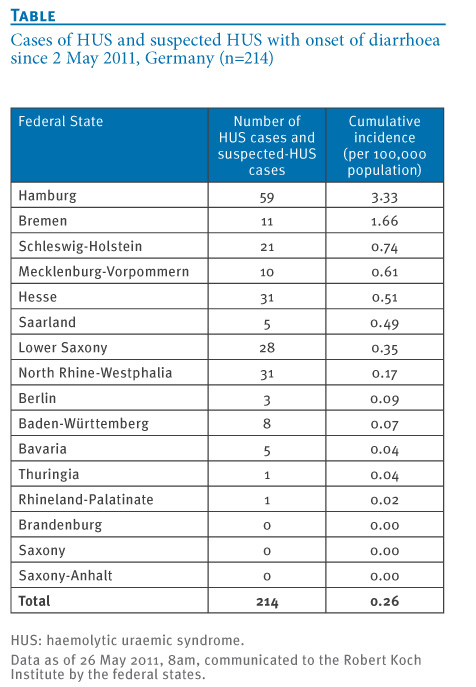
The outbreak began in Northern Germany; the heaviest concentration of confirmed cases – and of HUS – can be found in the states of Hamburg and Bremen. As of May 26th, thirteen German states had reported 214 cases of HUS – Hamburg (59), Bremen (11), Schleswig-Holstein (21), Mecklenburg-Vorpommern (10), Hesse (31), Saarland (5), Lower Saxony (28), North Rhine-Westphalia (31), Berlin (3), Baden-Württemberg (8), Bavaria (5), Thuringia (1) and Rhineland-Palatinate (1). These numbers already are far out of date, as the total number of cases has more than doubled since that report was issued.

Thanks to the ease of international travel – especially within the European Union, where most borders are invisible and undefended – the outbreak has not been confined to Germany. Eight other countries have reported confirmed or suspect cases of enterohemorrhagic E. coli in German nationals visiting their country or in individuals who reported having traveled to Germany:

  • Austria: 2 cases
  • Denmark: 14 cases, 6 with HUS
  • France: 6 cases
  • Netherlands: 7 cases, 3 with HUS
  • Spain: 1 case
  • Sweden: 41 cases, 15 with HUS and one death
  • Switzerland: 2 cases 
  • United Kingdom: 3 cases, 2 with HUS

Despite the best efforts of Germany’s epidemiologists, the source of this outbreak is unknown – except that it appears to be associated with consumption of raw tomatoes, cucumber and leaf salad.

For a time, suspicion fell on raw cucumbers imported from Spain – especially after lab analysis of two cucumber samples yielded enterohemorrhagic E. coli. But the cucumber contaminant did not match the outbreak strain.

The most frightening aspect of this outbreak, other than the lack of success in finding its cause, is the unusually high percentage of victims who have developed HUS – more than 30% of victims, as compared to the 5-10% HUS rate experienced in most other outbreaks.

HUS is a life-threatening complication, usually beginning with kidney failure and often progressing to failure of other organs and systems. Some 5-10% of HUS patients die, and most others suffer life-long consequences of their fight for survival – even with treatment. Conventional treatment consists of dialysis and, where necessary, plasma exchange.

The massive and deadly Canadian E. coli O157:H7 outbreak that was centered in Walkerton, Ontario in 2000 spurred Canadian researchers to study ways of preventing HUS – by preventing the bacterial toxins from binding to its target cells in the body. Researchers at the University of Maryland and in Argentina independently explored similar approaches – using monoclonal antibodies against the toxin in order to block its activity.

Just a few days ago, researchers in Canada, France and Germany reported that they used yet another antibody to treat successfully three 3-year-old children who were suffering from severe cases of HUS. But this new development might be too late to help many of the German outbreak victims.

The German outbreak has many unknowns:

  • What is the source?
  • What is the true number of illnesses?
  • Why is the incidence of HUS so high?
  • Why have adult women been disproportionately stricken?

And, most importantly, when will it end?