
We still need the risk of Criminal Sanctions in Food Poisoning Cases

This opinion piece by Bill Marler first appeared on Marler Blog and is reposted here with the author’s permission.

As I wrote last Spring, I have tried to steer clear of politics with respect to the Felon in Chief, but this is nuts, or at least peanuts.  According to yet another edict from the White House, it is now the policy of the United States that:

(a)  Criminal enforcement of criminal regulatory offenses is disfavored.

(b)  Prosecution of criminal regulatory offenses is most appropriate for persons who know or can be presumed to know what is prohibited or required by the regulation and willingly choose not to comply, thereby causing or risking substantial public harm.  Prosecutions of criminal regulatory offenses should focus on matters where a putative defendant is alleged to have known his conduct was unlawful.

(c)  Strict liability offenses are “generally disfavored.”  United States v. United States Gypsum, Co., 438 U.S. 422, 438 (1978).  Where enforcement is appropriate, agencies should consider civil rather than criminal enforcement of strict liability regulatory offenses or, if appropriate and consistent with due process and the right to jury trial, see Jarkesy v. Securities and Exchange Commission, 603 U.S. 109 (2024), administrative enforcement.

(d)  Agencies promulgating regulations potentially subject to criminal enforcement should explicitly describe the conduct subject to criminal enforcement, the authorizing statutes, and the mens rea standard applicable to those offenses.

Typically, every crime has two elements—a bad act and a culpable state of mind (mens rea, which generally means intent or recklessness). Section 333(a)(1) of the FDCA, the misdemeanor provision, is noteworthy because it creates one of the few true strict liability crimes in federal criminal law. That is, the government does not need to prove a state of mind to obtain a conviction. If a food product is misbranded or adulterated and is distributed into the channels of interstate commerce, a crime has been committed. Depending upon the nature of the conduct, a violation of the Food, Drug, and Cosmetic Act may be a felony or a misdemeanor. Misdemeanor violations of section 331 are punishable by a maximum prison sentence of one year and a maximum fine of $100,000. 

Perhaps the folks at the Peanut Corporation of America would still be prosecuted as a felony, but they certainly argued that they did not know the peanut butter was tainted with Salmonella. However, if this new policy stands it is not likely the Blue Bell, Kerry, Con Agra, Chipotle, Wright County, Odwalla nor Jensen Farms would have been prosecuted, and it is likely that few prosecution will occur in the future.
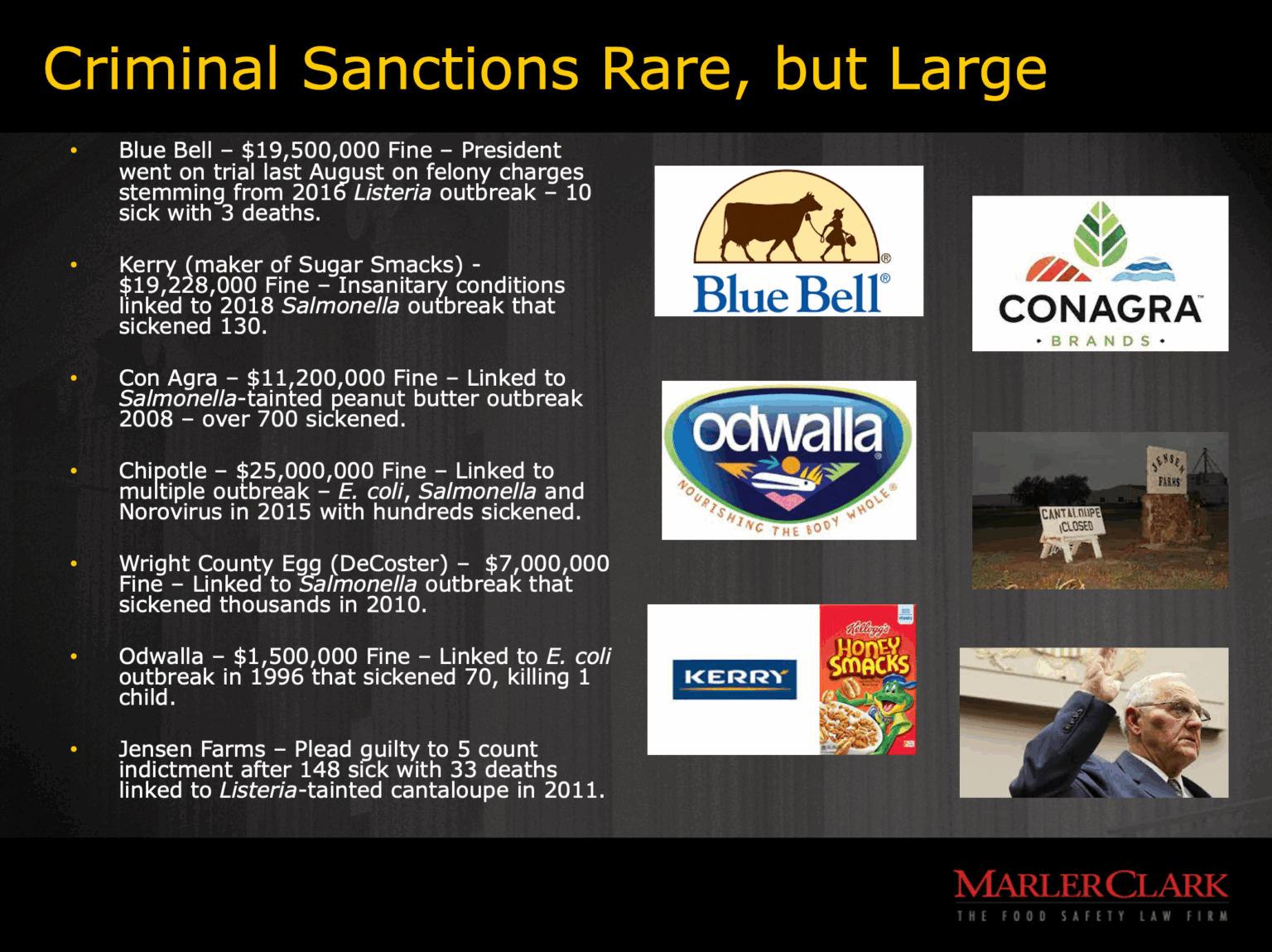
Even if they had an appetite to prosecute, there will be no one there to do the work. According to Sarah N. Lynch at Reuters:

A Justice Department unit that handles criminal and civil enforcement of U.S. food and drug safety laws is being disbanded as part of an ongoing cost-cutting campaign by President Donald Trump’s administration…

About 215 people work for the Consumer Protection Branch, part of the Justice Department’s Civil Division, including attorneys, support staff and law enforcement agents…

Although it is located in the Civil Division, the Consumer Protection Branch is an unusual office because its work involves a hybrid of criminal prosecutions and civil enforcement.

It handles criminal cases to enforce the Food, Drug and Cosmetic Act, a federal law that makes it a crime to sell or distribute adulterated or misbranded food or drugs. It also enforces statutes for the Federal Trade Commission and the Consumer Product Safety Commission…

The Consumer Protection Branch has been at the heart of some high-profile cases…

Prosecutors from the branch also brought the criminal case against former executives at Peanut Corporation for crimes that led to a 2009 outbreak involving more than 700 cases of salmonella poisoning.

We live in interesting times.

What price compromise?

When seven Democrat senators and one independent sided with the Republican majority to pass a bill meant to end the government shutdown earlier this week, they did so in full knowledge that they were throwing Affordable Care Act premium subsidies under the bus.

Mike Johnson already has signaled that a vote in the Senate in favour of extending those subsidies would not guarantee a vote in the House.

But, did they realize that, by voting for the Republican bill, they were also throwing food safety under the wheels of that same bus?

According to The Lever, as reposted by Bill Marler (tip of the Petri dish lid for finding and sharing this), the Senate-approved language guts funding for certain current and planned FDA programs and Rules.

Ironically, this Rule was first proposed under Trump 1.0 and is designed to simplify the tracing of a food to its source during a recall or foodborne disease outbreak investigation.

The Rule, which was finalized in 2023, requires food manufacturers, processors, packers, etc., “…maintain records containing information on critical tracking events in the supply chain for these designated foods, such as initially packing, shipping, receiving, and transforming these foods.”

The FDA allowed three years (ie., until January 2026) for those affected by the Rule to come into compliance with its requirements.

Last August, the FDA proposed to extend the compliance deadline by 30 months, to July 2028.

A provision of the Senate bill specifies that no funds “…may be used to administer or enforce the ‘Requirements for Additional Traceability Records for Certain Foods,’ published on Nov. 21, 2022.” 

In 2016, the FDA issued a Final Rule, “Standards for the Growing, Harvesting, Packing, and Holding of Produce for Human Consumption” in response to a steady increase in foodborne disease outbreaks linked to contaminated produce.

Compliance dates for this Rule were staggered, with the smallest farms given until 2020 to conform.

The Senate bill just passed PROHIBITS any of the funding made available by the bill from being used to enforce the Produce Safety Rule.

Finally, in the ultimate irony of the MAHA world, the Senate bill slashes funding for the FDA to develop or administer regulations “…long-term population-wide sodium reduction actions until an assessment is completed on the impact of the short-term sodium reduction targets.” 

As it happens, I am in the throes of writing a sequel to my food safety book, TAINTED: From Farm Gate To Dinner Plate, Fifty Years of Food Safety Failures.

The planned title of my new book is, TAINTED II: From Baby Food To Seniors’ Snacks, Making Americans Sick Again.

Watch for it.


TAINTED formats 3
“Reads like a true crime novel” – Food Safety News

Interested in learning more about food safety and the history of foodborne disease outbreaks and investigations?

Click on the link to listen to a short excerpt, then follow the buy links to add a digital, print or audio copy to your personal library.

Chapter 6. Birth of a Pathogen

OP-ED: It’s time for states to step up for food safety

Donald Trump and his acolyte, RFK, Jr., vowed to “Make America Healthy Again.”

They lied.

Watch what they do, not what they say.

Rachel Maddow, MSNBC host
  • RFK, Jr. fired every single member of FDA’s media communications team, including its director.
  • The proposed 2026 budget for the FDA outlines plans to shift the responsibility for routine food safety inspections to the states.
  • The 2026 FDA budget also proposes an overall reduction in full-time equivalent staffing for the Human Foods Program of 7.6%, with the Office of Investigations and Inspections reduced by 2.0%, and the Field Laboratory Operations by 54.4%.
  • Staff cuts at the FDA have already put the brakes on the agency’s ability to trace the source of foodborne disease outbreaks. In 2024, the agency investigated a total of 26 outbreaks and identified the source of 20 (77%). In 2025, the FDA has closed its investigation of 11 outbreaks after identifying the source of only 4 (36%); an additional 11 investigations remain under investigation, with a food source having been identified in four (36%).
  • The CDC has reduced its active surveillance of foodborne pathogens from six target organisms to just two, claiming lack of funding.
  • RFK, Jr. and Secretary of Agriculture, Brooke Rollins proposed allowing bird flu to “rip through” infected poultry flocks instead of culling the flocks to prevent further spread.
  • The USDA withdrew its proposed rule that, for the first time, would have placed (very lenient) limits on the presence of certain Salmonella strains in raw poultry.
  • Staff cuts at the USDA’s Animal and Plant Health Inspection Service have reduced the agency’s ability to combat livestock diseases, including bird flu.
  • The US Justice Department unit that used to handle drug and food safety cases on behalf of the FDA has been disbanded.
  • The EPA has rolled back clean air standards and eased limits on pesticide use.

What can US consumers expect as a result of these roll-backs?

  • More foodborne disease, including more hospitalizations and deaths
  • More outbreaks going unreported and unsolved
  • Inconsistent food safety inspection standards from state to state

I have been a food safety microbiologist for more than fifty years. I have worked both in government and in the private sector.

During my entire career, I have advocated for a single agency to oversee food safety—an agency with Cabinet-level representation that would replace the current fragmented regulatory system in the United States.

But desperate times require desperate measures. The federal government is not doing its job. Nor does it plan to in the future.

The various states that have the resources to do so must take action to protect their population from the failures of the federal government.

Democrat-led states on both coasts have already acted to counter the CDC vaccine panel’s new recommendations that would restrict access to respiratory (Covid-19, influenza, and RSV), MMRV, and Hepatitis B vaccines.

The West Coast Alliance is comprised of California, Oregon, Washington, and Hawaii. The Northeast Public Health Collaborative includes New York, Pennsylvania, New Jersey, Connecticut, Massachusetts, Maine and Rhode Island, as well as New York City’s Department of Health.

If a state government can override federal recommendations on vaccine access, the state also can superimpose its own food safety regulations on those handed down by the FDA and USDA in order to protect its population from disease.

I propose that the West Coast Alliance be extended to encompass food safety, including the following actions:

  • Develop and implement a common set of inspection standards for produce and processed foods originating in California, Oregon, Washington, and Hawaii.
  • Embargo all shipments of produce and processed foods originating from outside the borders of its member states unless each individual shipment is accompanied by a Certificate of Analysis issued by an accredited laboratory.
  • Regulate discharge emanating from concentrated animal feeding operations (CAFOs) in the member states—discharge that pollutes the soil in which crops are grown and the water used to irrigate those crops.

I am not suggesting these actions will be easy or inexpensive. But, as the federal government no longer appears to be interested in protecting the public from unsafe food, the states that are able to do so must take over.


TAINTED formats 3
“Reads like a true crime novel” – Food Safety News

Interested in learning more about food safety and the history of foodborne disease outbreaks and investigations?

Click on the link to listen to a short excerpt, then follow the buy links to add a digital, print or audio copy to your personal library.

Chapter 6. Birth of a Pathogen