
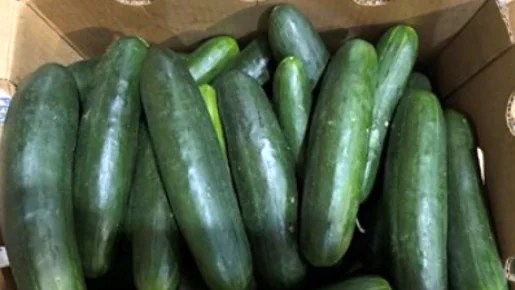
Salmonella Africana outbreak and the cucumber conundrum

The US Centers for Disease Control and Prevention (CDC) and the US Food and Drug Administration (FDA) are investigating two outbreaks of Salmonella infections that apparently are linked to consumption of cucumbers.

On June 1, 2024, Fresh Start Produce Sales, Inc. recalled 6167 cases of Whole Cucumbers grown in Florida after the Pennsylvania Department of Agriculture (PDA) found Salmonella in a sample of the company’s cucumbers.

Nevertheless, it is still an open question whether the cucumbers supplied by Fresh Start are the source of either or both outbreaks.

The Salmonella Africana outbreak

  • As of June 12, a total of 196 people infected with the outbreak strain of Salmonella Africana have been reported from 28 states and the District of Columbia.
  • Illnesses started on dates ranging from March 11, 2024, to May 23, 2024.
  • 68 people have been hospitalized.
  • Age of outbreak victims range from <1 to 94 years.
  • 63 out of 85 people interviewed (74%) reported eating cucumbers, as compared with 50% of individuals responding to a population survey.

The Salmonella Braenderup outbreak

  • As of June 12, a total of 185 people in multiple states were reported to be infected with the outbreak strain of Salmonella Braenderup.
  • The outbreak shares similarities with the Salmonella Africana outbreak, including where and when illnesses occurred and the demographics of ill people.
  • Investigators are working to determine whether the two outbreaks could be linked to the same food vehicle. 

The Salmonella-positive cucumber sample

  • The cucumber sample supplied by Fresh Start Produce and tested by the PDA was contaminated with Salmonella Bareilly. The strain does not match any ongoing Salmonella outbreaks.
  • The recalled cucumbers were distributed to 14 states: Alabama, Florida, Georgia, Illinois, Maryland, North Carolina, New Jersey, New York, Ohio, Pennsylvania, South Carolina, Tennessee, Virginia, and West Virginia.
  • The cucumbers recalled by Fresh Start were packed by Bedner Growers, Inc., a family-owned business. Bedner grows 1,500 acres of bell peppers and 500 acres of cucumbers in Palm Beach and Martin counties, Florida.
  • The FDA inspection database shows no record of any prior inspections of Bedner Growers by the federal agency.

Bedner is just one among many cucumber growers in the state of Florida.

The FDA and its state partners are continuing to sample cucumbers from other sources as part of the traceback investigation for both the Salmonella Africana and the Salmonella Braenderup outbreaks. However, cucumbers have a limited shelf life, and the produce responsible for the outbreaks may no longer be available for sale.

The best chance of making a definitive link to a specific grower/packer will be if the FDA is able to find one or both outbreak strains in samples obtained during an on-site inspection.

The FDA has already initiated inspection and sampling activities in conjunction with the Salmonella Africana outbreak, although the agency has not specified where the inspection is taking place. More information will be forthcoming from the FDA as it becomes available.

  • Do not eat any recalled cucumbers. If you recently purchased cucumbers and have them at home, you can check with the store where you purchased them to see if they were part of the recall. If you can’t tell, do not eat them.
  • Wash items and surfaces that may have touched the recalled cucumbers using hot soapy water or a dishwasher.
  • Call your healthcare provider if you have any of these severe Salmonella symptoms:
    • Diarrhea and a fever higher than 102°F
    • Diarrhea for more than 3 days that is not improving
    • Bloody diarrhea
    • So much vomiting that you cannot keep liquids down
    • Signs of dehydration, such as:
      • Not peeing much
      • Dry mouth and throat
      • Feeling dizzy when standing up
  • Do not sell or serve recalled cucumbers.
  • Wash and sanitize items and surfaces that may have come in contact with recalled cucumbers.
  • Stores can also notify customers who may have purchased recalled cucumbers using signs in stores or emails to customers.

TAINTED formats 3
“Reads like a true crime novel” – Food Safety News

Interested in learning more about food safety and the history of foodborne disease outbreaks and investigations?

Click on the link to listen to a short excerpt, then follow the buy links to add a digital, print or audio copy to your personal library.

Chapter 6. Birth of a Pathogen

TAINTED is available in digital format from all major on-line retailers. Press the button to go directly to your preferred digital bookstore.

Insanitary Conditions In India Behind Sushi Salmonella Outbreak

The contaminated raw tuna that is responsible – as of May 2, 2012 – for at least 258 Salmonella illnesses in 24 states and the District of Columbia was produced under filthy conditions in a substandard food manufacturing plant in Kerala, India.

FDA inspected the Kerala facility where Moon Fishery (India) Pvt. Ltd. produced the contaminated “Tuna Scrape” that was exported to the USA and sold to restaurants and grocery stores through distributors in Illinois, New Jersey, New York Massachusetts, Georgia, North Carolina, Texas and Maryland. The inspection took several days (April 19th – 24th, 2012).

Earlier today, Marler Blog released the initial Inspectional Observations Report (known as the 483) from that FDA inspection. It doesn’t take an advanced degree in microbiology or a great deal of imagination to deduce the probable source of the Salmonella contamination after reading the following observation, reproduced in full from the report:

You are not monitoring the sanitation conditions and practices with sufficient frequency to assure conformance with Current Good Manufacturing Practices including safety of water that comes into contact with food or food contact surfaces, including water used to manufacture ice, condition and cleanliness of food contact surfaces, maintenance of hand washing, hand sanitizing, and toilet facilities, and protection of food, food packaging material, and food contact surfaces from adulteration.

A- You are not monitoring the safety of water as evidenced by:

1- Tanks used for storage of process waters have apparent visible debris, filth, and microbiological contamination. Sand and activated carbon filter units used in manufacturing of water are not sanitized, and ventilation for tanks is not filtered to protect against contamination. There is no laboratory analysis for water used in ice manufacturing at the … facility to show the water used to make ice is potable. Ice manufacturing lacks sanitary controls: ice manufacturing equipment at the Moon Fishery facility is located outside and is susceptible to adulteration from pests and the environment. Apparent bird feces were observed on the ice manufacturing equipment at Moon Fishery; insects and filth were observed in and on the equipment. Ice manufacturing equipment at your … facility is rusty and situated so that the ice can not be protected against adulteration, as the ice manufacturing process is constructed into the flooring of the ice facility. Tuna processed at your facility, which is consumed raw or cooked, comes in direct contact with water and ice.

B- You are not monitoring the condition or cleanliness of food contact surfaces as evidenced by:

1-Some of the floor and wall tiles in the tuna processing area are broken and cracked, not allowing for proper cleaning.

2- After cleaning, the ceiling directly above the in-process tuna line was observed to have visible product residue.

3-After cleaning, product residues and rust were observed on knives and utensil storage boxes. These knives are used to cut raw tuna.

C-You are not monitoring protection from adulterants as evidenced by:

1-Peeling paint was observed directly above the in-process tuna line.

D-You are not monitoring hand washing, hand sanitizing and toilet facilities as evidenced by:

1-There were no hand drying devices available in the employee rest rooms on the first floor.

In short, the place was a mess!

There has been a tremendous amount of focus over the years on China as a source of hazardous foods and food ingredients. There has been very little media attention paid to India, even though that densely populated country struggles with a chronic shortage of sewage treatment facilities, a limited supply of potable water, and frequent food poisoning outbreaks.

Last month (April 2012), FDA refused 223 shipments of foodstuffs and other products from China, and 222 shipments from India. Reasons for rejecting food products from India included Salmonella, pesticides and process adulteration.

FDA physically examines less than 2% of all imported food shipments under its jurisdiction. The agency can’t be expected to check every shipment – it hasn’t the money, the staff or the lab facilities to do so.

It’s time to put the burden of demonstrating the safety of imported foodstuffs onto the shoulders of the producers and importers.

Why I STILL Don’t Eat Sushi

Four years ago last month, I wrote an article titled “Why I Don’t Eat Sushi Or Sashimi” after ten patrons of a restaurant in Kisai, Japan were diagnosed with cholera contracted as a result of having eaten contaminated sashimi.

I was taken to task by a reader who pointed out that FDA and the European Union require that fish used for sushi and sashimi be frozen before consumption in order to kill parasites. “So while there might be issues in Japan and other places,” my reader opined, “the EU and USA are relatively safe places to eat sashimi and sushi.”

In response to this comment, I explained that freezing the fish does not provide any protection against food poisoning bacteria such as Salmonella, unsanitary handling practices, cross-contamination or poor temperature control.

I suggest that the 258 victims of this year’s Salmonella Bareilly/Salmonella Nchanga outbreak would agree that eating raw sushi may be a risky business – especially when the sushi contains Nakaochi Scrape.

Today’s update from CDC revealed that the Salmonella outbreak now covers 24 states, including California, where the importer of the contaminated tuna is located. Thirty-two out of 258 outbreak victims have been hospitalized.

Sushi Case Count Map As of May 2, 2012 (source CDC)

Victims of this outbreak range in age from 4 to 86 years (median age of 30). More than half (57%) of the confirmed case patients are female. Illness onset dates range between January 28th and April 20th.

The Epi curve (a bar chart showing illness onset dates) clearly indicates that additional cases are likely to be reported. The shaded area in this chart indicates the time frame within which additional cases may have developed, but have not yet been confirmed or reported to CDC.

Confirmed infections by date of illness onset as of May 2, 2012 (source CDC)

While this outbreak plays out, CDC continues to offer the following advice:

CDC’s Advice to Consumers

  • Do not eat the recalled frozen raw yellowfin tuna product, known as Nakaochi Scrape, from Moon Marine USA Corporation. This product is tuna backmeat that is scraped from the bones of tuna and may be used to make sushi, particularly “spicy tuna” sushi.
  • If you purchase “spicy tuna” or other sushi, sashimi, ceviche, or similar dishes that might contain Nakaochi Scrape tuna product from a restaurant or grocery store, check with the establishment to make sure that it does not contain raw recalled product from Moon Marine USA Corporation. When in doubt, don’t eat it.
  • Persons who think they might have become ill from eating possibly contaminated raw Nakaochi Scrape tuna product should consult their healthcare providers.
  • Infants, older adults, pregnant women, and persons with impaired immune systems are more likely than others to develop severe illness and should not eat raw or partially cooked fish or shellfish. If you are unsure of your risk, ask your healthcare provider.

CDC’s Advice to Retailers and Establishments

  • Do not serve raw recalled frozen raw yellowfin tuna product, known as Nakaochi Scrape, from Moon Marine USA Corporation. If you do not know the source of your raw scraped yellowfin tuna product, check with your supplier.

CDC and FDA have been close-mouthed, as usual, regarding the retail distribution of the Nakaochi Scrape tuna product that is behind this Salmonella outbreak. California, though, has published a list of restaurants and sushi bars that are known to have been supplied with the implicated tuna.