Italian mini-pastries sicken 87 in USA and Canada. CDC silent.

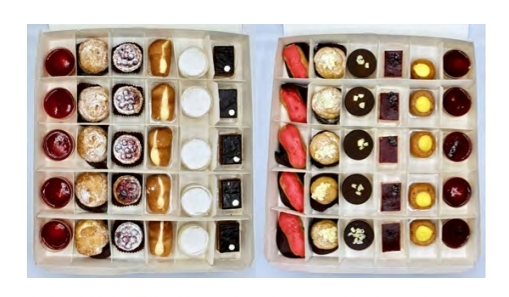
The US Food and Drug Administration (FDA) has traced a US outbreak of Salmonella Enteritidis to consumption of frozen mini-pastries imported from Italy.

Eighteen (18) people in California, Illinois, Massachusetts, North Carolina, New Jersey, New York, and Pennsylvania have been infected with the outbreak strain, which is identical to the strain that has infected 69 individuals in Canada.

One person in the US and 22 in Canada required hospitalization.

The US Centers for Disease Control and Prevention (CDC) has not posted any notice of this outbreak on its website.

The CDC website is currently undergoing modification, according to a notice featured prominently on each page of the agency website.

The Public Health Agency of Canada (PHAC) first reported on this illness outbreak on January 19, 2025, and updated its report on January 29th.

Outbreak cases in Canada have been reported in British Columbia (4), Alberta (3), Ontario (24), Québec (37), and New Brunswick (1).

The Canadian Food Inspection Agency (CFIA) linked the Canadian illnesses to consumption of Sweet Cream brand mini pastries, imported from Italy.

The Sweet Cream brand mini pastries were recalled in Canada on January 18, 2025. On January 29, 2025, a separate recall of certain D. Effe T. brand pastries (also from Italy) was announced after one of the outbreak illnesses was believed to be associated with consumption of this brand.

According to the FDA, these same pastries were imported into the US by two distributors, both of whom were contacted by the agency. One of the distributors had no remaining product on hand; the other quarantined all remaining product on hand and informed all of their downstream customers of the recall.

In the US, the mini pastries were distributed in Florida, New Jersey, New York, and Pennsylvania to food service locations such as hotel cafes, bakeries, institutions, and restaurants. The mini pastries were also served at catered events.

According to the FDA, the recalled products should no longer be available for sale.

  • Food service customers who received the recalled product should follow FDA’s safe handling and cleaning recommendations and use extra care in cleaning and sanitizing any surfaces and containers that may have come in contact with recalled products to reduce the risk of cross-contamination.
  • Contact your healthcare provider if you think you may have developed symptoms of a Salmonella infection.

The following advice applies to individuals, as well as retailers, distributors and food service establishments such as grocery stores, bakeries, hotels, restaurants, cafeterias as well as facilities such as hospitals and retirement residences across Canada: 

  • Check to see if you have the recalled products in your home or establishment by looking for the specific product name and size, UPC and codes in the recall alert.
  • Do not consume, serve, use, sell or distribute recalled products.
  • Throw out or return recalled products to the location where they were purchased. Consumers or establishments who are unsure if they have purchased the recalled products are advised to contact their retailer or supplier where the products were purchased.
  • Do not cook food for other people if you’ve been diagnosed with a Salmonella infection or any other gastrointestinal illness.
  • Contact your health care provider if you think you’re experiencing symptoms of Salmonella infection.

“Reads like a true crime novel” – Food Safety News

Interested in learning more about food safety and the history of foodborne disease outbreaks and investigations?

Click on the link to listen to a short excerpt, then follow the buy links to add a digital, print or audio copy to your personal library.

Chapter 6. Birth of a Pathogen

TAINTED is available in digital format from all major on-line retailers. Press the button to go directly to your preferred digital bookstore.

Mini-pastries from Italy trigger Canadian Salmonella outbreak

The Public Health Agency of Canada (PHAC) is investigating an outbreak of Salmonella Enteritidis infections in multiple provinces.

Sixty-one laboratory-confirmed cases have been reported to date in British Columbia (4), Alberta (2), Ontario (21), Quebec (33), and New Brunswick (1). Outbreak victims range in age from 3 to 88 years old.

Seventeen people have been hospitalized.

The outbreak began in late September 2024; the most recent case was reported in December 2024. Many of the victims reported eating mini pastries at catered events or other establishments.

PHAC advises that the investigation is ongoing and more cases may come to light.

The illnesses have been linked to consumption of Sweet Cream brand mini pastries.

Importations Piu Che Dolci Inc. has recalled the following Sweet Cream brand mini-pastries:

  • Mini Patisserie (~4 kg (4 boxes of 30 pieces); UPC 8 058302 730028; All best before dates from 2025/06/17 up to and including 2025/11/15; Product of Italy)
  • Mini Patisserie – Tray A (1 kg (30 pieces); UPC 8 058302 730004; All best before dates from 2025/06/17 up to and including 2025/11/15; Product of Italy)
  • Mini Patisserie – Tray B (1 kg (30 pieces) UPC 8 058302 730011; All best before dates from 2025/06/17 up to and including 2025/11/15; Product of Italy)

The mini-pastries may have been sold clerk-served or in smaller packages, with or without a label that may not bear the same brand, product name, or best before date.

The recalled products were distributed to bakeries, hotels, restaurants, cafeterias, hospitals, retirement residences, and the general public in Alberta, British Columbia, Nova Scotia, Ontario, and Quebec, and may also have been distributed in other Canadian provinces and territories. The pastries also were served at catered events.

The following advice from the PHAC applies to individuals, as well as retailers, distributors, and food service establishments (bakeries, hotels, restaurants, and cafeterias), as well as facilities such as hospitals and retirement residences across Canada:

  • Contact your health care provider if you think you’re experiencing symptoms of Salmonella infection.
  • Check to see if you have the recalled products in your home or establishment by looking for the specific product name and size, UPC and codes in the recall alert.
  • Do not consume, serve, use, sell or distribute recalled products.
  • Throw out or return recalled products to the location where they were purchased. Consumers or establishments who are unsure if they have purchased the recalled products are advised to contact their retailer or supplier where the products were purchased.
  • Do not cook food for other people if you’ve been diagnosed with a Salmonella infection or any other gastrointestinal illness.

Salmonellosis has a wide range of symptoms. You may not get sick at all. However, if you do get sick, symptoms usually start within 6 to 72 hours after exposure.

You may experience one or more of the following symptoms: chills, fever, nausea, diarrhea, vomiting, stomach cramps, and a sudden headache. Most symptoms end within 4 to 7 days.

While most people recover completely on their own, some people may have a more serious illness that requires hospital care, possibly leading to long-lasting health effects or death.


TAINTED formats 3
“Reads like a true crime novel” – Food Safety News

Interested in learning more about food safety and the history of foodborne disease outbreaks and investigations?

Click on the link to listen to a short excerpt, then follow the buy links to add a digital, print or audio copy to your personal library.

Chapter 6. Birth of a Pathogen

TAINTED is available in digital format from all major on-line retailers. Press the button to go directly to your preferred digital bookstore.

Death toll rises to 8 in cantaloupe outbreak

Salmonella-contaminated cantaloupe products are now blamed for eight deaths in a cross-border outbreak that has sent 140 people to hospital.

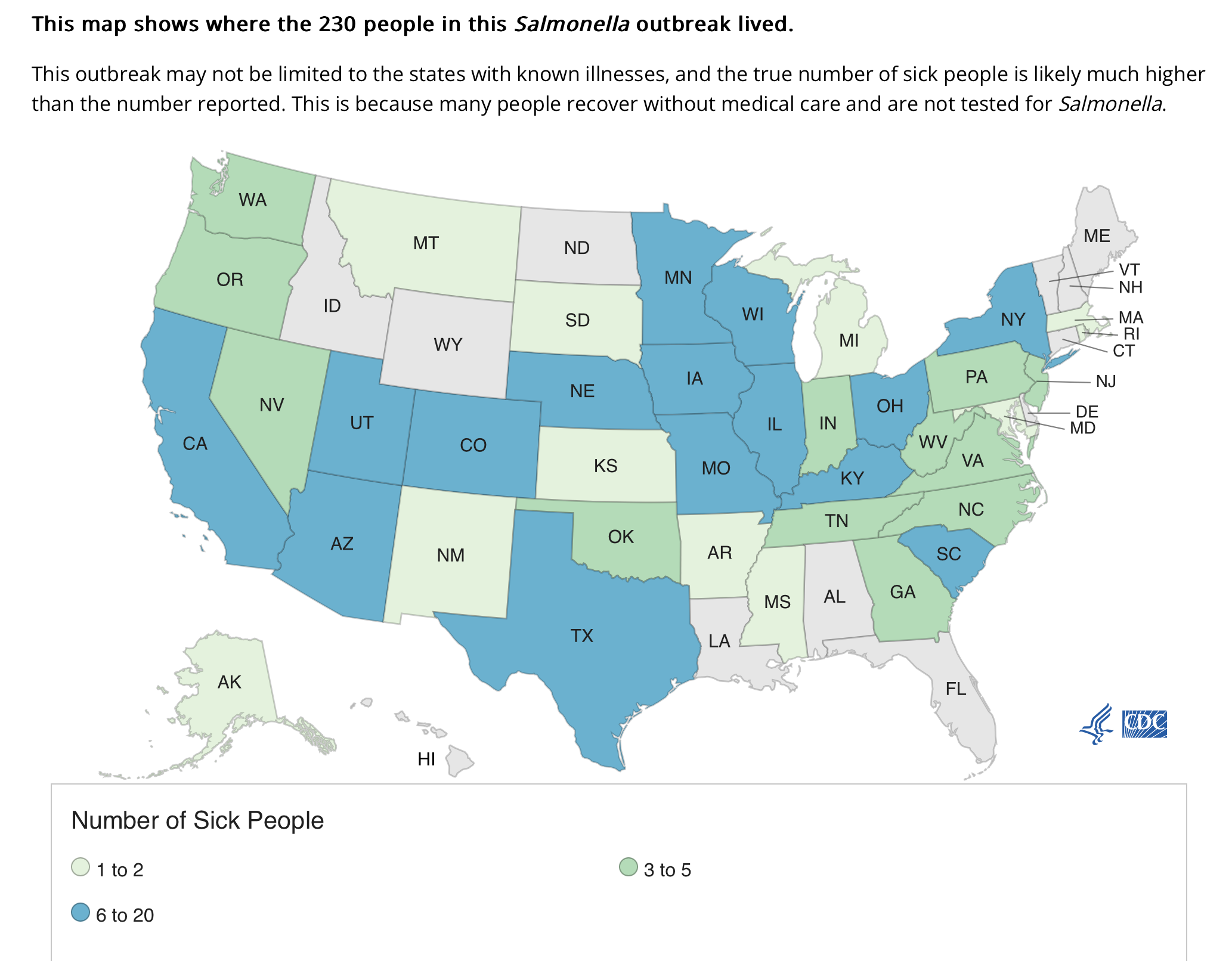
As of the latest reports from the US Centers for Disease Control and Prevention (CDC) and the Public Health Agency of Canada (PHAC), there have been 230 lab-confirmed cases reported in the USA and 129 in Canada.

Five deaths have been reported in Canada and three in the United States.

Six Canadian provinces have reported outbreak cases to the PHAC:

  • British Columbia: 15
  • Ontario: 17
  • Quebec: 91
  • Prince Edward Island: 2
  • New Brunswick: 2
  • Newfoundland and Labrador: 2

In the United States, cases have been reported by 38 states (see image below, supplied by the CDC).

Multiple recalls have been announced in both countries. The US Food and Drug Administration (FDA) has activated a webpage devoted to listing the recalls announced publically in the USA. A list of Canadian recalls has been provided on the Canadian Food Inspection Agency website.

Both the CDC and the PHAC have pointed out that children under the age of five and adults over the age of 65 have accounted for a large majority of the lab-confirmed cases in both countries.

In the USA, children under the age of five account for 27% of the confirmed cases to date, while seniors (over the age of 65) account for 47% of cases.

In Canada, 35% of the confirmed cases occurred in children under the age of five, while seniors accounted for 45% of confirmed cases.

The very young and the elderly typically are more susceptible to most infections than the rest of the population, and also are prone to experiencing more severe symptoms.

But there are other factors in play, which are highlighted by demographic data provided by the CDC.

Specifically, 23 children attended childcare centers, and 24 of the adult victims were residents of longterm care facilities among the 230 cases in the USA.

The PHAC also reported that many of the Canadian victims resided in a long-term care home, or a retirement residence, or attended daycare.

Many of the recalled products—especially many cut fruit products and fruit salads—were supplied to medical facilities, institutions, food service facilities, hotels, and restaurants.

Not all of these recalls have been made public in the United States. Instead, the recalling company communicated directly with its customers. For example:

  • Market Cuts LLC:- Recalled 8 cut fruit products by letter notification to its customer(s) in Illinois, Indiana, Michigan and Wisconsin
  • Freshpoint Of Southern CA:- Recalled Imperial Fresh brand whole cantaloupes, which it had supplied to food services in California, Arizona and Nevada
  • FreshPoint Dallas:- Recalled Imperial Fresh brand whole cantaloupes, which it had supplied to institutions, medical facilities and direct food service accounts in Arkansas, Missouri, Mississippi, Kansas, Louisiana, Oklahoma, Texas

Several of the cut fruit products and whole cantaloupes distributed in Canada also were supplied to hotels, food service operations and institutions (such as hospitals, longterm care facilities and child care facilities).

This outbreak is far from over, and the case counts are continuing to climb. Furthermore, the number of reported cases in any outbreak represents only a fraction of the total number of people who become infected.

Consumers are advised to discard and not consume Malichita or Rudy cantaloupes or any other recalled products. If you have whole or pre-cut cantaloupes or fruit cups, fruit platters, or fruit medleys in your home and are unsure of their origin, discard them as a precaution.

Food contaminated with Salmonella may not look or smell spoiled but can still make you sick. Young children, pregnant women, the elderly and people with weakened immune systems may contract serious and sometimes deadly infections. Healthy people may experience short-term symptoms such as fever, headache, vomiting, nausea, abdominal cramps and diarrhea. Long-term complications may include severe arthritis.

If you feel unwell, and especially if you have symptoms like diarrhea or vomiting, do not cook or prepare food for other people.

If you suspect you are suffering from a Salmonella infection, consult your healthcare provider.


TAINTED formats 3
“Reads like a true crime novel” – Food Safety News

Interested in learning more about food safety and the history of foodborne disease outbreaks and investigations?

Click on the link to listen to a short excerpt, then follow the buy links to add a digital, print or audio copy to your personal library.

Chapter 6. Birth of a Pathogen

TAINTED is available in digital format from all major on-line retailers. Press the button to go directly to your preferred digital bookstore.