
We still need the risk of Criminal Sanctions in Food Poisoning Cases

This opinion piece by Bill Marler first appeared on Marler Blog and is reposted here with the author’s permission.

As I wrote last Spring, I have tried to steer clear of politics with respect to the Felon in Chief, but this is nuts, or at least peanuts.  According to yet another edict from the White House, it is now the policy of the United States that:

(a)  Criminal enforcement of criminal regulatory offenses is disfavored.

(b)  Prosecution of criminal regulatory offenses is most appropriate for persons who know or can be presumed to know what is prohibited or required by the regulation and willingly choose not to comply, thereby causing or risking substantial public harm.  Prosecutions of criminal regulatory offenses should focus on matters where a putative defendant is alleged to have known his conduct was unlawful.

(c)  Strict liability offenses are “generally disfavored.”  United States v. United States Gypsum, Co., 438 U.S. 422, 438 (1978).  Where enforcement is appropriate, agencies should consider civil rather than criminal enforcement of strict liability regulatory offenses or, if appropriate and consistent with due process and the right to jury trial, see Jarkesy v. Securities and Exchange Commission, 603 U.S. 109 (2024), administrative enforcement.

(d)  Agencies promulgating regulations potentially subject to criminal enforcement should explicitly describe the conduct subject to criminal enforcement, the authorizing statutes, and the mens rea standard applicable to those offenses.

Typically, every crime has two elements—a bad act and a culpable state of mind (mens rea, which generally means intent or recklessness). Section 333(a)(1) of the FDCA, the misdemeanor provision, is noteworthy because it creates one of the few true strict liability crimes in federal criminal law. That is, the government does not need to prove a state of mind to obtain a conviction. If a food product is misbranded or adulterated and is distributed into the channels of interstate commerce, a crime has been committed. Depending upon the nature of the conduct, a violation of the Food, Drug, and Cosmetic Act may be a felony or a misdemeanor. Misdemeanor violations of section 331 are punishable by a maximum prison sentence of one year and a maximum fine of $100,000. 

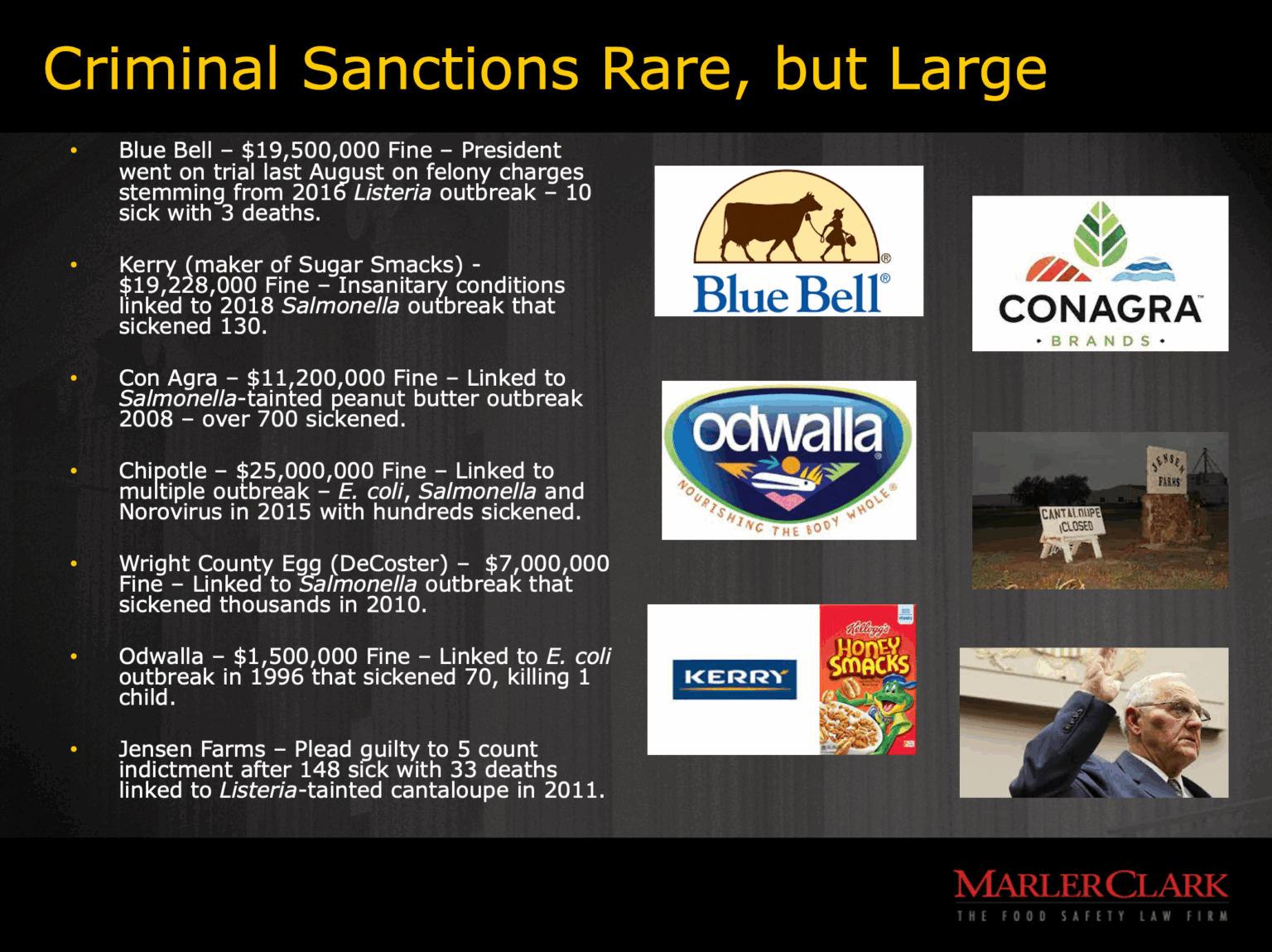
Perhaps the folks at the Peanut Corporation of America would still be prosecuted as a felony, but they certainly argued that they did not know the peanut butter was tainted with Salmonella. However, if this new policy stands it is not likely the Blue Bell, Kerry, Con Agra, Chipotle, Wright County, Odwalla nor Jensen Farms would have been prosecuted, and it is likely that few prosecution will occur in the future.
Even if they had an appetite to prosecute, there will be no one there to do the work. According to Sarah N. Lynch at Reuters:

A Justice Department unit that handles criminal and civil enforcement of U.S. food and drug safety laws is being disbanded as part of an ongoing cost-cutting campaign by President Donald Trump’s administration…

About 215 people work for the Consumer Protection Branch, part of the Justice Department’s Civil Division, including attorneys, support staff and law enforcement agents…

Although it is located in the Civil Division, the Consumer Protection Branch is an unusual office because its work involves a hybrid of criminal prosecutions and civil enforcement.

It handles criminal cases to enforce the Food, Drug and Cosmetic Act, a federal law that makes it a crime to sell or distribute adulterated or misbranded food or drugs. It also enforces statutes for the Federal Trade Commission and the Consumer Product Safety Commission…

The Consumer Protection Branch has been at the heart of some high-profile cases…

Prosecutors from the branch also brought the criminal case against former executives at Peanut Corporation for crimes that led to a 2009 outbreak involving more than 700 cases of salmonella poisoning.

We live in interesting times.

It is time to rebuild the US food safety system

Several weeks ago, food safety advocate Bill Marler launched his campaign to “Get the ‘F’ out of the FDA.”

Marler proposed that Congress split the Food and Drug Administration into two separate agencies—one with responsibility for food safety and human nutrition, and the other for drugs, cosmetics and medical devices.

While I agree with the need for a separate agency to oversee food safety and human nutrition, I believe Marler’s proposal does not go far enough.

It is time to consolidate all food safety activities at the federal level under a single umbrella.

Here’s why.

Split jurisdiction

At present, responsibility for overseeing food safety is split between two main federal agencies: the FDA and the Food Safety and Inspection Service (FSIS) of the US Department of Agriculture (USDA).

The USDA is responsible for the safety of meat and poultry, catfish, and egg products.

The FDA is responsible for the safety of all food products that do not contain meat or poultry, for intact eggs, and for all fish other than catfish.

This division of responsibility by commodity has led to some strange and confusing situations.

  • canned foods containing meat or poultry come under FSIS jurisdiction, while all other canned foods are FDA-regulated.
  • pizzas containing more than 2% meat are the responsibility of FSIS; less than 2% meat, and the FDA takes over.
  • open-faced sandwiches containing meat are overseed by FSIS; closed sandwiches are the responsibility of the FDA, whether or not meat is present.

These arbitrary distinctions mean that many food processing plants must answer to two separate federal agencies.

Conflict of interest

The USDA operates under a double mandate.

On the one hand, it is responsible for certifying that the food products under its jurisdiction are safe for human consumption.

On the other hand, the USDA also is charged with promoting US agricultural products both domestically and to overseas markets.

This is akin to having the quality assurance department of a food company report to the head of the marketing department.

We have seen the consequences of this conflict most recently in the FSIS draft proposal to allow as much as one Salmonella per gram of chicken in raw, breaded stuffed chicken products. 

Advertisements

An immodest proposal

It is time to demolish the current ineffective, wasteful, and conflicted system and build a new one, centered on a new Food Safety and Nutrition Agency (FSNA) with a seat at the Cabinet table.

The FSNA would take over all of the food safety and nutrition program activities currently performed by the FDA. In addition, all responsibility for meat, poultry, egg products and catfish would fall under the FSNA umbrella.

The USDA would retain responsiblity for certifying the fitness of livestock for slaughter and certifying the fitness of their meat for human consumption.

At the moment meat or poultry leaves the slaughterhouse, jurisdiction would shift to the FSNA.

This approach would have the benefit of eliminating the conflict of interest inherent in the USDA’s double mandate. It would also unscramble the arbitrary and confusing overlap of jurisdictions between the FDA and the FSIS.

The consolidation of all food safety responsibilities within a single, independent agency is not a new idea.

The Canadian Food Inspection Agency (CFIA) was created in 1997 by consolidating into a single agency the food safety components of the Health Protection Branch (then the Canadian equivalent to the FDA), the Department of Agriculture, and the Department of Fisheries and Oceans.

Other countries, including the United Kingdom, Australia, and New Zealand have followed a similar path.

The bottom line

Congress created the current dysfunctional structure over a span of many decades. 

Therefore, it is up to Congress to deconstruct this broken system and build a new one that will work to the benefit of the public it has been elected to represent.


TAINTED formats 3
“Reads like a true crime novel” – Food Safety News

Interested in learning more about food safety and the history of foodborne disease outbreaks and investigations?

Click on the link to listen to a short excerpt, then follow the buy links to add a digital, print or audio copy to your personal library.

Chapter 6. Birth of a Pathogen

TAINTED is available in digital format from all major on-line retailers. Press the button to go directly to your preferred digital bookstore.