
FDA continues to review possible link between pet diets and canine heart disease

This story by Phyllis Entis first appeared in Food Safety News and is reposted here with permission

A diet rich in legumes or potatoes might be linked to an increased risk of canine dilated cardiomyopathy (DCM), according to the Food and Drug Administration.

Prior to issuing a public notice on July 12, the FDA had received sporadic reports involving 30 dogs and 7 cats over a three-year period. During that same period, the veterinary cardiology community received about 150 similar reports. In dogs, the disease results in an enlarged heart.

Some of the dogs exhibited signs of heart disease, including decreased energy, cough, difficulty breathing, and episodes of collapse. Reports received by FDA identified a range of brands and formulas. 

The common element in these foods appears to be the presence of legumes (including peas, beans, lentils, chickpeas, soybeans, peanuts), pulses (seeds of legumes), and/or potatoes as main ingredients in the pet foods. The list also encompasses protein, starch or fiber derived from legumes.

Since the July 12 notification, FDA has received additional reports, which it is in the process of evaluating. None of these reports involve cats. According to a spokesperson from FDA, the agency is not able to provide an accurate accounting at this time, as the number of reports is continuing to rise and the information is being analyzed as it is received.

Some dog breeds are genetically susceptible to developing DCM. However, at least some of the initial reports to FDA involved other breeds of dog not typically prone to this disease. FDA is evaluating various possible dietary causes of DCM in dogs, including, nutritional makeup of the main ingredients or how dogs process them, main ingredient sourcing, processing, and amount used.

At this point in its investigation, FDA is not advising dog owners to make any dietary changes. Pet owners whose dogs are showing any symptoms of DCM or other heart conditions should contact their veterinarian.

FDA is encouraging pet owners and veterinary professionals to report cases of DCM in dogs suspected of having a link to diet by using the electronic Safety Reporting Portal or calling their state’s FDA Consumer Complaint Coordinators.


FDA warns of possible link between food, canine heart disease

This article by Phyllis Entis first appeared in Food Safety News and is reposted here with permission. 

Pet foods containing peas, lentils, other legume seeds or potatoes as main ingredients may be linked to cases of canine dilated cardiomyopathy (DCM) in dogs, according to an alert to pet owners this week from the Food and Drug Administration.

Certain large and giant breed dogs, including great danes, boxers, Newfoundlands, Irish wolfhounds, saint bernards and doberman pinschers, are thought to have a genetic predisposition to DCM. Atypically, cases of DCM reported to FDA have been of mixed breeds and of smaller breeds that were not thought to be predisposed to this condition, including: golden and Labrador retrievers, whippets, a Shih Tzu, a bulldog and miniature schnauzers.

Canine DCM is a disease of the heart muscle, resulting in an enlarged heart, which can lead to congestive heart failure if not treated successfully. Dogs suffering from DCM may show symptoms of heart disease, such as decreased energy, cough, difficulty breathing and episodes of collapse.

In June 2017, Dr. Joshua Stern,  associate professor of cardiology in the School of Veterinary Medicine at the University of California-Davis, alerted the veterinary community to reports of  DCM in golden retrievers that were taurine-deficient.

Taurine is an amino acid, which is a building block of protein, necessary for heart health. It is normally found in animal tissue, including red meats, poultry and seafood. Taurine is not present in plant tissue. Although it is not considered to be an “essential” amino acid in the canine diet, some dry dog foods are supplemented with taurine.

Dogs that receive an adequate amount of the amino acids cysteine and methionine are able to produce taurine for themselves. Both cysteine and methionine are found in significant concentrations in meats, poultry, seafood and dairy products. These essential amino acids tend to be found at relatively lower concentrations in most edible plants, including peas, potatoes and lentils.

In four atypical cases of DCM reported to FDA, three golden retrievers and one Labrador retriever, blood tests revealed low whole blood levels of taurine. The Labrador retriever is recovering under veterinary treatment, including taurine supplementation and a change in diet.

Four other atypical DCM cases in a miniature schnauzer, a Shiuh Tzu and two Labrador retrievers, had normal blood taurine levels.

FDA has contacted pet food manufacturers to discuss the reports and to help further the investigation.

The FDA encourages pet owners and veterinary professionals to report cases of DCM in dogs suspected of having a link to diet by using the electronic Safety Reporting Portal or calling their state’s FDA Consumer Complaint Coordinators. See “How to Report a Pet Food Complaint” for additional instructions.

Canal water likely source of E. coli in romaine-related outbreak

This article by Coral Beach first appeared in Food Safety News and is reposted here with permission.

Federal officials say contaminated canal water near romaine lettuce growing fields is the likely source of the unusually virulent strain of E. coli that has sickened people across 36 states, killing five.

This NASA photo shows a canal snaking through the Arizona desert near Yuma, AZ. Such canals carry water to communities and farmers.

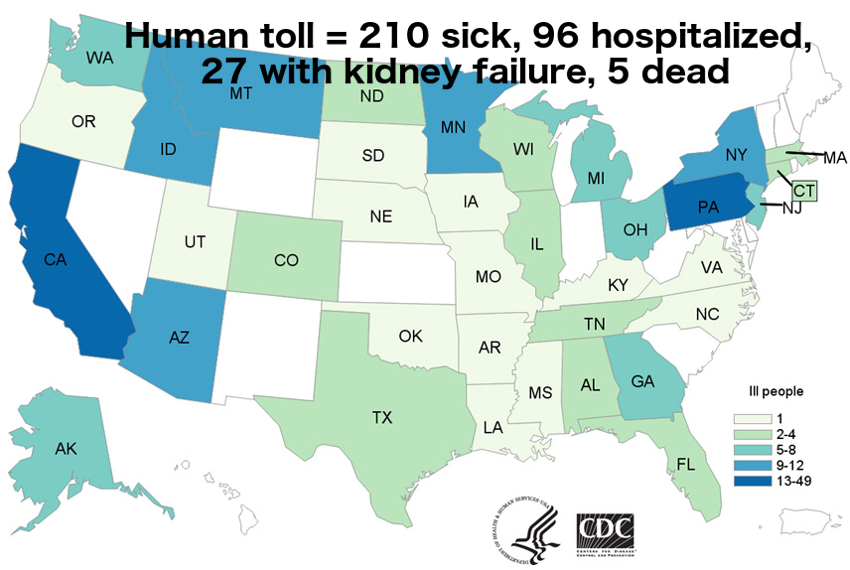
The outbreak is over, according to an update this afternoon from the Centers for Disease Control and Prevention. The agency has confirmed 210 people with infections. Twenty-seven of the victims have developed kidney failure. The most recent victim became sick on June 6.

“Samples have been collected from environmental sources in the region, including water, soil, and cow manure. Evaluation of these samples is ongoing,” according to an update this afternoon from the Food and Drug Administration investigators.

“To date, CDC analysis of samples taken from canal water in the region has identified the presence of E. coli O157: H7 with the same genetic fingerprint as the outbreak strain. We have identified additional strains of Shiga-toxin producing E. coli in water and soil samples, but at this time, the samples from the canal water are the only matches to the outbreak strain.”

Growers, researchers and produce trade associations have said in recent weeks that the Yuma area uses canal water from the Colorado River for irrigation and other agriculture uses. Some have theorized that a common water source is one of the most likely sources of the E. coli bacteria.

“CDC laboratory testing identified the outbreak strain of E. coli O157: H7 in canal water samples taken from the Yuma (AZ) growing region,” according to the CDC’s update this afternoon, which is the first since June 1.

To view a larger version of this map, please click on the image

“The U.S. Food and Drug Administration is continuing to investigate the outbreak to learn more about how the E. coli bacteria could have entered the water and ways this water could have contaminated romaine lettuce.”

FDA last reported to the public on June 1 when traceback efforts were still stymied because of a tangle of hand-written, incomplete and incompatible shipping and receiving records through the supply chain from growers to retailers.

From the beginning of the outbreak, FDA and CDC have said the implicated romaine lettuce came from the Yuma growing region. Produce industry individuals and groups told the federal agencies the last romaine from that area was harvested April 16. People usually begin to show symptoms of infection in less than a week after exposure to E. coli bacteria.

The first confirmed illness in the outbreak began on March 13. The age range of victims is 1 to 86 years old.

“In interviews, ill people answered questions about the foods they ate and other exposures they had before they became ill. Of the 166 people interviewed, 145 (87 percent) reported eating romaine lettuce in the week before their illness started,” according to the CDC.


A Supplementary Note

In a related Food Safety News opinion piece, Coral Beach highlights the long delay between the determination of the geographic source of the E. coli O157:H7 outbreak and the sampling of canal water in the region.

In Chapter 8 of my book, Food Safety: Old Habits, New Perspectives, published in 2007 by ASM Press, I wrote:

Take a drive on the Interstate 5 through California’s San Joaquin Valley and you will pass fields of produce, open irrigation canals, and cattle feedlots. Irrigation is a way of life in this semi-arid agricultural area; rain is a rare visitor, except during the winter months. But when it rains, it pours. The soil becomes saturated, and excess water drains off the fields and feedlots. Some of the runoff finds its way into the irrigation canals, bringing with it pathogens such as E. coli O157:H7.

This observation is equally applicable to the agricultural region around Yuma, Arizona.