The FDA, together with the CDC and state and local partners are investigating an outbreak of fourteen (14) Salmonella Senftenberg infections in twelve US states.
Two people have been hospitalized.
Cases have been reported in Arkansas (1), Georgia (2), Illinois (1), Massachusetts (1), Missouri (1), Ohio (1), North Carolina (1), New York (1), South Carolina (1), Texas (2), Virginia (1), and Washington (1).
Image supplied by CDC
According to the FDA, five out of five outbreak victims who were interviewed reported consuming peanut butter prior to becoming ill. Four of the five specifically mentioned Jif peanut butter.
Although the FDA has not yet found the outbreak strain in a finished product sample, the agency reports that a strain of Salmonella recovered from an environmental sample collected at the Jif Lexington, Kentucky, production plant twelve years ago (in 2010) is a genetic match for the Salmonella strain recovered from victims in this current outbreak.
This archival culture, combined with the information from outbreak victims who had consumed Jif peanut butter, catalyzed a voluntary recall on the part of The J.M. Smucker Co., the manufacturer of the Jif family of products.
The recall
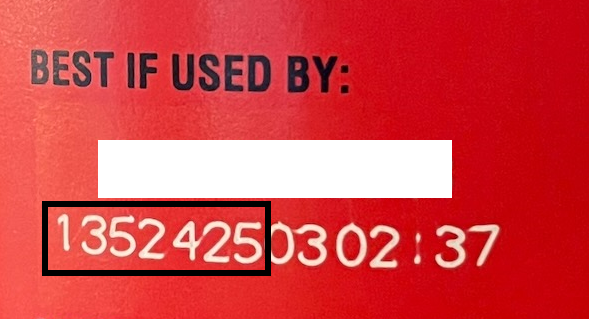
The recall includes lot codes from 1274425 to 2140425, but only for lot codes that end in “425,” which is the identifier code for the Lexington, Kentucky production plant. Recalled products were distributed nationwide in the United States.
As the recalled products have a two-year shelf life, the FDA urges consumers to check their pantries and discard or return any of the products included in the recall.
The lot code can be found near the bottom of the product label, directly below the BEST IF USED BY date, as illustrated here.
FDA recommends:
Consumers, restaurants, and retailers should not eat, sell, or serve any recalled Jif brand peanut butter that have lot code numbers 1274425 through 2140425. This product has a two-year shelf life so consumers should check any Jif peanut butter in their home.
If you have used the recalled Jif brand peanut butter that have lot code numbers 1274425 through 2140425, you should wash and sanitize surfaces and utensils that could have touched the peanut butter.
If you or someone in your household ate this peanut butter and have symptoms of salmonellosis, please contact your healthcare provider.
As reported yesterday, Abbott Nutrition has entered into a Consent Decree of Permanent Injunction that spells out the conditions under which the company will be permitted to recommence and continue powdered infant formula production at its Sturgis, Michigan, plant.
Despite the company’s protestations of innocence regarding the outbreak of four cases of Cronobacter sakazakii illnesses–including two deaths–in infants who consumed Abbott’s products, the formal Complaint filed by the US Justice Department sets out very clearly the extent of Abbott’s culpability.
The Complaint
After summarizing the relevant statutes, regulations and rules, the Complaint lists the following supporting evidence, found during the inspections carried out by US Food and Drug Administration (FDA) investigators in September 2021 and January-February 2022.
FDA lab analysis found C. sakazakii on several surfaces in the production area, including the cover of a hopper that feeds scoops directly into infant formula containers. The sample was collected at the time a batch of formula was being packaged, and the scoops come into direct contact with product.
Abbott’s own environmental samples confirmed the presence of Cronobacter spp. on surfaces in the powdered infant formula production area between September 25, 2019, and February 20, 2022. The company did not perform the necessary test to determine whether or not the bacteria were Cronobacter sakazakii.
On January 31, 2022, FDA investigators noted the presence of pooled water on several levels of a multi-story spray dryer tower while the spray dryer was being used to produce a batch of powdered infant formula.
Abbott’s own records documented a total of 310 “water events” (leaks and condensation) between January 1, 2020, and February 1, 2022, in dry-production areas for powdered infant formula (e.g. during spray-drying and/or container-filling operations). Several of those leaks are described in the company’s records as necessitating repairs to a roof.
Abbott had never validated the dry-out step for their spray dryers to ensure that the interiors of the dryers are completely dry following cleaning.
Abbott’s own records documented a history of internal deterioration of the spray dryers dating back to September 2018, including (but not limited to) pits and cracks inside the dryers’ main chambers.
Plant personnel working in the infant formula production area did not always wear necessary protective apparel.
The company failed to conduct an adequate investigation into the validity of a complaint that showed a possible health hazard existed, and failed to test any retained samples of the suspect production lot for microbiological contamination.
At the completion of the September 2021 inspection, the FDA issued an FDA-483 form, listing several deficiencies. Although Abbott promised to take corrective action, the company did not implement sustained corrections or demonstrate ongoing compliance with statutory requirements.
On behalf of the FDA, the US Department of Justice has petitioned the Court to issue a permanent injunction requiring Abbott to “… cease manufacturing, processing, preparing, packing, labeling, holding, and/or distributing any article of food unless and until Defendants bring their manufacturing, processing, preparing, packing, labeling, holding, and distribution operations into compliance with the Act and its implementing regulations to the satisfaction of FDA.”
The request also includes authorization for FDA to inspect the company’s “… place(s) of business and all records relating to the receipt, manufacture, processing, preparing, packing, labeling, holding, and distribution of any article of food to ensure continuing compliance with the terms of the injunction, and that Defendants bear the costs of such inspections, including testing and sampling …” and to award costs to the government, including the cost of the investigation to date.
A short leash
The conditions stipulated in the Consent Decree under which Abbott Nutrition will be allowed to resume and maintain production will keep the company on a very short leash.
Abbott will be required to retain an independent expert or experts to evaluate all of the facilities and processes at the Sturgis, Michigan, location, and conduct an inspection to determine what will be necessary to bring the operation into compliance with FDA regulations. The company will be required to notify FDA of the identity and qualifications of the expert within two days after retaining him or her.
Abbott will need to verify the dry-out procedures and validate its method of testing for moisture in production equipment and processing environments.
A pre-production cleaning, sanitizing and dry-out followed by environmental testing for pathogens will be required.
Before starting production, Abbott will be required to provide FDA with a report from the expert that documents completion of all of the verification and validation activities and the pre-production review.
Once production has started, a qualified individual within Abbott’s quality unit will be required to review the batch record, product test results and environmental monitoring for every production lot prior to distribution of the lot. The responsible individual must certify in writing to FDA that each lot meets all specifications.
The consent decree also specifies the testing that must be conducted, and that production be halted and FDA be notified immediately in the event that any in-process or finished product test detects Cronobacter and/or Salmonella. Production will only resume after Abbott receives written permission from FDA.
Abbott must maintain a record of all sales and distribution of its products and make those records available to FDA immediately upon request.
Additional details include specifics as to the required environmental monitoring, training of personnel, preparation and submission to FDA of a plan for building and/or equipment repair, hiring of an auditor to conduct audit inspections of the production facility, methods and processes.
Under the provisions of the decree, in the event the FDA determines that Abbott has not lived up to its agreement, the agency has the authority to order the company to cease manufacturing, and to take whatever other corrective actions the agency deems necessary for protection of public health.
The foregoing is just a sample of the details contained in the 33-page Consent Decree and the 21-page Complaint. Nor is this the end of the story.
In his blog post this morning, Bill Marler warns that criminal sanctions may be in the offing.
Let’s hope the FDA and the US Department of Justice don’t consider Abbott Nutrition to be “too big to nail.”
Between September 1, 2019 and September 20, 2021, Abbott Nutrition received seventeen consumer complaints regarding multiple Similac powdered formula products.
Fifteen of the complaints related to infants testing positive for Salmonella after consuming a Similac product. One complaint cited an infant who was diagnozed with Cronobacter (Enterobacter) sakazakii, and one was as the result of an infant death from an unspecified cause.
This information is contained in the September 20-24, 2021, Establishment Inspection Report (EIR), obtained by eFoodAlert from the US Food and Drug Administration (FDA) in response to a Freedom of Information Act request.
How the complaints were handled
In response to the Cronobacter complaint, the company reviewed its batch records and its finished product microbiological testing records. The complaint was reviewed by an internal Abbott Nutrition Medical Team.
The firm closed the complaint after determining that all batch records were acceptable, that there were no other consumer complaints, and that microbiological testing was negative for C. sakazakii.
The infant death complaint triggered a batch record review for three lots of Similac Alimentum. After completing the review and determining that no other complaints or medical concerns had been identified for the products, the company closed the complaint.
The fifteen Salmonella complaints involved infants who had been fed one or more batches of Similac Alimentum, Similac ProAdvance, Similac Spit-Up, Similac Total Comfort, Similac Advance, Similac Pro Sensitive or Elecare for Infants.
All fifteen of the infants tested positive for Salmonella.
Once again, the batch record reviews came back acceptable, and finished product testing results were negative for Salmonella.
A finished product sample of one of the implicated batches (Similac Advance lot #472005) was obtained by Abbott Nutrition from the consumer. The sample was subjected to a visual exam, and the container was examined in the packaging lab.
The company did not conduct any microbiological tests on this sample.
Abbott Nutrition’s ‘Standard Operating Procedure for Handling Complaints’ specifies that “…any chemical or microbial testing of an unopened customer sample requires the approval of the AN Vice President Quality or delegate.”
The EIR does not state whether approval was sought to carry out microbiological tests on the sample.
Abbott’s internal test results raise concerns
In addition to the consumer complaints, the EIR also reveals that the company had found Cronobacter in two batches of finished product.
The first of these positive results was recorded for Similac Alimentum (Batch 697464), produced on September 25, 2019, just one day after the completion of the FDA’s September 2019 inspection of Abbott’s production facility.
The root cause of the contamination was determined to be environmental. The company implemented correction actions and destroyed the contaminated batch.
The specific root cause for the second positive result, this time in Similac Spit-Up (Batch 732675), produced on June 22, 2020, was never found, according to the EIR. Several deficiencies were noted during the root cause investigation, corrective actions were implemented, and the batch was destroyed.
In addition to the two instances of Cronobacter in finished products, Abbott also found Cronobacter in five environmental samples between January 2019 and August 2021. There were no Salmonella-positive environmental samples.
All of the Cronobacter-positive results were from non-product contact surfaces.
In its February 17, 2022 recall notice, Abbott acknowledged “…evidence of Cronobacter sakazakii in the plant in non-product contact areas.”
Yet the FDA investigation recovered Cronobacter sakazakii from at least one swab of what appears to be a contact surface, as described in the 1/31/2022-3/18/2022 Inspectional Observations report (FDA Form 483).
The explanation for the absence of Cronobacter-positive findings on product contact surfaces is revealed in the description of Abbott Nutrition’s environmental sampling procedures as reported in the September 2021 EIR.
According to the description of Abbott Nutrition’s environmental sampling program, the company conducts environmental sampling of product contact surfaces and non-product contact surfaces, as well as air, water, steam and compressed air.
Swabsamples from product contact surfaces and non-product contact surfaces are tested for Enterobacteriaceae.
Enterobacteriaceae is a family of bacteria that includes both Salmonella and Cronobacter, and a test for total Enterobacteriaceae may be used as an indicator of general sanitary conditions in a production facility.
If a non-product contact surface produced a positive result in an area of the plant that was considered “high care” by the company, the isolates were analyzed for both Salmonella and Cronobacter.
On the other hand, if a product contact surface was positive for Enterobacteriaceae, the company did NOT test the isolates for Salmonella or Cronobacter, rationalizing that the finished product is analyzed for both microbes.
However, except in the event of massive contamination, Salmonella or Cronobacter most likely would be present at very low levels in the finished product, and the chances of detecting these contaminants would be akin to having the same number come up twice in a row on a roulette wheel.
By choosing not to test Enterobacteriaceae-positive product contact surfaces for Cronobacter or Salmonella, the company missed an opportunity to head off a serious problem.
FDA not blameless
There was a two year gap between inspections of Abbott Nutrition’s production plant in Sturgis, Michigan.
During this time, the United States–indeed, the entire world–was reeling from the Covid-19 pandemic.
When the FDA returned to Abbott, the company’s Covid-19 protection program required that the agency give advance notice of their planned inspection–something that had not been the case in the past.
Although the company had four days notice during which they could “tidy up” in anticipation of the FDA visit, the inspection team still found several issues of note, which were detailed in the Inspectional Observations form (FDA Form 483) provided to the company at the end of the inspection.
But one key observation was missing from the list.
There was no mention of the two finished product batches that had tested positive for Cronobacter sakazakii since the previous inspection, nor of the Cronobacter-positive environmental test results.
These observations were included instead on the Form 483 issued at the end of the January-March 2022 inspection.
According to the September 2021 EIR, the two-person FDA inspection team did not carry out any environmental sampling during the course of their visit, even after learning of the Cronobacter-positive results. Two finished product batches were sampled for nutrient analysis and two for microbiological analysis.
Unanswered questions
Seven months after FDA received the first report of an infant infected with Cronobacter and nearly four months after the agency initiated its in-depth inspection of Abbott Nutrition’s production facility, several questions remain:
In view of what the FDA learned in September 2021 regarding Cronobacter-positive environmental and finished product samples at the Abbott facility, why did it take more than four months for the agency to initiate another inspection after receiving the first of the illness reports?
Why did the FDA inspectors not respond more forcefully to those Cronobacter-positive results when writing up the list of Inspectional Observations at the completion of their September 2021 inspection?
Would Abbott have discovered and addressed its contamination problem sooner if it had tested product-contact surfaces for Cronobacter instead of relying upon finished product tests?
As Cronobacter (unlike Salmonella) is not a “reportable” disease in most states, how many additional cases of Cronobacter in infants have gone unreported?
Why did it take until February 17, 2022, before the public was made aware of the situation?