To Safer Infant Formulas and doing away with Botulism, Cronobacter sakazakii, Salmonella and Bacillus cereus

NOTE: This post on Marler Blog was written by food safety attorney, Bill Marler, and is reposted here with the author’s permission.
A bit over a month ago, I was set to testify before the House and Senate Safe Food Caucus in D.C. Instead, the night before I had a heart attack. I am fine. I got great care at Howard University Hospital and have made a complete recovery – although changing a few habits going forward.

I had been asked to share some thoughts on the infant formula industry’s inability to make sure that such a critical food item is safe. As I sit here on this Sunday afternoon I am puzzled how we can spend countless billions on yet another unnecessary war and even more billions on AI and robots to make most of us irrelevant and we cannot make infant food safer? Here is some of what I wanted to discuss. I am sure there are other ideas – I would love to hear them.

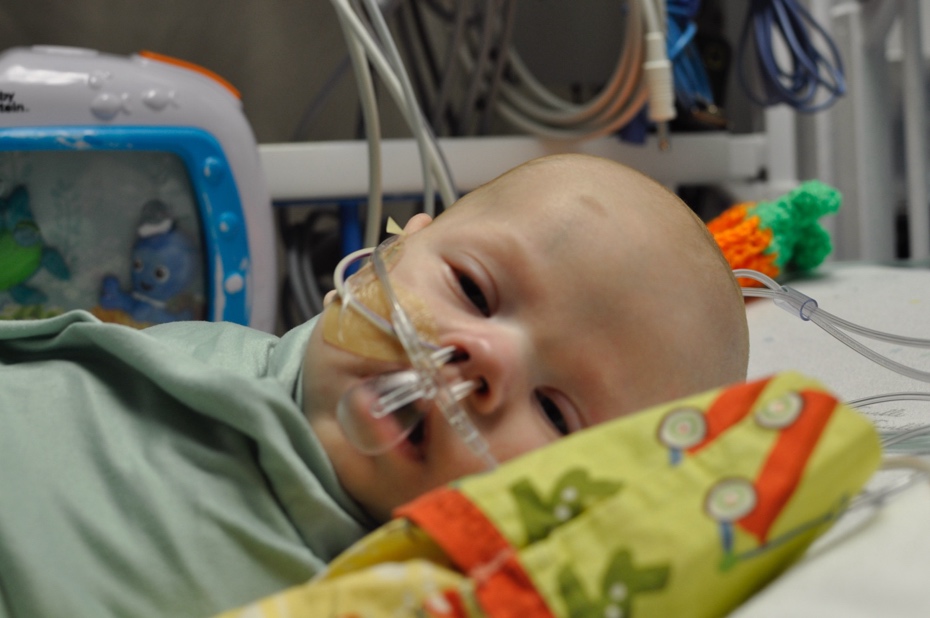
Infant formula has until recently been considered low risk for C. botulinum (and, then there are other pathogens – Cronobacter sakazakiiSalmonella and recently, Bacillus cereus of concern).

The recent C. botulinum outbreak and the mixed picture you get from looking at the multitude of WGS sequences on NCBI indicates that infant formula might be riskier. We need a new risk assessment of C. botulinum (and other pathogens) in infant formula and its constituent ingredients and how to control the pathogens in powdered infant formula (PIF). For C. botulinum we need more information about:

How often is infant formula and its constituents contaminated with C. botulinum spores?

Do we detect the pathogen when we need to? We need to assess if the current methods are good enough (sensitive enough)?

How often is a product contaminated with more than one strain of C. botulinum (multiple WGS profiles)? How many isolates (colonies on a plate) from each sample should be sequenced to detect all contaminants?

Should we routinely culture infant formula from cases of infant botulism when the child has been fed such a product? (I highly suspect that infant formula is causing many more cases of infant botulism than we know of at the moment).  

How do we best control C. botulinum spores in infant formula. We need studies on methods to control C. botulinum more efficiently in infant formula.

Do we need new regulations and redefined best practices for the production of infant formula and detecting and culturing the organism from product, environment and patients? 

Perhaps as a start:

Fund a risk assessment on the prevalence of C. botulinum spores, Cronobacter sakazakiiSalmonella and Bacillus cereus and sulfite reducing clostridia (as indicators) in:

            a.         raw milk

            b.         pasteurized milk

            c.         dairy powders – including whole milk powder, whey powder, whey protein concentrates, whey protein hydrolysates, nonfat dry milk, skim milk powder 

A specific risk assessment on the prevalence of C. botulinum spores and sulfite reducing clostridia in Powdered infant formula

Risk assessment on the prevalence of C. botulinum spores in minimally processed (non-retort thermally processed) commercial baby foods fed to children <1 year of age

Risk assessment on the prevalence of C. botulinum spores in low moisture infant first foods (puffs, cereals (rice and oatmeal), peanut butter, etc.)

Processing strategies to minimize spores in PIF – investigate technologies to reduce spores in infant foods while maintaining nutritional standards

Impact of farming practices on the incidence of C. botulinum spores in milk 

            a.         Prevalence of C. botulinum spores in silage, bedding, etc., at the farm

            b.         Milk collection on organic vs. conventional dairy farms

Improved resources for the tracking and following up of Infant Botulism cases to determine the source of botulism outbreaks

Bottom line for control of spores in powdered infant formula (PIF): either they destroy all the spores or reformulate to lower the incidence of spores in PIF (at least down to where it was prior to the addition of whole milk powder into the formulations of PIF). Because PIF is fed to infants from Day 1 it should be commercially sterile. Leave it up to the companies to determine how to make PIF commercially sterile. At the very least I would suggest that until a study is conducted to show the prevalence of C. botulinum spores in whole milk powder and a risk assessment is conducted, any formulation that contains whole milk powder should not enter into commerce.


It is inarguable that breastfeeding is the “gold standard” of infant nutrition. Unfortunately, not every woman is capable of providing an adequate supply of breast milk to her newborn.

Infant formula was developed originally as a means of supplementing a woman’s breast milk. Over the decades, it has grown into a Frankenstein’s monster—an ultraprocessed convenience food manufactured on a massive scale and heavily marketed to the medical profession and to individual consumers.

While the ultimate decision of breast- versus bottle-feeding rests with the mother, the responsibility for ensuring that infant formula is both safe and nutritious must sit on the shoulders of the industry and the FDA (and its sister agencies around the world).

The industry and its regulators have abrogated their responsibility for far too long. Bill Marler’s suggestions are sensible and long overdue.

We still need the risk of Criminal Sanctions in Food Poisoning Cases

This opinion piece by Bill Marler first appeared on Marler Blog and is reposted here with the author’s permission.

As I wrote last Spring, I have tried to steer clear of politics with respect to the Felon in Chief, but this is nuts, or at least peanuts.  According to yet another edict from the White House, it is now the policy of the United States that:

(a)  Criminal enforcement of criminal regulatory offenses is disfavored.

(b)  Prosecution of criminal regulatory offenses is most appropriate for persons who know or can be presumed to know what is prohibited or required by the regulation and willingly choose not to comply, thereby causing or risking substantial public harm.  Prosecutions of criminal regulatory offenses should focus on matters where a putative defendant is alleged to have known his conduct was unlawful.

(c)  Strict liability offenses are “generally disfavored.”  United States v. United States Gypsum, Co., 438 U.S. 422, 438 (1978).  Where enforcement is appropriate, agencies should consider civil rather than criminal enforcement of strict liability regulatory offenses or, if appropriate and consistent with due process and the right to jury trial, see Jarkesy v. Securities and Exchange Commission, 603 U.S. 109 (2024), administrative enforcement.

(d)  Agencies promulgating regulations potentially subject to criminal enforcement should explicitly describe the conduct subject to criminal enforcement, the authorizing statutes, and the mens rea standard applicable to those offenses.

Typically, every crime has two elements—a bad act and a culpable state of mind (mens rea, which generally means intent or recklessness). Section 333(a)(1) of the FDCA, the misdemeanor provision, is noteworthy because it creates one of the few true strict liability crimes in federal criminal law. That is, the government does not need to prove a state of mind to obtain a conviction. If a food product is misbranded or adulterated and is distributed into the channels of interstate commerce, a crime has been committed. Depending upon the nature of the conduct, a violation of the Food, Drug, and Cosmetic Act may be a felony or a misdemeanor. Misdemeanor violations of section 331 are punishable by a maximum prison sentence of one year and a maximum fine of $100,000. 

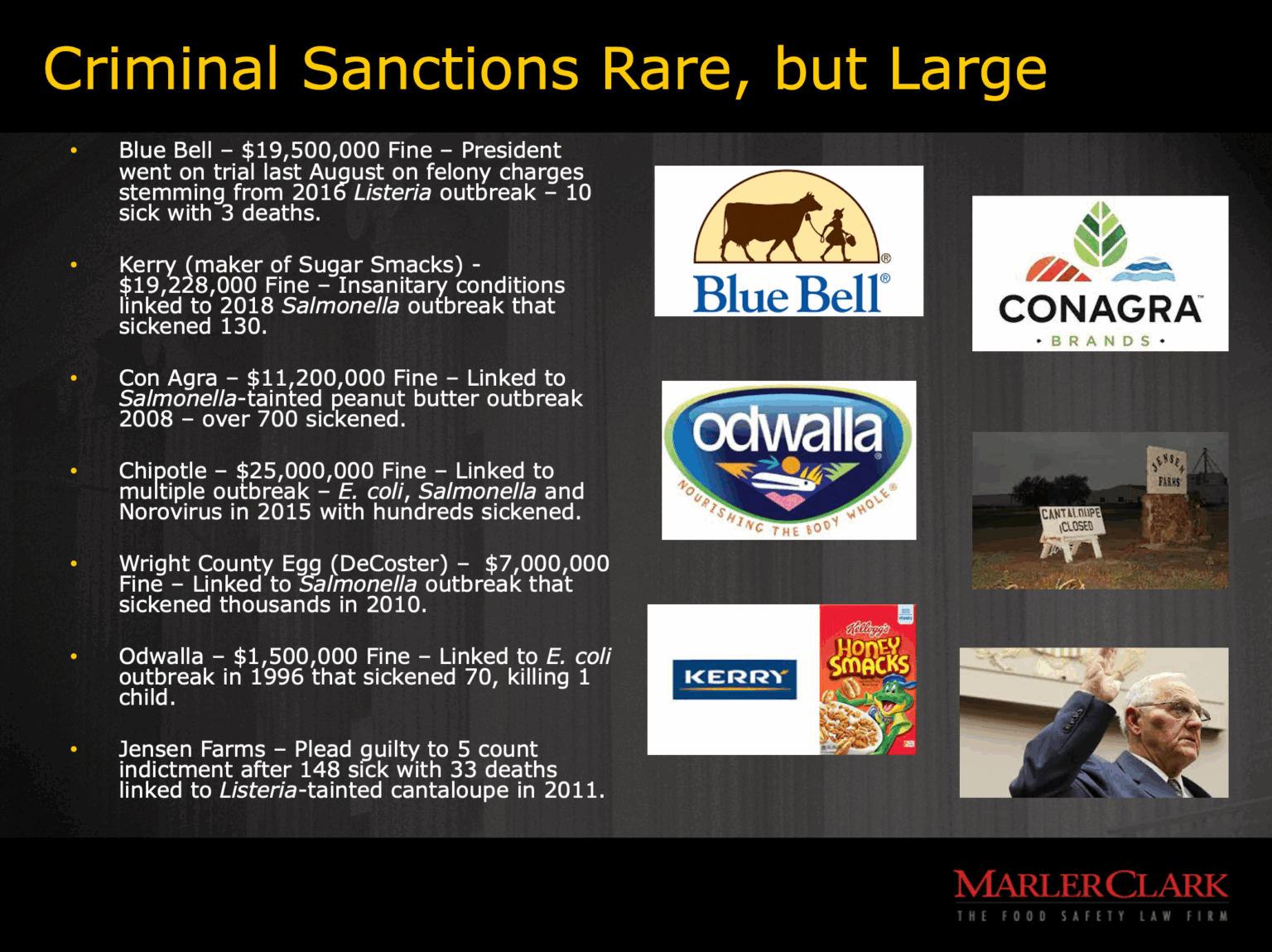
Perhaps the folks at the Peanut Corporation of America would still be prosecuted as a felony, but they certainly argued that they did not know the peanut butter was tainted with Salmonella. However, if this new policy stands it is not likely the Blue Bell, Kerry, Con Agra, Chipotle, Wright County, Odwalla nor Jensen Farms would have been prosecuted, and it is likely that few prosecution will occur in the future.

Even if they had an appetite to prosecute, there will be no one there to do the work. According to Sarah N. Lynch at Reuters:

A Justice Department unit that handles criminal and civil enforcement of U.S. food and drug safety laws is being disbanded as part of an ongoing cost-cutting campaign by President Donald Trump’s administration…

About 215 people work for the Consumer Protection Branch, part of the Justice Department’s Civil Division, including attorneys, support staff and law enforcement agents…

Although it is located in the Civil Division, the Consumer Protection Branch is an unusual office because its work involves a hybrid of criminal prosecutions and civil enforcement.

It handles criminal cases to enforce the Food, Drug and Cosmetic Act, a federal law that makes it a crime to sell or distribute adulterated or misbranded food or drugs. It also enforces statutes for the Federal Trade Commission and the Consumer Product Safety Commission…

The Consumer Protection Branch has been at the heart of some high-profile cases…

Prosecutors from the branch also brought the criminal case against former executives at Peanut Corporation for crimes that led to a 2009 outbreak involving more than 700 cases of salmonella poisoning.

We live in interesting times.

What price compromise?

When seven Democrat senators and one independent sided with the Republican majority to pass a bill meant to end the government shutdown earlier this week, they did so in full knowledge that they were throwing Affordable Care Act premium subsidies under the bus.

Mike Johnson already has signaled that a vote in the Senate in favour of extending those subsidies would not guarantee a vote in the House.

But, did they realize that, by voting for the Republican bill, they were also throwing food safety under the wheels of that same bus?

According to The Lever, as reposted by Bill Marler (tip of the Petri dish lid for finding and sharing this), the Senate-approved language guts funding for certain current and planned FDA programs and Rules.

Ironically, this Rule was first proposed under Trump 1.0 and is designed to simplify the tracing of a food to its source during a recall or foodborne disease outbreak investigation.

The Rule, which was finalized in 2023, requires food manufacturers, processors, packers, etc., “…maintain records containing information on critical tracking events in the supply chain for these designated foods, such as initially packing, shipping, receiving, and transforming these foods.”

The FDA allowed three years (ie., until January 2026) for those affected by the Rule to come into compliance with its requirements.

Last August, the FDA proposed to extend the compliance deadline by 30 months, to July 2028.

A provision of the Senate bill specifies that no funds “…may be used to administer or enforce the ‘Requirements for Additional Traceability Records for Certain Foods,’ published on Nov. 21, 2022.” 

In 2016, the FDA issued a Final Rule, “Standards for the Growing, Harvesting, Packing, and Holding of Produce for Human Consumption” in response to a steady increase in foodborne disease outbreaks linked to contaminated produce.

Compliance dates for this Rule were staggered, with the smallest farms given until 2020 to conform.

The Senate bill just passed PROHIBITS any of the funding made available by the bill from being used to enforce the Produce Safety Rule.

Finally, in the ultimate irony of the MAHA world, the Senate bill slashes funding for the FDA to develop or administer regulations “…long-term population-wide sodium reduction actions until an assessment is completed on the impact of the short-term sodium reduction targets.” 

As it happens, I am in the throes of writing a sequel to my food safety book, TAINTED: From Farm Gate To Dinner Plate, Fifty Years of Food Safety Failures.

The planned title of my new book is, TAINTED II: From Baby Food To Seniors’ Snacks, Making Americans Sick Again.

Watch for it.


TAINTED formats 3
“Reads like a true crime novel” – Food Safety News

Interested in learning more about food safety and the history of foodborne disease outbreaks and investigations?

Click on the link to listen to a short excerpt, then follow the buy links to add a digital, print or audio copy to your personal library.

Chapter 6. Birth of a Pathogen