It is time to rebuild the US food safety system

Several weeks ago, food safety advocate Bill Marler launched his campaign to “Get the ‘F’ out of the FDA.”

Marler proposed that Congress split the Food and Drug Administration into two separate agencies—one with responsibility for food safety and human nutrition, and the other for drugs, cosmetics and medical devices.

While I agree with the need for a separate agency to oversee food safety and human nutrition, I believe Marler’s proposal does not go far enough.

It is time to consolidate all food safety activities at the federal level under a single umbrella.

Here’s why.

Split jurisdiction

At present, responsibility for overseeing food safety is split between two main federal agencies: the FDA and the Food Safety and Inspection Service (FSIS) of the US Department of Agriculture (USDA).

The USDA is responsible for the safety of meat and poultry, catfish, and egg products.

The FDA is responsible for the safety of all food products that do not contain meat or poultry, for intact eggs, and for all fish other than catfish.

This division of responsibility by commodity has led to some strange and confusing situations.

  • canned foods containing meat or poultry come under FSIS jurisdiction, while all other canned foods are FDA-regulated.
  • pizzas containing more than 2% meat are the responsibility of FSIS; less than 2% meat, and the FDA takes over.
  • open-faced sandwiches containing meat are overseed by FSIS; closed sandwiches are the responsibility of the FDA, whether or not meat is present.

These arbitrary distinctions mean that many food processing plants must answer to two separate federal agencies.

Conflict of interest

The USDA operates under a double mandate.

On the one hand, it is responsible for certifying that the food products under its jurisdiction are safe for human consumption.

On the other hand, the USDA also is charged with promoting US agricultural products both domestically and to overseas markets.

This is akin to having the quality assurance department of a food company report to the head of the marketing department.

We have seen the consequences of this conflict most recently in the FSIS draft proposal to allow as much as one Salmonella per gram of chicken in raw, breaded stuffed chicken products. 

Advertisements

An immodest proposal

It is time to demolish the current ineffective, wasteful, and conflicted system and build a new one, centered on a new Food Safety and Nutrition Agency (FSNA) with a seat at the Cabinet table.

The FSNA would take over all of the food safety and nutrition program activities currently performed by the FDA. In addition, all responsibility for meat, poultry, egg products and catfish would fall under the FSNA umbrella.

The USDA would retain responsiblity for certifying the fitness of livestock for slaughter and certifying the fitness of their meat for human consumption.

At the moment meat or poultry leaves the slaughterhouse, jurisdiction would shift to the FSNA.

This approach would have the benefit of eliminating the conflict of interest inherent in the USDA’s double mandate. It would also unscramble the arbitrary and confusing overlap of jurisdictions between the FDA and the FSIS.

The consolidation of all food safety responsibilities within a single, independent agency is not a new idea.

The Canadian Food Inspection Agency (CFIA) was created in 1997 by consolidating into a single agency the food safety components of the Health Protection Branch (then the Canadian equivalent to the FDA), the Department of Agriculture, and the Department of Fisheries and Oceans.

Other countries, including the United Kingdom, Australia, and New Zealand have followed a similar path.

The bottom line

Congress created the current dysfunctional structure over a span of many decades. 

Therefore, it is up to Congress to deconstruct this broken system and build a new one that will work to the benefit of the public it has been elected to represent.


TAINTED formats 3
“Reads like a true crime novel” – Food Safety News

Interested in learning more about food safety and the history of foodborne disease outbreaks and investigations?

Click on the link to listen to a short excerpt, then follow the buy links to add a digital, print or audio copy to your personal library.

Chapter 6. Birth of a Pathogen

TAINTED is available in digital format from all major on-line retailers. Press the button to go directly to your preferred digital bookstore.

Thomson Onion Salmonella Outbreak: Is CDC Missing in Action?

On July 21, 2020, the US Centers for Disease Control and Prevention (CDC) informed the public of an outbreak of Salmonella Newport infections.

On July 24th, the Public Health Agency of Canada (PHAC) informed the public of an outbreak of Salmonella Newport infections apparently caused by the same outbreak strain as CDC was finding in the United States.

At the time of the initial reports, neither agency had determined the source of the outbreak.

On July 30th, PHAC updated its outbreak advisory, informing Canadians that the outbreak was linked to consumtion of red onions imported from the United States. That same day, the Canadian Food Inspection Agency (CFIA) posted a recall notice for red onions imported by Sysco in Western Canada.

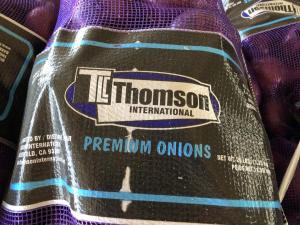
Using the Canadian data as its starting point, on July 31st, the US Food and Drug Administration (FDA) and CDC announced that the US outbreak was linked to consumption of red onions produced by Thomson International, Inc. of Bakersfield, California.

Thomson International is a family-owned business, incorporated in California.

On August 1st, Thomson recalled its entire harvest of red, yellow, white, and sweet yellow onions from the 2020 growing season – approximately 18,750 tons of onions. The onions were distributed across the United States and exported to Canada.

CDC issued status updates of the size and scope of the US outbreak on August 3rd, August 7th, August 18th and September 1st, and has not been heard from since.

PHAC issued status updates of the size and scope of the Canadian outbreak on August 2nd, August 7th, August 14th, August 21st, August 31st and September 14th.

By August 7th, FDA had initiated its on-site investigation of Thomson’s Bakersfield facility, looking for the source of the Salmonella Newport contamination. By August 11th, FDA personnel had submitted 370 samples to the agency’s lab for Salmonella testing, including 278 swab samples, 82 onion samples, and 10 miscellaneous environmental samples, according to information obtained by eFoodAlert in response to a Freedom of Information Act request.

Not a single sample contained Salmonella.

The FDA investigation is still in progress. However, with the growing season complete and the packing plant idle, the chances of finding the source of the Salmonella Newport diminish day by day.

As of the last report from CDC, 1012 individuals in 47 states have been infected with Salmonella Newport as a result of having consumed contaminated onions. Only Louisiana, Oklahoma and Vermont have not reported any outbreak cases. Although there have been no deaths associated with this outbreak, 136 (more than 13%) of the victims have required a hospital stay.

In Canada, there have been 506 confirmed cases of Salmonella Newport in seven provinces, and 71 people (14%) have been hospitalized.

Canada v. USA – A Performance Comparison

Why was CDC unable to determine the link between red onions and the Salmonella Newport outbreak until after PHAC had made the connection?

Why has CDC not provided an update to its outbreak status report in three weeks?

Why does Canada appear to have been much harder hit by this outbreak than the United States – 13.7 cases per million Canadians versus only 3.1 per million Americans? Is this due to some quirk of distribution, or have PHAC and its provincial partners done a better job of reporting than CDC and the various state health agencies?

Has the Covid-19 pandemic hit CDC so hard that it no longer has the resources to follow-up on illness outbreaks elsewhere?


IF CDC IS MISSING IN ACTION, WHAT DOES THIS MEAN FOR THE HEALTH AND SAFETY OF THE US POPULATION?


Contaminated Peaches from USA Cause Salmonella Outbreak in Canada

Thirty-three Canadians in Ontario (22 cases) and Quebec (11 cases) have become infected with Salmonella Enteritidis after consuming peaches imported from the USA, according to a report released this morning by the Public Health Agency of Canada (PHAC).

Three of the outbreak victims have been hospitalized.

Those infected with the outbreak strain of Salmonella Enteritidis range in age between 0 and 91 years, and 55% of the victims are female.

The outbreak is linked to peaches supplied by Prima Wawona, a California-based company, which has recalled a series of products from the marketplace.

Prima Wawona peaches have also been blamed for an outbreak of Salmonella Enteritidis in the USA, which had sickened 68 individuals in 9 US states as of August 21st, according to the US Centers for Disease Control and Prevention.

On August 22nd, the Canadian Food Inspection Agency (CFIA) issued a Consumer Advisory alerting Canadians to the presence of the recalled peaches in the country and warning that PHAC had identified some illnesses linked to their consumption.

Canadian consumers should avoid purchasing, serving or eating any of the following peaches, or any other food products containing these peaches.

  • Harvest Sweet Sweet 2 Eat Prima Sweet Value Wawona Yellow Peaches; PLU 4037, PLU 4038 PLU 4044,
  • Harvest Sweet Sweet 2 Eat Prima Sweet Value Wawona White Peaches; PLU 4401
  • Sweet 2 Eat Sweet O Organic Yellow Peaches; PLU 94037, PLU 94038, PLU 94044
  • Sweet 2 Eat Organic White Peaches; PLU 94401
  • Wawona Peaches; 907g / 2 lb; UPC 0 33383 32200 1
  • Wegmans Peaches; 907g / 2 lb; UPC 0 77890 49048 8
  • Extrafresh Peaches; 907g / 2 lb; 0 33383 02071 6; Codes CPO3148, CPO3164, CPO3163, CPO3186, CPO3207, CPO3213, CPO3228, CPO3265, CPO3281, CPO3302, CPO3328, CPO3354, MPO0500, MPO0503, MPO0524, MPO0671, MPO0678, MPO0689, MPO0693, MPO0703, MPO0716, MPO0725, MPO0730, MPO0767, MPO0795

Peaches imported in bulk may have been sold loose or in bulk, with or without a brand name. These peaches may have been repackaged into a variety of formats.

Except for the Extrafresh Peaches, the recall encompasses all products sold from June 1, 2020 forward.

What Consumers Need to Know

  • Do not purchase or consume any peaches listed above. If you are in doubt as to the origin of peaches which you have already purchased, throw them away and disinfect the bin in which they were stored.
  • Some of the peaches may have been supplied to restaurants, hotels, bakeries or various food service establishments, including hospitals and nursing homes and may have been used in salads, desserts or baked goods. It would be prudent to avoid all of these items, unless you can be certain they were produced using peaches not included in this Advisory.
  • If you are suffering from symptoms of salmonellosis, including low-grade fever, stomach cramps, diarrhea, and/or vomiting, consult your healthcare professional. Be prepared to provide information on the food items you consumed during the week before beginning to experience your symptoms

This is the third Canadian foodborne disease outbreak since the beginning of July, all of them linked to consumption of produce imported from the USA. Local produce is readily available during the summer months. Consider supporting your local producers instead of buying imported produce.