Donald Trump and RFK, Jr. have wasted no time in digging the CDC’s grave.
In a move reported today by multiple reputable news outlets (including CBS, NPR, and Fortune) the Department of Health and Human Services has ordered the CDC to eliminate nearly 1,300 probationary workers at the federal agency, decimating the agency’s workforce.
Probationary workers include those workers who are recent hires, as well as long-time workers who were promoted into more senior positions, including management roles.
The firings represent about 10% of the agency’s workforce and include almost one half of the CDC’s Epidemic Intelligence Service (EIS) Officers—the agency’s “disease detectives.”
The EIS firings will drastically impact the ability of the CDC to track the source of disease outbreaks, including foodborne diseases.
The CDC has not issued any news release about the firings. In fact, the CDC has not issued a news release on any topic since January 10, 2025.
It is safe to say that this is only the beginning.
In addition to these layoffs, the Trump/RFK administration has imposed restrictions on what research may be undertaken at the CDC and placed an embargo (“for the time being”) on submission of papers to scientific journals by CDC scientists, according to NPR.
Sadly, we can no longer rely upon the CDC for timely news of foodborne disease (or any other kind of disease) outbreaks.
While eFoodAlert cannot substitute for the CDC, I promise that we shall do our best to share whatever news is available.
I pledge to monitor all state departments of health and departments of agriculture websites and to communicate in a timely fashion any news that impacts the safety of the US consumers, especially as it relates to the food supply.
Five deaths have been reported in Canada and three in the United States.
Six Canadian provinces have reported outbreak cases to the PHAC:
British Columbia: 15
Ontario: 17
Quebec: 91
Prince Edward Island: 2
New Brunswick: 2
Newfoundland and Labrador: 2
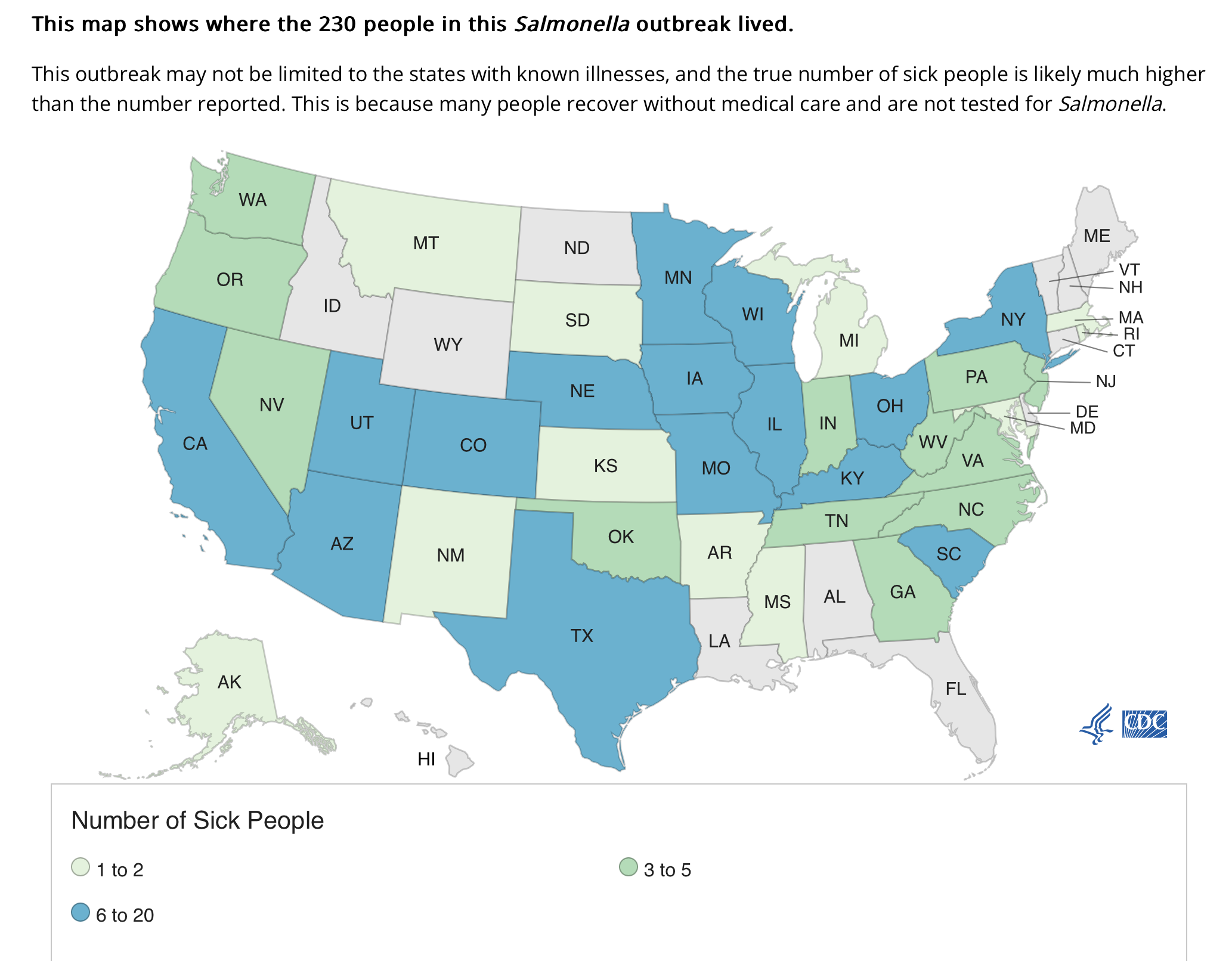
In the United States, cases have been reported by 38 states (see image below, supplied by the CDC).
Multiple recalls have been announced in both countries. The US Food and Drug Administration (FDA) has activated a webpage devoted to listing the recalls announced publically in the USA. A list of Canadian recalls has been provided on the Canadian Food Inspection Agency website.
Hardest hit populations
Both the CDC and the PHAC have pointed out that children under the age of five and adults over the age of 65 have accounted for a large majority of the lab-confirmed cases in both countries.
In the USA, children under the age of five account for 27% of the confirmed cases to date, while seniors (over the age of 65) account for 47% of cases.
In Canada, 35% of the confirmed cases occurred in children under the age of five, while seniors accounted for 45% of confirmed cases.
Why should this be so?
The very young and the elderly typically are more susceptible to most infections than the rest of the population, and also are prone to experiencing more severe symptoms.
But there are other factors in play, which are highlighted by demographic data provided by the CDC.
Specifically, 23 children attended childcare centers, and 24 of the adult victims were residents of longterm care facilities among the 230 cases in the USA.
The PHAC also reported that many of the Canadian victims resided in a long-term care home, or a retirement residence, or attended daycare.
Many of the recalled products—especially many cut fruit products and fruit salads—were supplied to medical facilities, institutions, food service facilities, hotels, and restaurants.
Not all of these recalls have been made public in the United States. Instead, the recalling company communicated directly with its customers. For example:
Market Cuts LLC:- Recalled 8 cut fruit products by letter notification to its customer(s) in Illinois, Indiana, Michigan and Wisconsin
Freshpoint Of Southern CA:- Recalled Imperial Fresh brand whole cantaloupes, which it had supplied to food services in California, Arizona and Nevada
FreshPoint Dallas:- Recalled Imperial Fresh brand whole cantaloupes, which it had supplied to institutions, medical facilities and direct food service accounts in Arkansas, Missouri, Mississippi, Kansas, Louisiana, Oklahoma, Texas
Several of the cut fruit products and whole cantaloupes distributed in Canada also were supplied to hotels, food service operations and institutions (such as hospitals, longterm care facilities and child care facilities).
What consumers in Canada and the United States should know
This outbreak is far from over, and the case counts are continuing to climb. Furthermore, the number of reported cases in any outbreak represents only a fraction of the total number of people who become infected.
Consumers are advised to discard and not consume Malichita or Rudy cantaloupes or any other recalled products. If you have whole or pre-cut cantaloupes or fruit cups, fruit platters, or fruit medleys in your home and are unsure of their origin, discard them as a precaution.
Food contaminated with Salmonella may not look or smell spoiled but can still make you sick. Young children, pregnant women, the elderly and people with weakened immune systems may contract serious and sometimes deadly infections. Healthy people may experience short-term symptoms such as fever, headache, vomiting, nausea, abdominal cramps and diarrhea. Long-term complications may include severe arthritis.
If you feel unwell, and especially if you have symptoms like diarrhea or vomiting, do not cook or prepare food for other people.
If you suspect you are suffering from a Salmonella infection, consult your healthcare provider.
“Reads like a true crime novel” – Food Safety News
Interested in learning more about food safety and the history of foodborne disease outbreaks and investigations?
Click on the link to listen to a short excerpt, then follow the buy links to add a digital, print or audio copy to your personal library.
Three people are dead among the 180 confirmed victims of Salmonella-contaminated cantaloupes from Mexico according to the latest information released in the United States and Canada.
Individuals in 34 US states account for two of the deaths and 117 lab-confirmed outbreak cases as of November 30th, according to the US Centers for Disease Control and Prevention (CDC). Sixty-one of the victims have been hospitalized.
The Public Health Agency of Canada (PHAC) has reported 63 lab-confirmed cases in five provinces as of November 24th, including 17 hospitalizations and one death.
Both the CDC and the PHAC have warned the public that additional cases are likely to be identified in the coming days.
Multiple recall notices have been posted in both countries in response to the outbreak. The US Food and Drug Administration (FDA) has compiled a list of product recalls and will continue to update the list as required. Similarly, the Canadian Food Inspection Agency (CFIA) has posted links to Canadian recalls triggered as a result of the outbreak investigation.
Border Control
The United States
The FDA uses a portfolio of Import Alerts to control the entry of products into the United States that may represent a food safety hazard.
Since October 20, 2023, the FDA has added four Mexican cantaloupe producers to this list, all of them based in the area around Hermosillo, in the state of Sonora.
Agricola Orqui S.A. de C.V. (added October 20, 2023)
Agroexport de Sonora S.A. de C.V. (added November 24, 2023)
Cassal Productos Del Campo S.A. de CV (added October 26, 2023)
Vinedo Maria Alejandra S.A. de C.V. (added November 27, 2023)
Canada
The CFIA employs a “System for the Reduction of Contamination Risks,” under which it relies on the Mexican government to certify that producers have met minimum requirements for good agricultural practices and food safety, according to a CFIA spokesperson.
Importers of food into Canada must hold a Safe Food for Canadians (SFC) licence and have in place a written preventive control plan for food safety hazards.
When asked whether specific actions had been taken to suspend importation of cantaloupes from individual Mexican producers, the CFIA responded that the “…importation of all cantaloupes from Mexico continues based on products meeting Canadian import and food safety requirements.”
The spokesperson added that “The CFIA…is conducting a food safety investigation and collaborating with Mexican authorities and industry to resolve this matter.”
What consumers in Canada and the United States should know
Consumers are advised to discard and not consume Malichita or Rudy any recalled products. If you have whole or pre-cut cantaloupes or fruit cups, fruit platters, or fruit medleys in your home and are unsure of their origin, discard them as a precaution.
Food contaminated with Salmonella may not look or smell spoiled but can still make you sick. Young children, pregnant women, the elderly and people with weakened immune systems may contract serious and sometimes deadly infections. Healthy people may experience short-term symptoms such as fever, headache, vomiting, nausea, abdominal cramps and diarrhea. Long-term complications may include severe arthritis.
If you feel unwell, and especially if you have symptoms like diarrhea or vomiting, do not cook or prepare food for other people.
If you suspect you are suffering from a Salmonella infection, consult your healthcare provider.
“Reads like a true crime novel” – Food Safety News
Interested in learning more about food safety and the history of foodborne disease outbreaks and investigations?
Click on the link to listen to a short excerpt, then follow the buy links to add a digital, print or audio copy to your personal library.






 eFoodAlert