
Wild Coast raw cat food recalled

March 2, 2025

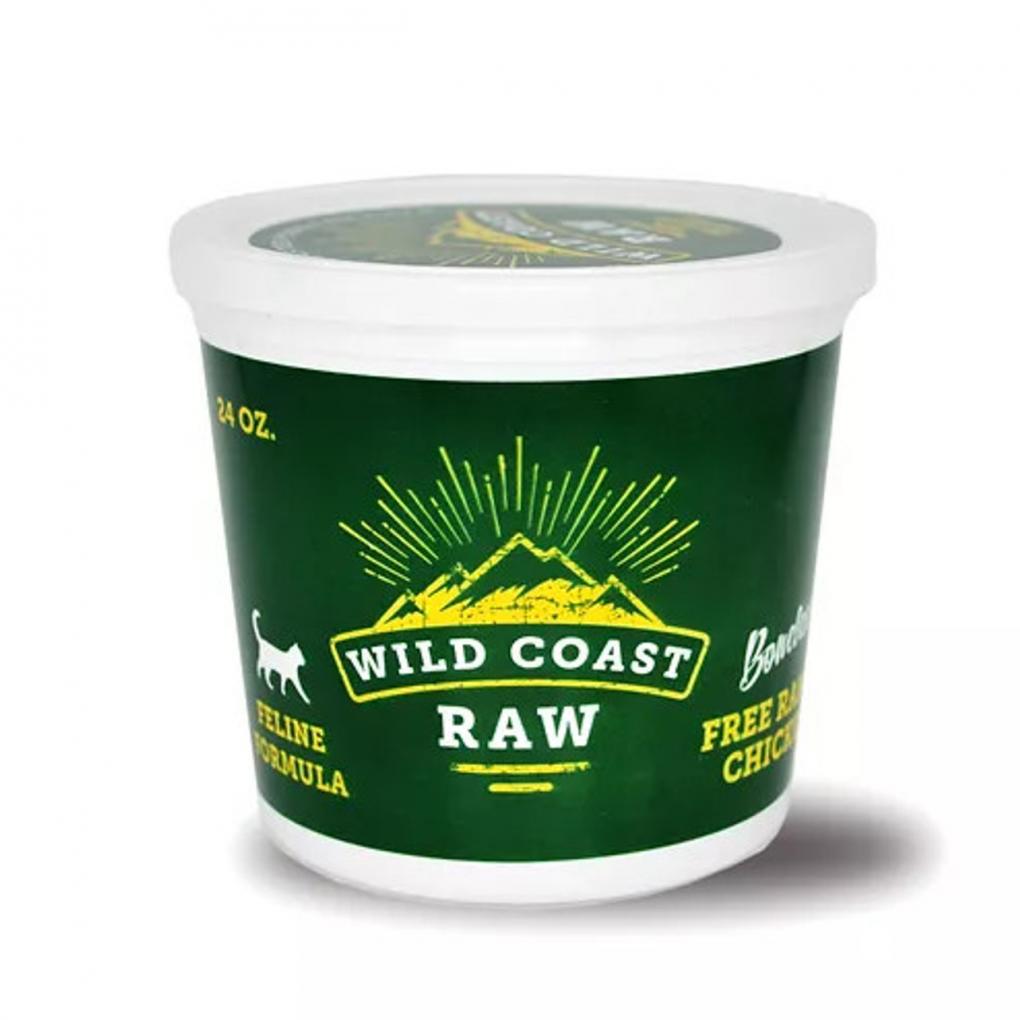
Wild Coast LLC (dba Wild Coast Raw) has recalled six lot codes of raw cat food that may be linked to four cases of bird flu in domestic cats in Oregon and Washington states.

The recall encompasses 16oz and 24oz containers of the following lot codes of frozen Boneless Free Range Chicken Formula raw pet food for cats, all bearing a Best Buy date of 12/25:

  • #22660
  • #22653
  • #22641
  • #22639
  • #22672
  • #22664.

The recalled products were distributed only in Oregon and Washington states.

The recalled lots have to potential to be contaminated with Highly Pathogenic Avian Influenza (HPAI) H5N1 virus, also known as bird flu.

The public first was alerted to this problem in mid-February, when the Oregon Department of Agriculture (ODA) reported two cases of bird flu in domestic cats from two separate households.

Both cats had been fed the recalled product. The ODA found the same strain of H5N1 in the affected cats and in the Wild Coast Raw pet food they had eaten.

The Washington State Department of Agriculture (WSDA) opened an investigation of the company in response to the ODA findings and also put a “stop sale” order on lot codes #22660 and #22664. The “stop sale” order was valid only with in the borders of Washington state.

More recently, the WSDA learned of two domestic cats in Washington who also became infected with bird flu after being fed Wild Coast Raw pet food. The cats were members of two different households.

Three of the four infected cats in Washington and Oregon were euthanized due to the severity of their illnesses. The fourth cat is being treated by a veterinarian.

Yesterday’s recall notice expands the scope of the implicated products to include any raw material sharing similar production dates and lot codes to the two lot codes covered by the initial “stop sale” order.

Do not sell or donate the recalled products. Do not feed the recalled product to pets or any other animals. Consumers who have purchased this product are urged to immediately and securely discard to prevent animals and wildlife from consuming the recalled product. Contact your place of purchase for a full refund. For more information contact Wild Coast Raw at info@wildcoastraw.com or (360) 591-3543 between 8am – 4 pm PST.


“A complete and compelling account of the hidden and not-so-hidden ways the food we give our beloved pets can be contaminated.” JoNel Aleccia, Health Reporter, Food & Nutrition, The Associated Press.

“An invaluable resource for busy pet owners” – Food Safety News

Available from all major on-line retailers, including:

Two more domestic cats infected with bird flu

February 27, 2025

Two domestic cats in the state of Washington have been infected with the highly pathogenic avian influenza (HPAI) virus according to a new release from the Washington State Department of Agriculture (WSDA) dated February 26, 2025.

The infections were confirmed in testing conducted by the National Veterinary Services Laboratory.

One of the cats was euthanized and the second is being treated by a veterinarian.

The two cats belonged to separate households in King and Snohomish counties.

Both infected cats were fed potentially contaminated Wild Coast Raw pet food. Two batches of Wild Coast LLC – Boneless Free Range Chicken Formula are the subject of a “stop sale” order in the state of Washington.

These new illnesses are in addition to the two illnesses reported by the Oregon Department of Agriculture (ODA) earlier this month.

On February 14, 2025, the ODA advised pet owners that two cats residing in separate households in Multnomah County had become infected with HPAI. Both cats were fed Wild Coast raw pet food.

Both cats were euthanized due to the severity of their illnesses.

All four cats were exposed to one or both of the same two lot numbers of the raw pet food, according to a spokesperson for the WSDA.

The WSDA began investigating Wild Coast’s manufacturing facility and operations on February 7th, the day that the first Oregon cat was confirmed to have been infected with HPAI. That investigation is ongoing and is still open.

While the HPAI infections have been confirmed in all four cats, the WSDA is still awaiting confirmation of the “non-negative” (positive PCR result) for the presence of live virus particles in samples of the two implicated lots.

When eFoodAlert asked what measures Washington state has put in place to reduce the risk to consumers and pet owners, we were told the following:

WSDA has been a leader in the country by conducting surveillance sampling for HPAI on non-heat treated meat or dairy based animal food. All our routine surveillance samples have been negative, including some of Wild Coast Raw’s earlier lots. Also conducting messaging to our stakeholders and to the general public about the risks, including the HPAI in cats graphic (attached) and blog. Implementing FDA’s recent requirement for pet food manufacturers to reanalyze their food safety plans to consider HPAI a known or reasonably foreseeable hazard and to identify how they will be addressing that hazard. Working with applicable partners to continue further investigation that are outside of our jurisdiction.


“A complete and compelling account of the hidden and not-so-hidden ways the food we give our beloved pets can be contaminated.” JoNel Aleccia, Health Reporter, Food & Nutrition, The Associated Press.

“An invaluable resource for busy pet owners” – Food Safety News
Available from all major on-line retailers, including:

‘Millions’ of roaches plagued maker of Pedigree, IAMS, Cesar, other pet foods

This story by Phyllis Entis first appeared in Food Safety News and is reposted here with permission

The Mars Petcare U.S. Inc. low-acid canned pet food production facility in Columbus, OH, was crawling with an infestation of German cockroaches between October 2016 and July 2017. Mars markets wet dog and cat foods in cans, plastic tubs, and laminated pouches under the Pedigree, Cesar, Whiskas, Nutro and IAMS brands.

Pet food from the plant also generated  consumer complaints about finding hard plastic pieces and a complaint about a elastic material in Mars’ pet foods.

On Oct. 7, 2016, Mars initiated a recall of 54,255 cases of CESAR Classics Filet Mignon Flavor canned dog food after the complaints about plastic. The recalled products were shipped to 36 states, including to three government facilities.

Ensuing inspections found the company had not completed repairs as promised.

Documents obtained by Food Safety News show that, during a July 2017 inspection of the Columbus facility, investigators from the Food and Drug Administration observed two significant deviations from current Good Manufacturing Practices (cGMP):

  • Failure to inspect, segregate, or otherwise handle raw materials and ingredients used in manufacturing under conditions that will protect the animal food against contamination and minimize deterioration; and
  • Failure to take effective measures to exclude pests from [the] plant and protect against contamination of animal food by pests.

Roaches and other pests
The infestation was first documented during an Oct. 27, 2016, comprehensive low-acid canned food (LACF) inspection by FDA, according to documents obtained under the Freedom of Information Act.

Although Mars management undertook to address and remedy the infestation in October 2016, FDA investigators observed a live roach in the manufacturing area adjacent to an area where in-process raw materials and ingredients are maintained, and another near the main hand-wash station at the entrance to the manufacturing area during the July 2017 inspection.

According to the company’s Employee Pest Sighting Log, there were 99 instances of pest activity observed during a 72-day period from Nov. 10, 2016, to July 14, 2017, including one instance described as “millions of roaches.”

Employees also reported birds, spider webs, beetles, multiple flies, maggots and larvae on several occasions. 

Mars contracts with a pest control operator (PCO) for routine rodent and insect control.

During their review of the PCO’s reports, FDA investigators found references to photographic evidence of pest activity, disrepair of dock doors, general disrepair of the building — including areas of ingress and egress — excessive spills of raw materials and damaged cans “covered” in flies. The photographs had not been retained by the company.

Several of the PCO observations regarding necessary repairs were repeated in multiple consecutive reports. For example, damage to a dock door was first reported on or about Sept. 26, 2016. The report was repeated after each visit until the door was finally repaired on or about Nov. 3, 2016.

Foreign objects – pieces of plastic
In addition to ongoing pest problems, Mars logged repeated violations related to the pieces of hard plastic that spurred the Oct. 7, 2016, recall.

During a March 31, 2017, recall follow-up inspection, Mars informed FDA that the firm had fully implemented corrective actions/preventative actions (CAPAs), including changing all food-contact white plastic material to a blue plastic material, enabling the presence of white plastic foreign objects to be detected more easily.

Despite this assurance, FDA inspectors were told on July 11, 2017, that only the “majority” of the belts and plastic wear plates on critical equipment had been changed out by that date.

As of the July 2017 inspection, Mars acknowledged that it was still receiving complaints from customers about foreign objects in its finished products.

FDA has received two new consumer complaints for plastic foreign objects in Mars canned, tubbed or pouched products since the inspection, according to an agency spokesperson. One of these was for an elastic-type object and the other was for two small, hard plastic pieces. The consumer did not provide a product lot number in the second case, and it is unclear whether the two complaints concerned product manufactured in the Columbus facility.

Refusals and obstruction
The Establishment Inspection Report (EIR) documents a lack of cooperation on the part of Mars management during the July 2017 inspection.

FDA investigators reported Mars officials refusing to cooperate on three points three during the course of the inspection, including:

  • Refusal to permit photography
  • Refusal to permit the review of consumer complaints
  • Refusal to provide photocopies of consumer complaints, manufacturing, shipping and pest control records.

In addition to the outright refusals reported in the EIR, investigators encountered delays in the production of requested documents and information, and denial of complete access to all areas of the facility. 

When faced with a refusal, FDA investigators are expected to call attention to the relevant section of the Food, Drug and Cosmetic Act or the Public Health Service Act, and then to complete the inspection, according to Chapter 5 of the FDA Investigations Operations Manual (2018).

The company’s lack of cooperation resulted in a delay in the completion of the inspection, which was begun on July 11, 2017, but was not completed for more than two weeks, on July 26.

According to an FDA spokesperson, the Office of Regulatory Affairs issued an Untitled Letter to Mars subsequent to the July 2017 inspection. An Untitled Letter is used “…for violations that may not meet the threshold of regulatory significance for a warning letter and request correction of the violations.”

The investigation triggered by the recall is now closed.