
Another year, another Salmonella outbreak linked to backyard poultry flocks

Twenty-one people have been hospitalized with Salmonella contracted through contact with backyard poultry flocks since February 2018, according to a report by the Centers for Disease Control and Prevention (CDC) released today.
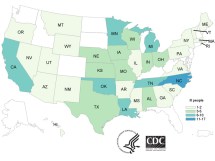
States reporting Salmonella illnesses linked to backyard poultry.

As of June 1st, 124 illnesses have been reported from 36 states. Nearly one-third of the outbreak victims are children of 5 years of age or younger.

The Salmonella outbreak has been linked to contact with live poultry – mainly chicks and duckings – in backyard flocks. The birds were obtained from multiple sources.

Several types of Salmonella have been found in outbreak victims, including:  Salmonella Seftenberg, Salmonella Montevideo, Salmonella Infantis, Salmonella Enteritidis, Salmonella Indiana, and Salmonella Litchfield.

Since 2000, contact with backyard poultry has been responsible for 4,794 documented Salmonella illnesses in 70 separate outbreaks. Seven people died in these outbreaks, and 894 required hospitalization. Ten outbreaks occurred in 2017 alone, sickening more than 1100 individuals in 48 states, killing one, and sending 249 of them to hospital.

Keeping backyard flocks has become increasing popular in recent years, with more and more cities amending their by-laws to permit residents to do so. According to a 2017 article in the Los Angeles Times, more than 1% of US households now keep chickens.

All too often, apparently healthy baby chicks and ducklings carry Salmonella. Children are especially drawn to these animals, which are small enough for tiny hands to hold. Unfortunately, a toddler or young child is all too likely to neglect to wash his or her hands after cuddling a feathered pet, and is especially susceptible to becoming infected with Salmonella as a result.

CDC offers the following advice for staying healthy while enjoying the benefits of a backyard flock:

Tips for staying healthy
  • Always wash your hands with soap and water right after touching live poultry or anything in the area where they live and roam.
    • Adults should supervise handwashing by young children.
    • Use hand sanitizer if soap and water are not readily available.
  • Don’t let live poultry inside the house, especially in areas where food or drink is prepared, served, or stored.
  • Set aside a pair of shoes to wear while taking care of poultry and keep those shoes outside of the house.
  • Don’t let children younger than 5 years, adults older than 65, or people with weakened immune systems from conditions such as cancer treatment, HIV/AIDS or organ transplants, handle or touch chicks, ducklings, or other live poultry.
  • Don’t eat or drink in the area where the birds live or roam.
  • Don’t kiss your birds or snuggle them and then touch your face or mouth.
  • Stay outdoors when cleaning any equipment or materials used to raise or care for live poultry, such as cages or feed or water containers.
  • Buy birds from hatcheries that participate in the U.S. Department of Agriculture National Poultry Improvement Plan (USDA-NPIP). This program is intended to reduce the incidence of Salmonella in baby poultry in the hatchery, which helps prevent the spread of illness among poultry and people.


‘Millions’ of roaches plagued maker of Pedigree, IAMS, Cesar, other pet foods

This story by Phyllis Entis first appeared in Food Safety News and is reposted here with permission

The Mars Petcare U.S. Inc. low-acid canned pet food production facility in Columbus, OH, was crawling with an infestation of German cockroaches between October 2016 and July 2017. Mars markets wet dog and cat foods in cans, plastic tubs, and laminated pouches under the Pedigree, Cesar, Whiskas, Nutro and IAMS brands.

Pet food from the plant also generated  consumer complaints about finding hard plastic pieces and a complaint about a elastic material in Mars’ pet foods.

On Oct. 7, 2016, Mars initiated a recall of 54,255 cases of CESAR Classics Filet Mignon Flavor canned dog food after the complaints about plastic. The recalled products were shipped to 36 states, including to three government facilities.

Ensuing inspections found the company had not completed repairs as promised.

Documents obtained by Food Safety News show that, during a July 2017 inspection of the Columbus facility, investigators from the Food and Drug Administration observed two significant deviations from current Good Manufacturing Practices (cGMP):

  • Failure to inspect, segregate, or otherwise handle raw materials and ingredients used in manufacturing under conditions that will protect the animal food against contamination and minimize deterioration; and
  • Failure to take effective measures to exclude pests from [the] plant and protect against contamination of animal food by pests.

Roaches and other pests
The infestation was first documented during an Oct. 27, 2016, comprehensive low-acid canned food (LACF) inspection by FDA, according to documents obtained under the Freedom of Information Act.

Although Mars management undertook to address and remedy the infestation in October 2016, FDA investigators observed a live roach in the manufacturing area adjacent to an area where in-process raw materials and ingredients are maintained, and another near the main hand-wash station at the entrance to the manufacturing area during the July 2017 inspection.

According to the company’s Employee Pest Sighting Log, there were 99 instances of pest activity observed during a 72-day period from Nov. 10, 2016, to July 14, 2017, including one instance described as “millions of roaches.”

Employees also reported birds, spider webs, beetles, multiple flies, maggots and larvae on several occasions. 

Mars contracts with a pest control operator (PCO) for routine rodent and insect control.

During their review of the PCO’s reports, FDA investigators found references to photographic evidence of pest activity, disrepair of dock doors, general disrepair of the building — including areas of ingress and egress — excessive spills of raw materials and damaged cans “covered” in flies. The photographs had not been retained by the company.

Several of the PCO observations regarding necessary repairs were repeated in multiple consecutive reports. For example, damage to a dock door was first reported on or about Sept. 26, 2016. The report was repeated after each visit until the door was finally repaired on or about Nov. 3, 2016.

Foreign objects – pieces of plastic
In addition to ongoing pest problems, Mars logged repeated violations related to the pieces of hard plastic that spurred the Oct. 7, 2016, recall.

During a March 31, 2017, recall follow-up inspection, Mars informed FDA that the firm had fully implemented corrective actions/preventative actions (CAPAs), including changing all food-contact white plastic material to a blue plastic material, enabling the presence of white plastic foreign objects to be detected more easily.

Despite this assurance, FDA inspectors were told on July 11, 2017, that only the “majority” of the belts and plastic wear plates on critical equipment had been changed out by that date.

As of the July 2017 inspection, Mars acknowledged that it was still receiving complaints from customers about foreign objects in its finished products.

FDA has received two new consumer complaints for plastic foreign objects in Mars canned, tubbed or pouched products since the inspection, according to an agency spokesperson. One of these was for an elastic-type object and the other was for two small, hard plastic pieces. The consumer did not provide a product lot number in the second case, and it is unclear whether the two complaints concerned product manufactured in the Columbus facility.

Refusals and obstruction
The Establishment Inspection Report (EIR) documents a lack of cooperation on the part of Mars management during the July 2017 inspection.

FDA investigators reported Mars officials refusing to cooperate on three points three during the course of the inspection, including:

  • Refusal to permit photography
  • Refusal to permit the review of consumer complaints
  • Refusal to provide photocopies of consumer complaints, manufacturing, shipping and pest control records.

In addition to the outright refusals reported in the EIR, investigators encountered delays in the production of requested documents and information, and denial of complete access to all areas of the facility. 

When faced with a refusal, FDA investigators are expected to call attention to the relevant section of the Food, Drug and Cosmetic Act or the Public Health Service Act, and then to complete the inspection, according to Chapter 5 of the FDA Investigations Operations Manual (2018).

The company’s lack of cooperation resulted in a delay in the completion of the inspection, which was begun on July 11, 2017, but was not completed for more than two weeks, on July 26.

According to an FDA spokesperson, the Office of Regulatory Affairs issued an Untitled Letter to Mars subsequent to the July 2017 inspection. An Untitled Letter is used “…for violations that may not meet the threshold of regulatory significance for a warning letter and request correction of the violations.”

The investigation triggered by the recall is now closed. 

Raw milk, farm animals likely cause of new E. coli outbreak among children

This story by Coral Beach first appeared in Food Safety News and is reposted here with permission.

Photo Illustration

Unpasteurized, raw milk and a visit to an unrelated agricultural animal operation are most likely the causes of an outbreak of E. coli infections among children in Knox County, TN. At least four of the victims are in kidney failure.

Health department spokeswoman Katharine Killen told Food Safety News this afternoon that all of the confirmed illnesses have been caused by the same serotype of E. coli bacteria. During a press conference with local media today, Dr. Joe Childs of East Tennessee Children’s Hospital also reported that all of the cases at that hospital are from one serotype.

Knox County Health Department epidemiologists are working with investigators from the state’s health department and other local and state agencies, including agriculture officials to pinpoint the source of the bacteria.

Childs said the ongoing E. coli outbreak is the largest he has seen in his 30 years at the hospital. Killen said the county averages only about 19 cases on an annual basis. Both said some of the sick children had consumed unpasteurized milk in the days before their symptoms began.

Other victims visited a farm unrelated to the raw milk dairy before becoming ill. Cows and other animals carry E. coli that can cause serious infections in humans. Swimming pools, however — especially public pools — are not a likely source because chemicals used to treat the water are very effective at killing E. coli bacteria, Childs said.

Officials have not specified what kind of agricultural animals victims of the current E. coli outbreak came into contact with before becoming ill. Goats are among the animals that can carry E. coli. Photo illustration

Neither the doctor nor the county spokeswoman would identify the dairy or animal farm. Killen said she wasn’t sure if the dairy was still selling its unpasteurized milk as of this afternoon. A conference call set today could provide more details.

The county started receiving reports about a cluster of E. coli infections among children last week, Killen said. She did not provide the total number of cases or the age range of the patients. However, there are “several” cases and all are children, according to county information.

The East Tennessee Children’s Hospital started hearing about the cluster of E. coli illnesses about 10 days ago, Childs said. He said the hospital is “approaching” 10 cases. Some children who were admitted have recovered enough to go home. Other’s are more seriously ill. Children started being admitted to intensive care units at the hospital about four days ago. Four of the children have developed a life-threatening form of kidney failure called hemolytic uremic syndrome (HUS).

Tennessee is one of the states that allows sales of unpasteurized raw milk. Federal law prohibits the interstate sale of raw milk because of its high risk for causing foodborne illnesses. Young children, elderly people, pregnant women and people with depleted immune systems are at the highest risk of developing life-threatening complications, according to a wide variety of health care providers and other entities.

Among those recommending against consumption of unpasteurized, raw milk are the American Academy of Pediatrics, state health departments, the federal Centers for Disease Control and Prevention, the Food and Drug Administration, and the U.S. Department of Agriculture.

Pasteurization is the process of heating milk to 161 degrees F for 15 seconds. It kills bacteria, viruses and parasites commonly carried by dairy cows. Those pathogens include E. coli, Listeria monocytogenes and Brucella.

Photo illustration

Advice to consumers
Anyone in the Knox County area — including people who consumed raw milk from the area or visited an animal operation — who develops symptoms of E. coli infection should immediately seek medical attention. 

People should make sure their doctors know about their possible exposure to the pathogen so the proper diagnostic testing and treatment can be provided, Childs said. 

Antibiotics generally should not be used for E. coli infections because the bacteria die off and release even more toxins into the body. This complicates diagnosis because the symptoms of E. coli infections are similar to other illnesses that should be treated with antibiotics.

Symptoms usually begin one to eight days after ingesting the bacteria, according to the U.S. Centers for Disease and Prevention. Symptoms can include diarrhea that can range from mild and watery to severe and bloody; abdominal cramping, pain or tenderness; nausea; and vomiting in some people.

Healthy adults usually recover from E. coli O157:H7 infections within a week. Young children, older adults, pregnant women and people with compromised immune systems have a greater risk of developing a life-threatening form of kidney failure called hemolytic uremic syndrome (HUS).