

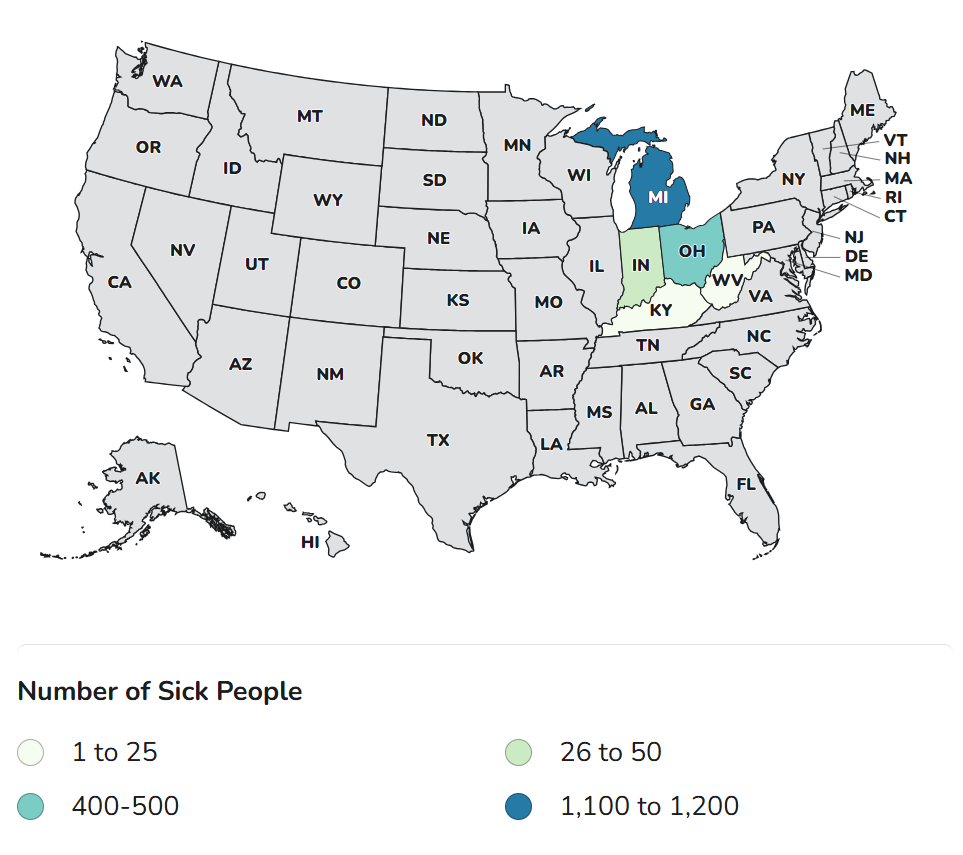
The FDA, CDC, and state and local partners have linked a five-state outbreak of Cyclospora illnesses to shredded iceberg lettuce from Mexico.
The imported lettuce was supplied to multiple Taco Bell locations in Indiana, Kentucky, Michigan, Ohio, and West Virginia.
All five of the states where the shredded lettuce was served have reported cases of Cyclospora illnesses linked to this outbreak. The confirmed case count reported by the CDC is “more than 1,644 illnesses,” including 94 hospitalizations.
Michigan leads the list of affected states with 1,141 confirmed cases, according to the CDC. Ohio is in second place with 420, followed by Indiana (47), Kentucky (25), and West Virginia (11).
These tallies are certain to increase. On July 13, 2026, the Michigan Department of Health and Human Services was investigating a total of 2,640 Cyclospora cases.
In addition to leading in the case count, Michigan also was in the forefront of determining the source of the infections, cautioning on July 13th that “[e]arly information has shown lettuce as a common product that regularly comes up during the investigation.” Michigan health officials analyzed meal consumption patterns from 190 of the victims interviews by the state and provided that information to the CDC, according to the FDA’s report.
Taco Bell is working to remove the lettuce from the implicated supplier from all of its outlets.
About Cyclospora
Cyclospora is not a bacterium. It is not a virus. Nor is it a yeast or a mold.
Cyclospora is a parasite.
Of the 20 or so known species, only Cyclospora cayetanensis is a human pathogen.
The Cyclospora cayetanensis lifecycle has been deduced mostly by observing other parasites belonging to the same family, because humans are the only known host for this pathogen. The cycle is believed to begin when a person ingests food or water contaminated with infectious Cyclospora oocysts (infective stage).
Once in the intestine, the oocysts excyst (germinate), and invade and multiply asexually within the epithelial cells lining the intestine. In some cases, they spread as far as the gall bladder. The parasite differentiates into both male forms (microgamonts) that engage in sexual reproduction, producing a zygote.
The Cyclospora zygotes develop into non-infectious oocytes, which are shed in the feces. Once in the environment, these oocytes mature over the course of 7-15 days into the infectious form.
Because of the maturation period, direct human-to-human transmission of Cyclospora is highly unlikely.
What the public needs to know
- Do not eat food items with shredded iceberg lettuce from Mexico served at Taco Bell locations in Indiana, Kentucky, Michigan, Ohio, and West Virginia.
- If you purchased or received food items with shredded iceberg lettuce served at Taco Bell at one of these locations, carefully clean and sanitize any surfaces or containers that it touched.
- Symptoms of cyclosporiasis can include watery diarrhea, loss of appetite, and weight loss. See your family physician if you are experiencing these symptoms.
- The FDA is investigating possible sources for at least four additional Cyclospora outbreaks.
- The Taco Bell outbreak does not account for all of the cases that have been reported by the CDC and the various states. As July 13th, the CDC had received reports of 1,645 confirmed cases of domestic origin (ie., people who had not traveled outside of the USA), including 141 hospitalizations, from 34 states. The CDC is aware of more than 5,100 additional cases still under investigation.
- Consumers should also consider the following when consuming produce during the Cyclospora season (summer months):
- Discard outer layers. When possible, discard outer layer of fruits and vegetables. For example, throw away the outer two to three layers of leafy greens.
- Rinse produce thoroughly. Rinsing produce is an appropriate first step but may not reliably eliminate the parasite. Rinse all fresh fruits and vegetables under clean running water, including before you peel them. Use a clean vegetable brush to scrub firm produce. Note that Cyclospora parasites are resistant to standard chlorine-based sanitizers. Consumers should not use soap or bleach to rinse produce.
- Be cautious with pre-washed or pre-cut produce. Commercial washing processes may not be sufficient to remove the parasite.
- Avoid cross contamination. Clean kitchen counter tops, cutting boards, utensils, etc. with hot, soapy water.
- Prioritize cooking. For any produce that can be cooked, cooking to a temperature of at least 158 °F (70°C) is the safest option, as the parasite is resistant to routine chemical disinfection and washing alone cannot guarantee its removal. Cyclospora cannot survive at these elevated temperatures.

Interested in learning more about food safety and the history of foodborne disease outbreaks and investigations?
Click on the link to listen to a short excerpt, then follow the buy links to add a digital, print or audio copy to your personal library.