FDA traceback investigations have identified Thomson International, Inc. of Bakersfield, CA as a likely source of potentially contaminated red onions believed to be the source of a fulminating outbreak of Salmonella Newport infections in the United States and Canada.
Fifty-nine people have been hospitalized in the USA and 16 in Canada.
Thomson International has advised FDA that the company will be recalling all varieties of onions that could have come in contact with potentially contaminated red onions, including red, white, yellow, and sweet onions.
The contaminated onions were distributed in Canada by Sysco, which has already issued a recall for its IMPERIAL FRESH – Jumbo red onions.
Consumers, retailers and food service establishments should avoid eating, selling or serving red, white, yellow or sweet onions from Thomson International.
According to the Public Health Agency of Canada (PHAC), the following provinces have reported illnesses associated with this outbreak: “British Columbia (43), Alberta (55), Manitoba (13), Ontario (2), and Prince Edward Island (1). The individual from Prince Edward Island reported travelling to Alberta before becoming ill. Saskatchewan has not reported any confirmed illnesses related to this outbreak, but provincial public health authorities are investigating some Salmonella Newport illnesses in the province.”
Sysco has recalled all IMPERIAL FRESH brand Red Onions – Jumbo (10-lb and 25-lb bags) imported into Canada from the United States since May 24th. The recalled onions were distributed in Alberta, British Columbia, Manitoba, Ontario, and Saskatchewan.
ThePublic Health Agency of Canada advises individuals in British Columbia, Alberta, Saskatchewan, Manitoba, and Ontario to not eat any red onions imported to Canada from the U.S., including any food products that contain raw red onions imported from U.S.. Retailers and restaurants in these locations are also advised not to use, sell or serve red onions imported from the U.S.. Red onions grown in Canada are not affected by this advice.
Although PHAC states that it has been exchanging information with the US, there has been no word yet today from CDC or FDA on these developments.
PHAC has offered the following guidance to consumers, retailers and the food service industry:
Individuals in British Columbia, Alberta, Saskatchewan, Manitoba, and Ontario are advised to not eat any red onions imported to Canada from the U.S., including any food products that contain raw red onions imported from U.S..
Retailers and restaurants in these locations are also advised not to use, sell or serve red onions imported from the U.S.. Red onions harvested in Canada are not affected by this advice.
Individuals are asked to check their homes for red onions, including whole, sliced, or chopped, as well as prepared foods that contain red onions as an ingredient, such as premade salads, sandwiches, wraps, or dips.
If you have red onions at home:
Look for a label showing where the red onion was grown. It may be printed on the package or on a sticker.
If the packaging or sticker shows that it is from the U.S., don’t eat it. Throw it away and wash your hands.
If it isn’t labeled, don’t eat it. Throw it away and wash your hands.
If you don’t know whether the red onion found in a premade salad, sandwich, wrap or dip contains red onion from the U.S., don’t eat it. Throw it away and wash your hands.
Wash and sanitize drawers or shelves in areas (such as fridges and cupboards) where red onions were stored.
If you buy red onions at a store:
Look for a label showing where the red onion was grown. It may be printed on the package or on a sticker.
If the packaging shows that it is from the U.S., don’t buy it.
If it is an unpackaged product, or is not labelled, ask the retailer whether the red onion comes from the U.S.
If you can’t confirm that the red onion in stores is not from the U.S., don’t buy it.
If you order salad or any other food item containing red onions at a restaurant or food establishment, ask the staff whether the red onions come from the U.S. If they did, or they don’t know, don’t eat it.
Restaurants and retailers should check the label on bags or boxes of red onions, or ask their suppliers about the source of their red onions.
Suppliers, distributors and others in the supply chain should not ship or sell red onions imported from the U.S.
If you have been diagnosed with a Salmonella infection or any other gastrointestinal illness, do not cook food for other people.
Contact your local public health authority to report any food safety concerns at restaurants or grocery stores, or if you suspect food poisoning from a restaurant or other food establishments.
The Public Health Agency of Canada (PHAC) has received reports of 37 confirmed cases of Cyclospora illnesses in Ontario (26), Quebec (10) and Newfoundland and Labrador (1).
The infections developed between mid-May and mid-June. One person has been hospitalized.
PHAC considers the outbreak to be ongoing, as the agency continues to receive reports of recent illnesses.
At least some of the outbreak victims report having eaten certain Fresh Express brand salad products containing iceberg lettuce, red cabbage and carrots before they fell ill. The rest of the cases are still under investigation.
On June 29, 2020, the Canadian Food Inspection Agency announced a recall of twelve varieties of Fresh Express brand salad products, which had been imported from the USA.
At the time of the recall, no Canadian illnesses associated with these products had been reported to PHAC.
The salad mixes implicated in this outbreak, and in a concurrent 8-state outbreak in the US, were produced at the Fresh Express facility located in Streamwood, Illinois. FDA is conducting a detailed traceback investigation into the source of the contamination.
The Cyclospora outbreak in the US has spread to 8 midwestern states, and has sickened at least 509 individuals as of CDC’s most recent (July 9, 2020) update. Thirty-three people have been hospitalized.
Lab-confirmed cases have been reported in Illinois (151), Iowa (160), Kansas (5), Minnesota (63), Missouri (46) Nebraska (48), North Dakota (6), and Wisconsin (30).
The following companies have announced product recalls in the USA due to Cyclospora contamination. Please click on the links for additional information on recalled products.
The recalled products have been distributed nationwide across Canada and in the following US states: Arkansas, Connecticut, Delaware, Iowa, Illinois, Indiana, Kansas, Kentucky, Massachusetts, Maryland, Maine, Michigan, Minnesota, Missouri, Montana, North Carolina, North Dakota, Nebraska, New Hampshire, New Jersey, New York, Ohio, Oklahoma, Pennsylvania, Rhode Island, South Dakota, Tennessee, Virginia, Vermont, Wisconsin, West Virginia, and the District of Columbia.
Products may have been further distributed and sent to retailers in additional states, according to FDA.
Consumers in Canada and the USA should check their refrigerators and discard any recalled products with production codes beginning with lot code “Z177” or a lower number and have best before dates up to and including 20JUL08 – 20JUL14. This includes Fresh Express brand products in Canada and both Fresh Express and the above-mentioned store brands in the USA.
Symptoms of Cyclospora infection usually begin within one week of consuming a contaminated product and may include: watery diarrhea, abdominal bloating and gas, fatigue (tiredness), stomach cramps, loss of appetite, weight loss, mild fever, and/or nausea. Symptoms may disappear and then return over a period of several weeks without treatment.
If you think you may have eaten a recalled product and are experiencing these symptoms, please consult a health care professional without delay.



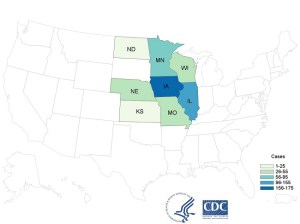 The Cyclospora outbreak in the US has spread to 8 midwestern states, and has sickened at least 509 individuals as of
 eFoodAlert