
Company and the US Food and Drug Administration enter into consent decree
A federal judge has entered a consent decree of permanent injuction against Bravo Packing, Inc., a manufacturer and distributor of raw pet food based in Carney’s Point, New Jersey.
(Bravo Packing is not related in any way to Bravo LLC / Bravo Pet Foods, located in Manchester, Connecticut)
The consent decree requires that Bravo “stop selling, manufacturing and distributing raw pet food and come into compliance with the Federal Food, Drug, and Cosmetic Act (FD&C Act).”
The backstory
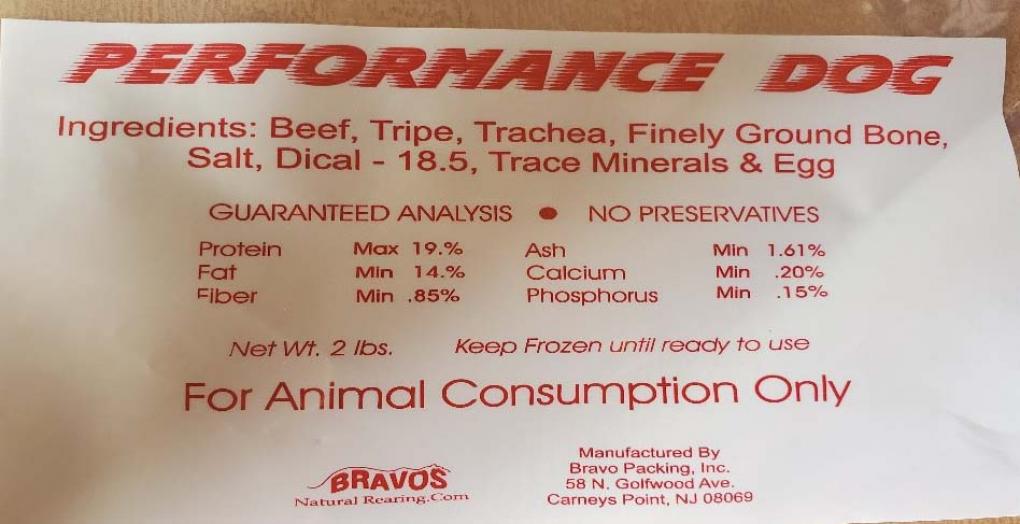
On September 12, 2018, Bravo Packing announced a voluntary recall of Performance Dog frozen, raw pet food (manufacturing date code 071418) after the FDA found Salmonella in a sample of the product during an inspection of the manufacturing facility.
In addition to the Salmonella-positive sample, FDA Investigator Michael Rosner also documented several issues of concern, including:
- Some condensate drip and ice buildup was observed on several boxes of finished dog food product in one of the firm’s freezers.
- The air curtains entering the dog food processing room were observed to be soiled and in disrepair.
- The firm was using a santiizer product at an incorrect dilution level, which reduced the sanitizer’s effectiveness.
- Some of the claims on the firm’s website were potentially misleading.
By the time the FDA returned to Bravo’s manufacturing facility in July 2019, the situation had deteriorated. This time, the FDA labs found Salmonella and Listeria monocytogenes in samples collected during an investigation that lasted from July 22nd to August 6th.
According to the Inspection Observations report (FDA Form 483), issued by Investigators Teigan Mule and Kyle Coville,
- after cleaning had been completed, the elbow portion of the feeder pipe from the mixer still had a buildup of dried, dark, crusty meat-like material
- a film residue remaining on the sides of a mixer exit chute after cleaning
- greasy buildup of animal fat remaining at the output of a grinder after cleaning
- black residue on the inside surface of buckets used to hold cut meat
- condensate drip and ice buildup on boxes of finished raw dog food products in a freezer
- cardboard boxes used to pack finished product observed to have bird droppings on the tops and sides
- apparent mammalian (rodent?) droppings adjacent to stored, palletized boxes
- inadequate training of employees on how to clean and degrease processing equipment after processing.
Although Bravo agreed to recall the contaminated Performance Dog Food product, the company never provided the FDA with the usual draft customer notification letter, distribution list, or draft press release.
In the absence of documentation from the company, the FDA issued its own Consumer Advisory on September 26, 2019, cautioning pet owners “not to feed their pets any Performance Dog frozen raw pet food.”
The FDA followed up its actions with a formal Warning Letter, issued on March 16, 2020. The letter reiterated and expanded upon the observations contained in the inspection report and requested a written response from the company within fifteen working days of receipt.
Downward slide accelerates
On March 3, 2021, Bravo issued yet another recall notice after Salmonella and Listeria monocytogenes were found once again in the company’s products.
The recall was expanded on March 16th to include all pet food and bones in all package sizes.
When the FDA returned to inspect Bravo’s production plant in May 2021, Investigators Kyle Covill and Sean Duke found a situation that had deteriorated further.
- a shovel used to push meat into the grinder was covered with residual dried, black meat-like material from the handle down to the shaft and all the way to the end of the blade
- a meat hook covered with cobwebs and other extraneous material was used to move deboned meat from raw ingredient barrels into the grinder during production
- the grinder contained heavy rust on the inside walls, basins and screw augur
- a piece of meat from a prior production run was left in the exit portion of the mixer, which also contained a pooled black liquid and white fat-like deposits, and the mixer was subsequently used during production without any further cleaning
- one of the owners was seen spitting chewing tobacco on the floor of the deboning room
- two cats were observed urinating on the outside of a raw ingredient barrel that was subsequently used (without undergoing cleaning and sanitizing) to produce Performance Dog ready-to-eat raw dog food
- the floors in multiple rooms of the production plant, including the processing room, had large cracks, holes and depressions, which contained pooled blood and water
- uncovered barrels of deboned meat were stored directly beneath a metal beam and brackets covered with flaking rust.
The bottom line
The consent decree prohibits the defendants (including the company’s owner and secretary, Joseph Merola, and its president, Amanda Lloyd) from receiving, preparing, processing, packing, holding, labeling, and/or distributing pet food unless and until the company undertakes and completes a comprehensive list of corrective actions.
The decree also allows the FDA to order a shutdown, recall, or other corrective action in the event of future violations and requires the defendants to pay the costs of inspections performed pursuant to the decree. Failure to abide by the agreement can also lead to civil or criminal penalties.
In commenting on the consent decree, Steven Solomon, DVM, MPH, director of FDA’s Center for Veterinary Medicine, said,
The food we give our pets should be safe for them to eat and safe for people to handle. The FDA has taken this action to protect public health because, despite multiple inspections, notifications of violations, and recalls, this firm continued to operate under insanitary conditions and produce pet food contaminated with harmful bacteria. We will not tolerate firms that put people or animals at risk and will take enforcement actions when needed.”


