
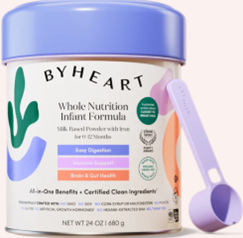
California finds presumptive Clostridium botulinum in can of powdered infant formula fed to outbreak victim

The California Department of Public Health (CDPH) has tested a can of ByHeart powdered infant formula that was fed to an infant who later developed infant botulism. Preliminary results indicate the presence of botulinum toxin-producing bacteria in the sample consisten with the type of toxin reported from confirmed outbreak cases.

As of November 8, 2025, 13 infants with suspected or confirmed infant botulism have been reported from 10 states, according to the CDC: Arizona, California (2), Illinois (2), Minnesota, New Jersey, Oregon, Pennsylvania, Rhode Island, Texas (2), and Washington.

Eight of the 13 cases have been confirmed as Type A botulism; the remaining five cases are still under investigation. Illnesses started on dates ranging from mid-August to November 2025. All 13 infants were hospitalized and treated with BabyBIG® (an antitoxin for infant botulism developed and supplied by the CDPH). No deaths have been reported. Infants ranged in age from 16 to 157 days.

Interviews conducted with caregivers for the 13 outbreak victims revealed that all 13 (100%) infants were fed ByHeart Whole Nutrition infant formula.

In response to the findings, ByHeart Inc. has recalled the following two batches of ByHeart Whole Nutrition Infant Formula (UPC: 5004496800):

  • Batch Code: 251261P2, Use by: 01 Dec 2026
  • Batch Code: 251131P2, Use by: 01 Dec 2026

ByHeart Inc. is the parent company for three manufacturing / packaging facilities:

  • Blendhouse LLC (Reading, PA), a manufacturing site
  • Blendhouse Allerton, LLC (Allerton, IA), a manufacturing site
  • Blendhouse Portland LLC (Portland, OR), a packaging site

Of these, the Reading facility manufactures the infant formula base product, which is then blended and packaged at a different facility.

The Reading location achieved its FDA registration on April 28, 2022 and was subjected to an initial, and successful, FDA inspection in June of 2022.

Then, the Cronobacter sakazakii tsunami hit, and the FDA chose to take an in-depth look at all of the powdered infant formula manufacturing sites, including ByHeart’s Reading facility. What they found was disturbing, resulting in both inspections being classified as “Official Action Indicated.”

The FDA investigation team uncovered numerous problems, which were summarized in a Warning Letter, dated August 30, 2023. These included

  • Lack of process control system, as evidenced by a finding of Cronobacter sakazakii in a batch of ByHeart Whole Nutrition Infant Formula finished product. The infant formula base which was incorporated into that batch had been manufactured in continuous process from July 13, 2022, through August 23, 2022.
  • Discrepancy between company’s root cause analysis of the Cronobacter contamination problem and the conclusion of the third-party lab, in which the company blamed lab error and the lab denied that they had erred.
  • Multiple notifications from third party lab of positive Cronobacter sakazakii findings from July 25, 2022, through August 27, 2022 within the processing environment.
  • Two water events, during which water leaked into the manufacturing areas from outside.

The FDA conducted its next inspection eleven months later. According to information posted on the FDA’s inspection data dashboard, investigators uncovered several serious problems.

  • did not implement a system of production and in-process controls for an infant formula
  • did not maintain a building used in the manufacture, processing, packing or holding of infant formula in a clean and sanitary condition
  • did not minimize the potential for contamination of raw materials through the use of appropriate measures
  • did not ensure that all surfaces that contacted ingredients, in-process materials and infant formula were cleaned and sanitized and maintained to protect infant formula from being contaminated by any source
  • did not monitor the temperature in a thermal processing equipment at a point where temperature control is necessary to prevent adulteration.
  • did not exclude pests from your food plant to protect against contamination of food.

The ByHeart recall notice appears to make light of the probability that the company’s products are the source of the 13 cases of infant botulism, stating, “The FDA has not identified a direct link between any infant formula and these cases and there is no historical precedent of infant formula causing infant botulism.”

However, Clostridium botulinum is a common inhabitant of soil. This spore-forming bacterium also is relatively resistant to heat, and has the ability to endure long exposure to dry conditions. Poor sanitation, inadequate temperature control, and inadequate pest control are all routes by which this microbe can find its way into a powdered product.

Infant botulism, unlike the form of the ailment that attacks the general population, does not require pre-formed toxin to be present in the product. An infant’s digestive system can become infected by spores that are ingested or inhaled and set up an infection in the intestine.

In 2005, researchers in the United Kingdom described a case of infant botulism that appeared to be linked to consumption of contaminated powdered infant formula, even recovering a strain of Clostridium botulinum from a sample of the formula. However, in that case, genetic profiling suggested that the strain recovered from the formula was not the same as the one responsible for the illness.

Most prior cases of infant botulism have been traced to ingestion of soil or honey products. Nevertheless, caregivers and medical professionals must be on the alert. Untreated, infant botulism can be deadly. It should never be taken lightly.

  • Do not use recalled infant formula. Throw it away or return it to where you bought it.
    • If possible, record the lot number.
  • Wash items and surfaces that may have touched the recalled formula using hot soapy water or a dishwasher.
  • Seek immediate medical care if your infant has consumed ByHeart Whole Nutrition Infant Formula and has any of these symptoms:
    • Poor feeding
    • Loss of head control
    • Difficulty swallowing
    • Decreased facial expression
  • Symptoms of infant botulism can take as long as several weeks to develop, so parents should remain vigilant if they used the recalled lots of infant formula.
  • Initial diagnosis of infant botulism is based on clinical symptoms.
  • Consultation with the Infant Botulism Treatment and Prevention Program is available for suspected cases. If you suspect your infant patient has botulism, immediately call 510-231-7600 for case consultation. Consultation is available 24/7.
  • If clinical consultation supports infant botulism, begin treatment as soon as possible. Do not wait for laboratory confirmation.
  • Infant botulism is a notifiable disease. All suspected cases must be reported to the state public health department.
  • Most infants with infant botulism will initially develop constipation, poor feeding, loss of head control, and difficulty swallowing.
  • If untreated, infants with infant botulism experience a progressive, flaccid paralysis that can lead to breathing difficulties and require weeks of hospitalization.
  • Treatment with BabyBIG® is recommended for all suspected cases of infant botulism.

TAINTED formats 3
“Reads like a true crime novel” – Food Safety News

Interested in learning more about food safety and the history of foodborne disease outbreaks and investigations?

Click on the link to listen to a short excerpt, then follow the buy links to add a digital, print or audio copy to your personal library.

Chapter 6. Birth of a Pathogen

Powdered Infant Formula linked to infant botulism outbreak

The FDA, CDC, California Department of Public Health and state and local partners are investigating a ten-state outbreak of infant botulism that has sickened 13 infants so far.

Caregivers for all thirteen infants reported feeding ByHeart Whole Nutrition infant formula.

Illnesses have been reported in Arizona (1), California (2), Illinois (2), Minnesota (1), New Jersey (1), Oregon (1), Pennsylvania (1), Rhode Island (1), Texas (2), and Washington (1). These totals include both suspected and confirmed cases.

The thirteen victims range in age from 16 to 157 days. All thirteen have been hospitalized and treated with BabyBIG®, an antidote to infant botulism.

Several states have collected leftover samples of infant formula for testing; work is in progress, but the results are not yet available.

The FDA has recommended that the manufacturer, ByHeart Inc., initate a recall. The company has complied and is recalling the following two lots, which were reported to have been consumed by the infants:

  • ByHeart Whole Nutrition Infant formula:- Lot no. 206VABP/251261P2 and Lot no. 206VABP/251131P2)

Infant botulism happens when swallowed spores from a type of bacteria called Clostridium botulinum infects a baby’s large intestine and make toxin in it. 

Infant botulism often starts with constipation but is usually first noticed as difficulty feeding (sucking and swallowing), a weak and altered cry, and loss of muscle tone. Symptoms can progress to difficulty breathing and respiratory arrest.

Symptoms of infant botulism, which is diagnosed clinically, can take as long as several weeks to develop following formula ingestion.

  • Parents and Caregivers should not use certain lots of ByHeart Whole Nutrition Infant Formula and should throw this product away immediately. If your child is experiencing symptoms (see below) after consuming ByHeart Whole Nutrition Infant Formula and you still have the formula in your home, please record the information on the bottom of the package before throwing it away.
  • Botulism can be fatal, and you should take action right away. If your child has consumed ByHeart Whole Nutrition Infant Formula and is experiencing signs and symptoms of botulism such as poor feeding, loss of head control, difficulty swallowing, or decreased facial expression, seek immediate health care. 
  • If you are a Physician and suspect your infant patient has botulism, immediately call 510-231-7600 for case consultation. Consultation is available 24/7.

TAINTED formats 3
“Reads like a true crime novel” – Food Safety News

Interested in learning more about food safety and the history of foodborne disease outbreaks and investigations?

Click on the link to listen to a short excerpt, then follow the buy links to add a digital, print or audio copy to your personal library.

Chapter 6. Birth of a Pathogen

Salmonella and Chicken — Bad Mix

“The fact is, if you make salmonella contamination expensive, if recalls exist and people feel embarrassed that they’re producing food that is making people sick or killing them, they’ll want to change their behavior,” Marler said.

Susanne Rust of the LA Times writes: “Poultry industry pushes back as food safety group cites salmonella contamination”                                   

                  •               A new report reveals salmonella is widespread in U.S. poultry production, with major brands like such as Costco regularly exceeding federal safety limits.

                  •               The USDA lacks authority to enforce salmonella standards or halt sales; inspectors can only note violations.

                  •               When the government reclassified E. coli into a more serious category, there were more recalls and fewer cases of illness.

A new report based on government inspection documents shows salmonella is widespread in U.S. grocery store chicken and turkey products. But because of how the pathogen is classified, the federal government has no authority to do much about it. 

Farm Forward, an organization that advocates for farmworker rights and humane farm practices, released a report this week that examined five years of monthly U.S. Department of Agriculture inspections at major U.S. poultry plants. It found that at many plants, including those that process and sell poultry under brand names such as Foster Farms, Costco and Perdue, levels of salmonella routinely exceeded maximum standards set by the federal government. 

“The USDA is knowingly allowing millions of packages of chicken contaminated with salmonella to be sold in stores from major brands,” said Andrew deCoriolis, the organization’s executive director.

Some 1.3 million Americans are sickened each year by eating salmonella-contaminated food, according to the U.S. Centers for Disease Control and Prevention. Most people have only mild symptoms, but others suffer diarrhea, nausea and vomiting. Roughly 19,000 people are hospitalized annually, and an estimated 420 die from the infected food. 

Chicken and turkey account for nearly a quarter of all salmonella infections, according to a 2021 government report on food illness.

The USDA’s Food Safety and Inspection Service inspects poultry plants monthly. The new report shows that five U.S. poultry plants exceeded maximum allowable salmonella contamination every month from 2020 to 2024. These included a Carthage, Mo., turkey plant owned by Butterball, a Dayton, Va., turkey plant owned by Cargill Meat Solutions, and a chicken plant located in Cunning, Ga., that is owned by Koch Foods. A Costco chicken producer, Lincoln Premium Poultry, exceeded the standard in 54 of 59 inspections.

“Lincoln Premium Poultry treats the safety of its products as an utmost concern,” Jessica Kolterman, the company’s director of administration, said in an email. “When the United State Department of Agriculture reports are updated and published, they will show that we have enhanced our standing. … We will continue to improve our processes.”

A spokesperson for Butterball said the company “takes food safety very seriously and follows all USDA and FSIS regulations and inspection protocols.” The spokesperson said facilities are subject to rigorous, continuous oversight, and they are “constantly reviewing and improving our food safety programs to ensure we meet or exceed government standards.”

Cargill, Perdue and Koch Foods did not reply to requests for comment. Foster Farms directed questions to the National Chicken Council, the industry’s trade group. 

“Consumers should not be concerned,” said Tom Super, a spokesman for the chicken council. He said the report was “unscientific” and described Farm Forward as an “activist organization whose stated goal is to end commercial chicken farming.”

Both Super and Bill Mattos, president of the California Poultry Federation, said poultry is safe when cooked to 160 degrees, and knives, cutting boards and other items that may have come into contact with raw meat are disinfected and cleaned.

“All chicken is safe to eat when properly handled and cooked,” said Mattos, noting that annually “Californians eat more chicken than any other state … 110 pounds per person!”

The report also suggests that the federal government’s standards for acceptable levels of salmonella are unduly high, and potentially put American poultry consumers at risk. 

For ground chicken, the USDA allows 25% of samples at a plant to be contaminated. For ground turkey, 13.5%. Chicken parts should not exceed 15.4% of samples contaminated, while the number is 9.8% for whole chickens. 

“I don’t know, but seems common sense to me that if you allow for a lot of salmonella, a lot of people are going to get sick,” said Bill Marler, an attorney with Marler Clark, a national food safety law firm.

When inspectors visit a plant, they do not assess the meat’s bacterial load, nor do they determine the strain of bacteria found on the product. They just test for the presence of the bacterium — it’s either there or it’s not.

According to Marler and Maurice Pitesky, a poultry science expert at UC Davis, there are hundreds of strains — or serotypes — of Salmonella. Most are considered harmless, but roughly 30 are known to be potentially lethal to people.

As a result, the USDA inspections don’t give a clear picture about what’s there, Pitesky said. 

“When I hear something has salmonella, I’m like, ‘OK, first question: I want to know its serotype. What kind of serotype is it?’ Because that that’s really the relevant piece of information,” he said.

When inspectors find a plant has exceeded the salmonella standard, there is very little they can do except note it. The agency has no authority to enforce the standards.

Marler said in the 1990s, after four children died and hundreds of people got sick eating ground beef contaminated with E. coli sold at Jack in the Box restaurants, the agency decided to classify the bacterium as an adulterant. That designation meant the USDA could stop the sale of contaminated products, or shut down a plant that failed inspections. 

He said the beef industry initially pushed back, fearing it would lose money — which it did, at first.

He said the USDA started doing retail testing, “and for a while, it felt like there was a recall a week — you know … 50, 100, a thousand pounds here, a million pounds there, even 10 million pounds.” Eventually, however, companies started testing their products “and coming up with interventions to get rid of it. And you know what? The number of E. coli cases linked to hamburger plummeted.”

He said now he sees a case only once in a while.

“I kind of look at that and think, well, if you get salmonella out of chicken, you’ll probably reduce those cases too,” he said.

Pitesky said that salmonella is notoriously difficult to get rid of. It can be introduced to flocks from wild animals, such as birds, rats, mice and other wildlife. It’s also found in the intestines of chickens, on their skin, feathers and feet, and it spreads among them when they poop, urinate and walk around in shared bedding, etc.

However, Marler thinks it can be controlled.

“Yeah, it’s difficult,” he said. “But you can do a lot of things. And this might piss people off, but you could eradicate flocks with salmonella. They do it in the EU all the freaking time.”

The European Union considers salmonella an adulterant, and require producers to reduce and control it via biosecurity, testing, vaccinations, recalls and occasionally depopulation.

“The fact is, if you make salmonella contamination expensive, if recalls exist and people feel embarrassed that they’re producing food that is making people sick or killing them, they’ll want to change their behavior,” he said.

This post by William Marler first appeared on Marler Blog on October 30, 2025, and is reposted here with permission.