Food safety takes a back seat at USDA—Again.

The US Department of Agriculture (USDA) is tasked with two mandates that are often in conflict—protecting the agriculture and food industry and protecting US consumers from contaminated and unsafe food. For far too many years, food safety has come in a distant second in USDA’s order of priorities.

Joe Biden’s choice of Tom Vilsack as Secretary of Agriculture is a clear indicator that nothing is likely to change in the coming years.

I have been advocating for decades for the formation of a single agency—preferably one with a seat at the Cabinet table—to oversee the safety of the US food supply. Other countries have done this successfully.

Until the United States can rationalize its overlapping, conflict-of-interest laden regulatory system, consumers can count on a continuing stream of foodborne disease outbreaks and product recalls.

Phyllis Entis, MSc.


The following opinion piece was written by Dan Flynn, Managing Editor of Food Safety News. It first appeared in Food Safety News on December 10, 2020, and is reposted here with permission.

Letter From The Editor: We wish there was a difference, but there’s not

If you are recently out of office as a popular agricultural state governor and your campaign for president went bust, getting yourself appointed as Secretary of Agriculture is your next logical option.  But if you’ve already done that: Why would you do it again?
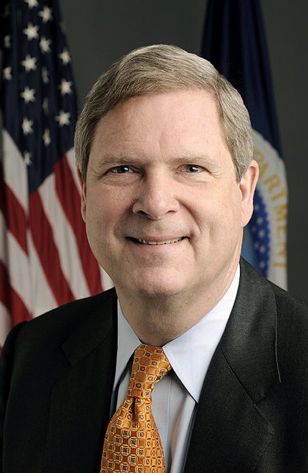
Tom Vilsack, who served as Secretary of Agriculture for Barack Obama’s entire presidency, is going to take another run at the job, once the Biden Presidency gets up and running. He’ll be giving up a job that most everyone in Washington D.C. really wants — being president and CEO of a national association. He’s been President and CEO of the U.S. Dairy Export Council since 2017. 

These are the jobs where seven-figure salaries are possible and the expense accounts are very attractive. Until he took the Export Council job, Vilsack’s salary almost always came from a government pay schedule. Only Vilsack can say why he wants to be Secretary of Agriculture again.

He left food safety at the USDA in a somewhat peculiar state. After Dr. Elisabeth Hagen, who Obama appointed as Under Secretary for Food Safety, left the department in December 2013, the government’s top food safety job was left vacant.

Today, the fresh produce lobby could hardly restrain itself when learning Vilsack’s back. They said it was “under his steady leadership we worked together to further the gains of the industry and broaden access to fresh fruits and vegetables, particularly for children.”

It was  Vilsack who was on one end of the deal that led to the murder of the Microbiological Data Program (MDP) that provided the only meaningful harvest time testing of fruits and vegetables in the United States. The industry wanted it killed and Vilsack was a willing co-conspirator. Could the secretary have saved the mere $5 million a year program for testing at land-grant universities? In a heartbeat.

Instead of naming a new Under Secretary for Food Safety, as required by law, Obama let Vilsack name Food Safety and Inspection Service (FSIS) Administrator Al Almanza as a Deputy Under Secretary. It put the FSIS boss in a position to provide his own food safety oversight. No Senate confirmation or oversight was required for the post.

Vilsack’s move left the Obama administration without an Under Secretary for Food Safety for longer than it had one. No one in Congress seemed to know or care.

If anyone has proof that Tom Vilsack knows or cares about food safety, it might be a good time for them to come forward.

As governor of Iowa, he was known for the famous Taylor’s Maid-Rite exemption for the Marshalltown, IA, restaurant’s reckless cooking practice for loose meat. Loose meat sandwiches are mostly an Iowa thing, and Taylor’s in Marshalltown made them using a cooker that was ripe for cross-contamination.

While he was governor, Vilsack protected Taylor’s and the few others who risked food safety by winking at cross-contamination.

Vilsack and Trump’s Secretary of Agriculture “Sonny” Perdue are really two peas in a pod. Both are former ag state governors who are plugged into the industry. Just as Vilsack’s loose meat history does not add up to much of a good safety record, Perdue did not exactly run to the scene in his state when he was governor of the 2008 Salmonella outbreak caused by Peanut Corporation of American peanuts and paste either.

No one much cared about that when Perdue’s appointment as ag secretary went through four years ago. But what they care about is that USDA net farm income is projected to total $120 billion for 2020, up to $38 billion over 2019. Direct government farm payments drive that number and Perdue’s name is associated with every dollar that goes out.

And, now we can strike “Sonny’s” name and substitute “Tom Vilsack.” It’s part of a system, but one that we just cannot say has anything to do with food safety, which is always touted as a top USDA priority.

Salmonella Outbreak Linked to Onions—a Post-mortem

Reported cases: 1,642
Hospitalizations:
246
States affected:
48
Provinces affected:
7
Infectious agent: Salmonella Newport
Probable source: Red onions produced and packed by Thomson International, Inc. of Bakersfield, CA


Two months after the US Centers for Disease Control and Prevention (CDC) and the Public Health Agency of Canada (PHAC) declared this outbreak over, its root cause remains a mystery.

The US Food and Drug Administration (FDA) has plowed through more than 2,000 samples, testing finished products, swab and environmental samples from Thomson’s packing facility, and environmental samples from the vicinity of the fields where the onions were grown.

FDA labs recovered eleven different Salmonella serotypes from the various environmental samples, according to information obtained by eFoodAlert in response to a Freedom of Information Act request.

Although Salmonella Newport was found in two samples described as soil/sediment, neither sample yielded the outbreak strain recovered from patients.

Not one of the onions tested in FDA labs were Salmonella-positive.

Not one of the swab samples obtained from inside the Thomson packing facility were Salmonella-positive.

But this is not the whole story. To understand FDA’s findings, it’s important to know more about onions.

The onion

Onions can be grown from seeds, seedlings, or sets (immature onion bulbs). The crop is ready for harvest when at least one-half of the leaves are dead.

In order to ensure an adequate storage life, the onions must be left in the field to “cure” for at least 12–24 hours. This allows the outer skin to dry. Curing is complete when the neck of the onion (the top of the bulb) is dry and tight.

After curing, the onions are “topped” above the neck to remove the leaves, after which they are ready for eating or for extended storage.

Onions are closely related to garlic and, like garlic, onions produce certain essential oils that possess anti-bacterial properties. Although Salmonella can survive on onions, these essential oils complicate the process of detecting the bacteria.

Thomson’s onion operations

Onions are onions, whether grown in a small backyard or in a large commercial field. The same principles apply. The differences are those of scale.

Thomson’s onions are grown from seeds in two different parts of California. The company uses fields both near Bakersfield, where its packing house is located, and just outside Holtville, in California’s Imperial Valley, approximately 330 miles to the south.

When the onion crop is ready for harvest, Thomson’s crews use specialized equipment to dig beneath the bulbs and cut them out of the ground. The onions are left in the field to cure.

Once the onions have cured, a crew of farm laborers works its way through the field, trimming off the tops and bottoms of the onions, culling and discarding damaged onions, and placing the trimmed onions into buckets.

Culled onions and the trimmed-off tops and bottoms are left in the field to be plowed back into the soil when it is prepared for the next crop.

The full buckets are poured into burlap bags, which are left in the field for additional curing.

Once curing is complete, the onions are either shipped in bulk directly to customers or are transported to Thomson’s Bakersfield packing facility, where they are brushed clean and packed for distribution.

What FDA did not find

  • No “egregious” conditions or violations of the Produce Safety Rule
  • No direct evidence of the outbreak strain in bagged onions
  • No direct evidence of the outbreak strain in any environmental samples either at the packing facility or in and around the fields

What FDA found in Bakersfield

  • Cats in and near the onion packing lines
  • Pigeons flying or roosting inside the packing house
  • Apparent bird droppings on and near the onion packing line
  • A thick build-up of dirt and soil on the packing line even after the most recent cleaning/sanitizing activity
  • Rough, dirty weld points on the packing line
  • Inadequate documentation of cleaning/sanitizing activity
  • Swallow nests overhead within a few feet of an onion-packing line
  • Inconsistent cleaning/sanitation Standard Operating Procedures documentation
  • Inconsistent bacteriological testing of agricultural water for coliforms and E. coli.
  • Salmonella in animal scat, drain sediment, and environmental swab sample and on a water filter

What FDA found in Holtville

  • Worn and uneven areas on field packing equipment that could harbor bacteria
  • Indications of bird activity around the fields and equipment
  • Flock of birds (ibis) in field undergoing flood irrigation adjacent to field where onions had been grown
  • Salmonella, including Salmonella Newport, in several soil/sediment samples

And then there’s the water…

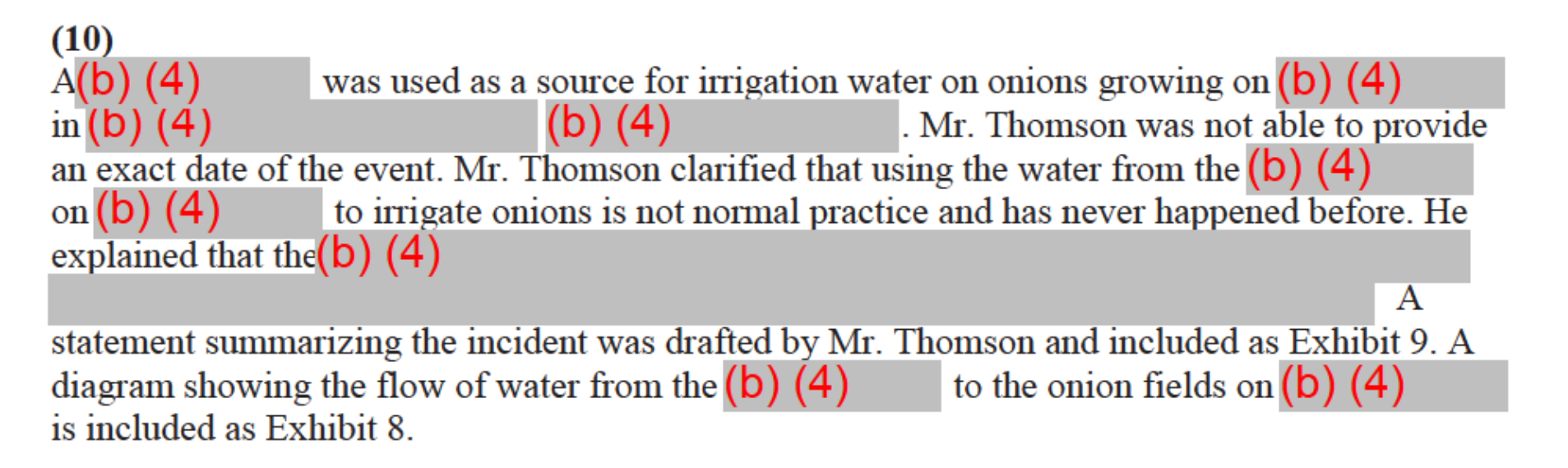
Information received under a Freedom of Information Act request is often heavily redacted, as anyone knows who watches The Rachel Maddow Show on MSNBC. This is what FDA’s investigation report had to say about the source of irrigation water used on the onion fields.

It would appear that irrigation water was drawn from a different source than was usual on at least one occasion. The details and date(s) on which this took place were redacted from the report, as was the diagram showing the flow of water from the source to the fields.

Why does this matter?

Irrigation water polluted by runoff from cattle feedlots has been linked to contaminated produce grown in the Salinas and Imperial Valleys in the past. A quick look at a Google map for the areas around Bakersfield and Holtville reveals the presence of feedlots in both vicinities.

The bottom line

As soon as Thomson onions were identified by CDC and FDA as the probable source of the Salmonella Newport outbreak, the company shut down its harvesting and packing operations.

By the time FDA investigators arrived on the scene, there were no field or packing activities for them to observe. The investigators were able to carry out extensive sampling of the equipment surfaces, the environment, and the stored onions, but were unable see either the harvest or packing operations in action.

Although neither FDA nor the Canadian Food Inspection Agency were able to find the outbreak strain in any of the onion samples, all of the epidemiological evidence from both the CDC and the PHAC points to Thomson’s red onions as the source of the outbreak,

The presence of multiple Salmonella-positive environmental samples lends weight to this conclusion, although the actual source of the contamination likely will never be known.

In case you missed it…

TAINTED is now available at all major on-line book sellers, and reached #1 New Release status in its Amazon category on Launch Day, December 2nd.

A Short Excerpt

Something Rotten in the State of Iowa

The CDC first became aware of an unusual rise in Salmonella Enteritidis infections in July 2010. Epidemiological and traceback investigations pointed the finger of suspicion at two Iowa-based suppliers of shell eggs: Quality Egg, LLC (also known as Wright County Egg) and Hillandale Farms of Iowa, Inc.

Alerted by the CDC, the FDA began a detailed inspection of Quality Egg on August 12th. They encountered an egg-laying farm overrun with rodents and birds. Henhouses and buildings used to store feed grain were in a state of disrepair, with manure seeping through the concrete foundation of one of the laying houses. Uncaged chickens ambled across an eight-foot high pile of manure to access the egg-laying area.

The situation confronting inspectors when they began their inspection of Hillandale Farms on August 19th was just as bad. Uncaged hens tracked manure into the henhouses, some of which had structural damage. There was standing water adjacent to the manure pit, and liquid manure was leaking into one of the henhouses.

It surprised no one when environmental samples collected at both Quality Egg and Hillandale Farms tested positive for Salmonella Enteritidis.

Quality Egg announced a recall on August 13th, and expanded the scope of the recall on August 18th. Hillandale followed suit with its own recall notice on August 20th.

TAINTED

From Farm Gate to Dinner Plate, Fifty Years of Food Safety Failures

Add TAINTED to your personal library today