
Questions loom as FDA remains quiet on investigation into infant formula outbreak

This story by Coral Beach first appeared in Food Safety News on March 5, 2022, and is reposted here with permission.

Parents, consumer groups, and a congresswoman want to know why it took the FDA months to begin investigations into infant formula after learning of the beginning of a cronobacter outbreak that has seen at least five babies develop infections with two deaths under investigation.

The Food and Drug Administration has yet to answer many questions including those posed by Food Safety News. We asked the agency on March 1 why there was a lag time from September 2021 to February 2022 before the agency began investigating Abbott Nutrition, which posted a recall for the implicated infant formula in late February.

On March 2 the FDA responded, to Food Safety News saying they were “working on a response for you and will respond as soon as possible.” On March 4 they responded to the same question saying: “We’re continuing to work on this for you.”

One plausible reason for the lag between when the FDA was notified of the first cronobacter infection this past September and when the recall and investigation began in February is that illnesses caused by the bacteria are not reportable in 49 of the 50 states. The infection has a 50 percent death rate.

Declaring illnesses as reportable is a state responsibility. 

For reportable illnesses, health care providers, hospitals, etc., must tell local or state officials about the illnesses. Those public health officials can then report the diseases to federal authorities.

Many people in the health care community, as well as consumer groups and patient advocates, say making cronobacter a reportable illness could have caught the ongoing outbreak sooner and narrowed its scope. Only Minnesota has cronobacter infection as a reportable disease. It was the state that reported the first infection to the FDA in September 2021.

Doug Schultz of the Minnesota Department of Health said the state only sees one case every three to five years, but it always reports them to federal authorities. When such cases are reported it allows the FDA and the Centers for Disease Control and Prevention to begin watching for other infections and possible links, but such efforts are hampered by the lack of mandatory reporting in the other 49 states.

A spokesperson from the CDC confirmed that reporting for cronobacter is not required by 49 states and that tracking of non-reportable diseases is a problem that the agency discusses with other entities such as the Council of State and Territorial Epidemiologists. 

“Case notification from public health agencies to CDC is voluntary, and the diseases that are nationally notifiable each year are determined by a collaborative process among Council of State and Territorial Epidemiologists (CSTE), State Epis, and CDC programs; it’s not just CDC’s decision,” said the CDC spokesperson.

The CSTE, whose recommendations are not binding, brings together disease and surveillance experts at CDC and from health departments across the country to determine what types of data should be deemed “notifiable” or “reportable” diseases.

“CSTE and CDC annually review the list of nationally notifiable conditions that state health departments agree to voluntarily report to CDC. Because CDC is not responsible for follow-up or investigation of individual people with cases of notifiable conditions, notifiable condition reports from states to CDC do not include patient or provider names or other personally identifying information,” according to the CSTE’s criteria statement.

“In early 2007, CSTE conducted a comprehensive review of its adopted position statements which call for a specified disease/condition to be nationally notifiable. This review also documented which position statement contains the most current version of the case definition. The resultant list contains 73 diseases/conditions, nine of which are non-infectious.

“At present, there is no formal list of conditions that are designated as immediately reportable from states to the national level.”

The CSTE contends that having a clearly defined list of immediately notifiable conditions at the national level will eliminate current ambiguity and enable a more timely response to conditions that may constitute a public health emergency or bioterrorism event at the national level. 

“Standardizing the list of routinely notifiable conditions will improve consistency,” according to the group’s criteria statement.

Bill Marler, a Seattle attorney who has been working in the field of food safety for more than 30 years, said if there is one good thing that could come out of this tragic outbreak it would be for states to declare cronobacter infection a reportable disease.

He used the deadly E. Coli O157:H7 outbreak linked to Jack in the Box hamburgers as an example.

“Most people think the outbreak began in January of 1993, but it actually began in November of 1992 when kids in California started getting sick,” Marler said. “But it was not a reportable disease in California so people didn’t start tracking it until after the contaminated meat was shipped to Washington (state) and kids started getting sick there.

“There is no question that if it had been a reportable disease that the outbreak would have been identified earlier and fewer kids would have gotten sick.”

Marler also pointed out that infant formula is not a sterile product and should be handled with care.  Thorough washing of bottles, nipples and containers between use is also vital to protect against disease.

Calls for action
Known for many years as a champion for food safety, U.S. Rep. Rosa DeLauro, who chairs the Congressional Food Safety Caucus, this week wrote to the Inspector General for the U.S. Department of Health and Human Services, Christi A. Grimm, seeking action on the FDA’s handling of the cronobacter outbreak and infant formula recall.

In her letter, the representative from Connecticut asked for “assistance in investigating whether the Food and Drug Administration (FDA) took prompt, appropriate, and effective action leading up to the recent recall involving powdered infant formula produced by Abbott Nutrition’s Sturgis, MI, plant. 

“Based on reports, I am concerned the agency acted too slowly in pulling potentially dangerous infant formula off store shelves, which may have resulted in additional illnesses and death,” she wrote.

DeLauro questioned why the FDA did not take action two years ago when troubling issues were uncovered at the Abbot Nutrition production facility.

As part of the review requested by the congresswoman, she wants the inspector general to investigate several questions including:

  • Why did it take several months and additional illnesses for the FDA to return to the plant for a follow-up inspection?
  • Why were the company records showing destroyed products in June 2020 omitted from the FDA’s inspection report?
  • Two years prior to the September 2021 inspection, the FDA found that the Abbott facility failed to test a representative sample for Salmonella at the final stage of the production cycle. Did the agency follow up on this issue after that inspection?
  • Will the FDA start conducting its own testing on infant formula to monitor for these dangerous bacteria?

 Questions from public interest groups
With many similar concerns as those raised by DeLauro, the Center for Science in the Public Interest (CSPI) posted a statement March 4 asking why parents and caregivers were not given earlier notice of the link between the Abbott infant formulas — which include certain types of Similac, Alimentum, and EleCare distributed in dozens of countries — and the infant illnesses and deaths.

“…consumers have taken to social media with complaints that products that have lot codes and expiration dates within the recalled range do not appear as part of the recall when they enter information into the company’s recall website, similacrecall.com,” according to the CSPI.

“We urge Abbott and the FDA to clarify the scope of the infant formula recall, including being straight with consumers about which products made in Abbott’s Sturgis facility are part of the recall.”

In comments to Consumer Reports, a long-time food safety advocate said the situation is unbelievable.

“This bacterium is known to be extremely deadly to babies,” said Mitzi D. Baum, chief executive officer of STOP Foodborne Illness, a nonprofit group. “It is distressing that the facility was cited in September 2021 for unsanitary conditions, about the time when the first illness was reported.”

Brian Ronholm, director of food policy for Consumer Reports went a step further.

“Once the severity of the situation became known, the FDA should have essentially set up shop at the facility and worked to resolve the problems,” Ronholm said.

Editor’s note: Bill Marler is the publisher of Food Safety News.

This story by Coral Beach first appeared in Food Safety News on March 5, 2022, and is reposted here with permission.

Cronobacter and Powdered Infant Formula

Where we are and how we got here

The current situation

On February 17, 2022, the US Food and Drug administration (FDA) advised the public that it was working with the US Centers for Disease Control and Prevention (CDC) and state and local agencies to investigate four consumer complaints of illnesses in infants.

The infants were fed powdered infant formulas manufactured by Abbott Nutrition in Sturgis, Michigan.

Three of the illnesses were due to Cronobacter sakazakii and the fourth was caused by Salmonella Newport.

The FDA received the illness reports between September 6, 2021, and December 18, 2021, from Minnesota (1), Ohio (1) and Texas (2).

All four of the infected infants were hospitalized. One of the Cronobacter-infected babies died, although it is uncertain whether the infant’s death was solely attributable to the infection.

As a result of the illness reports, the FDA initiated an inspection of the Sturgis production facility. In the course of their investigation, inspectors noted several unspecified adverse inspectional observations. In addition, several positive Cronobacter results were reported from environmental samples taken by FDA.

In response to the FDA’s findings, Abbott Nutrition has initiated a recall of multiple powdered infant formula products sold under the Similac, Alimentum and EleCare brand names. The affected products were manufactured in the Sturgis plant.

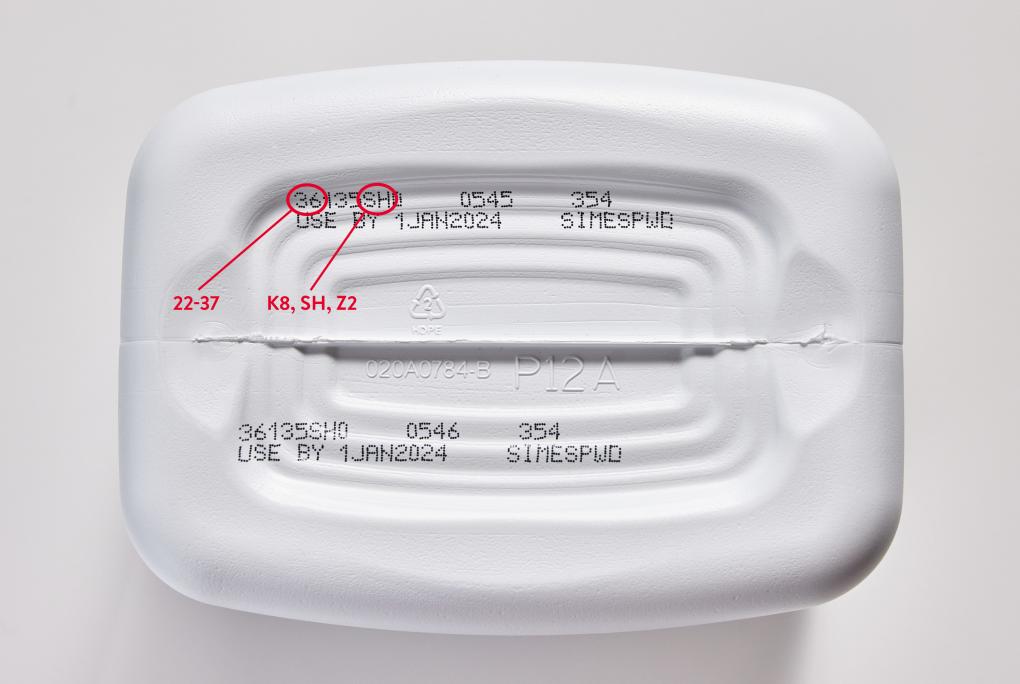
The products under recall have a multidigit number on the bottom of the container starting with the first two digits 22 through 37, contains K8, SH, or Z2 and with an expiration date of April 1, 2022, or after.

This image shows where to find important lot code information on the container.

The recalled products were distributed across the United States and may also have been exported to multiple countries around the world, including: Australia, Bahrain, Barbados, Bermuda, Canada, Chile, China, Colombia, Costa Rica, Dominican Republic, Ecuador, Egypt, Guam, Guatemala, Hong Kong, India, Indonesia, Israel, Jordan, Kuwait, Lebanon, Malaysia, Mexico, New Zealand, Oman, Peru, Puerto Rico, Qatar, Saudi Arabia, Singapore, South Africa, Sudan, Taiwan, Thailand, United Arab Emirates, United Kingdom, and Vietnam ANI South.

The recall notices

To access detailed information on the recalled products in your country, please click on the appropriate links. For countries not listed below, navigate to Abbott’s website to access additional information.

Cronobacter’s long shadow

Cronobacter was suspected to be a cause of meningitis in infants as long ago as the early 1960s.

In 1981, researchers at the Indiana University School of Medicine were able to confirm the link between Cronobacter sakazakii and a case of fatal meningitis.

In 1983, Dutch researchers were the first to suggest the connection between infant formula and Cronobacter infections. Their hypothesis was proven to be correct in a 1989 report of an Icelandic outbreak of meningitis in three newborn infants.

In 2001, the death of an eleven-day old infant in a neonatal intensive care unit (NICU) of a Tennessee hospital was traced to the use of Portagen powdered infant formula manufactured by Mead Johnson. Cronobacter was recovered from nine of forty-eight infants in the NICU.

The following year, a five-day old Belgian baby died shortly after being released from the hospital. The infant, who was infected with Cronobacter, had been fed Beba powdered formula manufactured by Nestlé.

These incidents prompted the FDA to increase its surveillance of infant formula manufacturers, with special emphasis on the possibility Cronobacter in powdered infant formulas. The agency updated its Compliance Guidance for infant formulas in 2018.

Abbott’s inspection history

Abbott’s infant formula production facility in Sturgis, Michigan, has undergone twenty-seven FDA inspections since October 2008, according to the FDA’s inspection database.

Twenty-four of the twenty-seven inspections resulted in the company’s operations receiving a clean bill of health.

In October 2010, the FDA inspector cited the company for three issues, specifically:

  • Effective measures are not being taken to exclude pests from the processing areas
  • There is no assurance that raw materials which are susceptible to contamination with extraneous materials comply with current FDA standards and defect action levels
  • Failure to manufacture foods under conditions and controls necessary to minimize contamination.

These issues were apparently corrected, as subsequent inspections that same year and for several years did not result in any adverse reports.

The situation changed in September 2019, when the FDA inspector cited Abbott for a single issue, stating:

  • You did not test a representative sample of a production aggregate of a powdered infant formula at the final product stage and before distribution to ensure that the production aggregate meets the required microbiological quality standards.

Once again, the company corrected its procedures to the FDA’s satisfaction.

There were no inspections carried out for two full years. Then, in September 2021, the FDA returned. This time, the inspection uncovered several issues:

  • Personnel working directly with infant formula, its raw materials, packaging, or equipment or utensil contact surfaces did not wash hands thoroughly in a handwashing facility at a suitable temperature after the hands may have become soiled or contaminated.
  • You did not maintain a building used in the manufacture, processing, packing or holding of infant formula in a clean and sanitary condition
  • An instrument you used to measure, regulate, or control a processing parameter was not properly maintained.
  • You did not monitor the temperature in a thermal processing equipment at a frequency as is necessary to maintain temperature control.
  • You did not install a filter capable of retaining particles 0.5 micrometer or smaller when compressed gas is used at a product filling machine.

In its recall notice, Abbott acknowledged having found “evidence of Cronobacter sakazakii in the plant in non-product contact areas,” but denied having found the bacterium in finished product.

This would appear to be in direct contradiction to the FDA’s revelation that the company had recorded the destruction of product in the past due to the presence of Cronobacter.

FDA advice to consumers

If you want to check if your powdered formula is part of the recall, you can enter the product lot code on the bottom of your package on the company’s website.

If you have questions or need information about the recall, you can Submit Questions/Get Assistance from the FDA.

If your infant is experiencing symptoms related to Cronobacter or Salmonella infection, such as poor feeding, irritability, temperature changes, jaundice, grunting breaths, abnormal movements, lethargy, rash, or blood in the urine or stool; contact your health care provider to report their symptoms and receive immediate care.

To report an illness or adverse event, you can

Note: Information on the history of Cronobacter infections in infants was drawn from TAINTED: From Farm Gate to Dinner Plate, Fifty Years of Food Safety Failures.

For additional information on Cronobacter, visit the CDC web page, Cronobacter infection and infants.

URGENT PUBLIC HEALTH WARNING

Powdered infant formula made by Abbott Nutrition linked to Cronobacter and Salmonella illnesses.

The US Food and Drug Administration (FDA) is investigating four consumer complaints of infant illnesses linked to products from Abbott Nutrition’s Sturgis, MI facility.

The complaints span a period of time from September 6, 2021 to December 18, 2021, and were reported from Minnesota (1), Ohio (1) and Texas (2).

All four infants were fed powdered infant formula produced in Abbott’s Sturgis facility.

The complaints include three reports of Cronobacter illness and one report of Salmonella Newport illness in infants.

All four infants were hospitalized, and one of the infected infants has died.

The death may not be solely attributable to the Cronobacter infection.

The FDA has been conducting an inspection of the facility and has found Cronobacter in several environmental samples. In addition, the company’s internal records include findings of environmental contamination with Cronobacter.

Company records also document the destruction of finished product due to Cronobacter contamination.

The FDA is advising consumers not to use Similac, Alimentum or EleCare powdered infant formulas if:

  • the first two digits of the code are 22 through 37 and
  • the code on the container contains K8, SH, or Z2, and
  • the expiration date is 4-1-2022 (APR 2022) or later.

At this time, the FDA’s advisory is limited to these specific products.

Abbott Nutrition is working with the FDA to initiate a voluntary recall of these products.

Affected products were distributed across the United States and also were likely exported to other countries.

How serious is Cronobacter?

Cronobacter is a foodborne bacterium that can cause a rare, but serious illness in infants. Newborn infants are especially susceptible.

In 2001, nine infants in the Neonatal Intensive Care Unit of a Tennessee hospital were infected with Cronobacter as a result of being tube-fed a batch of Portagen powdered infant formula manufactured by Mead Johnson. One of the babies died.

According to the FDA’s advisory, Cronobacter bacteria can cause severe, life-threatening infections (sepsis) or meningitis (an inflammation of the membranes that protect the brain and spine). Symptoms of sepsis and meningitis may include poor feeding, irritability, temperature changes, jaundice (yellow skin and whites of the eyes), grunting breaths, and abnormal movements. Cronobacter infection may also cause bowel damage and may spread through the blood to other parts of the body.

If your child is experiencing any of these symptoms, you should notify your child’s healthcare provider and seek medical care for your child immediately. Healthcare providers and health departments are encouraged to report any confirmed cases of Cronobacter sakazakii to CDC.

Additional information about Cronobacter can be found on the CDC’s website. A history of Cronobacter infections (including the 2001 outbreak linked to Portagen infant formula) can be found in Chapter One of TAINTED. From Farm Gate to Dinner Plate, Fifty Years of Food Safety Failures.