
Bravo Packing enjoined from producing raw pet food

Company and the US Food and Drug Administration enter into consent decree
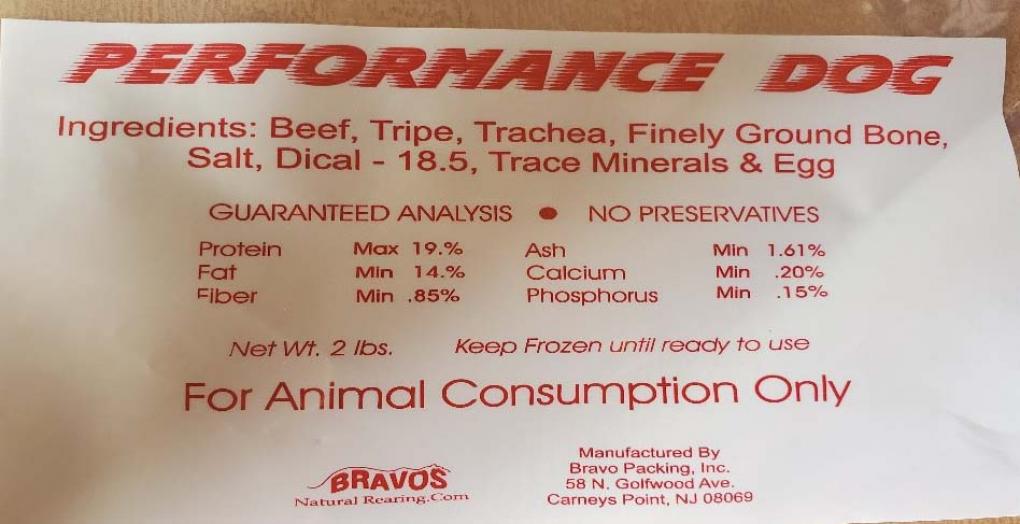
A federal judge has entered a consent decree of permanent injuction against Bravo Packing, Inc., a manufacturer and distributor of raw pet food based in Carney’s Point, New Jersey.

(Bravo Packing is not related in any way to Bravo LLC / Bravo Pet Foods, located in Manchester, Connecticut)

The consent decree requires that Bravo “stop selling, manufacturing and distributing raw pet food and come into compliance with the Federal Food, Drug, and Cosmetic Act (FD&C Act).”

The backstory

On September 12, 2018, Bravo Packing announced a voluntary recall of Performance Dog frozen, raw pet food (manufacturing date code 071418) after the FDA found Salmonella in a sample of the product during an inspection of the manufacturing facility.

In addition to the Salmonella-positive sample, FDA Investigator Michael Rosner also documented several issues of concern, including:

  • Some condensate drip and ice buildup was observed on several boxes of finished dog food product in one of the firm’s freezers. 
  • The air curtains entering the dog food processing room were observed to be soiled and in disrepair. 
  • The firm was using a santiizer product at an incorrect dilution level, which reduced the sanitizer’s effectiveness.
  • Some of the claims on the firm’s website were potentially misleading.

By the time the FDA returned to Bravo’s manufacturing facility in July 2019, the situation had deteriorated. This time, the FDA labs found Salmonella and Listeria monocytogenes in samples collected during an investigation that lasted from July 22nd to August 6th.

According to the Inspection Observations report (FDA Form 483), issued by Investigators Teigan Mule and Kyle Coville,

  • after cleaning had been completed, the elbow portion of the feeder pipe from the mixer still had a buildup of dried, dark, crusty meat-like material
  • a film residue remaining on the sides of a mixer exit chute after cleaning
  • greasy buildup of animal fat remaining at the output of a grinder after cleaning
  • black residue on the inside surface of buckets used to hold cut meat
  • condensate drip and ice buildup on boxes of finished raw dog food products in a freezer
  • cardboard boxes used to pack finished product observed to have bird droppings on the tops and sides
  • apparent mammalian (rodent?) droppings adjacent to stored, palletized boxes
  • inadequate training of employees on how to clean and degrease processing equipment after processing.

Although Bravo agreed to recall the contaminated Performance Dog Food product, the company never provided the FDA with the usual draft customer notification letter, distribution list, or draft press release.

In the absence of documentation from the company, the FDA issued its own Consumer Advisory on September 26, 2019, cautioning pet owners “not to feed their pets any Performance Dog frozen raw pet food.”

The FDA followed up its actions with a formal Warning Letter, issued on March 16, 2020. The letter reiterated and expanded upon the observations contained in the inspection report and requested a written response from the company within fifteen working days of receipt.

Downward slide accelerates

On March 3, 2021, Bravo issued yet another recall notice after Salmonella and Listeria monocytogenes were found once again in the company’s products.

The recall was expanded on March 16th to include all pet food and bones in all package sizes.

When the FDA returned to inspect Bravo’s production plant in May 2021, Investigators Kyle Covill and Sean Duke found a situation that had deteriorated further.

  • a shovel used to push meat into the grinder was covered with residual dried, black meat-like material from the handle down to the shaft and all the way to the end of the blade
  • a meat hook covered with cobwebs and other extraneous material was used to move deboned meat from raw ingredient barrels into the grinder during production
  • the grinder contained heavy rust on the inside walls, basins and screw augur
  • a piece of meat from a prior production run was left in the exit portion of the mixer, which also contained a pooled black liquid and white fat-like deposits, and the mixer was subsequently used during production without any further cleaning
  • one of the owners was seen spitting chewing tobacco on the floor of the deboning room
  • two cats were observed urinating on the outside of a raw ingredient barrel that was subsequently used (without undergoing cleaning and sanitizing) to produce Performance Dog ready-to-eat raw dog food
  • the floors in multiple rooms of the production plant, including the processing room, had large cracks, holes and depressions, which contained pooled blood and water
  • uncovered barrels of deboned meat were stored directly beneath a metal beam and brackets covered with flaking rust.

The bottom line

The consent decree prohibits the defendants (including the company’s owner and secretary, Joseph Merola, and its president, Amanda Lloyd) from receiving, preparing, processing, packing, holding, labeling, and/or distributing pet food unless and until the company undertakes and completes a comprehensive list of corrective actions.

The decree also allows the FDA to order a shutdown, recall, or other corrective action in the event of future violations and requires the defendants to pay the costs of inspections performed pursuant to the decree. Failure to abide by the agreement can also lead to civil or criminal penalties.

In commenting on the consent decree, Steven Solomon, DVM, MPH, director of FDA’s Center for Veterinary Medicine, said,

The food we give our pets should be safe for them to eat and safe for people to handle. The FDA has taken this action to protect public health because, despite multiple inspections, notifications of violations, and recalls, this firm continued to operate under insanitary conditions and produce pet food contaminated with harmful bacteria. We will not tolerate firms that put people or animals at risk and will take enforcement actions when needed.”

Abbott’s Cronobacter problem more than two years old

The presence of Cronobacter sakazakii in Abbott Nutrition’s Sturgis, Michigan, production facility dates back to at least September 2019, according to information contained in an Inspection Observation report (FDA Form 483) released today by the US Food and Drug Administration (FDA).

The report details a ten-page long list of observations documented by a team of eleven FDA investigators during an inspection that lasted from January 31, 2022 to March 18, 2022.

The inspection was initiated in response to a series of four complaints of infant illnesses and death following consumption of powdered infant formula manufactured in the Sturgis facility.

Cronobacter sakazakii is an opportunistic pathogen, affecting mainly newborns, and causes neonatal necrotizing enterocolitis and neonatal meningitis. In older infants, children and adults, it can cause sepsis and/or respiratory illness. Symptoms in newborns include fever, rapid heart rate, seizures and other neurological abnormalities.

Product Recall

On February 17, 2022, Abbott initiated a recall of multiple Similac, Alimentum, or EleCare powdered infant formulas. The recall notice includes a link to the company website, where a complete list of recalled products can be found.

The recalled infant formula was distributed nationwide across the United States and also exported to multiple countries around the world, including: Australia, Bahrain, Barbados, Bermuda, Canada, Chile, China, Colombia, Costa Rica, Dominican Republic, Ecuador, Egypt, Guam, Guatemala, Hong Kong, India, Indonesia, Israel, Jordan, Kuwait, Lebanon, Malaysia, Mexico, New Zealand, Oman, Peru, Puerto Rico, Qatar, Saudi Arabia, Singapore, South Africa, Sudan, Taiwan, Thailand, United Arab Emirates, United Kingdom, and Vietnam ANI South.

What FDA Discovered

During the course of their in-depth inspection, the FDA’s investigation team documented multiple issues of concern, among which were:

  • Presence of Cronobacter sakazakii on environmental surfaces in the packaging room. The sample was collected while a product was being packaged.
  • Presence of Cronobacter sakazakii on the floor in the immediate vicinity of a dryer.
  • Presence of Cronobacter sakazakii in a sample of infant formula tested by the company in September 2019.
  • Presence of Cronobacter sakazakii in a sample of infant formula tested by the company in June 2020.
  • Water leaking from a dryer inlet and dripping from the valves onto the floor. Company work order documents indicated prior problems with this same inlet in February 2021, November 2021 and again on January 21, 2022.
  • Standing water in multiple production areas.
  • Lack of validation of the dry-out step at the end of the dryer cleaning cycle, resulting in a risk that water would remain inside the dryer at the end of the cleaning cycle.
  • A history of internal deterioration of the firm’s dryers dating back to 2018, including six instances of cracks and pits in the main chamber of two different dryers and ten cracked braces for one of the dryers.
  • Inadequate investigation of root causes of the four consumer complaints relating to illness reports received by the FDA. These four complaints were each asssociated with a different Abbott product.
  • Inadequate attention by employees and contractors to the wearing of necessary protective apparel.

In addition to the evidence of inadequate maintenance and sanitation, the inspection report contains observations appear to directly contradict statements made in Abbott’s Voluntary Recall Notice.

Specifically, Abbott stated that the company “…found evidence of Cronobacter sakazakii in the plant in non-product contact areas.” Yet the FDA recovered the microbe from a scoop hopper used to feed scoops, “…which are placed directly inside infant formula containers and contact product.”

Also, Abbott claimed that, “…retained samples related to the three complaints for Cronobacter sakazakii tested negative for Cronobacter sakazakii.”

But the FDA investigators reported that the company’s Medical Safety and Surveillance team did not request that retain samples be tested for the production lot associated with the infant death as of January 31, 2022 (the day the investigators began their inspection).

A History Lesson

As previously reported, the FDA had conducted twenty-seven prior inspections of Abbott’s production facility since 2008. Twenty-four of the twenty-seven inspections resulted in the company’s operations receiving a clean bill of health.

In 2019, the FDA investigation team noted just one deviation during its routine inspection, observing that the firm collected only thirty samples of a production batch for Salmonella testing instead of the specified sixty samples.

Two years elapsed before the FDA conducted its next inspection. In September 2021, a team of two investigators reviewed the Sturgis plant’s operations over a four-day period. They found standing water in multiple locations, sanitation and product-handling lapses, and inadequate temperature monitoring for a pasteurizer.

The September 2021 inspection was carried out after the FDA had received the first complaint of infant illness associated with an Abbott product. The agency has offered no explanation or reason for the more than four month delay between receipt of the first complaint and initiation of an in-depth investigation of the production facility.

According to the CDC, four infants have been infected by Cronobacter sakazakii after consuming a powdered infant formula manufactured by Abbott Nutrition. All four of the infants were hospitalized and two of them have died.

The CDC has received additional reports of possible Cronobacter infections in infants and is conducting investigations to determine whether these may also be associated with this outbreak.

What Consumers Need to Know

  • The first symptom of Cronobacter infection in infants (0–1 year old) is usually a fever, accompanied by poor feeding, excessive crying, or very low energy. Some infants may also have seizures. Infants with these symptoms should be seen by a medical provider as soon as possible.
  • Cronobacter germs can cause a dangerous blood infection (sepsis) or make the linings surrounding the brain and spinal cord swell (meningitis). Infections in infants usually occur in the first days or weeks of life. Infants 2 months of age and younger are most likely to develop meningitis if they are infected with Cronobacter.
  • Visit the FDA’s consumer advisory page to access a complete list of recalled products.

A Postscript

Cronobacter sakazakii was first associated with meningitis in infants in the 1960s. In 2001, the death of an eleven-day old infant in a neonatal intensive care unit (NICU) of a Tennessee hospital was traced to the use of Portagen powdered infant formula manufactured by Mead Johnson. Cronobacter was recovered from nine of forty-eight infants in the NICU.

Following the Mead Johnson incident, the FDA strengthened its surveillance of infant formula manufacturers and improved its lab methods for detecting Cronobacter sakazakii.

Learn more about Cronobacter sakazakii and other foodborne disease outbreaks in TAINTED. From Farm Gate to Dinner Plate, Fifty Years of Food Safety Failures, now available in digital, print and audiobook editions.

“Reads like a true crime novel” – Food Safety News

Excerpt from the new audiobook edition of TAINTED

Chapter 6. Birth of a Pathogen

‘Tainted’ audiobook now available

This story by Jonan Pilet first appeared on Food Safety News and is reposted here with permission.

“Tainted” by Phyllis Entis is available in book, digital and audiobook formats.

Phyllis Entis’s new book “Tainted” is now available as an audiobook. The book is narrated by Entis herself. 

The book is particularly topical as the first chapter talks about Cronobacter sakazakii, a dangerous bacterium that has caused an ongoing outbreak. The Cronobacter outbreak has sickened at least five infants, killing two, and has been linked to Similac, Alimentum, and EleCare infant formulas recalled Abbott Nutrition. 

“Tainted” tells readers that when it comes to food safety, conventional wisdom isn’t always enough. As Entis puts it, “the food preparation skills we learned from our parents and grandparents are no longer good enough to keep us safe.”

The audiobook can be found here.

I had the chance to read the book this past December and talk with Entis about it. Whether it’s Salmonella in eggs, Listeria in deli meats, melamine in milk or Cyclospora in lettuce, “Tainted” illustrates that everyone has a responsibility to ensure that the food we eat is as safe as we can make it. Entis shows that everyone — government regulators, farmers, ranchers, food processors, food service workers, retailers, educators and consumers — are needed to accomplish this herculean task.

Phyllis Entis is a retired food safety microbiologist. “Tainted” is the update of her 2007 book, “Food Safety: Old Habits, New Perspectives.” The original version had an academic bent, but “Tainted” is more in line with Entis’s original vision of making food safety accessible to the lay reader.

In recent years, Entis has honed her storytelling abilities as she has been working as a mystery writer. She is known for the Damien Dickens Mysteries series, which includes “The Green Pearl Caper,” “The White Russian Caper,” “The Chocolate Labradoodle Caper,” “The Gold Dragon Caper,” “The Blue Moon Caper,” and “The Silver Star Caper.” Her debut novel, “The Green Pearl Caper,” was a Library Journal SELF-e Selection.

Writing mystery novels prepared her well to write “Tainted,” as food safety illnesses often function as mysteries. “Tainted” often reads like a true crime novel, where laymen and authorities uncover clues to save the public from future poisonings and reveal the culprits of past poisonings.

After reading “Tainted,” I asked Entis if she has a particular story from the novel that she finds most memorable. She pointed to the Regent Chocolate episode.

In January 1974, a Salmonella Eastbourne outbreak was linked to Regent Chocolate. Entis’s lab with Canada’s Health Protection Branch was responsible for checking all of the suspect chocolate stored in warehouses in Manitoba and Saskatchewan. “I am a chocoholic and it was torture to be surrounded by all those giant Easter bunnies and chocolate Christmas tree ornaments and not be able to nibble,” she said.

Entis was able to watch Regent’s response firsthand and see how effective the company’s approach and changes were. She explains in the book how Regent could serve as a model for how companies can learn from their mistakes.

Though “Tainted” is a great book for those interested in learning more about food safety, it’s also a book for those who simply want to be entertained by the drama behind the scenes of food safety.

If you read “Tainted” and have been spurred to read more about food safety, Entis recommends Nicols Fox’s 1997 book, “Spoiled, The Dangerous Truth About a Food Chain Gone Haywire,” Jeff Benedict’s “Poisoned,” and Deborah Blum’s “The Poison Squad.”

“Tainted” was released Dec. 2, 2020, and can be ordered on Amazon. Entis’s book reached  No. 1 overall in the Microbiology category on Amazon during the first week of its release.


TAINTED. From Farm Gate to Dinner Plate, Fifty Years of Food Safety Failures is available in ebook and audiobook formats from all major on-line retailers. The paperback and hardcover editions can be ordered from Amazon or through your local bookstore.